
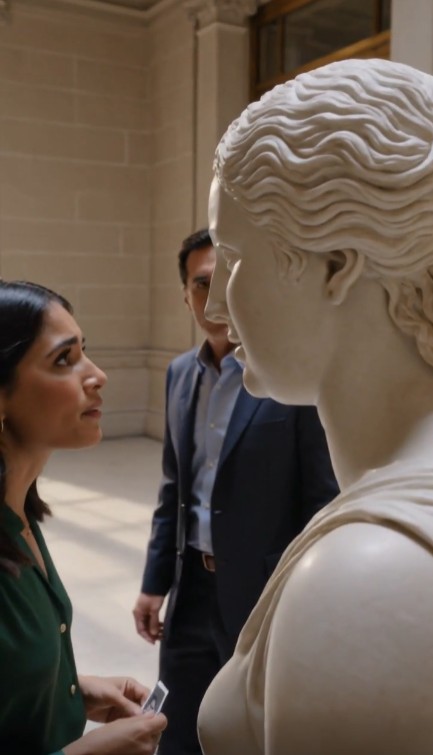
A woman walked into a museum and stopped so suddenly that the people behind her nearly bumped into her.
Her name was Anna.
She had come to the city for work and entered the museum only because she had an hour to spare before her train.
She expected paintings.
Old furniture.
Historical objects.
Then she turned into the sculpture gallery.
And saw her mother.
Not a photograph.
Not a painting.
A marble statue.
Anna stopped breathing.
The woman carved into the stone had the same soft smile.
The same curled hair.
The same narrow chin.
Even the tiny dimple beside her mouth.
Anna whispered:
“Mama?”
A museum curator nearby immediately approached.
“Ma’am, is everything alright?”
Anna pointed toward the sculpture.
“That’s my mother.”
The curator looked at the statue.
Then back at Anna.
“I’m sorry?”
“That woman.”
“My mother looked exactly like that.”
The curator gave a careful smile.
“Sometimes portraits resemble people we know.”
Anna shook her head.
“No.”
She opened her handbag.
Inside was a small family photograph she carried everywhere.
It showed Anna at about six years old standing beside her mother, Elena.
Anna held the photograph next to the statue.
The curator stopped smiling.
Same eyebrows.
Same mouth.
Same unusual dimple.
The resemblance was unmistakable.
“Where did you get this photograph?” he asked.
Anna frowned.
“It’s my mother.”
“Why?”
The curator looked toward the sculpture.
“Because according to our records, the artist said she never met the woman she sculpted.”
Anna stared.
“That doesn’t make sense.”
The statue had arrived at the museum nearly two years earlier.
It was titled simply:
ELENA.
No surname.
No dates.
No public dedication.
The artist was a respected sculptor named Margaret Ellis.
But the commission itself had been anonymous.
According to museum records, Margaret had received several old photographs and detailed instructions.
She completed the sculpture without ever learning the identity of the woman represented.
Anna’s heart began beating faster.
“Can I see the photographs?”
The curator hesitated.
Then said:
“There may be something else.”
He brought Anna into a small administrative office.
There, he opened the commission file.
Payment records had been handled through an attorney.
The donor’s identity had been sealed for a fixed period.
But one envelope had been left specifically for museum staff to open if anyone ever came forward claiming to know the woman in the sculpture.
The curator removed it from the file.
Anna stared at the envelope.
“This has been sitting here?”
“For almost two years.”
He opened it.
Inside was another photograph.
Anna leaned closer.
Then covered her mouth.
The picture showed Anna as a little girl.
Maybe seven.
She was standing in the garden of her childhood home.
Her mother Elena stood behind her.
But beside Elena was another woman.
Anna stared at the stranger.
Then something returned to her.
A laugh.
A perfume she couldn’t name.
A woman sitting at their kitchen table.
“Wait.”
The curator looked at her.
“You recognize her?”
Anna pointed.
“She used to come to our house.”
The memory was faint.
The woman had visited often when Anna was small.
Then suddenly stopped.
Anna had not thought about her in decades.
“What was her name?” the curator asked.
Anna closed her eyes.
“Claire.”
She turned the photograph over.
There was writing on the back.
The curator read it.
If Anna ever sees the statue, please give her the blue file.
Anna looked up.
“What blue file?”
The curator returned to the cabinet.
Behind the commission documents sat a thin blue folder.
It contained letters.
Old photographs.
And one handwritten note addressed to Anna.
She recognized the handwriting immediately.
Not her mother’s.
Claire’s.
Anna,
If you are reading this, then you finally saw Elena again.
Anna sat down.
The letter continued.
Your mother was the bravest person I ever knew.
And I owe her a life I never properly thanked her for.
Anna’s eyes filled.
Claire explained everything.
She and Elena had met when they were seventeen.
They worked together at a small clothing factory.
Both came from families with very little money.
Both dreamed about leaving the town someday.
Elena wanted to become a teacher.
Claire wanted to study architecture.
Neither expected those plans to survive adulthood.
For years, they remained close.
Then Claire’s life became difficult.
She married young.
The marriage became controlling.
By the time Anna was a small child, Claire had become almost completely isolated.
Elena noticed.
She did not lecture her.
She did not pressure her.
She simply kept the kitchen door open.
Claire began appearing at Anna’s house.
Sometimes for coffee.
Sometimes for dinner.
Sometimes without explaining why.
Anna remembered that now.
Claire had always arrived when her father was at work.
She and Elena would sit at the kitchen table speaking quietly.
As a child, Anna assumed they were simply friends talking.
They were.
But Elena was also helping Claire make a plan.
A safe place to stay.
Copies of important documents.
Money hidden little by little.
The phone number of a support service.
A train ticket stored inside one of Elena’s cookbooks.
Eventually, Claire left the marriage.
She moved to another city.
Started again.
Finished school years later than planned.
Then built a successful career designing public housing and community buildings.
Anna looked up from the letter.
“My mother never told me any of this.”
The curator answered softly:
“Maybe she thought it was Claire’s story to tell.”
The letter continued.
Claire had wanted to repay Elena many times.
Elena always refused.
Years later, after Elena became ill, Claire returned.
By then Anna was grown and living elsewhere.
Claire visited Elena quietly.
That was when they discussed the sculpture.
Anna frowned.
“Mom knew about it?”
The next page answered.
Elena had one request.
If Claire ever created a memorial, it could not become a grand public tribute about heroism.
Elena hated being praised for helping her.
She said:
“I opened a door.”
“Claire walked through it.”
So Claire waited until after Elena died.
Then commissioned the sculpture anonymously.
But why put it in a museum?
The curator handed Anna another document.
Claire had funded a small permanent program through the museum.
Every year, young women rebuilding their lives after difficult circumstances could attend free creative workshops there.
Photography.
Drawing.
Sculpture.
Design.
No public plaque carried Claire’s name.
No sign explained Elena’s story.
The program was simply called:
THE OPEN DOOR PROJECT.
Anna stared at the words.
Her mother had always used that phrase.
“If someone needs you, leave the door open.”
Anna used to think she meant hospitality.
Now she understood.
The curator turned to the final page.
There was one more instruction.
If Anna ever comes, contact Claire.
Anna’s heart jumped.
“She’s alive?”
The curator checked the file.
The contact information had been updated only three months earlier.
“Yes.”
Anna looked again at the old photograph.
Claire had disappeared from her childhood so completely that Anna assumed something bad had happened to her.
Instead, she had been living in another city.
Building a life her mother had quietly helped make possible.
The curator made the call.
Claire answered.
When she heard Anna’s name, there was a long silence.
Then:
“She saw the statue?”
“Yes.”
Another pause.
“Is she angry?”
Anna took the phone.
“Why would I be angry?”
Claire started crying.
“Anna?”
“Yes.”
“Oh my goodness.”
Her voice had aged.
But Anna recognized it.
That was the strangest part.
Memory did not return like a photograph.
It returned through sound.
Claire laughing in the kitchen.
Claire bringing Anna colored pencils.
Claire letting her stay up late while the adults talked.
Anna whispered:
“I remember you.”
Claire cried harder.
They spoke for nearly an hour.
Then met two days later.
Claire arrived at the museum carrying a small box.
The moment Anna saw her, she recognized the eyes from the old photograph.
Claire hugged her.
Then immediately stepped back.
“I’m sorry.”
“For what?”
“For disappearing.”
Anna shook her head.
“You were starting over.”
Claire nodded.
“Your mother told me not to come back until I knew I was coming because I wanted to, not because I felt I owed her.”
Anna smiled.
“That sounds exactly like Mom.”
They walked together to the sculpture.
Claire stood before it for a long time.
Anna asked:
“Why did you tell the sculptor you didn’t know her?”
Claire looked surprised.
“I didn’t.”
Anna frowned.
The curator later checked the wording.
There had been a misunderstanding.
Margaret, the sculptor, had been told she would never meet the subject.
Not that the commissioner had never met her.
Over time, that detail had been simplified in the museum notes.
The mystery was less dramatic than Anna first believed.
But the truth mattered more.
Claire knew Elena extremely well.
That was how the sculpture captured her expression so precisely.
Claire had supplied dozens of photographs.
And one description.
“When Elena thought someone needed encouragement, she smiled with only one side of her mouth.”
The sculptor used that detail.
Anna stepped closer to the statue.
She had noticed the smile immediately.
Because she had seen it her entire childhood.
Then Claire opened the small box.
Inside was something Anna had not expected.
A key.
Old.
Brass.
Anna laughed.
“What does this open?”
Claire smiled.
“Your mother’s kitchen door.”
Anna stared.
The house had been sold years earlier after Elena died.
Claire explained.
Before the sale, she asked permission to keep one small thing.
The old back-door lock.
Elena had once joked that Claire entered through that door so often she should have her own key.
So Claire kept it.
Not the whole door.
Just the lock and one key.
Anna laughed through tears.
“She would think this is ridiculous.”
“She absolutely would.”
The museum later offered Anna the chance to add her mother’s full story to the sculpture label.
Anna thought about it.
Then declined.
Instead, she allowed them to add only one sentence:
Elena Carter believed that sometimes helping someone begins with leaving a door open.
Nothing about Claire’s marriage.
Nothing about private pain.
Nothing that turned Elena into a saint.
That would have embarrassed her.
Anna became involved with the Open Door Project instead.
Twice a year, she attended workshops.
Sometimes she spoke.
Mostly she listened.
One afternoon, a teenager asked:
“Was Elena famous?”
Anna smiled.
“No.”
“Was she an artist?”
“No.”
“Then why is she in a museum?”
Anna looked toward the marble statue.
“Because she changed one person’s life.”
The teenager shrugged.
“Is that enough?”
Anna answered:
“Apparently.”
Years later, Anna still carried the original family photograph in her handbag.
But she added another.
The old picture of herself as a little girl standing beside Elena and Claire.
For most of her life, Anna thought it was simply a forgotten childhood moment.
Now she knew it captured something much larger.
A friendship.
A private rescue.
A second chance.
And a promise that survived long enough to bring two people back into the same room.
The statue had not been created simply so the world would remember Elena.
Claire knew Elena would have hated that.
It was created as a marker.
A quiet signal.
Something distinctive enough that if Anna ever happened to see it, she would stop.
Look closer.
Ask questions.
And eventually discover the woman standing in the background of an old photograph.
The woman Elena once helped walk through an open door.
The woman who spent decades waiting for the chance to say thank you to her daughter.
Anna entered the museum expecting to pass an hour before a train.
Instead, she found her mother’s face carved in marble.
And behind it, a part of her mother’s life she had never known.
Sometimes a memorial is not really about the person being remembered.
Sometimes it is a bridge.
And Elena’s statue had been waiting quietly for years to bring two people back together.