
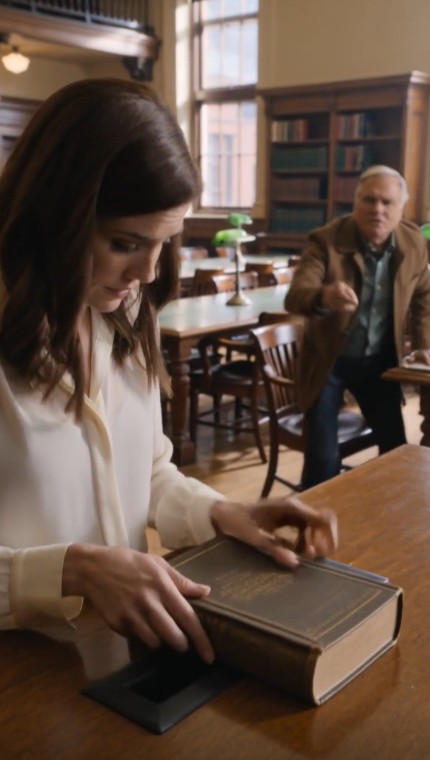
A librarian opened the returns box and found a book that was forty-three years overdue.
At first, she thought it had to be a mistake.
The cover was faded.
The corners were worn.
The pages had turned yellow with age.
And around the book was a tiny red ribbon.
The librarian, Anna, carried it to the desk.
She opened the back cover.
The original return-date card was still tucked inside.
The stamped date made her stare.
Forty-three years.
She whispered:
“Who keeps a library book for forty-three years?”
An elderly man standing near the newspaper rack suddenly looked up.
He walked toward the desk.
“Where did you find that?”
Anna held up the book.
“In the returns box.”
“When?”
“This morning.”
The man stared at the red ribbon.
His face changed.
Then he whispered:
“We promised to bring it back.”
Anna frowned.
“We?”
He nodded.
“Twelve of us.”
His name was Samuel Bennett.
He was seventy-two years old.
Anna had seen him in the library many times.
He came almost every Tuesday.
Read the newspaper.
Returned detective novels.
Sometimes helped elderly visitors use the printer.
She had never heard him mention anything about an overdue book.
Anna untied the ribbon.
“What do you mean, twelve?”
Samuel looked around the library.
Then sat down.
“Open it.”
Anna did.
Between the pages were small folded pieces of paper.
One near chapter three.
Another near chapter seven.
Then more.
Twelve altogether.
Each contained a handwritten name.
Samuel.
Margaret.
Thomas.
Helen.
Robert.
Claire.
Daniel.
Rose.
Arthur.
Elizabeth.
Michael.
And Catherine.
Samuel touched the first piece of paper.
“I haven’t seen some of these names together in decades.”
Anna looked at him.
“What happened forty-three years ago?”
Before Samuel could answer, another elderly visitor approached.
A woman named Helen.
She had overheard the conversation.
The moment she saw the book, she stopped.
“No.”
Samuel turned.
“Helen.”
Her eyes filled.
“You found it?”
Anna stared between them.
“You know this book too?”
Helen laughed softly.
“We all did.”
Then another visitor recognized it.
Then another.
Within half an hour, five elderly people were standing near Anna’s desk.
All of them knew the faded cover.
All of them remembered the red ribbon.
Anna could hardly believe it.
“What is this?”
Samuel looked at the others.
Then finally answered.
Forty-three years earlier, all twelve had been teenagers living in the same neighborhood.
Most came from families that did not have much money.
The library was where they spent their afternoons.
Not because they were all serious readers.
Because it was warm in winter.
Cool in summer.
And nobody asked them to buy anything.
The book had been recommended to them by the librarian at the time.
Her name was Margaret Ellis.
She was already in her sixties.
Strict.
Quiet.
And, according to Samuel, secretly kinder than anyone in the neighborhood knew.
The twelve teenagers had formed an informal reading group.
They passed the book around.
Each person read a section.
Then wrote a note inside.
Not on the pages.
On scraps of paper tucked between them.
Comments.
Jokes.
Questions.
Small confessions.
The book became theirs in a way no library book was supposed to.
Then one winter, something happened.
A fire destroyed part of Samuel’s family home.
Nobody was seriously hurt.
But several families in the neighborhood helped them temporarily.
Margaret, the librarian, quietly organized food, blankets, and school supplies.
She never accepted credit.
She simply told the teenagers:
“Someday, when you can help someone else, do it.”
The twelve decided they would return the favor somehow.
They tied a red ribbon around the book and made a childish promise.
The book would travel with them.
Each person would keep it for a time.
Add a note.
Then pass it on.
When all twelve had fulfilled Margaret’s request by helping someone else, they would bring the book back to the library together.
Anna stared at them.
“That was forty-three years ago.”
Samuel laughed sadly.
“We were seventeen.”
“We thought staying in touch forever would be easy.”
It wasn’t.
People moved.
Some married.
Some went abroad.
Some lost contact.
A few wrote letters.
Others disappeared from the group entirely.
The book moved too.
Samuel kept it first.
Then Helen.
Then Michael.
Then Catherine.
Eventually nobody knew who had it.
They assumed the tradition had ended.
Anna looked at the names.
“Then who returned it?”
Nobody knew.
Samuel was about to say something when he noticed a folded page marker near the back.
His expression changed.
“That wasn’t there before.”
Anna carefully opened the marked page.
Inside was an old photograph.
She stared.
An elderly woman sat on a park bench.
Beside her stood a little girl.
Maybe five years old.
The child was holding a picture book.
Anna frowned.
Something about the little girl felt familiar.
Then she looked closer.
Same eyes.
Same haircut.
Same small birthmark near the eyebrow.
Her hands began shaking.
“That’s me.”
Everyone went quiet.
Samuel stood.
“What?”
Anna held up the photograph.
“That little girl is me.”
Helen covered her mouth.
Anna looked at the elderly woman beside her.
She knew that face too.
Not well.
But enough.
“My grandmother had a photograph like this.”
Samuel stared.
“That’s Margaret.”
Anna looked at him.
“The librarian?”
He nodded.
Anna sat down.
“No.”
Margaret Ellis had been part of Anna’s childhood.
But not in the way she expected.
Anna remembered her only as Mrs. Ellis.
An elderly neighbor who sometimes watched her after school.
A woman who gave her books.
Made tea.
Corrected her grammar.
Then disappeared from Anna’s life when Anna was about six.
Her parents told her Mrs. Ellis had moved away.
Anna never knew she had once been the librarian who changed the lives of twelve teenagers.
She turned the photograph over.
On the back was a handwritten message.
Samuel read it first.
Then looked at Anna.
His eyes filled.
“What does it say?” she asked.
He handed it to her.
Anna,
If you are old enough to read this, then the book finally made it home.
You may not remember me well.
But I remembered you.
Anna’s breathing changed.
She kept reading.
Your mother brought you to the library when you were very small.
She was struggling.
She needed work.
She needed childcare.
And she needed someone to tell her she was not failing.
So I helped where I could.
Anna stopped.
Her mother had died years earlier.
She had never spoken much about those years.
The note continued.
Your mother eventually found stable work because one of the twelve young people from my old reading group helped her.
His name was Samuel.
Anna looked up.
Samuel was crying.
“You knew my mother?”
He nodded.
“Laura.”
Anna whispered her mother’s name.
“Yes.”
Samuel explained.
Years after the original reading group scattered, he returned to the neighborhood briefly.
He was working at a local transport company.
One afternoon, Margaret called him.
She rarely asked for anything.
She told him about a young mother named Laura who needed steady work.
Samuel arranged an interview.
Laura got the job.
It changed everything.
She stayed there for years.
Eventually moved into better housing.
Raised Anna.
Built a stable life.
Anna stared at Samuel.
“My mother never told me.”
He smiled.
“Margaret asked us not to turn kindness into debt.”
Anna looked back at the note.
There was more.
The promise we made at seventeen was never about returning a book.
It was about becoming the kind of people who noticed when someone needed help.
Some of them kept that promise.
Some took longer.
But they did.
Anna looked toward the twelve names.
Samuel explained.
Over the years, Margaret had quietly kept track of them.
Not constantly.
Just enough to know where their lives had gone.
Helen became a teacher.
Thomas repaired houses for families who could not afford contractors.
Rose volunteered at a hospital.
Arthur helped establish a food pantry.
Each, in different ways, had eventually done something for someone else.
Not because of the book alone.
Because life had taught them what Margaret meant.
Then Anna reached the final paragraph.
And now there is one last part of the promise.
The book must return to the library through the hands of someone whose life was changed by one of you.
That person is Anna.
Anna covered her mouth.
Samuel whispered:
“Then she finally kept her promise.”
Anna looked at him.
“What promise?”
He smiled.
“The one she made to us.”
Margaret had always said she would return the book herself if the twelve failed.
But later, she changed the plan.
She wanted it returned through someone connected to the chain of kindness they had started.
Anna.
The little girl whose mother received help because Margaret called Samuel.
The little girl Margaret later watched after school.
The child she quietly introduced to books.
Anna stared at the returns box.
“But who put it there?”
The answer was inside another envelope tucked behind the photograph.
It was from Catherine.
One of the twelve names.
She had been the final person holding the book.
For decades.
Catherine had moved abroad.
She kept the book through marriage.
Children.
Moves.
Then, several years earlier, she reconnected with Margaret.
By then, Margaret was very old.
They discussed the original promise.
Margaret gave Catherine one final instruction.
Do not return the book until Anna works at the library.
Anna laughed through tears.
“She knew I became a librarian?”
Samuel nodded.
“She must have.”
Anna had started working there eight years earlier.
But Catherine waited.
She wanted to gather the old notes first.
She found as many members of the original twelve as she could.
They mailed their names and short messages back.
Some had died.
Their families contributed on their behalf.
The book became complete again.
Then Catherine returned to town quietly.
Early that morning, before the library opened, she placed the book in the returns box.
She did not want a ceremony.
She did not want attention.
She wanted Anna to find it naturally.
Exactly as Margaret had planned.
Anna looked around at the elderly people now standing near her desk.
“How many of the twelve are still alive?”
Samuel answered:
“Eight.”
By the end of that week, six came to the library.
Two joined by video call.
For the first time in decades, the surviving members of the reading group saw one another together.
The book sat in the middle of the table.
Still technically forty-three years overdue.
Anna joked:
“You owe us a lot in fines.”
Samuel looked horrified.
Then she smiled.
“We stopped charging overdue fines years ago.”
Everyone laughed.
The library decided not to return the book to ordinary circulation.
Instead, with permission from the group, it became part of a local-history display.
The red ribbon remained.
So did the handwritten names.
The private notes were preserved but not displayed publicly.
Some things belonged only to the people who wrote them.
The photograph of Anna and Margaret went into a frame.
Beside it was a short description:
One book.
Twelve readers.
Forty-three years.
One promise.
Anna kept Margaret’s letter.
For years, she had believed her childhood was ordinary.
Her mother worked hard.
A neighbor occasionally watched her.
A library became her favorite place.
Then she discovered those things were connected.
Her mother’s first stable job came through Samuel.
Samuel helped because Margaret once helped him.
Margaret helped Anna because that was simply what she had always done.
A chain of small decisions.
None dramatic on its own.
Together, they changed lives.
One afternoon, Anna found Samuel standing beside the display.
He was looking at the old book.
She asked:
“Was it worth forty-three years?”
He smiled.
“We should have returned it sooner.”
Anna laughed.
“That isn’t what I meant.”
Samuel thought for a moment.
Then nodded.
“Yes.”
“Why?”
“Because at seventeen, I thought the promise was about keeping a book safe.”
He pointed toward Anna.
“It wasn’t.”
The book had never really been waiting to come home.
It was waiting for the promise inside it to finish traveling.
Through twelve teenagers.
Through jobs.
Families.
Mistakes.
Loss.
Acts of kindness nobody recorded.
Until one morning, forty-three years late, it landed in the hands of a librarian who had no idea she was already part of its story.
Anna opened the returns box expecting ordinary books.
Instead, she found a piece of her own childhood.
And finally understood why one elderly woman had spent so many years teaching young people the same lesson:
A good thing does not end when you pass it on.
That is usually where it begins.