
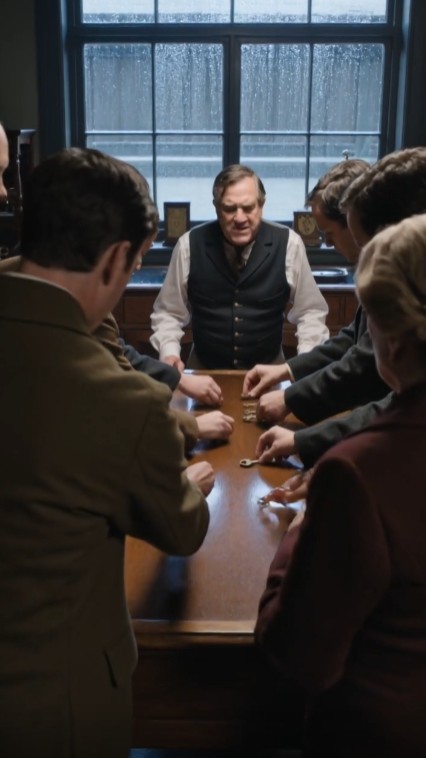
Eleven strangers walked into the same locksmith shop and placed eleven identical brass keys on the counter.
The locksmith stared at them.
His name was Daniel.
For twenty-seven years, he had worked in the same narrow shop his father once owned.
Keys hung from the walls.
Old locks filled glass cases.
And behind the counter sat a wooden cabinet Daniel had never been allowed to open.
The first woman pushed her key toward him.
“It came in the mail.”
A man beside her nodded.
“Mine too.”
“So did mine.”
“And mine.”
Daniel picked up one of the keys.
Brass.
Heavy.
Old-fashioned.
A tiny star had been engraved near the top.
He examined another.
Exactly the same.
Then another.
Same cut.
Same star.
Same unusual design.
Daniel’s expression changed.
“Who sent these?”
Nobody knew.
Each envelope had arrived that morning.
No return address.
No letter.
Only a key.
Then an elderly woman named Margaret stepped forward.
“My envelope had something else.”
She placed an old photograph on the counter.
Daniel looked at it.
Then stopped moving.
The picture showed a handmade wooden cabinet.
Eleven small drawers.
Carved edges.
A tiny brass star above each lock.
Daniel slowly turned toward the back of his shop.
Behind a glass display stood the exact same cabinet.
Margaret followed his eyes.
“That’s it.”
Daniel whispered:
“My father made that.”
The room went silent.
His father, Samuel, had been a locksmith and carpenter.
He built strange little boxes.
Secret compartments.
Puzzle locks.
Furniture that required two keys.
As a child, Daniel thought his father could make anything.
Then, when Daniel was eleven years old, Samuel disappeared.
Not forever.
But long enough to change the family.
One morning, Samuel left the shop.
He did not come home that evening.
Or the next.
For nearly a year, nobody knew where he was.
When he finally returned, he was thinner.
Quieter.
And unwilling to explain much.
He reopened the shop.
Raised Daniel.
Worked another twenty years.
Then died without ever telling his son what had happened during that missing year.
The cabinet remained.
Samuel had always told Daniel:
“Not yet.”
Even when Daniel was an adult.
Even when he took over the business.
“Dad, what’s inside?”
“Not yet.”
After Samuel died, Daniel could have broken the locks.
He was a locksmith.
It would have been easy.
But he never did.
His father had spent a lifetime teaching him that a lock could be opened by force, but that didn’t mean it should be.
So the cabinet stayed behind glass.
Until eleven strangers arrived carrying the keys.
Daniel unlocked the display.
He removed the cabinet carefully.
Then inserted Margaret’s key into the first drawer.
Click.
It opened perfectly.
Inside was a cream-colored envelope.
Daniel froze.
His own name was written across the front.
He opened it.
Inside was a photograph.
Eleven children stood together beneath paper decorations at a community celebration.
Daniel recognized himself immediately.
He was the boy standing at one end.
Eleven years old.
Beside him were ten other children.
Daniel looked up.
Then stared at the people crowded inside the shop.
Older.
Changed.
But recognizable.
“You were there.”
Margaret nodded.
Daniel looked again.
“You’re these children?”
One man laughed softly.
“Apparently.”
Daniel touched the photograph.
“I remember this day.”
It had been the neighborhood summer festival.
The last celebration Daniel attended before his father disappeared.
Then Margaret whispered:
“Where was this?”
Daniel looked toward the remaining ten drawers.
His expression changed.
“The day my father left.”
Nobody spoke.
Daniel opened the letter addressed to him.
Son,
If eleven keys have reached this shop, then everyone came.
That means I was right to trust them.
Daniel sat down.
The letter continued.
You spent your life believing I left because I wanted to disappear.
I didn’t.
I left because eleven families needed help, and I was too afraid to tell you until I knew I could finish what I started.
Daniel looked confused.
Eleven families?
He opened the second drawer using another key.
Inside was another envelope.
This one carried Margaret’s maiden name.
She opened it.
Inside was a photograph of her mother standing outside a tiny apartment.
And a note.
Margaret read aloud.
Your mother came to me because your landlord was changing the locks while she was at work.
Daniel looked at her.
Margaret’s eyes filled.
She remembered.
Barely.
Her mother had been raising three children alone.
Money was constantly short.
One summer, the landlord announced a rent increase she could not afford.
When she challenged several unsafe conditions in the building, he threatened to remove the family.
One afternoon, Margaret came home from school and found Samuel standing beside her mother.
He was changing their lock.
But not for the landlord.
For them.
The landlord had attempted to enter without proper notice.
Samuel refused to participate.
Instead, he helped Margaret’s mother contact a tenants’ organization and document what was happening.
Margaret stared at Daniel.
“Your father helped us keep our apartment.”
Daniel had never known.
He opened the third drawer.
Another name.
Another family.
This time, the letter belonged to Thomas.
His father had owned a tiny grocery store.
A developer wanted the building.
The locks were changed during a property dispute.
Samuel had discovered that the eviction paperwork was incomplete.
He refused to lock the family out.
Then helped them find legal aid.
The fourth drawer told another story.
A woman named Claire had lived with her grandmother.
Their front door broke during winter.
They had no money for repairs.
Samuel replaced the entire locking mechanism for free.
The fifth drawer belonged to Robert.
His family was temporarily living in a church basement after a fire.
Samuel quietly helped build secure storage lockers so they would not lose the few possessions they had left.
Drawer after drawer opened.
Each held a small part of the same year.
One family needed a lock repaired.
Another needed documents secured.
Another needed help retrieving belongings after a landlord dispute.
Another needed a safe installed for medication because someone in the household kept taking it.
Samuel was involved every time.
Not as a hero.
Not as a wealthy benefactor.
As a locksmith.
He used the skill he had.
Then Daniel found the connection.
The community festival in the photograph had been organized to raise money for neighborhood families facing displacement.
Samuel had volunteered.
During that day, eleven parents separately approached him.
Different problems.
Different situations.
But all connected by one issue.
Housing.
A property company had begun purchasing several buildings in the neighborhood.
Tenants were being pressured to leave.
Small businesses were losing leases.
Some locks were changed unexpectedly.
Others were threatened with removal.
Samuel started helping.
At first, only with locks.
Then with records.
He wrote dates.
Copied notices.
Kept receipts.
Took photographs.
Eventually he realized the same company was appearing again and again.
Daniel looked up.
“That’s why he disappeared?”
Not exactly.
Drawer eight contained a letter from Samuel himself.
Daniel read it quietly.
The company offered me money to stop asking questions.
I refused.
Then someone broke into the shop.
Nothing was taken except my notebook.
I became frightened for you.
Daniel stopped.
His hands trembled.
He remembered that break-in.
He had been told it was random.
It wasn’t.
Samuel continued.
I sent you to stay with your aunt.
Then I left town to gather records from the property company’s other buildings.
I thought it would take weeks.
It took almost a year.
That was why Samuel disappeared.
Not because he abandoned Daniel.
He had become a witness in a large housing case.
Attorneys advised him to stay away from the neighborhood temporarily while evidence was collected.
Samuel did not explain the details to his young son because he feared Daniel might repeat something unsafe.
Daniel had spent most of his childhood believing his father chose strangers over him.
The truth was more complicated.
Samuel had been trying to protect both.
Margaret opened another drawer.
Inside was a newspaper clipping.
Daniel unfolded it.
A property company had eventually been investigated for fraudulent tenancy records, unlawful evictions, and falsified building documents.
Several families received settlements.
Others kept their homes.
But Samuel’s name barely appeared.
One line called him:
A local tradesman who provided records.
Daniel laughed bitterly.
“That’s all?”
Margaret looked at him.
“That’s probably how he wanted it.”
The tenth drawer contained eleven small brass blanks.
Daniel picked one up.
They matched the keys on his counter before being cut.
The final drawer remained locked.
Everyone had used a key except Daniel.
Margaret looked at him.
“There are eleven of us.”
Daniel counted.
She was right.
But there were twelve children in the photograph if he included himself.
He looked again.
No.
Eleven children total.
Daniel was one of them.
Ten strangers plus Daniel.
He had not noticed because eleven people had entered the shop, but one of them was not in the photograph.
An elderly man standing silently near the door.
Daniel looked at him.
“Who are you?”
The man smiled.
“My name is Arthur.”
Margaret turned.
“You’re not one of us.”
“No.”
Arthur removed something from his pocket.
A twelfth key.
Different from the others.
Silver.
Daniel stared.
Arthur placed it on the counter.
“Your father gave me this thirty-two years ago.”
Daniel’s voice dropped.
“You knew him?”
“I was the attorney on the housing case.”
The room went quiet again.
Arthur explained.
Samuel had insisted the cabinet remain closed until the people involved were old enough to understand why he made it.
After the case ended, Samuel created one brass key for each child whose family had been directly affected.
The idea was simple.
If those children ever returned to the neighborhood as adults, they would each receive a key.
But life scattered everyone.
Addresses changed.
Families moved.
Samuel grew older.
He never managed to bring them together.
Before he died, he gave Arthur a list.
Find them if you can.
Send all the keys on the same day.
Arthur had spent almost three years tracing everyone.
Not through private secrets.
Through old public records, community contacts, and families who agreed to help.
He had finally located all ten remaining children.
And Daniel, of course, was still in the shop.
Arthur looked at him.
“Your father made me promise not to tell you until everyone could stand in this room together.”
Daniel laughed through tears.
“Everyone in my life apparently enjoys promises.”
Then he inserted Arthur’s silver key into the final hidden lock beneath the cabinet.
A narrow panel opened.
Inside was one last envelope.
No name.
Daniel read it aloud.
To all of you,
If this cabinet is open, then you survived long enough to become strangers to one another.
That is not an insult.
Life is supposed to move.
Some of you probably left this neighborhood.
Some stayed.
Some succeeded.
Some struggled.
But once, when you were children, your families were connected by the same problem.
And people helped one another.
Do not remember me as the man who saved anyone.
I fixed locks.
Your parents did the difficult part.
They stood together.
Daniel paused.
Then continued.
The keys are not souvenirs.
They are reminders.
A lock can keep someone out.
A lock can keep someone safe.
The difference depends on who controls the key.
The room became silent.
Then Margaret noticed something written at the very bottom.
There is one final drawer behind the photograph.
Daniel removed the old festival picture.
Behind it was a shallow compartment.
Inside were eleven small wooden stars.
Each had a name carved into it.
Daniel handed them out.
One by one.
Margaret.
Thomas.
Claire.
Robert.
Helen.
Elizabeth.
Michael.
Rose.
Catherine.
Samuel Jr.
Daniel.
Everyone stared at the names.
One woman laughed.
“Why wooden stars?”
Daniel already knew.
His father carved stars onto everything he built.
Key tags.
Cabinets.
Tool handles.
Even Daniel’s childhood bed.
The tiny star on every brass key had been Samuel’s mark.
Arthur finally explained why all eleven keys had been mailed on the same day.
Samuel’s original instruction specified a date.
Not his birthday.
Not the date of the court decision.
The neighborhood festival.
Exactly thirty-two years later.
The day all the children had last stood together.
The strangers remained inside Daniel’s shop for hours.
They shared what happened afterward.
Margaret became a nurse.
Thomas ran a grocery business.
Claire became a teacher.
Robert worked construction.
Two had moved abroad.
One had returned only recently.
Most had not thought about that summer in decades.
But all remembered Samuel.
Not equally.
Not clearly.
A man fixing a door.
A man carrying tools.
A man speaking quietly with worried parents.
Daniel listened.
For the first time, the missing year of his childhood stopped feeling like an empty space.
It became a story.
Not a perfect one.
Daniel still wished his father had told him sooner.
He still believed Samuel could have handled parts of it differently.
But he finally understood why the cabinet existed.
Samuel had not made it to reveal a secret fortune.
There was no property hidden inside.
No inheritance.
No dramatic ownership claim.
Only records of ordinary people helping one another when powerful people expected them to stay isolated.
Before everyone left, Margaret asked:
“What happens to the cabinet?”
Daniel looked at it.
For thirty-two years, it had sat behind glass.
Untouched.
Waiting.
He smiled.
“We use it.”
“For what?”
Daniel removed the drawers.
Cleaned the locks.
Then hung a small sign in the shop window several weeks later.
COMMUNITY KEY FUND.
People who could afford to contribute did.
The money helped elderly residents, struggling families, and small local organizations pay for basic lock repairs and security work.
Nothing enormous.
Exactly the kind of work Samuel had once done quietly.
The cabinet remained in the shop.
But now its drawers held applications, receipts, and spare keys for community projects.
Daniel kept the photograph above it.
Eleven children at a summer festival.
Underneath, he placed his father’s sentence:
A lock can keep someone out.
A lock can keep someone safe.
The difference depends on who controls the key.
Years later, people sometimes entered the shop after hearing the story.
They expected some mysterious cabinet full of treasure.
Daniel always laughed.
“The treasure was paperwork.”
But he knew that wasn’t entirely true.
The real gift had been the eleven keys.
Not because of what they opened.
Because of who they brought back.
Eleven people arrived as strangers.
They placed identical brass keys on a counter.
Then one by one, a cabinet opened the part of their childhood none of them fully understood.
Daniel had spent most of his life wondering why his father disappeared.
The answer had been sitting behind glass only a few feet away.
Samuel had left for a year because he believed families who were being pushed out deserved someone willing to stand beside them.
And thirty-two years later, he arranged one final act.
He gave the children from that story the keys.
Then made sure they had to come back together to understand what they opened.