
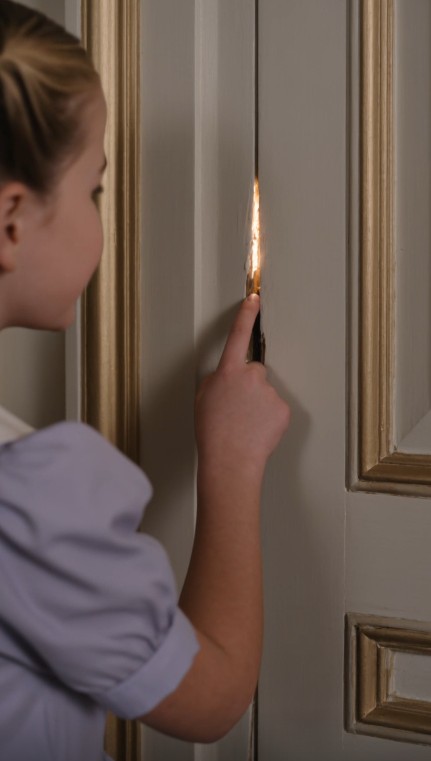
A little girl found light coming from inside the wall of her father’s mansion.
At first, everyone thought she was imagining things.
Her name was Lily.
She was seven years old.
And for nearly a week, she kept pointing toward the same section of wallpaper in the upstairs hallway.
“Daddy… look.”
Her father, Daniel, barely noticed the first time.
The mansion was old.
Beautiful.
Expensive.
And full of strange shadows.
He assumed Lily had seen light reflecting from one of the tall windows.
But that evening, she called him again.
This time, she pulled him by the hand.
“Here.”
Daniel knelt beside her.
A thin line of warm light escaped from beneath the wallpaper.
Not from the floor.
Not from a lamp.
From behind the wall.
Daniel frowned.
“That shouldn’t be there.”
The family had lived in the mansion for six years.
Daniel had renovated most of it after purchasing the property from the estate of its previous owner.
Architects had inspected it.
Contractors had opened walls.
Electrical work had been replaced.
Nobody had ever mentioned a room in that location.
Daniel pressed gently against the paneling.
Nothing happened.
Then Lily touched a tiny indentation near the molding.
A soft click followed.
The wall moved.
Daniel stood quickly.
A narrow panel swung inward.
Behind it was a small passage.
Lily’s eyes widened.
“I told you.”
Daniel almost laughed.
“You absolutely did.”
He called the housekeeper, Maria, before entering.
Then switched on his phone flashlight.
The passage led several feet inward.
At the end was a small room.
It smelled dusty.
The room had no proper window.
Only a narrow vent that allowed a little exterior light inside.
That explained the glow Lily had noticed.
A small old lamp was also burning.
Daniel looked surprised.
“How is that even on?”
An electrician later discovered it had been connected to an old low-voltage circuit that had somehow remained active after the renovations.
But Daniel did not know that yet.
At that moment, he was focused on what was inside the room.
An antique wooden chair.
Several shelves.
A red music box.
A stack of old books.
And one large painting turned toward the wall.
Daniel walked closer.
Maria stayed near the doorway with Lily.
“Daddy, what’s that?”
Daniel carefully lifted the painting and turned it around.
Then froze.
The portrait showed two people standing outside the mansion.
One was easy to recognize.
Arthur Whitmore.
The former owner.
Daniel had seen his photograph in the paperwork that came with the house.
Arthur had lived there for more than fifty years.
But the woman beside him was someone Daniel recognized too.
Someone who, as far as he knew, had never had anything to do with this mansion.
His mother.
Claire.
Daniel stared.
“That’s impossible.”
Maria stepped closer.
The moment she saw the portrait, she covered her mouth.
Daniel turned.
“You know about this?”
Maria’s face changed.
She had worked at the mansion long before Daniel purchased it.
Before Arthur died.
Before the estate was sold.
“Maria.”
She looked at him.
“Who is she?”
Lily pointed innocently.
“Who’s the lady?”
Maria looked at Daniel.
Then whispered:
“Sir… that’s the woman who saved this house.”
Daniel stared at her.
“What?”
His mother had died twelve years earlier.
She had been a school librarian.
Quiet.
Private.
Not wealthy.
Daniel had never heard her mention Arthur Whitmore.
Never heard her mention the mansion.
Yet the painting showed Claire standing beside Arthur when she was much younger.
Daniel set the portrait down carefully.
“Tell me everything.”
Maria hesitated.
Then looked toward Lily.
“Maybe not in front of—”
“She stays.”
Daniel’s voice was calm.
Lily moved closer to him.
Maria nodded.
Then she began.
Nearly thirty-five years earlier, the mansion had almost been lost.
Arthur Whitmore’s family fortune had declined badly.
People assumed he was still wealthy because of the house.
He wasn’t.
Maintenance costs were enormous.
Property taxes had fallen behind.
Arthur had also made several poor investments.
By the time Maria began working there, sections of the mansion had already been closed because he could not afford repairs.
Then Arthur became ill.
His relatives wanted him to sell immediately.
Developers were interested in tearing down part of the estate and dividing the land.
Arthur refused.
The house had belonged to his family for generations.
But sentiment did not pay debts.
Daniel interrupted.
“What does my mother have to do with any of this?”
Maria looked toward the painting.
Claire had met Arthur at the local library.
She was twenty-six.
Arthur was already in his sixties.
He came in almost every week.
Mostly to read newspapers.
Sometimes old property records.
Claire noticed he was searching through historical archives.
Eventually, he told her why.
Arthur believed part of the land surrounding the mansion might be protected under an old preservation agreement.
If true, it could prevent a rushed redevelopment sale and give him time to restructure his debts.
But he could not locate the original documents.
Claire helped.
For months.
She searched old municipal records.
Historical maps.
Property transfers.
Newspaper archives.
Then one evening, she found a reference to a preservation covenant attached to the estate decades earlier.
It did not magically erase Arthur’s debts.
But it changed the legal situation enough that the property could not simply be demolished and divided the way several buyers had planned.
That gave Arthur time.
He sold a smaller parcel that was not protected.
Repaid part of what he owed.
Opened portions of the grounds for paid historical tours.
And eventually stabilized the estate.
Daniel looked stunned.
“My mother did all that?”
Maria shook her head.
“She found the record.”
“Arthur did the rest.”
“But he always said without her, he would have sold the house in panic.”
Daniel looked again at the painting.
“Then why didn’t she ever tell me?”
Maria became quiet.
Because that was not the only connection.
Claire and Arthur became close friends.
Nothing romantic.
Arthur was decades older.
But he trusted her.
Claire helped him catalog old family papers.
Arthur encouraged her to study archival conservation.
She considered it.
Then Daniel was born.
His father left when Daniel was still very young.
Claire’s priorities changed.
She remained a librarian.
Raised Daniel.
And gradually stopped visiting the mansion.
Daniel frowned.
“That still doesn’t explain this room.”
Maria nodded.
“No.”
Arthur created the room later.
It had originally been a narrow service storage space.
He converted it into a private archive.
Not because he was hiding treasure.
Because he was afraid his relatives would discard old family documents after his death.
He stored letters.
Photographs.
Property records.
And things connected to people he believed had changed his life.
The red music box was one of Claire’s.
Daniel stepped toward it.
“My mother’s?”
Maria nodded.
Claire had given it to Arthur years earlier.
It played a simple melody.
Arthur kept it because he said the sound reminded him of the library where they first met.
Daniel opened it.
The melody was faint.
But he knew it.
His mother used to hum the same tune while cooking.
Daniel sat down.
For a moment, he could not speak.
Then Lily asked:
“Why did Grandma leave it here?”
Daniel looked at Maria.
Maria shook her head.
“She didn’t.”
“Arthur kept it after she died.”
Daniel stared.
“Arthur knew she died?”
“Yes.”
Maria’s eyes filled.
“He went to the funeral.”
Daniel looked shocked.
“I would have remembered him.”
“He stayed outside.”
Arthur had been frail by then.
He did not approach the family.
He left flowers.
Then went home.
Daniel rubbed his forehead.
The secret felt impossible only because his mother had lived such an ordinary life.
But ordinary lives could contain chapters children never saw.
Daniel stood and examined the room more carefully.
There were boxes labeled by year.
He opened one.
Inside were letters.
Some from Claire.
Some from Arthur.
Daniel did not immediately read them all.
He took only one envelope marked:
For Daniel, if he ever finds this.
His hands stopped.
Maria stared.
“I didn’t know that was there.”
Daniel opened it.
The letter was from Arthur.
Daniel,
If you are reading this, then either I finally became brave enough to tell you myself or, more likely, you discovered this room after I was gone.
Your mother helped preserve this house when I had nearly given up on it.
But that is not why I kept this room.
She taught me something more important.
A house is not saved because its walls survive.
It is saved because people find a reason for it to remain useful.
Daniel kept reading.
Arthur explained that after Claire helped him stabilize the property, she persuaded him to open part of the mansion to local schools.
For years, children visited free of charge.
History classes.
Reading groups.
Small concerts.
Claire helped organize the first programs.
Daniel had never known.
Arthur wrote:
Your mother refused every offer of payment.
She said libraries and old houses had one thing in common.
They only mattered if people could enter them.
Daniel stopped.
Lily looked up.
“What does it say?”
He smiled through tears.
“That Grandma was smarter than me.”
Lily nodded seriously.
“I knew that.”
Maria laughed quietly.
Then Daniel reached the final paragraph.
When I heard Claire had died, I closed this room.
I could not bring myself to sort it.
I intended one day to send these things to you.
I failed.
If you found them yourself, I am sorry.
But perhaps the house has finally managed to return something to her family.
Daniel folded the letter.
The room went silent.
Then Maria walked toward one of the shelves.
“There’s something else.”
She removed a thin folder.
Inside were records from an old educational trust.
The Whitmore House Learning Fund.
Daniel had heard the name.
He assumed it had been created by Arthur’s family.
It funded small local reading programs.
School visits.
Historical preservation workshops.
But on the original paperwork, beneath Arthur’s signature, was another name.
Claire Bennett.
Daniel whispered:
“She helped start it.”
Maria nodded.
“She wouldn’t let him name it after her.”
The trust had continued long after both Arthur and Claire were gone.
Daniel had unknowingly donated to it twice through local fundraising events.
That realization almost made him laugh.
For six years, he had lived in the very house his mother once helped save.
He bought it through a legitimate estate sale.
No secret inheritance.
No hidden ownership.
No legal surprise.
Just an extraordinary coincidence made possible because the house had stayed intact long enough to eventually come onto the market.
Daniel’s father had never told him.
His mother had never spoken about it.
And Arthur’s surviving relatives apparently knew little about Claire.
The relationship existed mostly in letters and records left behind.
Daniel asked Maria:
“Why didn’t you tell me when I bought the house?”
She looked embarrassed.
“I wasn’t sure you knew.”
“And Arthur asked me never to discuss his private papers.”
“After he died, the room was already sealed.”
“I thought the family had emptied it.”
They had not.
During renovations, workers assumed the wall was original structural paneling.
Nobody realized a narrow latch remained hidden beneath the wallpaper.
The small active light circuit behind the wall had been missed.
Then Lily saw it.
A tiny line of warm light.
That evening, Daniel called an archivist.
Then a preservation specialist.
He did not start opening everything himself.
The papers were old.
Some fragile.
They deserved proper handling.
Over the following months, the contents of the hidden room were documented.
Most belonged to Arthur’s family history.
Some were transferred, with the estate’s legal permission, to a local historical collection.
Copies of Claire’s letters went to Daniel.
The red music box stayed with him.
So did the portrait.
But Daniel made one decision that surprised everyone.
He reopened part of the mansion to children.
Not as a tourist attraction for wealthy guests.
As a small educational program.
Once a month, school groups came.
They toured the historical rooms.
Used the old library.
Listened to local musicians.
And learned how old documents could change what people understood about a place.
Lily loved those days.
She told every child:
“I found the secret room.”
Daniel always corrected her.
“You found a crack in the wallpaper.”
“That is how secret rooms work.”
He could never win that argument.
The hidden room itself remained closed to ordinary visitors.
It was too small and its materials too delicate.
But a display outside showed copies of the painting.
The preservation records.
And one line from Claire:
Old places should not become monuments to people who are gone.
They should become useful to people who are here.
Daniel had that sentence framed.
Years later, he still thought about the moment he turned the painting around.
He had expected an old portrait.
Instead, he found his mother standing inside a history she had never told him.
She had not secretly owned the mansion.
She had not hidden a fortune.
She had not lived a mysterious second life.
She had simply helped someone when her particular skills mattered.
She found records.
Organized papers.
Built programs.
Then returned to her own life.
To Daniel.
To the library.
To ordinary dinners and ordinary mornings.
The housekeeper’s unfinished sentence that day had sounded dramatic.
“Sir… that’s the woman who…”
The truth was quieter.
That was the woman who helped save the mansion.
And because she did, the house survived long enough for her own son and granddaughter to one day live inside it.
Six years after moving in, Daniel thought he knew every room.
Then Lily noticed one thin line of light.
Behind it waited a red music box.
A turned painting.
And proof that sometimes the largest parts of a person’s life are the ones they never thought to mention.