
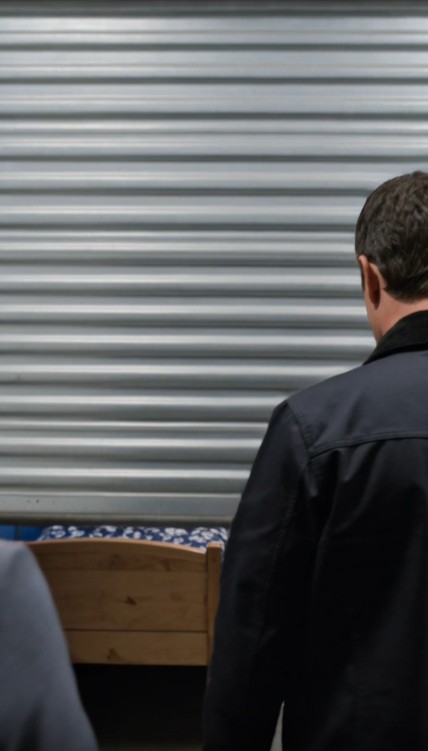
A businessman opened an abandoned storage unit and found his childhood bedroom inside.
Not furniture that looked familiar.
Not a room arranged to resemble the house where he grew up.
His actual childhood bedroom.
The same little wooden bed.
The same blue wallpaper.
The same narrow bookshelf.
Even the red toy train he had broken when he was seven.
His name was Daniel.
He was forty-eight years old.
And he had only come to the storage facility because his company had recently purchased the property.
Several abandoned units needed to be documented before renovation work could begin.
Daniel expected old furniture.
Boxes.
Maybe forgotten appliances.
Then the metal door rolled upward.
And he stopped breathing for a second.
The storage manager, Claire, looked at him.
“Sir?”
Daniel did not answer.
He stepped inside.
A section of wallpaper had been mounted carefully across a temporary wooden wall.
Blue.
Covered with tiny white clouds.
Near the bottom was a crooked yellow rocket.
Painted by a child’s hand.
Daniel pointed.
“I made that.”
Claire frowned.
“You recognize this?”
“My father helped me paint it.”
Daniel walked farther inside.
The little bed stood against the wall exactly as he remembered.
One corner of the headboard had a shallow scratch.
Daniel had made it while dragging a toy truck across the wood.
His father had been furious for approximately three minutes.
Then laughed.
Daniel touched the scratch.
It was still there.
On the shelf sat several books.
A wooden airplane.
Three glass marbles.
And the red toy train.
Daniel picked it up.
One wheel barely moved.
He turned it carefully.
There was a chipped white mark near the axle.
His father had tried to repair it with glue decades earlier.
Daniel whispered:
“That’s impossible.”
He had not seen these things since he was nine.
His family moved suddenly that year.
His parents told him they could not take everything.
He remembered crying over the train.
His father promised:
“We’ll come back for the rest.”
They never did.
Daniel eventually stopped asking.
Life moved on.
His father, Robert, died when Daniel was twenty-six.
His mother died several years later.
Daniel built a career.
Married.
Had children.
Divorced.
Started a company.
And almost never thought about the little blue bedroom again.
Until now.
Claire watched him open an old wooden wardrobe.
Inside hung a navy child’s coat.
Daniel touched the sleeve.
“My mother made me wear this every winter.”
Then he saw a cardboard box on the bottom shelf.
He lifted it onto the bed.
On top was a photograph.
Daniel as a little boy.
Standing beside Robert.
His father had one hand on Daniel’s shoulder.
Behind them stood the old house.
Daniel’s hands began trembling.
He turned toward Claire.
“Who rented this unit?”
Claire walked to the office computer.
The active rental information was incomplete because the unit had not been paid for in years.
But archived records went much further back.
She searched.
Then stopped.
Her expression changed.
“Sir…”
Daniel stepped closer.
“What?”
“Your father didn’t rent this.”
Daniel stared.
“Then who did?”
Claire turned the monitor slightly.
The earliest rental agreement listed a woman named:
Margaret Ellis.
Daniel froze.
He knew the name.
At least he thought he did.
“Margaret?”
Claire looked at him.
“You know her?”
Daniel nodded slowly.
“She lived across the street from us.”
Margaret had been their neighbor when Daniel was a child.
An older woman even then.
She baked cookies.
Grew tomatoes.
And allowed Daniel to help water her garden badly.
But Daniel had not thought about her in decades.
“Why would she have my room?”
Claire kept searching.
The unit had been rented thirty-nine years earlier.
Margaret paid for it every month.
After her death, payments continued from an account belonging to her daughter, Susan.
Then from a small family trust.
Only recently had the payments stopped.
Daniel stared at the screen.
“Thirty-nine years?”
Claire nodded.
Daniel looked back toward the reconstructed bedroom.
Someone had preserved it almost his entire adult life.
He needed to understand why.
Claire found a contact number connected to the old account.
It belonged to a woman named Laura Bennett.
Margaret’s granddaughter.
Daniel called.
When he explained who he was, Laura became silent.
Then she said:
“I wondered if someone would ever find that room.”
Daniel sat down.
“You knew about it?”
“Yes.”
“Why does your family have my childhood furniture?”
Laura took a long breath.
Then told him.
The year Daniel’s family moved away had not been an ordinary move.
Daniel knew his father had lost his job.
What he did not know was how bad things became.
Robert had invested money into a small construction business with a partner.
The business collapsed.
Debts followed.
Then their house entered foreclosure.
Daniel’s parents had only days to leave.
They packed what fit into one truck.
Everything else was supposed to be sold or abandoned.
Robert was ashamed.
He refused to ask anyone for help.
But Margaret saw what was happening.
She had known the family for years.
She knew Daniel’s bedroom was the place where Robert and his son spent most of their time together.
Building train tracks.
Painting rockets.
Reading.
Repairing broken toys.
So after the family left, Margaret contacted Robert.
Daniel interrupted.
“My father knew?”
“Yes.”
Laura continued.
Margaret offered to store some of their belongings until Robert got back on his feet.
Robert refused at first.
He said:
“Daniel needs to forget that house.”
Margaret disagreed.
She told him:
“Children shouldn’t have to lose everything because adults are having a hard year.”
Eventually Robert agreed to let her save a few boxes.
But Margaret saved much more than that.
Before the house was cleared, she took Daniel’s furniture.
The wallpaper could not be removed intact, so she carefully cut a large section containing the little rocket.
She kept the toys.
Books.
Clothes.
Photographs.
Everything she thought Daniel might someday want.
At first, it filled part of her garage.
Years later, when she moved, she rented the storage unit.
Laura said:
“My grandmother called it Daniel’s room.”
Daniel felt a lump in his throat.
“But why preserve it like this?”
That part came later.
Margaret originally stored the items in boxes.
Then, about twenty years after Daniel’s family left, Robert came to see her.
Daniel sat completely still.
“My father went back?”
Laura nodded.
Robert had tracked Margaret down.
By then, Daniel was in college.
Robert was proud of him.
Very proud.
He told Margaret Daniel had survived the difficult years.
That he had done well.
That he had built a life.
Then Margaret showed Robert the stored furniture.
The moment he saw the red train, he started crying.
Robert asked her to do something unusual.
“Keep it.”
Margaret said:
“For Daniel?”
Robert nodded.
“But don’t tell him yet.”
“Why?”
Because Robert carried enormous guilt about losing the family home.
He believed Daniel had experienced enough instability as a child.
He did not want old belongings suddenly reopening painful memories while his son was trying to build a future.
Margaret asked:
“When should I tell him?”
Robert answered:
“When it feels like a memory instead of a wound.”
Daniel lowered his head.
That sounded exactly like his father.
Always trying to protect him.
Sometimes wisely.
Sometimes too much.
Laura continued.
After Robert died, Margaret planned to contact Daniel.
But her health deteriorated.
She died before she could.
Her daughter Susan inherited the responsibility.
Susan never met Daniel.
She knew only the story her mother told.
So she continued paying the storage bill.
At some point, Susan and Laura decided the items deserved better preservation.
They rebuilt the room layout using old photographs.
Not perfectly.
But enough that someone entering would understand what it had been.
Daniel looked around.
“That was your family?”
“Yes.”
“Why?”
Laura laughed softly.
“Because by then it felt like finishing Grandma’s promise.”
Daniel looked at the bed.
The train.
The blue wall.
A promise made by people he barely remembered had lasted nearly forty years.
Claire asked Laura why the payments stopped.
There was another pause.
Susan had died the previous year.
Laura inherited the account.
She intended to contact Daniel.
But she did not know where he was.
His surname was common.
The few old addresses she had were useless.
Then she became ill herself and fell behind on paperwork.
The storage payment lapsed.
Daniel asked quietly:
“So if my company hadn’t bought this building…”
Laura finished the thought.
“The room might have been auctioned.”
That shook him.
Not because the objects were valuable.
Most were not.
But because an entire chapter of his childhood had come within weeks of being scattered forever.
Daniel asked:
“Is there anything else?”
Laura hesitated.
“Yes.”
Inside the cardboard box, beneath the photograph, was a sealed envelope.
Daniel had not opened it yet.
On the front was his name.
In Robert’s handwriting.
Daniel sat on the little bed.
Then opened it.
Son,
If you ever see these things again, it means Margaret kept her promise longer than I deserved.
Daniel stopped.
Then continued.
Robert wrote about losing the house.
He admitted he had lied to Daniel.
The move had not been temporary.
There had never been a realistic plan to return.
He had said so because he could not bear to tell his nine-year-old son that the only home he remembered was gone.
The letter read:
You cried about the red train.
I told you I would fix it and bring it later.
I fixed one wheel.
The other never worked right.
I carried it to Margaret’s house the morning we left.
I told myself I would collect it in a month.
Then I was too embarrassed.
A month became a year.
A year became many.
Daniel looked at the train.
The wheel still stuck exactly where Robert described.
He continued.
I spent years thinking I failed you because I could not save the house.
It took me too long to understand that you never asked me to save a house.
You only wanted me to come home.
And somehow, even when the address changed, we kept doing that.
Daniel stopped reading.
His eyes filled.
There was one final paragraph.
If you find this when you are older, keep what matters and let the rest go.
Do not turn my guilt into your storage problem.
That made Daniel laugh through tears.
Typical Robert.
Emotional for three paragraphs.
Practical in the fourth.
Daniel called Laura again.
“I found the letter.”
“I know.”
“Did you read it?”
“No.”
“Grandma never did either.”
Daniel looked around the room.
“Your family paid for this for decades without knowing what was inside the envelope?”
“Yes.”
“Why?”
Laura answered simply:
“Because Margaret said it belonged to you.”
That was all.
No hidden inheritance.
No secret property claim.
No priceless collection.
A neighbor had simply protected a child’s belongings because his family was losing everything.
Then her daughter continued.
Then her granddaughter.
Not because they expected recognition.
Because someone had made a promise.
Daniel arranged to meet Laura.
A week later, she visited the storage facility.
She brought another box.
Inside were photographs Margaret had taken before the family moved.
One showed Daniel painting the little yellow rocket.
Robert held the paint tin.
Another showed Margaret standing outside the house with Daniel’s mother.
Then Daniel found a photograph that made him smile.
Robert sat on the floor.
The red train lay in pieces between his knees.
Young Daniel stood beside him looking furious.
On the back, Margaret had written:
Robert attempting another impossible repair.
Daniel laughed.
“I remember this.”
Laura smiled.
“Grandma apparently found it very funny.”
They spent hours going through everything.
Then Daniel made a decision.
He did not preserve the entire room forever.
His father’s letter had been clear.
Keep what matters.
Let the rest go.
Daniel kept the train.
The photograph.
The navy coat.
A section of wallpaper containing his crooked yellow rocket.
And the small wooden bed.
Other items were donated where appropriate.
The reconstructed walls were dismantled.
For a moment, Daniel felt guilty.
Then he remembered Robert’s words.
A memory did not need to become a museum.
At home, Daniel repaired the red train with his own son.
The boy was seventeen.
He looked at the damaged wheel.
“You’ve kept this since you were seven?”
Daniel smiled.
“Technically, three generations of strangers kept it for me.”
His son frowned.
“That needs explaining.”
So Daniel told him everything.
About the lost house.
Margaret.
The storage unit.
Robert’s letter.
The promise.
Then his son asked:
“Did Grandpa really think you blamed him?”
Daniel looked at the train.
“Probably.”
“Did you?”
“No.”
That answer came easily.
As a child, Daniel remembered losing a bedroom.
But he remembered his father more strongly.
Cheap apartments.
Shared dinners.
Robert helping with homework after long shifts.
Weekend walks because there was no money for expensive entertainment.
The house disappeared.
The father stayed.
Daniel finally understood what Robert had spent years struggling to forgive himself for.
And he wished he could tell him:
I never needed the house back.
Months later, Daniel returned to the storage facility after renovations began.
The unit was empty.
No bed.
No blue walls.
No train.
Just concrete.
Claire asked:
“Does it feel strange?”
Daniel nodded.
“But good.”
Before leaving, he mounted a tiny photograph inside the facility office.
Young Daniel.
Robert.
The old house behind them.
Under it, he wrote:
Some things are stored because they are valuable.
Others are stored because someone promised not to throw them away.
Laura visited once more.
Together, they placed a small plaque beside the photograph honoring Margaret and Susan.
Not because Daniel wanted strangers to know his entire family story.
Because he wanted the two women who quietly protected it to have their names remembered.
For nearly forty years, Daniel’s childhood bedroom existed in darkness inside a storage unit.
It survived because an elderly neighbor once decided a frightened nine-year-old had already lost enough.
Then one generation carried the promise to the next.
And another.
Daniel had entered the unit believing he had discovered something impossible.
His exact childhood.
Frozen in time.
But the truth was more human.
Nothing had frozen.
People had grown old.
People had died.
Bills had been paid.
Boxes had been moved.
Promises had been inherited.
The little room survived because someone kept choosing, year after year, not to let it disappear.
And in the end, the most valuable thing Daniel found was not the furniture.
It was proof that during one of the hardest years of his childhood, there had been more people looking out for him than he ever knew.