
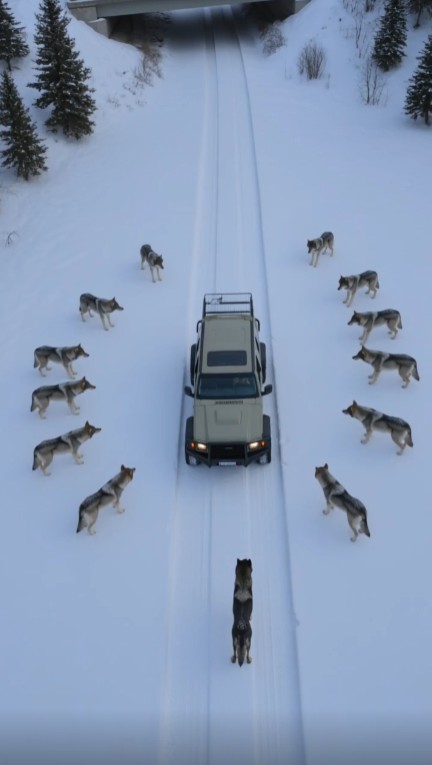
A wildlife ranger stopped her truck when twelve wolves appeared along a snowy forest road.
She did not get out.
She did not approach them.
She stayed inside the locked vehicle and watched.
Her name was Claire.
She had worked in wildlife conservation for fourteen years.
She had seen wolves before.
Usually at a distance.
Usually moving.
Usually disappearing into trees long before a vehicle came close.
This was different.
The animals were scattered along both sides of the road.
Not surrounding the truck.
Not approaching it.
Simply standing or sitting in the snow.
Watching the forest.
One large dark-gray wolf stood farther ahead near an old wooden bridge.
Claire kept the engine running.
Then lifted her camera.
The wolf turned its head toward the snowy embankment.
Waited.
Then looked again.
Claire zoomed in.
Something bright stood out against the white snow.
Orange.
Small.
Caught on a branch near the bridge.
Claire frowned.
Then her expression changed.
“That can’t be.”
She recognized it.
The object looked like an old tracking marker used by a regional wolf-monitoring program years earlier.
The project had ended after funding changed and newer equipment replaced the original collars and field tags.
Claire photographed the marker.
Then pulled up the archived project records on her work tablet.
The signal code printed along the side was difficult to read.
She enlarged the image.
Checked again.
Then found a match.
W-27.
Claire froze.
She knew that number.
Not personally.
But anyone who had worked in the region’s wolf program long enough had heard about W-27.
The animal had been a young female wolf fitted with a research collar more than nine years earlier.
She belonged to one of the first packs successfully documented returning to that section of forest after decades of decline.
Researchers followed her movements for several seasons.
Then her collar stopped transmitting.
The last confirmed location was miles away.
Search teams found no remains.
No collar.
Nothing.
She simply disappeared from the records.
Claire looked back toward the bridge.
The dark-gray wolf had moved closer to the embankment.
Then she saw something else.
Movement beneath the bridge.
Barely visible behind snow-covered branches.
Claire zoomed the camera farther.
A shape.
Gray fur.
Then another.
She whispered:
“Oh my God.”
At first, she thought she was looking at an injured wolf.
Then the animal lifted its head.
It was older.
Very old.
Its muzzle was almost white.
Around its neck was the damaged remains of a faded research collar.
Claire’s heart began racing.
She compared the markings visible in the archive photographs.
The pale patch around one eye.
The dark line along the shoulder.
The damaged orange marker.
It looked remarkably similar to W-27.
But Claire knew appearances were not proof.
She immediately radioed the wildlife team.
“I may have located a collared wolf from the old North Ridge project.”
The response came quickly.
“Alive?”
“Possibly.”
“Stay in the vehicle.”
“I am.”
“Do not approach.”
“I won’t.”
That part was non-negotiable.
Wild wolves were not pets.
Even an apparently weak animal could be dangerous if frightened or cornered.
Claire remained inside while a specialized field team headed toward her location.
The twelve wolves continued to linger nearby.
Some eventually disappeared into the trees.
Others remained farther up the slope.
Claire was careful not to describe them as “guarding” the older wolf.
That would have been an assumption.
There were several reasonable explanations for the group’s presence.
They could be members of the same pack.
They could be using a familiar travel corridor.
They might have been waiting because the older animal was resting near a route they regularly used.
The dark-gray wolf near the bridge eventually walked underneath.
For several minutes, both animals disappeared from view.
Then it emerged again.
That behavior caught Claire’s attention.
When the wildlife team arrived, they established distance and used long lenses to assess the older wolf.
The animal appeared weak.
But alert.
There was no visible severe injury.
The collar, however, was clearly damaged.
One section hung loosely.
The animal’s ribs were more visible than expected.
The lead biologist, Dr. Michael Hayes, studied Claire’s photographs.
“Where did you get the identification?”
She showed him the archive.
Michael stared.
“No way.”
“You recognize the number?”
“Everyone from that project does.”
He compared the old image with the wolf beneath the bridge.
Then shook his head.
“It could be her.”
“Could?”
“We verify.”
That process took time.
They did not rush in because the story felt exciting.
First, the team documented the wolf from a distance.
Then they consulted a wildlife veterinarian.
Because the animal appeared compromised and because the old collar could potentially be causing problems, the veterinarian approved a carefully controlled intervention.
The other wolves had gradually moved deeper into the forest.
Only then did the team proceed.
Using established wildlife protocols, they safely immobilized the older animal under veterinary supervision.
Claire watched from a distance.
The closer examination revealed something surprising.
The collar was indeed an old North Ridge unit.
The serial number matched W-27.
Claire stared at Michael.
“It’s actually her.”
He nodded.
Nine years after her last confirmed tracking signal, W-27 was alive.
Older.
Thinner.
But alive.
The mystery of her disappearance quickly became more understandable.
The collar had suffered mechanical damage.
The transmission unit was cracked.
Corrosion had affected the electronics.
At some point, the signal simply stopped.
The tracking team years earlier had interpreted that correctly only as a loss of data.
Not proof of death.
Without a working transmitter, W-27 had continued living outside the project’s view.
The orange marker Claire saw had likely broken from part of the damaged equipment and become caught on vegetation.
The veterinary examination found age-related dental wear, dehydration, and general weakness consistent with an elderly wild animal during a difficult winter.
But there was no evidence that she had been trapped under the bridge.
She had most likely chosen the sheltered area because it protected her from wind.
The bridge created a dry pocket beneath the road.
A practical resting place during heavy snow.
Then came the question everyone wanted answered.
What about the twelve wolves?
The team collected non-invasive evidence from tracks, camera records, and prior regional observations.
Over the next several weeks, biologists compared known pack patterns.
The results were fascinating.
Several of the wolves were almost certainly members of the local Cedar Valley pack.
Genetic sampling collected later from scat in the area suggested that W-27 was related to animals in that pack.
Possibly maternally.
Researchers could not responsibly claim every wolf on the road was her direct descendant.
But the data supported something important.
W-27 had not spent the missing years alone.
At some point after the tracking project ended, she had remained reproductively and socially connected to wolves in the region.
Her genetic line had continued.
Claire read the preliminary report twice.
“So the pack may include descendants?”
Michael nodded.
“Likely.”
“How many generations?”
“Probably more than one, but we shouldn’t overstate it.”
That mattered.
The discovery did not mean twelve wolves had gathered ceremonially around an elderly ancestor.
Wildlife behavior was more complex than that.
But it did show that an animal researchers had lost from their records years earlier had continued participating in the region’s wolf population.
Quietly.
Untracked.
Living an entire chapter nobody had documented.
After the collar was removed and W-27 recovered from the examination, the team faced another decision.
Should they keep her in rehabilitation?
The veterinarian advised against it unless medically necessary.
She was old, but still a wild wolf.
Her best chance at maintaining natural behavior was to remain in her established habitat.
So after treatment for dehydration and a short observation period, W-27 was released back near the area where she had been found.
Claire watched from a safe distance.
The wolf stood still for several seconds.
Then walked slowly toward the trees.
No dramatic farewell.
No backward glance.
She simply disappeared into the forest.
Exactly as wild animals often do.
The team installed remote cameras around the bridge.
For several days, nothing appeared.
Then one camera recorded W-27 passing through shortly before dawn.
Two other wolves followed several minutes later.
Another recording captured her near the edge of a frozen creek.
She was moving slowly.
But steadily.
Claire smiled when she saw it.
Weeks passed.
Then the cameras recorded her less frequently.
Eventually, not at all.
Nobody knew exactly what happened after that.
She may have shifted into another section of the pack’s range.
She may have died naturally later that winter.
Researchers refused to invent an ending simply because people wanted one.
But they did know this:
For at least nine years after her tracking signal disappeared, W-27 survived.
The discovery also forced the conservation team to revisit old assumptions.
Archived tracking maps were useful.
But incomplete.
A vanished signal did not necessarily mean a vanished animal.
Older wildlife projects depended heavily on technology that could fail.
Batteries died.
Collars broke.
Terrain blocked transmissions.
Animals moved beyond expected boundaries.
Claire proposed reviewing several other unresolved cases from the old monitoring program.
The team did.
Most produced no new information.
A few old collars were eventually recovered.
One had been dropped naturally when its fastening mechanism failed.
Another was found buried beneath vegetation years after its signal disappeared.
The work reinforced something wildlife biologists already understood but sometimes had to explain repeatedly:
Tracking data shows what equipment can detect.
Not every moment of an animal’s life.
Claire kept one photograph from the discovery.
Not the dramatic image of twelve wolves on the road.
Her favorite showed the old bridge.
Snow.
Bare trees.
And W-27 barely visible beneath it.
Almost hidden.
She printed the photograph and placed it beside the original research image from nine years earlier.
Young wolf.
Old wolf.
Same white patch near the eye.
Visitors to the conservation center often asked:
“Were all those wolves protecting her?”
Claire always answered carefully.
“We don’t know.”
Some were probably connected socially.
Some may have been members of her pack.
Their presence may have reflected ordinary pack movement or attention to another animal nearby.
But scientifically, the team could not say the wolves intentionally formed a protective guard.
Claire preferred the truth.
Because the truth was already remarkable.
A wolf vanished from human records.
But she had not vanished from the forest.
She survived winters.
Moved through territory.
Maintained social connections.
And likely contributed to generations of wolves researchers later documented without realizing where part of that family line began.
The orange marker near the bridge was only a broken piece of old equipment.
But it connected two chapters of the same conservation story.
One from almost a decade earlier.
One happening in front of Claire’s truck.
Months later, the old bridge became part of a new monitoring route.
Not because W-27 had made it magical.
Because the area was clearly an important wildlife corridor.
The road department also added seasonal signs asking drivers to reduce speed through the section during periods of heavy wildlife movement.
Claire still drove that route.
Sometimes she remembered the twelve wolves.
Mostly she remembered how easy it would have been to misunderstand what she saw.
A dramatic scene can invite dramatic explanations.
But wildlife deserves better than that.
W-27 did not need to be a legendary wolf queen surrounded by loyal descendants for the story to matter.
She was something more real.
An old wild animal.
Once studied.
Then lost to technology.
Still living years later in the same enormous ecosystem humans had assumed they understood.
And beneath an ordinary snowy bridge, one small orange marker finally gave researchers the chance to see how much of her story they had missed.