
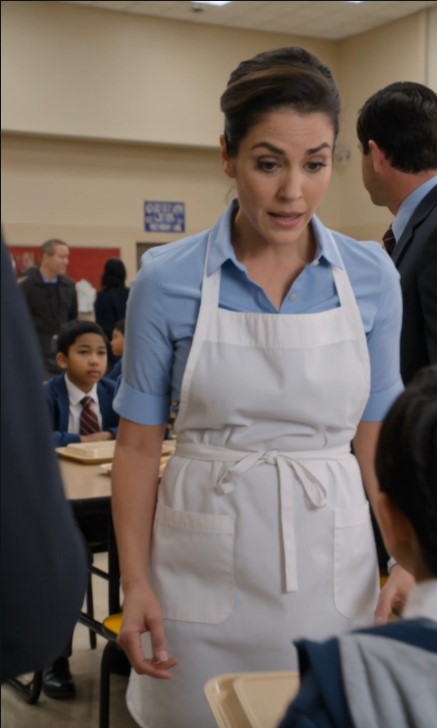
Everyone laughed when the new lunch lady refused to serve one little boy.
The cafeteria was loud that afternoon. Trays slid across the metal counter, children shouted over one another, and teachers tried to keep the lunch line moving before the next class arrived.
At the serving station stood Mrs. Elena Brooks, the new lunch lady.
It was only her third day at the school, and most students still did not know her name. To them, she was just the quiet woman in the apron who smiled gently, handed out food, and reminded children not to run.
But when one little boy reached the front of the line, she suddenly stopped.
His name was Noah.
He was small for his age, with dark circles under his eyes and a blue backpack hanging loosely from one shoulder. He held his lunch tray with both hands, staring down instead of looking at her.
Mrs. Brooks reached for a carton of milk.
Then she froze.
The tray was shaking.
At first, she thought the boy’s hands were trembling.
But they weren’t.
His fingers were still.
The tray itself was moving slightly from underneath.
Mrs. Brooks looked at Noah’s face.
He looked terrified.
Behind him, the line grew restless.
“Come on,” one student groaned.
“We’re hungry!”
A group of older boys laughed.
“Maybe she forgot how lunch works.”
The principal, standing near the cafeteria doors, hurried over with a tight smile.
“Mrs. Brooks,” she whispered, “please keep the line moving.”
But Mrs. Brooks did not move.
She kept her eyes on the tray.
“Noah,” she said softly, “did you put something under here?”
The little boy’s lips parted, but no words came out.
His eyes flicked toward the cafeteria entrance.
Then back to the tray.
Mrs. Brooks understood something was wrong.
She gently placed one hand on the edge of the tray.
“May I look?” she asked.
Noah gave the smallest nod.
The cafeteria was still buzzing with complaints when she lifted the tray.
Taped beneath it was a folded piece of paper.
For a moment, everyone nearby went quiet.
Mrs. Brooks peeled it away carefully and opened it.
Only four words were written inside.
“Don’t let me leave.”
Her hands started shaking.
The principal leaned closer.
“What is that?”
Mrs. Brooks turned the note toward her.
The principal’s face went pale.
Noah lowered his head, and a tear dropped onto the front of his shirt.
Mrs. Brooks stepped around the counter and gently placed herself between Noah and the cafeteria doors.
“Sweetheart,” she whispered, “who told you to leave?”
Noah’s voice was almost too quiet to hear.
“The man outside.”
The principal’s breath caught.
“What man?”
Noah swallowed hard.
“He said he was my uncle. He said Mom sent him. But I don’t have an uncle.”
The cafeteria changed instantly.
The laughter stopped.
The complaining stopped.
Even the children in the back of the line seemed to understand that something serious had happened.
The principal turned to a nearby teacher.
“Lock the side doors. Call the office. Now.”
Mrs. Brooks knelt in front of Noah, keeping her voice calm even though her heart was racing.
“You did the right thing,” she said. “You’re safe with me.”
Noah began to cry.
“He said if I told anyone, he’d be mad.”
Mrs. Brooks gently took his shaking hands.
“You don’t have to go anywhere.”
Seconds later, police were called to the school.
Teachers moved students away from the windows. The cafeteria doors were secured. The principal checked Noah’s emergency contact list and immediately called his mother.
When his mother answered, she had no idea anyone was coming to pick him up.
She had not sent an uncle.
She had not changed his dismissal plan.
She had been at work, believing her son was safe at school.
Minutes later, officers arrived and searched the parking lot. Near the far gate, they found a man standing beside a gray car, watching the school entrance. When questioned, his story changed again and again.
He said he was family.
Then a friend.
Then just waiting for someone.
But Noah’s mother confirmed she had never seen him before.
The officers took him away while the school remained locked down.
Inside the cafeteria, Noah sat beside Mrs. Brooks with a carton of milk untouched in front of him. His small hands were wrapped around the edges of his chair.
The principal stood nearby, shaken.
“I told you to hurry,” she said quietly.
Mrs. Brooks looked at the folded note on the table.
“You were doing your job,” she replied. “I was just listening to what his face was saying.”
Noah’s mother arrived soon after, running through the front office in tears. When she saw her son, she dropped to her knees and pulled him into her arms.
“I’m here,” she sobbed. “I’m here, baby.”
Noah clung to her tightly.
Then he looked back at Mrs. Brooks.
“She saw the note,” he whispered.
His mother turned to the lunch lady, unable to speak at first.
Then she reached for her hand.
“Thank you,” she said through tears. “You saved my son.”
Mrs. Brooks shook her head softly.
“No,” she said. “He saved himself. He was brave enough to ask for help.”
Later, the school learned what had happened.
That morning, Noah had noticed a man waiting near the fence. The man called him by name, probably after hearing another child say it. At recess, he told Noah that his mother had sent him and that he should come outside after lunch.
Noah knew something felt wrong.
But he was scared.
Too scared to tell a teacher directly.
So he took a scrap of paper from his classroom, wrote the only message he could think of, and taped it under his tray before entering the lunch line.
He hoped someone would notice.
Most people didn’t.
The children saw a slow lunch line.
The principal saw a delay.
The cafeteria saw a new employee causing trouble.
But Mrs. Brooks saw a shaking tray and a frightened boy.
And she stopped.
The next day, the school held an assembly about safety, trust, and speaking up when something feels wrong. The principal apologized to Mrs. Brooks in front of everyone.
“I thought she was slowing down lunch,” she said. “But she was protecting a child.”
The cafeteria erupted in applause.
Noah sat beside his mother in the front row, holding the folded note in his hand.
Mrs. Brooks did not look like someone who wanted attention. She simply smiled at him from the side of the room.
After that day, students learned her name.
They waved to her in the hallways.
They thanked her at lunch.
And Noah never passed her counter without whispering, “Hi, Mrs. Brooks.”
Sometimes heroes are not the loudest people in the room.
Sometimes they are the quiet ones behind the counter, watching carefully while everyone else rushes.
And sometimes, four tiny words hidden beneath a lunch tray are enough to stop a child from disappearing.