
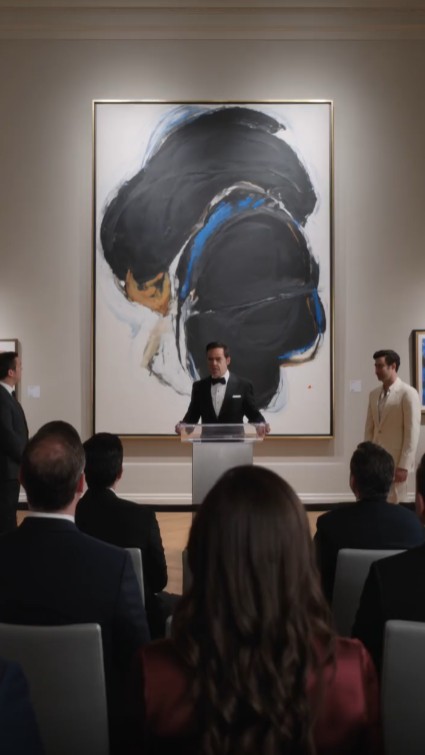
A woman interrupted a million-dollar art auction and shouted:
“STOP! THAT PAINTING IS MINE!”
The entire gallery fell silent.
The auctioneer’s hammer remained suspended above the podium.
Seconds earlier, bidding had climbed past one million dollars.
Now every face in the room had turned toward a woman standing near the back.
She wore a simple burgundy dress.
No expensive jewelry.
No security badge.
No famous name anyone recognized.
At the front of the gallery stood celebrated painter Adrian Vale.
The enormous canvas beside him was being presented as one of his most important early works.
Adrian looked furious.
“Who is this woman?”
The gallery owner hurried toward her.
“Ma’am, you cannot interrupt an auction.”
The woman did not move.
“My name is Clara Bennett.”
“That painting belongs to me.”
The owner lowered his voice.
“This artwork has documented provenance and is attributed to Mr. Vale.”
Clara pointed toward the bottom-right corner.
“Then ask him about the orange bird.”
Adrian’s expression changed.
Only slightly.
But Clara noticed.
So did the gallery owner.
Everyone looked at the painting.
At first, there seemed to be nothing unusual.
The canvas showed a sprawling city at dusk.
Dark rooftops.
Rain-soaked streets.
Windows glowing beneath a deep blue sky.
Then someone near the front whispered:
“There.”
Almost hidden beside the edge of a rooftop was a tiny orange bird.
No larger than a thumbnail.
The gallery owner looked toward Adrian.
“What does it mean?”
Adrian smiled.
But this time the confidence was gone.
“It’s decorative.”
Clara shook her head.
“No.”
The owner asked:
“Then what is it?”
Clara looked directly at Adrian.
“Tell them.”
He said nothing.
She stepped closer.
“The left wing has four brush marks.”
“The right has three.”
“There’s a tiny blue dot beneath the tail.”
“And underneath the orange layer is a line of green paint.”
The room became quieter.
The auctioneer looked toward the painting.
Those details were too specific to dismiss casually.
Adrian finally spoke.
“You could have studied photographs.”
Clara nodded.
“Not the green.”
The restoration report had never mentioned green beneath the orange bird.
It was invisible from the surface.
Clara continued.
“And I can tell you what’s under the tower too.”
She pointed toward a dark section near the center of the canvas.
“There’s another painting underneath.”
Adrian’s face drained of color.
“A kitchen table.”
“Two cups.”
“A yellow window.”
“And a woman sitting with her back turned.”
The gallery owner slowly looked toward Adrian.
“Is that true?”
Adrian did not answer.
Clara did.
“Because I painted it.”
Several people laughed nervously.
They thought she must be joking.
Then the auctioneer lowered his hammer.
The sale was suspended immediately.
Nobody was going to transfer a million-dollar artwork while the authorship was being publicly challenged.
Clara was escorted to a private room.
Not removed from the building.
The gallery wanted answers.
So did Adrian.
He entered ten minutes later with his attorney.
The atmosphere changed completely.
This was no longer a dramatic interruption.
It was now a provenance dispute.
And everyone understood how serious that could become.
The gallery director began carefully.
“Ms. Bennett, are you claiming legal ownership of the physical painting?”
Clara shook her head.
“That’s not exactly what I meant.”
The attorney leaned forward.
“You shouted that it was yours.”
“I meant the work.”
“The painting.”
“I created most of it.”
That distinction mattered.
Clara explained.
Twenty-six years earlier, she and Adrian had not been famous artists.
They were students sharing an industrial studio with several other painters.
Clara worked nights at a restaurant.
Adrian taught occasional drawing classes.
They had almost no money.
But they painted constantly.
Clara specialized in urban scenes.
Adrian painted large abstract figures.
Their styles were completely different.
Then an independent gallery announced a competition.
The winning artist would receive a solo exhibition.
Clara created a huge canvas.
The same dimensions as the painting now being auctioned.
She called it After the Rain.
Originally, it showed a kitchen interior.
Her mother sitting at a table.
Two cups.
A yellow window.
Clara hated it.
Not because the painting was bad.
Because it felt too private.
So she started painting over it.
She transformed the kitchen walls into buildings.
The window became the evening sky.
The table became a street.
Her mother’s figure disappeared beneath layers of paint.
Over several months, the city emerged.
And in the corner, she painted an orange bird.
The bird had a meaning.
Clara’s younger brother used to draw orange birds in school notebooks.
He died when they were teenagers.
Afterward, Clara hid one tiny orange bird in almost every major painting she completed.
Four brush marks on one wing.
Three on the other.
Seven feathers.
Her brother had been seven when he first drew the symbol.
The blue dot beneath the tail represented a mark he always added himself.
The green underlayer came from the green pencil he originally used before deciding birds “looked happier” in orange.
Nobody at the auction could have known that from the painting alone.
The gallery director asked:
“How does Adrian enter the story?”
Clara looked across the table.
Adrian stared down.
She continued.
When Clara finished After the Rain, she submitted photographs to the competition.
Then her life changed suddenly.
Her mother suffered a serious stroke.
Clara left the city to help care for her.
She expected to be gone for several weeks.
She stayed nearly a year.
The shared studio closed during that time.
Artists removed their belongings.
Clara arranged for Adrian to store several canvases temporarily.
Including After the Rain.
She trusted him.
They were friends.
More than friends for a short time, although that relationship had already ended.
Months later, Adrian told Clara that the studio had suffered serious water damage.
Several stored works, he said, were destroyed.
Including hers.
Clara was devastated.
But she had bigger problems.
Her mother needed care.
Clara was exhausted.
She accepted Adrian’s explanation.
Eventually she stopped painting professionally.
Not completely.
But enough that the art world moved on without her.
Adrian’s career went in the opposite direction.
Within a few years, his work began appearing in major galleries.
Then museums.
Then international auctions.
Clara occasionally saw photographs of his work.
She never saw After the Rain.
Until three weeks before the auction.
A colleague sent her an article.
The painting appeared under a different title:
City After Midnight.
Artist:
Adrian Vale.
Clara stared at the image.
At first, she thought she was mistaken.
The colors had changed.
Sections had been reworked.
Figures had been added.
The canvas looked more dramatic.
More polished.
But beneath everything was her city.
Then she saw the orange bird.
Same position.
Same shape.
Same tiny blue dot.
Clara contacted the auction house privately.
She said she had evidence the attribution was wrong.
The gallery asked for documentation.
Clara provided old photographs, but the images were low resolution.
The gallery’s initial staff could not immediately establish that the canvas was the same object.
With the sale approaching, Clara became afraid the painting would disappear into a private collection before a full review.
So she came to the auction.
The gallery director turned toward Adrian.
“Is any of this true?”
His attorney responded.
“My client will not answer unsupported accusations.”
Clara nodded.
“Then test the painting.”
That was exactly what the gallery did.
The auction remained suspended.
Independent conservators were brought in.
They used non-invasive imaging techniques first.
Infrared examination.
X-ray imaging.
Pigment analysis.
The results did not prove ownership by themselves.
But they revealed something extraordinary.
Beneath City After Midnight was another composition.
A table.
Two cup-like forms.
A bright rectangular window.
And the outline of a seated figure.
Exactly as Clara had described.
Then conservators examined the orange bird.
The visible orange layer covered green pigment.
Four distinct original strokes formed one wing.
Three formed the other.
And beneath the tail was a tiny blue mark.
Clara had described all of it before seeing any technical scan.
The gallery began reviewing Adrian’s records.
According to the catalogue, City After Midnight had been created twenty-four years earlier.
Adrian claimed it was entirely his.
But documentation from the first years was surprisingly weak.
There were no early photographs of him painting it.
No preparatory drawings.
No dated studio notes.
Its first confirmed public appearance came several years after Clara said her painting disappeared.
Then Clara produced a box.
She had kept it in storage for decades.
Inside were photographs from her old studio.
Most were ordinary snapshots.
Friends.
Paint-covered floors.
Half-finished canvases.
Then one image changed everything.
Clara stood beside a large city painting.
The date printed on the back was nearly two years before Adrian’s claimed creation date.
The composition was not identical to the auction painting.
But the central architecture was unmistakable.
The same rooftop line.
The same angled street.
The same tower.
And in the corner:
An orange bird.
The gallery director looked at Adrian.
“Explain this.”
Adrian finally spoke.
“She started it.”
Clara went still.
The attorney whispered something to him.
Adrian ignored him.
“She painted the original city.”
The room fell silent again.
Then Adrian added:
“But the painting sold today isn’t the painting she left.”
That became the central issue.
Adrian admitted Clara created the underlying composition.
But he claimed that when she left, the painting was unfinished.
Later, believing she had abandoned it, he heavily reworked the canvas.
He changed large sections.
Added figures.
Changed color relationships.
Repainted the sky.
Altered buildings.
Removed entire areas.
By his account, City After Midnight had become a collaborative or transformed work rather than simply Clara’s painting.
Clara stared at him.
“You told me it was destroyed.”
Adrian looked away.
That was the part he could not explain away.
If he genuinely believed the work was abandoned, why lie about its destruction?
The investigation expanded.
Old correspondence was recovered from email backups and paper archives.
One message from Adrian to a former studio manager was particularly important.
Clara may come back for the city canvas. Keep it separate for now.
Another, months later:
I’m working over Clara’s large piece. Don’t mention it until I know whether it works.
There was no evidence Clara had transferred ownership or authorship rights to Adrian.
Then came a third message.
This one ended the argument over whether he knew exactly whose work it had been.
She’ll recognize the bird if I leave it.
The orange bird.
Adrian had known.
And he left it anyway.
The gallery director asked him why.
Adrian answered quietly:
“I thought I’d paint it out later.”
“But I couldn’t.”
“Why?”
Adrian looked toward Clara.
“Because it was the best part.”
For the first time since entering the auction room, Clara had no response.
Adrian explained.
When he began reworking the painting, he planned to cover everything.
But every time he reached the orange bird, he stopped.
He liked it.
Then he became attached to it.
Eventually, it became part of the finished work.
As his career grew, admitting where the canvas started became harder.
One lie required another.
The catalogue changed.
Dates became vague.
Then confident.
Eventually the painting was presented as an important Adrian Vale work.
And after enough years, almost nobody questioned it.
Except Clara.
The auction house withdrew the painting from sale.
Immediately.
Not because Clara’s public accusation alone proved everything.
Because there was now significant evidence the published attribution was incomplete or misleading.
Experts spent months studying the canvas.
The final conclusion was complicated.
This was not a simple case where Adrian had taken a finished Clara Bennett painting and merely signed his name.
Technical analysis showed extensive later work.
Large areas had indeed been altered by another hand consistent with Adrian’s documented technique.
But the underlying composition, much of the architectural structure, and several visible sections originated with Clara.
The orange bird was hers.
The fundamental city design was hers.
The painting had become physically layered with contributions from both artists.
The problem was not only who had painted which percentage.
The problem was that Clara’s contribution had been deliberately concealed.
The gallery corrected its records.
The artwork was no longer catalogued solely as:
Adrian Vale, City After Midnight.
Instead, after legal and scholarly review, it was identified as a work originating with Clara Bennett and later substantially reworked by Adrian Vale, with exact attribution language reflecting the evidence and settlement between the parties.
The million-dollar sale was canceled.
The painting’s owner, who had consigned it to auction, had purchased it years earlier in good faith.
That complicated the question of physical ownership.
Clara did not simply walk out carrying the canvas.
Lawyers reviewed purchase history, studio records, ownership transfers, and applicable limitations.
Eventually, the parties reached a confidential settlement.
But Clara insisted on one public condition.
Her name had to remain attached to the painting’s history permanently.
Not in tiny print.
Not buried in a technical report.
Clearly.
Adrian agreed.
His reputation suffered.
Several institutions began reviewing early works with weak provenance.
That did not mean every Adrian Vale painting was suddenly considered fraudulent.
The investigation remained focused on evidence.
Some works had strong documentation.
Others required additional study.
Clara resisted dramatic claims.
“He did work on the painting.”
She said that repeatedly.
“What he did wrong was pretend I never had.”
That distinction mattered to her.
Months after the auction, the painting was displayed again.
Not for sale.
For a museum exhibition about attribution, restoration, and the hidden lives of artworks.
The exhibition included imaging showing the original kitchen scene beneath the city.
Visitors could see the yellow window.
The table.
The two cups.
The faint outline of Clara’s mother.
Then the layers above it.
The city.
Adrian’s later alterations.
And finally, the tiny orange bird.
Clara attended the opening.
Someone asked why she had painted over the portrait of her mother in the first place.
She smiled.
“Because I was twenty-six and convinced everything I made was terrible.”
The audience laughed.
Her mother had never been angry about it.
In fact, when Clara showed her the city painting years earlier, her mother said:
“I’m still in there.”
She had meant it metaphorically.
Decades later, imaging proved she was literally right.
Someone else asked Clara whether she hated Adrian.
She thought carefully.
“No.”
That answer surprised people.
She did not excuse what he had done.
She did not forgive him simply because time had passed.
But hatred was not what she wanted the rest of her life organized around.
What mattered was that the record was corrected.
Her work existed.
Her name existed.
And history would no longer pretend otherwise.
The museum eventually acquired detailed documentation about the painting’s creation.
Clara donated her studio photographs.
Not the originals.
Copies.
She kept the originals at home.
One picture showed the canvas before Adrian touched it.
A simpler city.
Less polished.
Less dramatic.
But unmistakably hers.
And there in the corner sat the orange bird.
Years later, a student asked Clara why she had not removed the little symbol from her work after her brother died.
“Wouldn’t it make you sad?”
Clara smiled.
“It did.”
“Then why keep painting it?”
She looked toward the massive canvas.
“Because being sad someone is gone and being glad they existed can happen at the same time.”
The student wrote that down.
Clara laughed.
“Don’t make that sound wiser than it is.”
The orange bird became the detail everyone remembered.
But Clara often reminded people that the bird did not prove everything.
One symbol could be copied.
Memory could be wrong.
People could make claims.
That was why the investigation mattered.
The old photographs.
Pigment layers.
Underlying composition.
Archived messages.
Studio records.
Technical examination.
Evidence turned an accusation into a documented history.
The auction had begun with a painting presented as the masterpiece of one celebrated man.
It ended with a much more complicated truth.
Two artists had touched the canvas.
One became famous.
The other disappeared from its story.
And for more than twenty years, the only visible witness to where that story began was a tiny orange bird Adrian could never bring himself to paint over.