
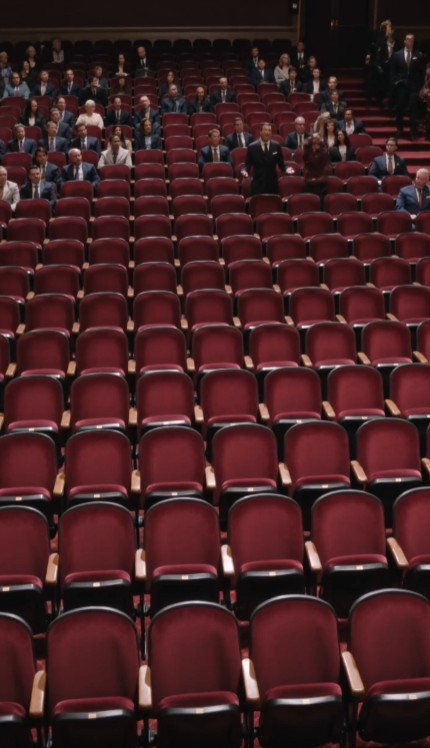
A woman bought forty tickets to a sold-out concert.
Then left almost every seat empty.
The theater manager could not understand it.
The first two rows should have been filled with some of the most sought-after guests of the evening.
Instead, thirty-nine beautiful red seats stood vacant.
The rest of the theater was packed.
People had called for weeks trying to find tickets.
Some had offered to pay double.
Others had joined cancellation lists.
Yet two of the best rows in the entire building sat almost completely empty.
The manager, Jonathan, looked toward one of the ushers.
“Who bought all these seats?”
The usher pointed toward the end of the front row.
An elderly woman sat there alone.
She wore a simple blue dress.
A small handbag rested beside her.
And in her lap was a bundle of unused tickets tied together with a white ribbon.
Jonathan approached.
“Excuse me, ma’am.”
The woman looked up.
“My name is Jonathan. I manage the theater.”
She smiled politely.
“Eleanor.”
“Ms. Eleanor, did you purchase these seats?”
She nodded.
“All forty.”
Jonathan glanced at the empty rows.
“Then where are your guests?”
Eleanor looked toward the stage.
For several seconds, she said nothing.
Then she whispered:
“They were supposed to be here.”
Jonathan immediately softened.
He assumed something terrible had happened.
“Is everything all right?”
Eleanor ran one hand over the bundle of tickets.
“Not exactly.”
Before he could ask another question, the lights dimmed.
The audience applauded.
The orchestra began taking its places.
Jonathan quietly stepped aside.
Then the evening’s featured violinist walked onto the stage.
Her name was Clara Bennett.
Twenty-eight years old.
Already considered one of the most promising young classical musicians in the country.
It was the most important concert of her career.
Her first major hometown performance after years of studying and performing abroad.
The audience stood.
Clara smiled.
Then she looked toward the first row.
Her expression changed.
She saw the empty seats.
Then Eleanor.
Clara stopped walking.
The applause slowly faded.
Her eyes filled with tears.
“You kept your promise.”
Eleanor stood.
Jonathan looked between them.
“What promise?”
Clara lowered her violin.
Eleanor looked at the thirty-nine empty chairs.
Then at the audience.
And finally began to explain.
Twenty years earlier, those seats had not been red.
The theater itself had barely survived.
It was an aging community hall then.
Leaking roof.
Worn carpet.
Old wooden seats.
A heating system that failed every winter.
The city had considered closing it.
But every Saturday morning, a group of children came through the side entrance carrying cheap instruments.
Violins.
Cellos.
Flutes.
Clarinets.
Most of them were beginners.
Some could barely make a recognizable sound.
They belonged to a small community music program called the Saturday Forty.
There were exactly forty students in the original group.
Clara had been one of them.
She was eight years old.
Her mother worked two jobs.
Her father was no longer in their lives.
There was no money for private music lessons.
The violin Clara carried to class had been donated.
It was slightly too large.
Its case had a broken handle repaired with tape.
Eleanor was not the music teacher.
She was the program administrator.
Which sounded much more impressive than the job really was.
She unlocked doors.
Made tea.
Photocopied music.
Called parents.
Found missing bows.
Repaired music stands with tape.
And, more importantly, somehow found money whenever the program was about to collapse.
The actual instructor was a man named Samuel Reed.
Samuel believed music education should not depend on whether a child’s parents could afford it.
So the Saturday Forty charged almost nothing.
Families contributed when they could.
Some paid five dollars.
Some paid nothing.
Nobody was removed because money was tight.
Samuel taught.
Eleanor kept everything else functioning.
For Clara, Saturday mornings became the most important part of the week.
At first, she was not particularly talented.
That detail mattered to Eleanor.
People later liked to tell the story as though everyone knew immediately that Clara was destined for greatness.
They did not.
Her first months were terrible.
She rushed.
She squeezed the bow too hard.
She hated scales.
She once announced that she was quitting because another girl could play a song faster than she could.
Samuel listened.
Then asked:
“Do you want to play faster than her?”
Clara nodded.
“Or do you want to play beautifully?”
Clara thought.
“Both.”
Samuel laughed.
“Good. Then come back Saturday.”
She did.
Year after year.
The forty children changed too.
Some left.
Others joined.
The name Saturday Forty remained even when there were thirty-seven students one year and forty-three the next.
It became less a number than an identity.
But the original group stayed unusually close.
There was Marcus on cello.
Nina on flute.
Brothers Peter and Andrew on trumpet.
Sofia on violin.
Leo on clarinet.
And Clara.
They grew up together inside that old hall.
They played terrible first concerts.
Then slightly less terrible ones.
Their parents brought cakes.
Samuel complained when people talked during performances.
Eleanor sat in the front row every time.
Then came the year the program almost ended.
A major donor withdrew.
The building needed repairs.
Insurance costs increased.
Samuel called a meeting.
The children were told the program might close after Christmas.
Clara was fourteen.
She cried all the way home.
The next Saturday, Eleanor arrived carrying a cardboard box.
Inside were forty envelopes.
She placed one on every music stand.
Each envelope contained a small card.
On the front, Eleanor had written:
ONE DAY.
Inside:
One day, one of you may perform on a stage bigger than this.
When that happens, remember the people who sat beside you before anyone bought a ticket to hear you.
The students laughed at the dramatic message.
Samuel teased Eleanor for being sentimental.
But then she made them a promise.
“If one of you ever performs the main concert in this theater, I will buy the first forty seats.”
Samuel asked:
“With what money?”
Eleanor answered:
“I’ll figure it out.”
The children loved the idea.
Someone asked:
“Even if the tickets cost a hundred dollars?”
Eleanor replied:
“Then you better become famous slowly.”
Everyone laughed.
Nobody took the promise very seriously.
At least not then.
The program survived.
Local businesses contributed.
Parents organized fundraisers.
The city provided temporary support.
Eventually, a charitable foundation helped stabilize it.
But life moved on.
The original forty grew up.
Most did not become professional musicians.
Marcus became an accountant.
Nina became a nurse.
Peter moved overseas.
Sofia became a teacher.
Some stopped playing completely.
Others still played for pleasure.
One student died young after an illness.
Another disappeared from contact.
Samuel retired.
Then, several years later, he died too.
But Clara continued.
Scholarships took her to conservatory.
Then another country.
Then orchestras.
Competitions.
Recitals.
Her career developed slowly.
Exactly as Eleanor had jokingly requested.
And eventually the announcement arrived.
Clara Bennett would return to perform as the featured soloist in the rebuilt theater where she had first played as a child.
Eleanor was eighty-one when she saw the poster.
She stood outside the theater for nearly five minutes staring at it.
Then walked directly to the box office.
“I need forty tickets.”
The employee laughed at first.
Eleanor did not.
“I’m serious.”
The tickets were expensive.
Much more expensive than Eleanor had imagined twenty years earlier.
She had been putting aside a little money for years.
Not specifically because she expected Clara to become famous.
But because she remembered the promise.
Forty seats.
The first two rows.
She bought them the morning sales opened.
Then she began searching for the original students.
That was the part nobody in the theater knew.
The seats were never intended to remain empty.
Eleanor had planned a reunion.
She wanted Clara to walk onto the stage and see the people who had learned beside her.
The Saturday Forty.
But bringing them together proved far harder than buying the tickets.
Some lived thousands of miles away.
One was caring for a sick spouse.
Another had surgery scheduled.
Several could not afford travel.
Eleanor offered to help, but not everyone could come.
Some addresses no longer worked.
One former student had died.
Then, three weeks before the concert, another tragedy came.
Marcus, the former cellist and unofficial organizer of the reunion, suffered a serious medical emergency.
He survived.
But he could not travel.
Several former students who had planned to come decided to visit him instead.
The reunion began falling apart.
Eleanor considered returning the tickets.
The theater had a long waiting list.
Every empty seat could have been resold immediately.
But then Marcus called her.
“Don’t give them back.”
“Why?”
“Because you promised forty.”
“But you won’t be there.”
“That doesn’t mean we weren’t.”
Eleanor became quiet.
Marcus reminded her what the seats represented.
Not forty people physically attending one concert.
Forty children who had once occupied the same room before anyone knew what their lives would become.
Still, Eleanor was uncomfortable.
She did not want to waste seats simply for symbolism.
So she contacted the theater.
That was where the story became more practical.
Eleanor did not secretly prevent forty fans from attending while leaving valuable seats empty.
She explained the situation to the box office several days before the concert.
The theater agreed to release most of the seats again if needed.
But a sponsor had already arranged standing and alternate seating for people on the cancellation list, and the production team decided to preserve the first two rows as part of a planned acknowledgment of the music program.
Some tickets were reassigned elsewhere in the hall.
Others remained intentionally empty.
By concert night, thirty-nine seats around Eleanor were vacant.
On each one rested a small white card.
The cards were difficult to see from the stage.
Jonathan had not been told the full story.
He leaned toward the nearest empty chair.
Then finally noticed what was written on it.
MARCUS — CELLO.
The next:
NINA — FLUTE.
Then:
SOFIA — VIOLIN.
Each empty seat represented one of the original students.
Some were still alive.
Some could not attend.
A few were gone forever.
And one card simply read:
SAMUEL REED — TEACHER.
Jonathan swallowed.
Now he understood.
Clara did too.
She had known Eleanor planned to attend.
But she had no idea about the seats.
From the stage, she looked across the names.
People she had not thought about in years.
Children she remembered as twelve or thirteen, now adults scattered across different lives.
Then she saw Samuel’s name.
She covered her mouth.
Eleanor held up the old bundle tied with the white ribbon.
They were not just unused concert tickets.
Inside the bundle were copies of the forty cards Eleanor had placed on their music stands twenty years earlier.
ONE DAY.
Clara looked toward her.
“You kept them?”
Eleanor nodded.
“I keep too many things.”
The audience laughed softly.
Clara wiped her eyes.
Then said:
“I think I know what I’m playing first.”
The program originally called for a difficult concerto.
Instead, before beginning it, Clara asked permission to play one short piece alone.
The conductor nodded.
Clara lifted her violin.
And played the first ensemble melody Samuel had ever taught the Saturday Forty.
It was simple.
Almost childlike.
Several people in the audience did not understand its significance.
Eleanor did.
She closed her eyes.
For a few minutes, the expensive theater disappeared.
She heard forty children again.
Wrong notes.
Squeaking bows.
Samuel counting too loudly.
Someone dropping sheet music.
Clara rushing the tempo.
All of it.
When the piece ended, Eleanor was crying.
So was Clara.
Then the actual concert began.
Clara played brilliantly.
But afterward, when journalists asked which part of the night had mattered most, she did not mention the standing ovation.
She talked about the empty chairs.
“People see an empty seat and think nobody is there,” she said.
“But sometimes an empty seat is full of history.”
After the concert, Clara came into the audience.
She hugged Eleanor.
Then began reading every name.
Marcus appeared by video call from his home.
When Clara saw him on Eleanor’s phone, she laughed.
“You still play?”
Marcus answered:
“Only when everyone else has left the house.”
Nina joined another call from a hospital break room.
Sofia sent a photograph of the old violin she still owned.
One by one, the scattered Saturday Forty became part of the evening after all.
Not physically.
But honestly.
There was no magical reunion where all forty suddenly emerged from backstage.
No secret fortune.
No dramatic inheritance.
Life had taken them in too many directions for that.
Some promises survive differently than we imagine.
The next year, Clara helped establish a scholarship fund for the community music program.
She did not name it after herself.
She asked Eleanor what it should be called.
Eleanor answered immediately.
“The Forty.”
The fund paid for lessons, instrument repairs, transportation, and concert tickets for children whose families needed help.
The theater contributed too.
One condition was added.
Every year, a block of seats would be reserved for current students in the community program.
Not left empty.
Filled.
Eleanor preferred that.
She told Clara:
“The old seats made their point.”
“Now let children sit in them.”
Several years later, Eleanor attended another Clara Bennett concert.
She walked toward the front row.
This time, forty seats were full.
Children whispered.
Moved around.
Dropped programs.
One boy complained that the concert was too long.
Eleanor smiled.
It reminded her of the old days.
A girl holding a borrowed violin case recognized Clara’s name in the program.
She leaned toward Eleanor.
“Do you know her?”
Eleanor looked toward the stage.
“A little.”
The girl asked:
“Was she always that good?”
Eleanor laughed.
“Absolutely not.”
Then the lights dimmed.
Clara walked onto the stage.
Before lifting her violin, she looked toward the first two rows.
Forty young musicians.
Every seat occupied.
Near the aisle sat Eleanor.
Still wearing blue.
Clara smiled.
Eleanor raised one hand.
No dramatic speech.
None was necessary.
Twenty years earlier, she had promised forty children that if one of them ever reached that stage, she would buy forty seats.
When the night finally arrived, life prevented most of them from coming.
So the empty chairs became a record of where Clara had started.
Not a tribute to fame.
A reminder that nobody reaches an important stage entirely alone.
Behind one violinist stood teachers.
Friends.
Classmates.
Parents.
Donors.
People who repaired cheap instruments.
People who unlocked rehearsal rooms.
People who stayed after everyone else had gone home.
The theater manager had first looked at those empty red seats and seen a waste.
By the end of the evening, he understood why Eleanor had looked at them differently.
Thirty-nine chairs were empty.
But none of them represented nobody.