
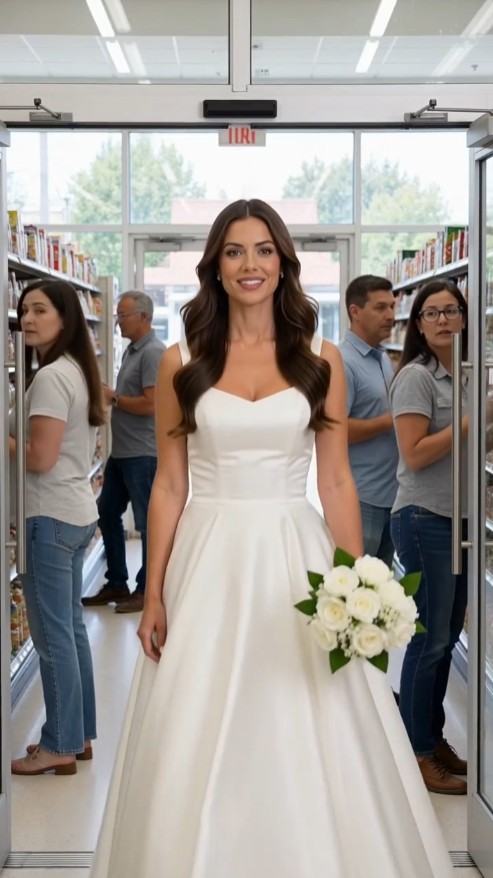
A bride walked into a supermarket wearing her wedding dress.
Customers stopped shopping.
The cashier looked up.
Then suddenly covered her mouth.
“Emily?”
Standing near the entrance was her daughter.
White dress.
Bouquet in hand.
Hair carefully pinned.
Ready to get married.
But instead of going straight to the ceremony, Emily had come to the supermarket.
Her mother, Maria, had worked there for almost twenty years.
Early mornings.
Late evenings.
Holiday shifts.
Extra weekends.
All so her daughter could have opportunities she herself never had.
Emily walked slowly toward the checkout lane.
Maria stared at her.
“What are you doing here?”
Emily smiled.
“Coming to get you.”
Maria looked down at her uniform.
Then toward the line of customers waiting nearby.
“Sweetheart, I’m still working.”
“I know.”
“You should be at the venue.”
“I will be.”
Maria shook her head.
“Your ceremony starts soon.”
Emily’s voice softened.
“I couldn’t start it without you.”
For a moment, Maria said nothing.
Then the groom stepped forward from behind Emily.
His name was Daniel.
He was carrying a small white box.
He opened it.
Inside was a simple flower corsage.
Daniel handed it to Emily.
Emily gently placed it around her mother’s wrist.
Maria stared at the flowers.
“What is this?”
Emily looked at her.
“For every time you had to miss something because you were working.”
Maria’s face changed.
The customers around them became quiet.
Emily had grown up knowing exactly what her mother’s schedule meant.
When she was seven, Maria missed a school music performance because another employee called out sick.
When she was ten, Maria arrived late to a parent-teacher evening still wearing her supermarket uniform.
At thirteen, Emily won an academic award.
Maria watched the recording after finishing a closing shift.
Every time, Maria apologized.
And every time, Emily told her it was fine.
As a child, sometimes she meant it.
Sometimes she did not.
She remembered sitting in school auditoriums watching other parents wave from the audience.
She remembered scanning the doorway.
Hoping.
Waiting.
Then telling herself:
Mom has to work.
What Emily did not understand then was what Maria was sacrificing.
Maria raised her alone for most of her childhood.
Emily’s father was present only inconsistently.
Bills did not care whether there was a school concert.
Rent did not wait for birthdays.
Food had to be bought.
Uniforms.
Books.
Transportation.
When Emily needed braces, Maria took extra shifts.
When Emily wanted to attend a summer science program, Maria worked Sundays for months.
Emily never knew that part until years later.
She only knew her mother was always tired.
But somehow there was food on the table.
Birthday cake every year.
Clean clothes.
Enough money for school trips.
Not much extra.
Enough.
Maria had once dreamed of becoming a nurse.
Then Emily was born.
Life became more complicated.
The nursing program was postponed.
Then postponed again.
Eventually, the supermarket job that was supposed to be temporary became permanent.
Maria never complained about that to Emily.
Not directly.
She would joke:
“Twenty years and I still don’t know why people leave frozen food beside the cereal.”
Emily laughed.
But she also noticed things.
Maria knew customers by name.
She remembered which elderly man needed help packing heavy bags.
She kept spare coins in her pocket for children short on lunch money.
She knew when someone had lost a spouse.
When someone had a baby.
When someone was struggling.
The supermarket was not the life Maria had imagined.
But she had made a life inside it anyway.
That was why Emily came.
Not to embarrass her.
Not to create a public spectacle.
Because she wanted the happiest day of her life to include the place that had quietly helped make that life possible.
Maria whispered:
“I can’t just leave.”
Then a voice came from behind her.
“Yes, you can.”
The store manager was standing near the customer service desk.
Maria turned.
“Thomas?”
He smiled.
“Your shift is covered.”
Maria stared.
“What?”
“We planned this.”
Emily looked guilty.
“For about three weeks.”
Maria looked from Emily to the manager.
“You knew?”
Thomas nodded.
“Everyone knew except you.”
Maria shook her head.
“That explains why nobody could look me in the eye this morning.”
One of her coworkers laughed.
Maria started crying.
She tried to stop.
That only made it worse.
Emily stepped closer.
“Mom.”
Maria wiped her face.
“My makeup.”
“You’re not wearing any.”
“That is not the point.”
Everyone laughed.
Then Emily took her mother’s hands.
“I need to tell you something.”
Maria looked at her.
Emily’s voice trembled.
“You spent my whole life showing up for me.”
Maria immediately shook her head.
“No.”
“Yes.”
“I missed half your school events.”
“That’s not what showing up means.”
Maria went quiet.
Emily continued.
“You showed up every morning.”
“When I was sick.”
“When I was scared.”
“When I needed money for school.”
“When I didn’t know what I was doing.”
“You came home exhausted and still helped me study.”
“You packed lunches.”
“You worked birthdays.”
“You worked holidays.”
“You kept everything going.”
Maria’s eyes filled again.
Emily smiled through tears.
“So today I came to show up for you.”
That was when Maria hugged her.
Not a careful wedding-dress hug.
A real one.
Emily almost dropped the bouquet.
Daniel caught it.
Customers started applauding.
One woman near the produce aisle was openly crying.
A little boy asked his father why everyone was clapping.
His father whispered:
“Because that’s her mom.”
The boy seemed to accept this as a complete explanation.
Maria’s coworkers gathered nearby.
One had brought a garment bag.
Inside was the dress Maria planned to wear to the wedding.
Another employee had brought shoes.
Someone else had packed a small makeup bag.
Maria stared.
“You moved my clothes here?”
Emily nodded.
“We didn’t trust you to actually leave work on time.”
“That is offensive.”
“It is also accurate.”
Maria could not argue.
The store’s tiny staff room became a dressing room.
Emily waited outside while her mother changed.
Daniel checked the time.
They still had plenty.
This had been planned carefully.
No bride was actually about to miss her ceremony.
No supermarket was being abandoned without staff.
The emotional moment was real.
But so was the organization behind it.
When Maria emerged, the store went quiet again.
Her uniform was gone.
She wore a navy dress.
The white corsage remained on her wrist.
Emily smiled.
“There she is.”
Maria looked down.
“I feel strange.”
“Good strange?”
“I’ve been standing behind that register since six this morning.”
“Very glamorous.”
Maria laughed.
Then one of her coworkers handed her a small envelope.
“What’s this?”
“Open it later.”
Maria frowned.
Everyone insisted.
So she opened it immediately.
Inside were short handwritten messages from coworkers.
Some had known Maria for years.
Others only months.
One read:
Thank you for training me without ever making me feel stupid.
Another:
You covered my shift when my son was sick. I never forgot.
Another:
You taught me how to survive Saturday mornings.
Maria laughed through tears.
Then she reached the final card.
It was from Thomas, the manager.
You spent years putting everyone else first. Today you are officially banned from working overtime.
Maria looked at him.
“Is that legally binding?”
“Absolutely.”
“It isn’t.”
“Please don’t ruin the moment.”
The supermarket doors opened.
A small wedding car waited outside.
But before Maria left, Emily asked for one photograph.
Not at the wedding venue.
Right there.
Checkout Lane 4.
Maria stood beside the register.
Emily in her wedding dress.
Daniel beside them.
Maria’s coworkers behind.
The photograph looked almost ridiculous.
Price displays.
Shopping baskets.
A rack of chewing gum.
And a bride holding flowers.
It became Emily’s favorite picture from the entire wedding.
Not the formal portraits.
Not the first dance.
That one.
Because the supermarket had been in the background of their family story for almost twenty years.
When Emily was little, she sometimes sat in the employee break room after school for twenty minutes before Maria’s shift ended.
She did homework at a plastic table.
She knew which vending machine stole coins.
She knew the names of half the cashiers.
She knew the smell of the bakery at closing time.
Maria hated that Emily had spent so much time there.
Emily no longer did.
It was part of their history.
The wedding ceremony began that afternoon exactly on schedule.
Maria sat in the front row.
Not arriving late.
Not checking the clock.
Not wearing a name badge.
When Emily entered, she immediately looked toward her mother.
Maria was already crying.
During the reception, Daniel gave a short speech.
He thanked family.
Friends.
Then he looked toward Maria.
“I thought I was marrying one strong woman.”
He smiled.
“Then I met the woman who raised her.”
Maria covered her face.
Emily laughed.
Later, Maria and Emily danced together.
No grand choreographed performance.
Just mother and daughter.
Maria whispered:
“You know I don’t regret working.”
Emily nodded.
“I know.”
“I regret missing things.”
“I know that too.”
Maria looked at her.
“You really waited all these years to tell me?”
Emily smiled.
“I was busy.”
“With what?”
“Getting married.”
Maria laughed.
Then Emily said something she had wanted her mother to hear for a long time.
“I never measured your love by how many school chairs you sat in.”
Maria stopped dancing for a second.
Emily continued.
“I measured it by everything you did when nobody was watching.”
Maria hugged her again.
Years later, the supermarket photograph remained framed in Emily’s house.
Eventually, her own daughter asked about it.
“Why are you wearing your wedding dress in a grocery store?”
Emily laughed.
Then told her the story.
About Grandma Maria.
About the years behind a checkout counter.
About sacrifices children do not always understand until they become adults.
She did not tell her daughter that Maria had been a perfect mother.
She wasn’t.
No parent is.
Maria had missed things.
She got tired.
Sometimes impatient.
Sometimes she worried so much it became frustrating.
But she stayed.
Worked.
Loved.
And kept going.
The story was never really about a bride walking into a supermarket.
It was about recognizing that some of the biggest acts of love happen in ordinary places.
Under fluorescent lights.
Behind cash registers.
During early shifts.
Inside packed lunches.
In worn-out shoes at the end of a twelve-hour day.
Maria once thought the moments she missed were proof she had failed her daughter.
Emily saw them differently.
Every shift Maria worked had been part of building the life that eventually carried Emily toward that wedding day.
That was why Emily refused to begin it without her.
So before the music.
Before the aisle.
Before the vows.
A bride walked through the automatic doors of an ordinary supermarket.
She found her mother behind the register.
Placed a white flower on her wrist.
And finally told her:
“You spent your whole life showing up for me.”
“Today, I came to show up for you.”