
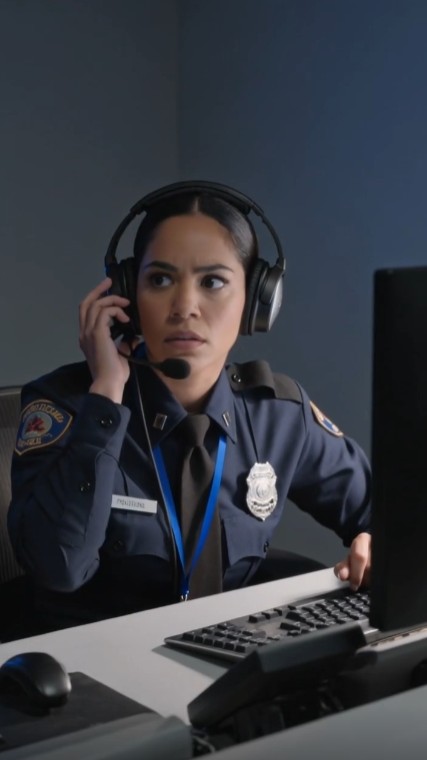
A 911 dispatcher listened to a recorded call.
And heard her own voice.
There was only one problem.
She had never made the call.
Her name was Mia Carter.
She had worked in emergency communications for nearly nine years.
She knew her own voice better than most people ever would.
Her accent.
Her pauses.
The way she pronounced street numbers.
The slight breath she took before repeating important information.
So when she heard the recording, she froze.
“This is Mia. Cancel the request. Unit no longer needed.”
Mia replayed it.
Once.
Twice.
Then a third time.
Same voice.
Her voice.
Or something frighteningly close to it.
She immediately called her supervisor.
“Thomas, I need you to hear something.”
Thomas came to her workstation.
Mia played the recording.
He listened.
Then looked at her.
“That’s you.”
“No.”
“Mia—”
“I never said that.”
Thomas frowned.
He checked the timestamp.
11:42 p.m. Tuesday.
Then he opened the staffing records.
His expression changed.
Mia had not been working Tuesday night.
She had been nearly forty miles away at her sister’s house.
Thomas replayed the audio.
“This makes no sense.”
Mia leaned closer.
“What request did it cancel?”
Thomas opened the incident history.
That was when the situation became much more serious.
The message had been connected to a welfare check.
An elderly woman named Evelyn Porter lived alone in a small house on Meadow Lane.
Her neighbor had called after noticing Evelyn’s front door standing partly open late at night.
The neighbor said the lights were on.
Evelyn was not answering her phone.
A patrol unit had been assigned.
Seven minutes later, the cancellation message arrived.
“This is Mia. Cancel the request. Unit no longer needed.”
The patrol officer was redirected to another call.
No one went to Evelyn’s house.
Mia stared at the screen.
“Who canceled it in the system?”
Thomas checked.
The system showed Mia’s dispatcher identification number.
Her credentials.
Her workstation profile.
Everything appeared legitimate.
Except Mia had not been there.
Thomas immediately locked the account.
Then called the communications director.
This was no longer a strange recording.
Someone had apparently used Mia’s identity to interfere with an emergency response.
The department’s technical team began reviewing access logs.
At first, investigators suspected stolen credentials.
Maybe Mia had accidentally exposed her password.
Maybe someone had logged into the dispatch system remotely.
But that theory quickly developed problems.
The login associated with the cancellation had originated from inside the communications building.
Not from an outside connection.
Mia felt sick.
“Someone here?”
Thomas shook his head.
“Maybe.”
“We don’t know yet.”
Security footage was reviewed.
At 11:42 p.m., only authorized night staff were visible in the dispatch center.
Nobody sat at Mia’s usual workstation.
Then a technician found something stranger.
The cancellation had not actually been entered through Mia’s physical console.
It came through an older internal interface used for system testing and backup operations.
Very few employees even knew it existed.
Thomas looked at the access history.
“How many people can use this?”
“Six.”
Mia asked:
“Who?”
The technician refused to speculate until management and investigators reviewed it properly.
But one fact was clear.
Whoever had done this understood the emergency communications system.
And they had gone to considerable effort to make the cancellation look as though Mia had sent it.
Then there was the voice.
Audio specialists examined the recording.
They compared it with genuine recordings of Mia handling calls.
The similarity was extraordinary.
Same tone.
Same rhythm.
Even some of the same small vocal habits.
But closer analysis revealed irregularities.
Tiny unnatural transitions between words.
Breathing patterns that did not match the sentence.
Subtle changes in background noise.
The recording was not simply someone impersonating Mia.
It appeared to have been assembled or artificially generated using samples of her real voice.
Mia stared at the report.
“Someone copied me?”
The specialist answered carefully.
“Someone appears to have created audio designed to sound like you.”
That possibility was disturbing enough.
Then Thomas asked the question everyone had nearly forgotten.
“What happened to Evelyn Porter?”
The department immediately sent officers to her address.
Her house was empty.
The door was locked.
No sign of Evelyn.
Her car was gone.
At first, everyone feared the worst.
Then investigators contacted a nearby hospital.
Evelyn was there.
Alive.
A family member had taken her to the emergency department early Wednesday morning after she became confused and weak.
She had been diagnosed with dehydration and an infection.
She was expected to recover.
Mia felt enormous relief.
But the cancellation still mattered.
Someone had intentionally prevented officers from reaching Evelyn’s home the previous night.
Why?
Detectives interviewed Evelyn when doctors considered her well enough.
She remembered very little about that evening.
But she remembered one thing.
A man had visited.
He said he worked for a utility company.
He told her there had been a problem with her account.
Evelyn had allowed him inside.
Her memory became unclear after that.
Her daughter checked the house.
Several items were missing.
Not jewelry.
Not electronics.
Documents.
Bank statements.
Insurance papers.
A folder containing property information.
That changed the investigation.
Evelyn owned her house outright.
She had lived there for forty-seven years.
Property values in the neighborhood had risen dramatically.
Police began examining whether someone had targeted her financially.
Then another detail surfaced.
Evelyn had received repeated calls during the previous month from people claiming to represent banks, government agencies and utility companies.
Her daughter had warned her about scams.
Evelyn usually hung up.
But the visitor at the door appeared to know personal details.
Detectives obtained records and began tracing the activity.
One number appeared repeatedly.
It belonged to an internet-based calling service.
Then investigators found something else.
Two months earlier, another elderly resident in a neighboring district had experienced a strange incident.
A family member requested a welfare check.
The response was later canceled.
That cancellation had been attributed to a different dispatcher.
The dispatcher denied making it.
At the time, supervisors assumed it was a documentation mistake.
Now they reopened the record.
The audio still existed.
Investigators listened.
It sounded like the second dispatcher.
But the phrasing was unusual.
Digital analysis suggested the recording had also been manipulated.
Mia looked at Thomas.
“This happened before.”
He nodded.
“And nobody connected it.”
The investigation expanded.
Emergency system logs were compared across several months.
Most canceled responses were completely legitimate.
Callers sometimes called back.
Situations changed.
Duplicate requests occurred.
But investigators found three suspicious incidents with similar characteristics.
Each involved an older person living alone.
Each involved a canceled welfare-related response.
Each cancellation appeared to come from legitimate staff credentials.
And each occurred shortly after reports of suspicious activity near the home.
The pattern was too strong to ignore.
Detectives began looking for the connection between the victims.
It was not their bank.
Not their doctor.
Not their neighborhood.
Then an analyst found it.
All three had recently used the same home-services company.
The company provided minor repairs, inspections and property maintenance for older homeowners.
That did not prove the business itself was involved.
It employed dozens of people.
But investigators narrowed the records.
One technician had visited all three addresses.
His name was Eric Nolan.
More importantly, Eric had previously worked as an information-technology contractor.
And several years earlier, one of his short-term contracts had been with the emergency communications center.
Thomas stared at the record.
“He knows the system.”
Investigators now had a person of interest.
Not proof.
So they continued.
Eric had helped install backup networking equipment during an upgrade.
His temporary access should have been removed when the contract ended.
Most of it had been.
But an old testing account remained active.
Buried deep in the system.
Rarely monitored.
The same interface used to issue the fake cancellation under Mia’s name.
Now investigators understood how somebody might have entered the system.
But not how Eric obtained dispatcher credentials or their voices.
The answer was disturbingly simple.
Public records.
Training materials.
And unsecured internal audio.
Years earlier, the department had created sample recordings for training.
Some contained real dispatcher voices.
Mia had recorded several.
They included common phrases.
Unit numbers.
Street names.
Cancellation terminology.
In addition, ordinary emergency calls generated countless hours of dispatcher speech.
Someone with enough technical access could collect samples.
Investigators searched Eric’s property after obtaining the necessary warrant.
They found computers.
External drives.
Property records belonging to multiple elderly residents.
And folders containing audio clips labeled with dispatcher names.
One folder was labeled:
MIA_C.
Mia was not shown every file.
But she was told enough.
Someone had collected pieces of her voice.
The same was true for at least four other dispatchers.
Digital investigators found software capable of generating or assembling speech from recorded samples.
They also recovered screenshots of the emergency communications interface.
Lists of active credentials.
Schedules.
And addresses.
The case began to come together.
Investigators alleged that Eric used his legitimate home-service work to identify vulnerable older residents.
He could enter homes without immediately raising suspicion.
He learned whether they lived alone.
Where they kept paperwork.
Whether relatives visited frequently.
In several cases, prosecutors alleged, he returned later under false pretenses.
If a neighbor became suspicious and called authorities, he had a contingency plan.
Access the old system.
Send a cancellation.
Use a dispatcher’s identity.
Attach convincing audio.
Make the response disappear before officers arrived.
It was sophisticated.
But not perfect.
The first time, nobody noticed.
The second time, the anomaly was dismissed.
The third time, Mia heard her own voice.
That was the mistake that unraveled everything.
Eric was eventually arrested.
He denied several allegations.
His attorney challenged the interpretation of some digital evidence.
The case moved through court rather than ending with a dramatic confession.
Investigators also examined whether anyone else had participated.
Some evidence suggested stolen credentials had been obtained through weak internal security rather than help from an employee.
Authorities did not publicly accuse other staff without proof.
For Mia, however, the hardest part was hearing the recording.
She listened to it only once more after the investigation began.
“This is Mia. Cancel the request.”
The voice still sounded like her.
But now she noticed what the analyst had described.
No breath between certain words.
A strange pause.
A slightly unnatural ending.
Something almost human.
Almost.
Mia hated it.
“It feels like someone stole part of me.”
Thomas understood.
Her voice was her professional identity.
People heard it on some of the worst days of their lives.
It told callers:
Help is coming.
Stay with me.
Tell me where you are.
Now someone had turned that voice into a tool for preventing help from arriving.
The communications department changed procedures immediately.
Old backup accounts were disabled.
Credentials were reset.
Multi-factor authentication was introduced wherever the systems allowed it.
High-risk cancellations required stronger verification.
Certain actions generated automatic alerts.
Audit logs were monitored more aggressively.
Training recordings containing identifiable staff voices were reviewed and restricted.
Most importantly, supervisors stopped treating unusual discrepancies as simple clerical errors until they had been verified.
The department also changed how cancellations worked.
One recorded voice would no longer be enough.
The action needed authenticated system confirmation tied to the current operator and, in certain circumstances, supervisor review.
Thomas later told the staff:
“We built our procedures around the assumption that hearing someone’s voice meant that person was speaking.”
“We can’t always make that assumption anymore.”
Mia thought about that for a long time.
Technology had made imitation easier.
But the solution was not to trust nothing.
It was to verify better.
Months later, Mia met Evelyn.
The elderly woman had recovered.
Her daughter brought her to the communications center after learning how the investigation began.
Evelyn held Mia’s hands.
“They told me you helped catch him.”
Mia shook her head.
“A lot of people did.”
“But you heard it.”
“Yes.”
Evelyn smiled.
“You knew yourself.”
Mia had never thought about it that way.
She had recognized not only what sounded right.
But what felt wrong.
The difference was tiny.
Yet enough.
The criminal investigation uncovered additional suspected victims.
Some losses were financial.
Others involved attempts that failed.
Not every allegation resulted in charges.
Not every suspicious cancellation could be conclusively linked to Eric.
Investigators were careful about that.
But the evidence tied to the three central cases was substantial enough for prosecutors to proceed.
Years later, Mia used the experience when training new dispatchers.
She played two short recordings.
One genuine.
One fabricated.
Most trainees could not reliably tell which was which.
That was the point.
“Don’t build procedures around your ears,” Mia told them.
“Build them around verification.”
One trainee asked:
“How did you know?”
Mia thought.
“I didn’t know from the sound alone.”
“It sounded exactly like me.”
She paused.
“I knew because I knew where I had been.”
That distinction mattered.
The timestamp.
The schedule.
The system logs.
The canceled request.
Facts exposed what the voice tried to hide.
Mia remained an emergency dispatcher.
For a while, she considered leaving.
The idea that someone could reproduce her voice unsettled her.
But eventually she returned to what she had always believed.
A voice is only one part of the job.
Judgment mattered.
Procedure mattered.
People mattered.
One night, several months after the case ended, Mia answered an emergency call.
A frightened woman said her elderly father had stopped responding.
Mia dispatched help.
Then watched the incident remain active until officers confirmed they had arrived.
She did not think about Eric.
Not consciously.
But she stayed focused until the response was verified.
The officer radioed:
“Contact made. Patient conscious. Request medical.”
Mia released a breath.
“Copy.”
Her real voice.
Her real workstation.
Her real shift.
And this time, nobody canceled anything.
The strange recording that started the investigation lasted only a few seconds.
“This is Mia. Cancel the request.”
Five words had sounded completely ordinary.
But they led investigators to an old system account.
A missing welfare check.
Several vulnerable residents.
Stolen documents.
And a person who had learned that pretending to be somebody else could sometimes be easier than breaking through a locked door.
He almost got away with it.
Until the real Mia listened.
And said:
“That voice sounds exactly like me.”
“But it isn’t.”