
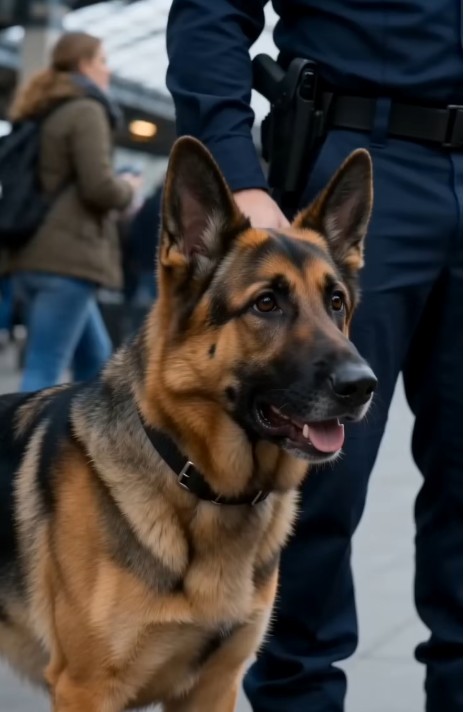
The train was less than a minute from departure when Ranger suddenly pulled against his leash.
His handler, Officer Lucas Grant, barely had time to react.
“Ranger!”
The German Shepherd twisted free.
Then sprinted along the platform.
Passengers turned.
A conductor leaned out of the carriage.
Lucas ran after him.
“Ranger! Come back!”
The dog ignored him.
He passed the first carriage.
Then the second.
Then the third.
Straight toward the final luggage car.
The departure whistle had already sounded.
But Ranger stopped beside a locked service compartment.
He began barking.
Not his normal excited bark.
Short.
Repeated.
Focused.
Lucas knew the difference.
Something had Ranger’s attention.
“What is it, boy?”
The dog scratched once at the lower edge of the door.
Then barked again.
Lucas stepped closer.
At first, he heard nothing.
Then—
Knock.
Knock.
A pause.
Then another weak knock.
Lucas immediately grabbed his radio.
“Hold departure. Last carriage. I may have someone inside a locked compartment.”
Railway security responded within seconds.
The train remained at the platform.
A supervisor arrived with access keys.
He opened the door.
Inside, sitting against the wall between stacked luggage racks, was an elderly man.
His work jacket was dirty.
His glasses were crooked.
He looked exhausted.
But alive.
“Sir?”
Lucas crouched beside him.
“Can you hear me?”
The man nodded.
“My name’s Arthur Bell.”
The railway supervisor froze.
“Arthur?”
Arthur had worked for the railway for more than forty years.
He had retired from full-time duty but still worked occasional maintenance and inspection shifts.
More importantly, he had been reported missing the previous evening.
His daughter had contacted police after he failed to return home.
Search teams had checked his usual route.
His workshop.
Nearby stations.
Nothing.
Yet there he was.
Inside a luggage compartment scheduled to leave the city within seconds.
Lucas expected relief.
Instead, Arthur grabbed his sleeve.
“Don’t let this train leave.”
“It isn’t leaving.”
Arthur shook his head urgently.
“The suitcase.”
Lucas followed his gaze.
A black hard-shell suitcase sat upright beside the racks.
No passenger name was visible from where Lucas stood.
Arthur pointed at it.
“That one.”
“What about it?”
Arthur lowered his voice.
“It isn’t supposed to be here.”
Lucas looked at the railway supervisor.
Neither man moved toward it immediately.
They cleared the compartment.
Passengers were kept away.
Rail security began identifying luggage through baggage records.
Lucas asked Arthur:
“How did you end up locked in here?”
Arthur took a breath.
“I followed the man carrying that case.”
“Why?”
“Because I recognized the label.”
That answer made no sense at first.
Arthur explained.
The previous evening, he had been completing a routine check in an old storage building connected to the station.
Most of the equipment there had been retired years ago.
Signal components.
Maintenance tools.
Paper archives.
Old keys.
Nothing glamorous.
But some items were still controlled because they related to operating infrastructure.
Arthur noticed a man wheeling a black suitcase through a staff-only corridor.
The man wore a high-visibility vest.
That alone did not concern him.
Contractors used the corridor regularly.
Then Arthur saw the luggage label.
It was not a passenger baggage tag.
It was an internal equipment-transfer tag.
Orange stripe.
Black serial number.
Arthur recognized the format immediately.
The railway had stopped using those tags almost eight years earlier.
“What was wrong with that?” Lucas asked.
Arthur looked at him.
“Because the storage room where those tags were kept was cleared out last month.”
Arthur challenged the man.
The stranger claimed he was moving obsolete electrical testing equipment for disposal.
Arthur asked to see the transfer sheet.
The man became defensive.
Then walked away quickly.
Arthur followed him.
Not because he thought he had discovered some dramatic crime.
Because unauthorized removal of railway equipment had to be reported.
The man entered the luggage service area.
Arthur followed.
Then somebody pushed the compartment door shut behind him.
The lock engaged automatically.
His phone had no signal inside.
He shouted.
Banged.
Waited.
Nobody heard.
Through a narrow gap near the door, Arthur occasionally heard staff outside.
But never close enough.
At some point the black suitcase appeared inside.
Arthur could not tell whether the same man placed it there or whether another worker did.
That was why he was so concerned.
“I don’t know what’s inside.”
Lucas asked:
“Did the man threaten you?”
“No.”
“Did he say anything?”
“No.”
“Did you see his face?”
“Partly.”
Police did not assume the suitcase contained something dangerous.
They treated it cautiously because its ownership and contents were unknown.
The station’s security protocol was activated.
The luggage car remained closed.
Passengers were moved away from the immediate area.
Specialist officers examined the suitcase before anyone opened it.
The result was less dramatic than rumors later suggested.
No explosive device.
No weapon.
No immediate physical danger.
Inside were electronic modules, diagnostic readers, sealed memory units and several pieces of railway maintenance hardware.
Arthur recognized some immediately.
“That’s signal-testing equipment.”
The railway supervisor looked stunned.
“Current equipment?”
“Some of it.”
Others appeared older.
But one device had been assigned to a maintenance depot across town and had recently been reported missing from inventory.
Another carried a serial number belonging to a contractor.
Lucas asked the obvious question.
“Why would somebody put railway equipment in passenger luggage?”
Nobody had an answer yet.
Investigators began with the suitcase tag.
The newest passenger-style label had been created only that morning.
It listed a destination hundreds of miles away.
The passenger name attached to the reservation was Thomas Vale.
But when station staff checked the boarding record, Thomas Vale had entered the station.
Passed through the departure area.
Then exited again twelve minutes before the train was scheduled to leave.
Security video showed him carrying no suitcase when he departed.
Lucas asked:
“So he checked the bag and disappeared?”
“Looks that way.”
They pulled more footage.
The man seen by Arthur appeared the previous evening.
Same height.
Similar coat.
But the camera angle did not clearly show his face.
Then investigators found another recording.
A service corridor camera showed the man placing the black suitcase on a maintenance trolley.
He scanned an access badge.
The badge belonged to a subcontractor named Nathan Cole.
Nathan’s company had worked on station electrical systems the previous year.
But its contract had ended three months earlier.
His badge should no longer have worked.
That sounded familiar to the railway supervisor.
The station had recently changed parts of its access-control system.
Some contractor credentials had been migrated incorrectly.
A review began immediately.
Nathan was located and questioned.
He denied stealing equipment.
He claimed the suitcase had been given to him by another technician and that he believed the contents had been cleared for disposal.
Investigators did not accept or reject that explanation immediately.
They checked records.
One item inside the suitcase had indeed been marked for disposal.
Two others had not.
Another had been transferred legitimately but to a completely different location.
The situation was messy.
Not every object came from the same source.
That suggested something larger than one person casually taking abandoned equipment.
Investigators reviewed months of inventory records.
Several maintenance devices had disappeared in small quantities.
Never enough at once to trigger immediate alarm.
A diagnostic reader here.
A communications module there.
Replacement parts.
Old but still valuable equipment.
Some items had later appeared for sale through private industrial resellers.
That changed the investigation.
Police traced serial numbers.
A pattern emerged.
Someone with knowledge of railway inventory procedures was selecting equipment that would not be missed immediately.
Older stock.
Recently replaced stock.
Devices moving between contractors.
Items sitting in temporary storage.
The old orange transfer tags were useful because they made the objects appear as though they were already being relocated.
Arthur had noticed the one detail most newer employees would not.
The tag was obsolete.
He knew because he remembered when the railway stopped using it.
His forty years of experience had turned an ordinary label into a warning sign.
Investigators identified three people who had access to the relevant storage areas.
Nathan was one.
Another was a current contractor.
The third was a former logistics employee named Eric Mason.
Eric had worked at the station for eleven years.
He left after a disciplinary dispute.
But investigators discovered something important.
Several online listings for industrial railway equipment were connected to an account using a payment destination linked to a company registered by Eric’s brother.
That did not prove Eric personally stole the equipment.
But it justified deeper investigation.
Search warrants followed.
Records were examined.
Additional equipment was recovered from a rented storage unit.
Some belonged to the railway.
Some came from legitimate surplus auctions.
Investigators had to separate the two carefully.
The railway also acknowledged its own failures.
Inventory systems did not always communicate properly between departments.
Contractors returned equipment through different procedures.
Older storage areas contained items nobody had catalogued accurately in years.
That made theft easier to hide.
Arthur’s black suitcase became only one piece of a broader case.
But Lucas still had another question.
“How did Ranger know you were in there?”
Arthur smiled.
“Ask him.”
Lucas looked at the German Shepherd.
Ranger was sitting calmly beside the handler now.
The likely explanation was simple.
Sound.
Scent.
Possibly both.
Arthur had been inside the compartment for hours.
When Ranger passed the final carriage, he may have detected human scent escaping through ventilation gaps.
Or heard movement behind the metal door.
Police dogs are trained to respond to certain cues, but Lucas was careful not to claim Ranger somehow knew Arthur was a missing person.
“He found something unusual,” Lucas later explained.
“And he insisted on checking it.”
That was enough.
Arthur spent several hours at the hospital.
Dehydration.
Fatigue.
Minor bruising from trying to force the door.
Nothing more serious.
His daughter, Claire, arrived furious and crying.
“You FOLLOWED HIM?”
Arthur looked embarrassed.
“I asked a question.”
“You followed a stranger into a restricted luggage area.”
“I was already in a restricted luggage area.”
“That is not helping.”
Lucas tried not to smile.
Claire hugged her father.
Then said:
“You’re retired.”
“Partially.”
“You are seventy-four.”
“That is accurate.”
“You are not a detective.”
Arthur looked toward Lucas.
“I found the suitcase.”
Lucas immediately said:
“I am staying out of this.”
Claire pointed at him.
“Good decision.”
The train eventually departed several hours late.
The passengers were frustrated.
Some complained.
Others became fascinated once rumors spread.
One rumor claimed police had discovered a bomb.
False.
Another said a kidnapped railway worker had been hidden inside luggage.
Also false.
Another claimed Ranger had smelled stolen money.
Completely invented.
The truth was stranger in a quieter way.
An elderly railway worker recognized an obsolete label.
He followed someone he believed was moving equipment improperly.
He became trapped.
A suitcase containing questionable railway property was loaded onto a departing train.
And a police dog detected something near a door seconds before departure.
Months later, prosecutors brought charges against multiple people connected to the stolen-equipment operation.
The cases were different for each defendant.
Some pleaded guilty to offenses involving stolen property.
Others contested specific allegations.
Not every suspicious transaction became a criminal charge.
The evidence had to stand on its own.
Nathan’s role turned out to be more complicated than Arthur initially believed.
Records suggested he had transported equipment on several occasions.
But investigators found messages indicating he sometimes believed the transfers were authorized.
In other instances, evidence suggested he knew documentation was false.
The courts handled those distinctions.
Eric faced more serious allegations connected to resale records and the storage unit.
Again, the outcome depended on evidence, not Arthur’s suspicion alone.
The railway made changes immediately.
Old contractor badges were audited.
Obsolete transfer labels were destroyed.
Inventory movements required digital confirmation from two systems.
Service compartments could now be opened from inside in an emergency.
That final change made Claire particularly happy.
“So nobody else gets locked in?”
The supervisor answered:
“That’s the idea.”
Arthur replied:
“That would have been useful yesterday.”
Claire stared at him.
“Please stop helping.”
Arthur did not stop helping.
But he did agree to carry a better radio.
And to call security before following suspicious people.
Ranger became a minor celebrity at the station.
Employees brought him treats.
Lucas restricted the number.
“He still has to work.”
Arthur visited several weeks later.
He brought Ranger a new rubber toy shaped like a train.
Lucas looked at it.
“He is going to destroy that in six minutes.”
Arthur said:
“Then he’ll understand railway maintenance.”
Ranger destroyed it in four.
The black suitcase itself remained evidence for months.
Eventually, after the case concluded, the railway recovered the equipment that legally belonged to it.
Some devices were returned to service.
Others were finally disposed of properly.
Arthur asked what happened to the obsolete orange tag.
The investigator smiled.
“You want it?”
“No.”
“Good.”
“Because you’re not getting evidence.”
Arthur laughed.
What stayed with Lucas was not the suitcase.
It was the timing.
Another thirty seconds and the conductor might have received clearance to move.
The train would not necessarily have left with Arthur unnoticed forever.
He was alive.
Someone probably would have heard him eventually.
But he would have been carried away from the very station where police were already searching for him.
And the suitcase might have continued toward its destination.
Instead, Ranger broke formation.
Ran the length of the platform.
And refused to leave a locked door alone.
Lucas never described the dog as solving the case.
Ranger did something more specific.
He drew attention to a place everyone else had overlooked.
Arthur provided the information.
The suitcase provided evidence.
Records revealed the pattern.
Investigators built the case.
Each piece mattered.
Arthur later returned to the station as a guest for a staff safety meeting.
Someone asked what lesson he took from the experience.
Everyone expected him to talk about theft.
Or dogs.
Or luggage tags.
Arthur thought for a moment.
Then said:
“Old workers notice old mistakes.”
The room laughed.
He continued:
“That label bothered me because I remembered when we stopped using it.”
“Someone else might have walked past.”
“That doesn’t make me clever.”
“It just means experience is useful when people listen to it.”
Then Claire, sitting in the back row, called out:
“And what did we learn about following strangers alone?”
Arthur sighed.
“That my daughter attends too many meetings.”
Everyone laughed again.
But later, Lucas wrote down something Arthur had said.
Experience is useful when people listen to it.
Because that was really what happened.
Ranger listened to something behind a locked door.
Arthur noticed something wrong with an old tag.
Lucas listened to Arthur.
Investigators listened to the records.
A missing man was found.
A suspicious suitcase was stopped.
And a quiet pattern of missing railway equipment finally became visible.
The train had been seconds from leaving.
To most people on the platform, nothing looked unusual.
Then a German Shepherd ran toward the final carriage.
And refused to let everyone keep walking past.