
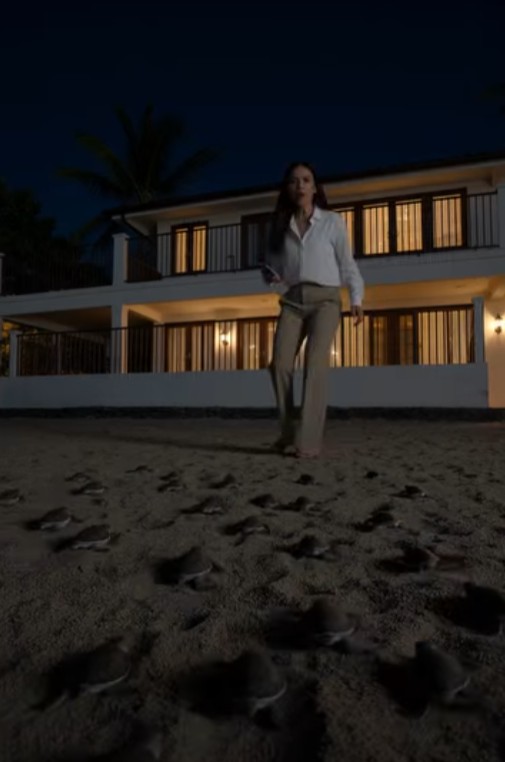
Maya couldn’t believe what the marine conservation officer had just discovered.
Dozens of newly hatched sea turtles were crawling across the sand toward the brightly illuminated hotel instead of the ocean.
Some had already reached the terrace.
Others were struggling through the decorative plants surrounding the beachfront garden.
But when conservation officer Daniel Reyes looked farther down the coastline, he noticed something even more troubling.
Another hotel was glowing in the darkness.
Beyond it stood several restaurants, holiday apartments, and beachfront properties, all casting bright artificial light across the sand.
Daniel raised his radio.
“We need another team farther south. I think this is happening along the entire beach.”
Maya stared at him.
“You mean there are more turtles going the wrong way?”
Daniel nodded.
“Possibly hundreds, if other nests are hatching tonight.”
He looked toward the tiny animals struggling across the sand.
“And unless we find out where they’re going, some of them may never reach the ocean.”
What began as a strange discovery outside one hotel was about to reveal a much larger problem threatening the coastline’s youngest inhabitants.
The Strange Visitors Outside the Hotel
The evening had been unusually quiet at the Oceanview Resort.
Most guests had finished dinner, and the beachfront restaurant was preparing to close.
Maya Collins, a twenty-eight-year-old hotel employee, had been checking the outdoor seating area when she noticed movement near the glass doors.
At first, she thought leaves were blowing across the terrace.
Then she looked more closely.
Tiny dark shapes were crawling over the sand.
One reached the edge of a wooden walkway.
Another disappeared behind a flowerpot.
Maya stepped outside.
“Oh my goodness.”
They were baby sea turtles.
Dozens of them.
Each was only a few inches long, with tiny flippers moving rapidly against the sand.
But instead of heading toward the waves, they were moving toward the hotel.
Maya knew sea turtles normally made their way to the ocean soon after emerging from their nests.
She had seen photographs of hatchlings traveling across moonlit beaches.
But she had never imagined finding them approaching a hotel entrance.
She immediately called the local marine conservation hotline.
“Please send someone,” she told the operator. “There are baby turtles everywhere, and they’re crawling away from the water.”
The Hidden Danger Behind the Beautiful Lights
Daniel Reyes arrived with another conservation volunteer and began examining the beach.
He watched several hatchlings moving toward the hotel terrace.
Then he turned toward the building.
Bright decorative lamps illuminated the pathways.
Powerful floodlights shone across the garden.
And large glass doors reflected the golden light from the lobby.
Daniel immediately understood the likely problem.
“The turtles are being disoriented by the lights,” he explained.
Maya looked confused.
“But the ocean is right there.”
Daniel pointed toward the dark water.
“Newly hatched sea turtles use visual cues to orient themselves toward the sea. On a natural beach, the open ocean horizon is often brighter than the dunes and vegetation behind them.”
He turned toward the hotel.
“But artificial lighting can interfere with that process.”
The hatchlings were responding to the brightly lit buildings instead of finding their way toward the water.
Maya looked down at a turtle struggling beside the terrace.
“So they think the hotel is the ocean?”
“Not exactly,” Daniel replied. “They’re following visual cues that are leading them in the wrong direction.”
He explained that artificial light can cause hatchlings to travel inland, become exhausted, lose valuable energy, and face additional risks from dehydration, predators, vehicles, and obstacles.
Maya immediately reached for her phone.
“We need to turn these lights off.”
The Night the Hotel Went Dark
Within minutes, Maya contacted the night manager.
At first, he was concerned about switching off the beachfront lighting while guests were still moving around the property.
But Daniel explained that unnecessary lights visible from the nesting beach could be turned off or shielded while essential safety lighting remained available.
The manager agreed.
Staff switched off decorative terrace lights, closed curtains facing the beach, and reduced unnecessary outdoor illumination.
Gradually, the bright glow surrounding the hotel faded.
The beachfront became darker.
From the sand, the open horizon over the ocean was more visible.
Maya returned to the conservation team.
“Is that better?”
Daniel watched the hatchlings.
Several were still moving in different directions.
But others began orienting toward the water.
One tiny turtle turned away from the garden and started crawling across the open sand.
Then another followed.
Maya smiled.
“Look. They’re going toward the ocean.”
Daniel nodded.
“That’s encouraging. But we need to continue monitoring them.”
The team kept guests back and avoided unnecessary handling while following the applicable wildlife protection procedures.
Slowly, more hatchlings began making their way toward the surf.
And when the first tiny turtle reached the water, Maya felt an unexpected rush of relief.
But Daniel’s attention had already shifted toward the lights farther down the beach.
The Discovery Near the Second Hotel
Daniel contacted the conservation coordinator and requested additional volunteers.
Soon, another team began checking the neighboring beachfront properties.
What they found was deeply concerning.
At a hotel several hundred yards away, hatchlings had emerged from a nest near the dunes and scattered toward an illuminated swimming pool area.
Some had become trapped beside a low concrete wall.
Others had crawled into landscaped flowerbeds.
A few were moving dangerously close to a service road.
Farther down the beach, another group of hatchlings had followed lights from an outdoor restaurant.
The volunteers carefully assessed the situation and took protective measures under the direction of authorized conservation personnel.
Daniel received updates over the radio.
“Multiple disoriented hatchlings at the second property.”
Another message followed.
“Additional nest activity near the southern access path.”
Maya listened nervously.
“How many are there?”
Daniel looked toward the shoreline.
“We don’t have a complete count yet.”
He paused.
“But this isn’t just a problem at your hotel.”
The lights that made the waterfront attractive to visitors after sunset were creating serious difficulties for wildlife trying to survive its first journey to the sea.
And until that night, many property owners had never realized the consequences.
The Most Frightening Discovery of the Night
Shortly after midnight, Daniel received another call.
A volunteer near the southern end of the beach had found a group of hatchlings gathered around a stormwater drain.
Several were moving along the concrete edge instead of heading toward the ocean.
The area was brightly illuminated by a nearby parking lot.
The volunteer had already secured the immediate area to keep people and vehicles away.
But the team needed additional assistance.
Daniel turned toward Maya.
“There’s another group in trouble.”
Maya immediately offered to help coordinate communication with nearby hotel managers.
Daniel thanked her and left with the conservation team.
When they reached the parking area, they found several tiny turtles moving between patches of sand and concrete.
One was struggling against the edge of the drain.
Another had become caught among dry leaves near the opening.
The rescuers worked carefully, following their established procedures for protecting disoriented hatchlings.
They kept the area clear, coordinated with the property staff to reduce the problematic lighting, and ensured any necessary handling was performed by authorized personnel.
It was a delicate situation.
The turtles were fragile.
And after spending so much time traveling in the wrong direction, some appeared exhausted.
Daniel watched one particularly small hatchling trying repeatedly to climb over the concrete edge.
“We need to get this area secured,” he told his team.
The volunteers continued their work until the immediate danger was addressed.
But what troubled Daniel most was how easily the situation could have gone unnoticed.
If Maya hadn’t discovered the first turtles outside her hotel, nobody might have realized how many nesting areas were affected that night.
Why the Hatchlings Needed Every Bit of Energy
As the rescue operation continued, Daniel explained why the first journey from nest to ocean was so important.
Sea turtle hatchlings emerge with limited energy reserves.
Those reserves help power their journey across the beach and their initial swimming period after entering the water.
The longer they spend crawling in the wrong direction, the more energy they may use before reaching the sea.
Artificial lights can also expose them to dangers they might otherwise avoid.
A hatchling wandering inland may become trapped in vegetation, fall into an opening, or encounter roads and buildings.
And even a turtle that eventually reaches the water may have lost precious time and energy.
For Maya, the explanation was heartbreaking.
She had always thought of the beachfront lights as something beautiful.
They made the hotel look welcoming.
They helped guests see the gardens at night.
And they created a warm glow across the terrace.
But she had never considered what that glow might look like to a baby turtle emerging from the sand.
It wasn’t simply decoration.
It could become a dangerous distraction.
The Morning That Changed the Hotel
By dawn, the conservation volunteers had finished their immediate response.
The team had documented multiple nesting areas affected by artificial lighting and had assisted hatchlings found in dangerous locations.
Although they could not know the long-term survival of every turtle, many had reached the ocean during the night.
Maya remained near the terrace as the sky began to brighten.
She was exhausted.
But she couldn’t stop thinking about what she had seen.
Dozens of tiny animals emerging from the sand, beginning a journey that should have led them toward the waves.
Instead, they had been drawn toward the buildings people had constructed along the shore.
When the hotel manager arrived, Maya approached him.
“We can’t keep the lights like this during nesting season.”
He nodded.
“I agree.”
They arranged a meeting with the conservation team to review the hotel’s beachfront lighting.
Daniel returned several days later with recommendations.
Some fixtures needed shielding.
Others could be redirected away from the beach.
Decorative lights could be turned off during important nesting and hatching periods.
Where lighting was necessary, wildlife-sensitive options could be considered according to local guidance.
The hotel also agreed to educate staff and guests about protecting nesting turtles.
Maya volunteered to help coordinate the changes.
She wanted to make sure that what happened that night would lead to something lasting.
A Meeting That Brought the Community Together
Word of the incident spread among local hotel managers, restaurant owners, residents, and conservation volunteers.
Within two weeks, the community organized a beachfront meeting.
Daniel attended with several marine wildlife specialists.
Maya stood beside the hotel manager as photographs from the rescue were displayed.
The images showed tiny hatchlings crawling toward hotel terraces, parking areas, and garden lights.
Many people in the audience were shocked.
One restaurant owner raised his hand.
“I had no idea our outdoor lights could affect them.”
A beachfront homeowner agreed.
“We leave our garden lights on every night.”
Daniel explained that artificial light pollution was a recognized threat to nesting sea turtles and hatchlings.
He emphasized that effective solutions depended on the location, species, and relevant wildlife regulations.
But the general principles were clear.
Reduce unnecessary lighting.
Keep light from shining toward the beach.
Use appropriate shielding and fixtures.
And follow local sea turtle protection guidance during nesting and hatching seasons.
Several property owners immediately expressed interest in making changes.
Others asked how to maintain safe pathways without creating unnecessary brightness on the sand.
The conservation team worked with them to identify practical options.
By the end of the meeting, the community had agreed to develop a coordinated beach-lighting protection plan.
The Promise Made Beneath the Stars
Over the following months, visible changes began appearing along the beachfront.
Hotels reviewed their outdoor lighting.
Restaurants adjusted decorative fixtures.
Some property owners installed timers or motion-controlled lights where appropriate.
Others replaced fixtures with options better suited to wildlife-sensitive coastal areas.
Educational signs appeared near beach access points.
They explained why artificial lighting could confuse hatchlings and asked visitors to follow local rules regarding beach lights, flashlights, and nesting areas.
The conservation team also organized volunteer training and improved coordination with businesses.
Maya helped introduce a nighttime checklist at her hotel.
Before closing the beachfront terrace, staff checked that unnecessary lights were off and curtains facing the nesting beach were closed.
The changes weren’t dramatic.
They didn’t require rebuilding the hotels or closing the beach.
But together, they reduced the bright artificial glow that had once spilled across the nesting sand.
And for Maya, every darker evening felt like a promise being kept.
The Night the Turtles Returned
The following nesting season, Maya received a message from Daniel.
A monitored nest near the hotel was approaching its expected hatching period.
The conservation team was preparing for another nighttime observation.
Maya volunteered to assist with hotel coordination.
That evening, she walked through the terrace and checked the lighting.
The decorative lamps were off.
The curtains were closed.
And the beachfront was darker than it had been the previous year.
Guests had been informed about the nesting activity and reminded to keep their distance.
Later that night, a conservation volunteer noticed movement near the marked nesting area.
The sand shifted.
Then a tiny head appeared.
A sea turtle hatchling emerged.
Another followed.
And then several more.
Maya watched from the designated viewing area with the conservation team.
The hatchlings began moving across the sand.
This time, the hotel lights were not drawing them toward the terrace.
Many moved in the direction of the open ocean.
Maya held her breath as the first turtle reached the wet sand.
A small wave rolled forward.
The hatchling disappeared into the water.
Then another reached the surf.
And another.
Daniel smiled.
“That’s what we hoped to see.”
Maya wiped a tear from her cheek.
She remembered the confusion of that first night.
The tiny animals crawling toward the hotel doors.
The emergency calls.
The rescue teams working until dawn.
And the frightening discovery that the problem extended far beyond one building.
Now, she was watching a new group of hatchlings begin their journey without the same obvious distraction from her hotel’s lights.
The Small Turtle That Made Everyone Smile
Near the end of the emergence, one particularly small hatchling appeared behind the others.
It paused near a shallow indentation in the sand.
Then it began moving forward.
Its tiny flippers pushed against the beach.
Every few seconds, it stopped.
Maya watched anxiously.
“Is that one okay?”
Daniel observed from a distance.
“It appears to be moving. Let’s give it space.”
The little turtle continued.
It crossed a patch of dry sand.
Then another.
Finally, it reached the darker, damp sand near the shoreline.
A wave approached.
For a moment, the hatchling stopped.
Then the water washed gently around it.
When the wave receded, the turtle continued moving forward.
The next wave carried it into the sea.
Maya smiled.
“That little one really took its time.”
Daniel nodded.
“But it found its way.”
Neither could know what awaited the hatchling beyond the surf.
The ocean was vast.
Its journey would be long.
And surviving to adulthood would be difficult.
But that night, the little turtle had been given the opportunity to begin its life in the direction nature intended.
The Legacy of One Unexpected Discovery
Years later, Maya would still remember the night she opened the hotel’s beachfront doors and found dozens of baby sea turtles crawling toward the building.
At first, she had been confused.
Then frightened.
And finally determined to do something.
She had never imagined that a routine hotel shift could lead to a community-wide effort to protect wildlife.
But that was exactly what happened.
The conservation team continued working with local businesses and residents to improve lighting practices.
Visitors learned why dark nesting beaches mattered.
Hotel employees became more attentive to seasonal wildlife activity.
And the community developed a stronger understanding of the fragile relationship between coastal development and the animals that had nested there long before the hotels existed.
One evening, as Maya finished her shift, she stepped outside and looked toward the ocean.
The beachfront was quiet.
The terrace lights were dimmed according to the hotel’s wildlife protection plan.
Above the water, the horizon stretched beneath a sky filled with stars.
Daniel happened to be visiting the property for a routine conservation meeting.
He joined her near the entrance.
“Remember the first night?” he asked.
Maya laughed softly.
“How could I forget?”
She looked toward the sand.
“I thought the turtles were trying to get into the hotel.”
Daniel smiled.
“In a way, the lights were inviting them.”
Maya nodded.
“And all we needed to do was stop giving them the wrong direction.”
They stood quietly for a moment, listening to the waves.
Then Maya turned toward the building and checked the terrace one final time.
Everything was ready for another night.
Because the greatest surprise wasn’t that dozens of baby sea turtles had crawled toward a hotel instead of the ocean.
It was that one employee’s decision to ask for help revealed a problem affecting an entire coastline — and inspired a community to change the way it shared the beach with wildlife.
Sometimes, protecting nature doesn’t begin with doing something extraordinary. It begins with noticing the harm we never intended to cause, and choosing to do something about it.