
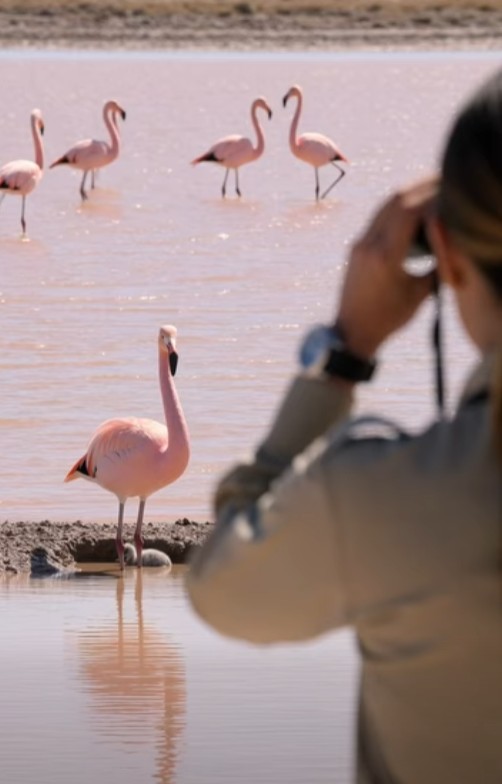
Wildlife ranger Sofia Martinez had been watching the flamingo colony for nearly an hour when she realized the situation was far worse than anyone expected.
A lone pink flamingo stood near the edge of a rapidly drying lagoon, refusing to follow the hundreds of birds moving toward deeper water.
At first, Sofia thought the animal was simply resting.
Then she noticed something moving beneath its wing.
A tiny gray flamingo chick.
The baby was struggling in the soft mud, its thin legs sinking whenever it tried to stand.
Sofia immediately contacted the wildlife rescue team.
But when the specialists arrived and began assessing the stranded chick, one of them noticed movement farther across the exposed lagoon bed.
“Sofia, look over there.”
She raised her binoculars.
Several pale-gray shapes were scattered across the mud.
One moved.
Then another.
Sofia’s heart sank.
The first chick wasn’t the only one in trouble. A group of young flamingos had become stranded as the shrinking lagoon separated them from the deeper water.
And with the afternoon heat increasing, the rescuers knew they had a much bigger problem on their hands.
The Lagoon That Had Slowly Disappeared
For years, the shallow lagoon had been an important gathering place for flamingos.
During the wetter months, the water spread across a wide area, creating feeding grounds rich in small aquatic organisms.
Hundreds of flamingos gathered there, moving gracefully through the shallow water while filtering food with their specialized bills.
But that season had been unusually dry.
Rainfall was scarce, and the afternoon temperatures remained high for weeks.
As water evaporated, the lagoon gradually shrank.
Small islands of mud appeared where shallow water had once covered the ground.
Channels that previously connected different pools began drying out.
And some of the flamingos started moving toward deeper sections of the wetland.
Sofia and her colleagues had been monitoring the situation closely.
They knew that flamingos could respond to changing water conditions by relocating to more suitable areas.
But younger birds were especially vulnerable when feeding and nesting areas deteriorated.
That afternoon, Sofia was conducting a routine observation when she noticed one adult flamingo remaining behind.
While the others gradually moved away, the bird stood almost motionless beside a patch of pale mud.
Something about its posture made Sofia look twice.
The Tiny Chick Hidden in the Mud
Through her binoculars, Sofia noticed the adult flamingo lower its head toward the ground.
Then she saw a faint movement beside its legs.
A small gray chick was trying to stand.
It managed to lift its body for a moment before sinking back into the mud.
Sofia adjusted her binoculars.
The chick appeared exhausted.
Its soft gray feathers were coated with damp mud, and its movements were slow.
The adult remained close, occasionally shifting position and watching the surrounding area.
Sofia couldn’t determine whether the bird was the chick’s mother from observation alone, but its behavior suggested a close association.
She recorded the location and contacted the wildlife response coordinator.
“We have a young flamingo stranded near the eastern mudflat,” she reported.
After a pause, she added, “There’s an adult staying close to it.”
The coordinator asked her to continue observing from a safe distance while a trained response team was dispatched.
Sofia knew approaching too quickly could frighten the birds and cause additional stress.
So she remained at her observation point, watching the chick through her binoculars.
Every few minutes, it tried to stand.
Every time, the soft mud made movement difficult.
The Discovery Beyond the First Chick
The wildlife rescue team arrived with specialized equipment for working in wetland environments.
Team leader Daniel Ortega surveyed the area before allowing anyone onto the mudflat.
The surface looked firm in some places but could become dangerously unstable without warning.
He instructed the team to assess safe access routes and avoid disturbing the larger flamingo colony.
As they examined the first chick, another specialist noticed several small shapes farther across the lagoon.
At first, they appeared to be pieces of dried vegetation.
But one lifted its head.
Daniel raised his binoculars.
“There’s another chick.”
He moved the binoculars slowly across the mud.
“Wait. I can see more.”
Sofia joined him.
Together, they counted several young flamingos separated from the deeper pools by wide stretches of sticky mud.
Some were standing.
Others were sitting with their legs tucked beneath their bodies.
A few were attempting to move toward the remaining water.
But the exposed ground was making their journey difficult.
Daniel lowered his binoculars.
“This isn’t just one stranded bird.”
Sofia looked across the lagoon.
“How many?”
“We need a proper survey,” he replied. “But there may be more than a dozen in the affected area.”
The team immediately requested additional support.
Why the Drying Mud Was So Dangerous
As the water disappeared, the lagoon’s exposed sediment had become increasingly difficult for young birds to cross.
Some sections had hardened under the sun.
Others remained soft and sticky beneath the surface.
For adult flamingos with longer legs and greater strength, moving between pools could be manageable.
But young chicks were less capable of negotiating the changing terrain.
Daniel explained that flamingo chicks usually spend their early development in groups, sometimes forming large nurseries called crèches.
Adults continue caring for their young, recognizing and feeding their own chicks.
But when environmental conditions deteriorate, young birds may become vulnerable to exhaustion, dehydration, and difficulty accessing suitable areas.
Sofia looked toward the first chick.
It had barely moved since she spotted it.
The nearby adult was still standing close.
“Do you think it has been there all day?” she asked.
Daniel shook his head.
“We can’t know for certain.”
He studied the surrounding mud.
“But we shouldn’t assume these birds can reach safety without help.”
The team began planning a carefully controlled response.
The Rescue Had to Be Done Carefully
Before entering the affected area, the specialists assessed the stability of the mudflat and mapped the locations of the stranded chicks.
They coordinated with the wetland management authority and experienced wildlife veterinarians.
The objective wasn’t simply to pick up every bird.
Unnecessary handling could create additional stress, and moving chicks away from their parents or colony could cause serious problems.
Instead, the team identified which animals were genuinely trapped or showing signs of distress.
They also evaluated whether safe access to nearby water could be restored without disturbing the habitat.
For the first chick, the situation was urgent.
It was struggling to stand and appeared increasingly weak.
The specialists carefully approached using equipment suited to the unstable ground.
The adult flamingo moved several steps away.
Sofia watched nervously.
“Will it come back?”
Daniel answered cautiously.
“We’ll give it space and observe. Our priority is to minimize disturbance.”
A trained responder gently secured the chick for assessment.
Its legs were coated in mud, but it was still responsive.
The team carefully examined it for injuries and signs of dehydration.
Then the veterinarian gave the instructions for the next stage of its care.
The Smallest Flamingo Needed Extra Help
The chick Sofia first discovered was in poorer condition than the team had hoped.
Its body was weak, and it struggled to support itself.
The veterinarian suspected that prolonged exposure to the heat and difficulty moving across the mud had contributed to its condition.
The chick was transferred to a temporary shaded assessment area, where trained staff provided appropriate supportive care.
Sofia remained nearby.
She had watched countless young animals during her years as a ranger, but something about this little flamingo affected her deeply.
Perhaps it was the way the chick kept trying to stand.
Or the sight of the adult bird waiting nearby.
Whatever the reason, Sofia couldn’t stop thinking about it.
“Come on, little one,” she whispered.
The veterinarian continued monitoring the chick.
After some time, it began responding more actively.
It lifted its head.
Moved its legs.
And made several soft calls.
Sofia smiled.
“That’s better.”
But the team still had many other birds to assess.
And across the lagoon, the exposed mud was growing hotter under the afternoon sun.
A Bigger Problem Than Anyone Imagined
As additional specialists surveyed the wetland, the true extent of the situation became clearer.
Several groups of young flamingos had become isolated in shallow depressions where water had recently disappeared.
Others remained near small pools that were steadily shrinking.
The situation wasn’t uniform.
Some chicks were healthy and moving normally.
Others appeared tired or had difficulty crossing muddy areas.
The rescue coordinator decided that a broader habitat response was necessary.
The team worked with wetland managers to identify ways of improving access between suitable areas while avoiding damage to the breeding colony.
They also arranged close monitoring of the remaining water levels.
Sofia joined a survey team on the eastern side of the lagoon.
Through her binoculars, she watched a group of young flamingos walking slowly toward a deeper pool.
Several adults stood nearby.
For the first time that afternoon, she felt cautiously hopeful.
But then her radio crackled.
“Assessment team to Sofia. We have an update on the first chick.”
She stopped walking.
“What is it?”
“The chick is responding better. We’re preparing to evaluate whether it can safely return to the colony.”
Sofia closed her eyes for a moment.
It was the news she had been hoping to hear.
The Moment the Little Flamingo Stood Again
Later that afternoon, Sofia returned to the temporary assessment area.
The small gray chick was standing.
Its legs were still unsteady, but it was much more alert than when the rescuers found it.
The veterinarian watched its movements carefully.
After further assessment, the team determined that the chick could be returned to a suitable location near its original group, with continued observation.
They selected a safer area of firm, shallow ground close to the colony.
The transfer was conducted carefully by trained personnel.
Once released, the chick stood still for several seconds.
Then it took a step.
Another.
And another.
Sofia watched through her binoculars.
“Look at it go.”
The chick began moving toward other young flamingos nearby.
Several adults were present in the area.
The team remained at a distance to observe how the birds responded.
After a while, the chick settled near the group.
Sofia smiled.
It wasn’t proof that every danger had passed.
But the little animal had a much better chance than it did when she first saw it struggling in the mud.
The Bird That Had Stayed Behind
Before leaving the area, Sofia looked toward the location where the first chick had been found.
The adult flamingo was no longer standing in the same spot.
Instead, several flamingos were moving through the shallower water closer to the colony.
Sofia tried to identify the bird she had watched earlier.
But many of the adults looked similar from a distance.
She couldn’t be certain which one it was.
Still, she remembered how the adult had remained near the struggling chick while much of the flock moved toward deeper water.
Daniel joined her.
“Thinking about that first bird?”
Sofia nodded.
“I wonder if it was the mother.”
“Possibly,” he replied. “We can’t know without individual identification.”
Sofia smiled.
“Whatever the reason, I’m glad it stayed close enough for me to notice the chick.”
Daniel looked across the lagoon.
“Sometimes that’s how a rescue begins. Someone notices something unusual and checks carefully.”
The Community Joined the Effort
Over the following days, the wildlife authorities continued monitoring the lagoon.
The conservation team documented affected nesting areas and worked with wetland managers to understand the changing conditions.
Local volunteers helped with approved support activities away from sensitive parts of the colony.
Some assisted with equipment and logistics.
Others helped record water levels and environmental observations.
The focus was not only on responding to stranded chicks but also on understanding why parts of the wetland had become unsuitable.
Experts reviewed seasonal rainfall patterns, water movement, and the condition of the surrounding habitat.
They knew that one rescue operation couldn’t solve every challenge facing the flamingos.
Long-term protection would require careful habitat management and monitoring.
Sofia helped prepare reports detailing the locations where young birds had become isolated.
She included photographs, observations, and the measures taken during the response.
At the end of the report, she added a note.
“The first indication of the wider problem was a single adult flamingo remaining beside a struggling chick.”
The Return of the Rains
Several weeks later, clouds began gathering over the wetland.
The dry season had stretched longer than expected.
But one evening, rain finally arrived.
At first, it was light.
Small drops struck the cracked mud.
Then the rainfall became steadier.
Over the following days, water levels gradually improved in some parts of the lagoon.
The conservation team continued monitoring the habitat, recognizing that recovery depended on more than a single rainstorm.
But the changes were encouraging.
Some shallow channels began filling again.
Pools that had been separated by exposed mud became better connected.
And flamingos continued gathering in areas where feeding conditions were suitable.
Sofia returned to the same observation point where she had first noticed the stranded chick.
The landscape looked different.
There was more water.
Fewer exposed stretches of sticky mud.
And groups of flamingos moving through the shallows.
She watched them for a long time.
Then she noticed a cluster of gray juveniles walking together near the edge of a pool.
She couldn’t identify the individual chick rescued weeks earlier.
But seeing young flamingos moving confidently through the wetland filled her with hope.
The Rescue That Changed Sofia’s Perspective
Sofia had worked in wildlife conservation for many years.
She understood that nature could be harsh.
Droughts, storms, predators, and changing environmental conditions were part of the challenges wild animals faced.
But the incident at the lagoon reminded her how important careful observation could be.
The first adult flamingo had seemed unusual because it remained behind while much of the flock moved away.
That small detail led Sofia to notice a struggling chick.
And the rescue team’s wider survey uncovered additional young birds that needed assessment.
What began as concern for one animal became a coordinated effort involving wildlife specialists, veterinarians, and wetland managers.
It also highlighted the importance of protecting suitable breeding and feeding habitats.
One afternoon, a young volunteer asked Sofia whether she believed the adult flamingo had intentionally stayed to protect its chick.
Sofia thought carefully.
“Flamingos do care for their young,” she explained. “But we can’t know exactly what that individual bird understood.”
She looked toward the lagoon.
“What matters is that its behavior drew our attention to something we might otherwise have missed.”
The volunteer nodded.
“And that helped the other chicks, too.”
Sofia smiled.
“Exactly.”
The Final Visit to the Lagoon
Months later, Sofia returned to the wetland during a routine wildlife survey.
The afternoon was warm, but the lagoon was no longer as severely dry as it had been during the rescue.
Hundreds of flamingos stood in the shallow water.
Some were feeding.
Others rested on one leg.
A group of younger birds moved together near the shoreline.
Sofia raised her binoculars.
She remembered the tiny gray chick that had struggled to stand in the mud.
The frightened calls.
The careful rescue.
And the moment the little bird finally took its first steady steps after receiving help.
A fellow ranger approached.
“Everything looking good?”
Sofia lowered her binoculars.
“Much better than the last time we were here.”
She looked across the flock.
The birds moved gracefully through the water, their pink feathers reflecting the afternoon sunlight.
For a moment, the lagoon seemed peaceful.
But Sofia knew how quickly conditions could change.
The experience had strengthened her determination to keep monitoring the wetland and protecting the animals that depended on it.
The Mother Flamingo Nobody Forgot
As the sun began setting, Sofia packed her binoculars and prepared to leave.
Before turning away, she looked once more toward the edge of the lagoon.
She could still picture the adult flamingo standing almost motionless beside the trapped chick.
While hundreds of other birds moved toward deeper water, that one animal had remained near the drying mudflat.
Nobody could say for certain whether it understood the danger.
Nobody knew whether it was the chick’s mother or another closely associated adult.
But its presence had been the first clue that something was wrong.
And that clue helped launch a rescue effort that reached far beyond a single bird.
Sofia smiled to herself.
She had arrived that afternoon expecting a routine wildlife observation.
Instead, she discovered young flamingos struggling across a drying lagoon and became part of an effort to help them.
Hundreds of flamingos had moved toward deeper water, but one adult remained beside a vulnerable chick.
When a ranger stopped to investigate, she discovered that several other young birds were facing similar difficulties.
And sometimes, protecting an entire group begins with noticing the one animal that refuses to move on.