
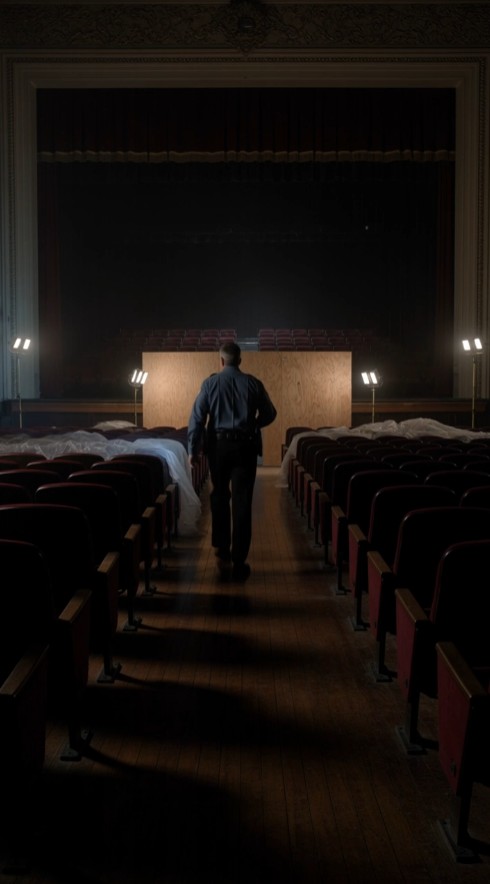
At 11:47 PM, security guard Marcus Reed was making his final patrol through the abandoned Grandview Theater when he heard three deliberate knocks coming from behind a newly constructed wooden wall.
The building had been undergoing renovations for several weeks. All the workers had gone home, the electricity in the main auditorium was switched off, and the theater was supposed to be completely empty.
Marcus raised his flashlight and listened.
Three more knocks.
Then a faint voice.
“Please… somebody help me.”
He immediately contacted the maintenance supervisor, who arrived within minutes and insisted that nobody could possibly be behind the wall.
“That corridor was sealed yesterday,” the supervisor explained.
But when they opened a small inspection panel, Marcus saw a human hand moving in the darkness.
Emergency services were called, and the construction crew was instructed to stay away from the partition until the area could be assessed safely.
Then the supervisor shone his flashlight through the opening.
His expression changed instantly.
“Oh no. That’s Mr. Harrison.”
The man trapped behind the wall was seventy-two-year-old Thomas Harrison, the theater’s former stage manager, who had worked there for more than thirty years.
But what shocked the rescuers most wasn’t simply that Thomas had become trapped. It was what he had been trying to prevent when the corridor was sealed.
The Theater That Held Thirty Years of Memories
The Grandview Theater had stood at the center of the town for nearly a century. Generations of residents had attended school performances, musical productions, and community celebrations beneath its ornate ceiling.
Thomas Harrison began working there in 1978 as a young stage assistant.
Over the next three decades, he became the person everyone relied upon whenever something went wrong backstage.
He knew every passageway, every storage room, and every unusual sound the old building made.
Actors remembered him for his patience. Directors trusted his experience. Young performers often looked for him before their first appearance on stage because he always seemed to know how to calm their nerves.
Thomas officially retired several years earlier, but he continued visiting the theater occasionally.
When the building closed for renovations, he was among the volunteers helping staff identify historical materials that should be preserved.
He had one particular concern.
An old maintenance corridor behind the stage contained storage cabinets filled with photographs, handwritten scripts, and records from the theater’s earliest productions.
Thomas had repeatedly asked the renovation team to make sure those items were removed before the corridor was permanently closed.
But somewhere during the project, that warning was overlooked.
The Morning Thomas Entered the Corridor
Two days before Marcus heard the knocking, Thomas arrived at the theater to collect several boxes of photographs.
He had been told that the old corridor would be sealed later in the week, and he wanted to make one final inspection before the work began.
The renovation manager had previously permitted him to retrieve materials during supervised access hours.
But on that particular morning, there was confusion about the schedule.
Thomas entered through a side service door while a construction crew was working in another section of the building.
He made his way down the narrow passage behind the stage and began searching through the cabinets.
Inside, he found original photographs from the theater’s opening season, a collection of handwritten performance notes, and several boxes containing old costume designs.
He was examining one of the boxes when he heard construction equipment operating outside.
Then a loud metallic sound echoed through the corridor.
Thomas turned toward the entrance.
The temporary access door had closed.
He hurried toward it and tried the handle.
It wouldn’t open.
At first, he assumed someone would return shortly.
But as the hours passed, the sounds of construction gradually faded.
Thomas began knocking.
Nobody answered.
The Mistake That Nobody Noticed
The renovation crew had been instructed to close an unused passageway behind the stage.
According to the construction drawings, the area was no longer needed for regular operations, and a new service route had been established elsewhere.
Before sealing the opening, workers were supposed to verify that the corridor was empty and that all authorized personnel had been accounted for.
However, the final inspection was incomplete.
Thomas’s visit hadn’t been properly recorded in the contractor’s sign-in system.
And because he was a retired employee rather than a member of the renovation crew, nobody realized he was still inside.
The temporary access door had become blocked during the work.
By the time workers installed the new wooden partition, Thomas was trapped behind it.
He had shouted for help, but the noise of construction equipment made it difficult for anyone outside to hear him.
When the workers left for the day, he was alone in darkness.
His phone had almost no signal inside the thick-walled corridor.
Then its battery died.
Forty-Eight Hours in the Dark
Thomas survived the ordeal by remaining in the corridor’s small maintenance alcove, where he had access to a limited amount of drinking water left among old supplies.
He knew he had to conserve his energy.
The narrow passage was dusty, cold, and poorly ventilated, although a small service vent allowed some airflow.
Thomas tried shouting during the day whenever he heard distant noises.
But no one responded.
He attempted to reach the blocked entrance several times, only to discover that the newly installed partition prevented him from leaving.
As time passed, he became increasingly weak.
He was seventy-two years old and had a heart condition that required regular medication.
By the second evening, he had missed doses and was beginning to feel dizzy.
Still, he continued trying to attract attention.
He found a short metal pipe among the maintenance materials and used it to strike the wooden partition.
Three knocks.
Then a pause.
Three more knocks.
He repeated the pattern whenever he had enough strength.
Late that night, security guard Marcus finally heard him.
The Rescue Behind the Wooden Wall
When firefighters arrived, they first assessed the stability of the newly constructed partition and the conditions inside the corridor.
The maintenance supervisor provided the building plans and explained how the passage had been closed.
Rescue personnel established communication with Thomas through the inspection opening.
“Mr. Harrison, can you hear us?” one firefighter called.
A weak voice answered.
“Yes. Please hurry.”
The firefighters reassured him and began preparing a safe access route.
Because the partition was part of an active renovation area, they worked carefully to avoid disturbing nearby structural supports or creating additional hazards.
After the opening was widened, a rescue specialist entered the corridor and reached Thomas.
He was sitting against the wall, pale and exhausted.
A small flashlight lay beside him.
Nearby were several cardboard boxes containing old photographs and theater records.
Thomas looked up.
“Did you find the albums?” he whispered.
The firefighter knelt beside him.
“Sir, we’re here to get you out.”
Thomas shook his head weakly.
“The photographs. Please don’t throw them away.”
The rescuer assured him that the materials would be left for the appropriate staff to collect once the area was safe.
Then the team helped Thomas out of the corridor and transferred him to waiting paramedics.
The Secret He Had Been Trying to Protect
At the hospital, doctors treated Thomas for dehydration, exhaustion, and complications related to his missed medication.
Fortunately, he had been found in time to receive the care he needed.
When Marcus visited him the following afternoon, Thomas explained why he had entered the corridor.
He wasn’t searching for money or valuables.
He had been trying to save a collection of historical photographs and handwritten documents that the renovation team had forgotten.
Among the boxes was a photograph of the theater’s first youth production in 1952.
Several performers in the picture had gone on to become well-known teachers, musicians, and community leaders.
But one particular photograph mattered more to Thomas than the others.
It showed a young woman standing on the Grandview stage, holding a bouquet of flowers after a performance.
Her name was Margaret Harrison.
Thomas’s late wife.
The Photograph He Couldn’t Leave Behind
Thomas met Margaret at the theater in the early 1980s.
She was a pianist who accompanied local productions, while he worked backstage managing lights and scenery.
Their friendship began during rehearsals for a musical.
Margaret often stayed late practicing, and Thomas would quietly remain in the auditorium after finishing his work.
Eventually, he began bringing her tea.
She teased him for always finding excuses to stay.
A year later, they married.
For more than thirty years, the theater remained an important part of their lives.
Margaret performed there regularly, while Thomas helped organize productions and maintain the backstage equipment.
When Margaret died several years earlier, Thomas found comfort in visiting the place where they had shared so many memories.
The photograph stored in the sealed corridor had been taken on the evening of her final performance.
It was one of the few surviving images from that night.
Thomas had been trying to retrieve it before the renovation began.
“I couldn’t bear the thought of losing that picture,” he told Marcus.
The security guard sat quietly beside his hospital bed.
“You almost lost your life trying to get it.”
Thomas looked down.
“I know.”
Then he added softly, “I suppose I wasn’t thinking clearly. I just wanted one more piece of her to hold on to.”
The Discovery That Stunned the Renovation Crew
The following morning, the renovation manager called an emergency meeting.
The entire construction team was informed about what had happened.
Workers were shocked to learn that someone had been trapped behind a wall they had installed.
Several remembered hearing faint noises during the previous workday but had assumed the sounds came from nearby machinery.
The project manager acknowledged that the access-control and inspection procedures had failed.
A retired employee had entered the work area without being properly recorded.
The corridor had been closed before the team confirmed that it was unoccupied.
And the construction noise had prevented workers from recognizing the trapped man’s attempts to call for help.
The theater’s management immediately suspended work in the affected area while the incident was investigated.
They also introduced stricter procedures for contractor check-ins, access control, and final area inspections before any passageway could be sealed.
For everyone involved, the incident was a frightening reminder of how dangerous a seemingly ordinary oversight could become.
The Boxes That Almost Disappeared
Once the corridor was declared safe to enter, theater staff carefully removed the historical materials Thomas had been trying to protect.
There were hundreds of photographs, old programs, handwritten production notes, and recordings.
Some documents dated back more than sixty years.
Many had never been properly cataloged.
Among them was a collection of personal letters exchanged between performers, directors, and stage workers over several decades.
The theater’s historical committee decided that the materials deserved preservation.
Instead of storing them in another forgotten room, they began organizing a small permanent exhibition in the renovated lobby.
The exhibition would celebrate the theater’s history and the people who had helped keep it alive.
Thomas was invited to assist once his health permitted.
But the first photograph selected for display was the one he had been searching for.
Margaret standing on stage, smiling beneath the theater lights.
The Moment Thomas Returned
Six weeks after his rescue, Thomas returned to the Grandview Theater for the first time.
He was accompanied by his daughter, Sarah, who had traveled from another city after hearing about the incident.
Sarah had been terrified when the hospital called.
She knew how deeply her father loved the theater, but she hadn’t realized he had been visiting the renovation site alone.
As they entered the lobby, Thomas stopped.
A large photograph of Margaret had been placed near the entrance to the new historical exhibition.
Beneath it was a small plaque.
“Margaret Harrison — Pianist, Performer, and Beloved Member of the Grandview Theater Family.”
Thomas approached slowly.
His daughter watched as he touched the edge of the frame.
For a long moment, he said nothing.
Then he smiled through tears.
“She would have loved this.”
Sarah slipped her arm through his.
“She would have loved knowing you were safe even more.”
Thomas nodded.
“You’re right.”
The Guard Who Refused to Ignore Three Knocks
Marcus attended the theater’s reopening several months later.
The renovated building looked magnificent.
The original auditorium had been restored, new lighting illuminated the stage, and the lobby featured photographs from generations of performances.
During the opening ceremony, the theater director invited Marcus to the front.
He explained how the security guard had stopped during his late-night patrol after hearing an unusual sound behind the wall.
Instead of dismissing the knocking as old pipes or construction noise, Marcus investigated.
When he heard a faint voice, he contacted the maintenance supervisor and emergency services.
Those decisions led rescuers to Thomas before his condition became even more serious.
Marcus was presented with a small plaque recognizing his alertness.
But he seemed uncomfortable with the attention.
“I was just doing my job,” he told the audience.
Thomas, sitting in the front row beside his daughter, shook his head.
“You were listening when nobody else did.”
The room fell silent.
Then the audience began applauding.
The Final Conversation That Brought Everyone to Tears
After the ceremony, Thomas approached Marcus near the stage.
He carried a small framed photograph.
It was a copy of the picture showing Margaret after her final performance.
“I wanted you to have this,” Thomas said.
Marcus looked surprised.
“Mr. Harrison, I can’t take that.”
Thomas smiled.
“It’s a copy. The original is staying with the theater.”
He handed Marcus the frame.
On the back was a handwritten message.
“Thank you for giving me more time to remember the woman I loved.”
Marcus looked at the words.
For a moment, he couldn’t speak.
Then Thomas added something else.
“When I was behind that wall, I kept thinking about Margaret. I thought I might never see daylight again.”
His voice trembled.
“I was afraid my daughter would lose me without even knowing where I was.”
Marcus gently placed a hand on his shoulder.
“I’m glad we found you.”
Thomas nodded.
“So am I.”
The Theater That Never Forgot
Over the following years, the Grandview Theater continued hosting performances, concerts, and community events.
The historical exhibition became a popular attraction, especially among residents who remembered attending shows decades earlier.
Thomas remained involved as an occasional volunteer, helping identify performers in old photographs and sharing stories from the theater’s history.
He no longer entered construction areas or closed sections of the building.
Instead, he worked alongside staff in designated public spaces, where his knowledge and experience could be shared safely.
Marcus continued his security work.
But whenever he passed the newly restored backstage corridor, he remembered the three knocks that had interrupted his midnight patrol.
The section where Thomas had been trapped was no longer sealed.
It had been redesigned to provide safe maintenance access and clear emergency procedures.
A small plaque near the entrance acknowledged the importance of proper inspections and worker accountability during renovations.
For Marcus, it served as a reminder that safety often depended on paying attention to details others might overlook.
The Three Knocks That Changed Everything
One evening, Thomas stood in the auditorium watching a rehearsal.
A young actress was practicing her lines on stage while technicians adjusted the lighting.
For a moment, the scene reminded him of the days when Margaret performed there.
He smiled.
The theater had changed over the decades.
The seats were newer.
The lights were brighter.
And many of the familiar faces from his early career were gone.
But the building still held the same sense of wonder he remembered from his youth.
Sarah joined him in the aisle.
“Ready to go, Dad?”
Thomas nodded.
“In a minute.”
He looked toward the stage one last time.
Then he turned and walked beside his daughter toward the exit.
Months earlier, he had almost lost his life trying to protect a memory.
Now he understood that the greatest gift wasn’t simply saving an old photograph.
It was having more time to make memories with the people who were still beside him.
A security guard heard three mysterious knocks coming from behind a wall that had been sealed during theater renovations.
When rescuers opened the passage, they discovered a seventy-two-year-old former stage manager who had been trapped for nearly two days while trying to save irreplaceable theater photographs.
And among those forgotten pictures was the final photograph of his late wife on the stage where their love story began.
The three knocks saved a life, but the discovery behind the wall reminded an entire community that some memories are worth preserving—and that no memory should ever cost someone their future.