
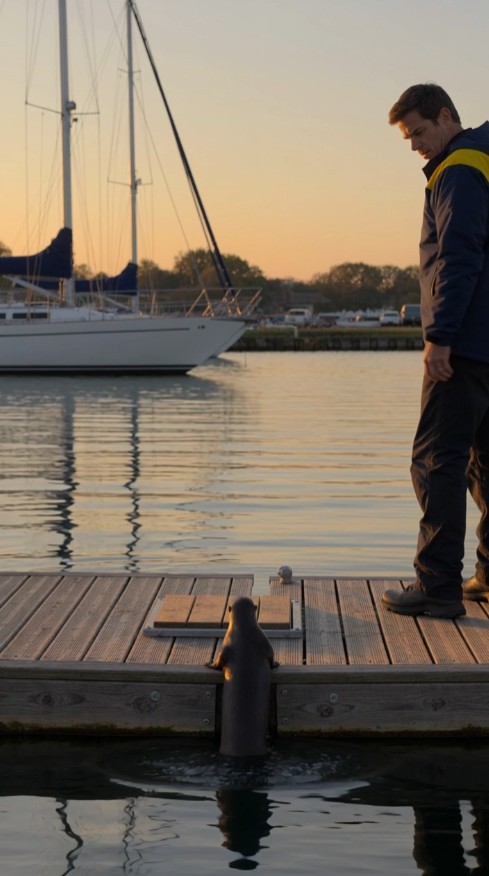
Every morning for nearly a week, a small brown otter appeared beside the same floating dock at Clearwater Harbor.
Fishing boats came and went. Seagulls circled overhead, and fishermen occasionally tossed scraps into the water.
But the otter wasn’t interested in food.
She climbed onto the dock, hurried toward a particular wooden panel, and looked down into the narrow opening beside it.
Then she slipped back into the water.
Minutes later, she returned.
Harbor worker Jack Miller noticed the unusual behavior during his morning inspection.
At first, he assumed the animal was searching for fish.
But when the otter appeared for the fourth time that morning, Jack became curious.
“What’s wrong, little one?” he whispered.
The otter suddenly disappeared beneath the dock.
Jack knelt near the railing and listened.
For several seconds, he heard only water moving against the wooden supports.
Then came a faint sound.
A tiny squeak.
Jack leaned closer.
Another squeak.
This time, unmistakably from beneath the floating platform.
He immediately contacted the local wildlife rescue team.
When rescuer Emma Collins arrived, she carefully opened an authorized maintenance hatch and shined her flashlight underneath.
Then she stopped moving.
“Oh my goodness.”
On a narrow support ledge, barely above the water, lay a tiny otter pup.
The baby was trembling, exhausted, and unable to climb back into the harbor.
But when Emma examined the situation more closely, she noticed something that completely changed the rescue plan.
The pup wasn’t alone.
And the second tiny animal was in much greater danger.
The Otter That Never Stopped Returning
Clearwater Harbor was home to a small population of wild river otters that occasionally visited the sheltered water near the fishing docks.
Most avoided people.
But one female had recently become a familiar sight.
She had a small pale marking beneath her chin and frequently appeared near the floating platforms during quiet mornings.
Jack had noticed her several times.
Unlike some animals that approached fishing boats looking for scraps, this otter seemed uninterested in human activity.
She moved quickly through the water, climbed onto an empty section of dock, and disappeared beneath the floating structures.
Jack assumed she was using the area as part of her normal hunting route.
But her behavior gradually changed.
She began visiting the same wooden panel repeatedly.
Sometimes she scratched at the edge.
Other times she lowered her head toward the water and made short, high-pitched calls.
Then she waited.
When Jack finally heard a faint squeak answering her, he realized there might be a trapped animal beneath the platform.
What Rescuers Found Below the Dock
Emma had worked with injured and orphaned wildlife for more than twelve years.
She knew that otter mothers could become distressed when separated from their young, and that interfering unnecessarily could make a difficult situation worse.
Before approaching, she asked Jack to clear the immediate area and keep boats away from the platform.
The mother otter remained in the water nearby.
Emma opened the maintenance hatch while another rescuer monitored the platform’s stability.
Her flashlight revealed a narrow wooden support ledge.
On it was a tiny brown otter pup.
Its fur was wet, and it appeared exhausted.
The little animal lifted its head and squeaked.
Emma immediately noticed that its movements were weak.
But then she heard another sound.
A softer squeak.
Coming from farther beneath the dock.
She moved her flashlight.
Behind a thick support beam, partially hidden by fishing rope and floating debris, was a second pup.
It was smaller than the first.
And it was struggling to keep its head above the water.
“Jack,” Emma called quietly, “there are two babies.”
Jack stared at her.
“Two?”
She nodded.
“And one of them needs help right now.”
The Hidden Danger Beneath the Platform
The second pup had become caught in a loop of discarded fishing line tangled around a submerged support.
Each time it tried to climb toward the ledge, the line restricted its movement.
The first pup remained nearby, calling repeatedly.
Emma realized that removing only the visible baby would leave the second one trapped.
She immediately revised the rescue plan.
The team needed to retrieve both pups safely while avoiding unstable sections beneath the floating dock.
A trained rescuer used appropriate equipment to reach the tangled pup and carefully free the line.
Another team member prepared a secure, ventilated carrier lined with soft material.
The mother otter surfaced several yards away.
She raised her head.
Then made another high-pitched call.
Both pups answered.
Jack felt his eyes fill with tears.
“She knows they’re there.”
Emma nodded.
“She can hear them.”
But she reminded him that they needed to work carefully.
Wild otters could become defensive, and the rescue team didn’t want anyone approaching the mother or attempting to handle the pups without proper precautions.
The Rescue That Almost Went Wrong
The first pup was carefully lifted from the ledge and placed in the carrier.
It squeaked loudly.
From the water, the mother answered.
The second pup was more difficult to reach.
The fishing line had wrapped around part of the wooden support and become caught in debris.
Emma’s colleague worked slowly, making sure the animal could be released without further harm.
Finally, the line came free.
But when the rescuer lifted the pup, it barely moved.
Emma’s expression changed.
The tiny animal was cold and weak.
She immediately assessed it and contacted the team’s wildlife veterinarian.
Jack watched anxiously from a safe position.
“Is it going to survive?”
Emma didn’t make promises.
“We’ve freed it. Now we need to get it assessed and stabilized.”
The team moved both pups to a nearby sheltered work area.
The larger pup was alert but tired.
The smaller one needed immediate supportive care.
Meanwhile, the mother continued swimming near the dock.
She repeatedly surfaced beside the wooden panel where Jack had first noticed her.
The Mother Who Refused to Leave
Throughout the morning, the mother otter remained close to the platform.
She swam around the supports, climbed briefly onto the dock, and returned to the water.
Several fishermen watched quietly from a distance.
One offered to bring fish scraps.
Emma declined.
Feeding wild otters could create additional problems, and the animal was clearly focused on locating her young.
Jack stood beside the harbor office, watching through binoculars.
The mother approached the hatch.
She lowered her head toward the opening.
Then called again.
There was no answer.
Both pups were receiving care away from the dock.
The otter remained near the platform for several minutes before disappearing beneath the water.
But she returned.
Again.
And again.
Jack had never seen anything like it.
“She keeps checking,” he said.
Emma glanced toward the water.
“Her babies were here. It makes sense that she’s staying close.”
The Smallest Pup’s Fight to Recover
At the wildlife rehabilitation facility, the veterinarian examined both otter pups.
The larger youngster was exhausted but had no obvious serious injuries.
The smaller pup showed signs of chilling and stress associated with its entrapment.
Fortunately, the fishing line hadn’t caused a major visible injury.
The team provided appropriate care and monitored the smaller animal closely.
For several hours, its condition remained uncertain.
Then it began responding more actively.
It lifted its head.
Moved its paws.
And eventually made a soft squeaking call.
Emma smiled.
It was an encouraging sign.
The veterinarian continued assessing whether both pups were strong enough for a prompt, supervised reunion with their mother.
For young otters, remaining with their mother is important for feeding, protection, and learning essential survival behaviors.
The rescuers wanted to reunite the family as soon as it was safe.
But they needed to be certain the smallest pup was ready.
The Sound That Changed Everything
The following morning, Emma returned to Clearwater Harbor with her team.
Both pups had improved, and the veterinarian had approved a carefully monitored reunification attempt.
Jack was waiting near the harbor office.
“Are they okay?”
Emma smiled.
“They’re doing much better.”
Jack looked relieved.
“And their mother?”
He pointed toward the dock.
“She was here twenty minutes ago.”
The team selected a quiet area near the same platform, away from boat traffic and curious visitors.
They placed the pups in a secure release enclosure and withdrew to a safe observation position.
Then they waited.
For several minutes, nothing happened.
The harbor was quiet.
A fishing boat passed in the distance.
Then a small brown head appeared above the water.
The mother otter.
She swam slowly toward the dock.
At first, she seemed uncertain.
Then the larger pup began calling.
The mother stopped.
Raised her head.
And answered.
The sound was immediate.
The smaller pup squeaked too.
And the mother moved toward them.
The Reunion That Left Everyone Silent
Once the rescuers confirmed that the mother was approaching and conditions were suitable, they opened the release enclosure remotely from a safe distance.
The two pups moved cautiously toward the water’s edge.
The larger one went first.
The smaller pup followed more slowly.
The mother surfaced directly in front of them.
For several seconds, she remained almost motionless.
Then she approached.
She sniffed the first pup and touched it gently with her nose.
The youngster pressed against her.
Then she turned toward the smaller baby.
The pup made a faint squeak.
The mother moved closer, making repeated contact with its face and shoulders.
Jack watched through binoculars.
His eyes filled with tears.
The mother gathered both pups close to her body.
For a moment, all three floated together beside the dock.
Then she turned toward a sheltered section of shoreline.
The larger pup followed.
But the smaller youngster hesitated.
It paddled slowly, struggling to keep up.
The mother turned back.
She approached the tiny pup and remained beside it until it began moving again.
Then, together, the three otters disappeared beneath the shadow of the reeds.
Nobody on the dock spoke.
The Detail Jack Could Never Forget
Jack had spent nearly twenty years working around boats and marine wildlife.
He had seen seals resting on floating platforms, seabirds nesting near abandoned equipment, and dolphins passing through the harbor.
But he had never witnessed a reunion like this.
What stayed with him wasn’t simply the moment the mother reached her pups.
It was the way she returned when the smaller one fell behind.
She had spent days searching around the same dock.
Then, when both babies were finally free, she stayed close until they could follow her.
Jack looked toward Emma.
“She went back for the little one.”
Emma smiled.
“She did.”
For the first time since discovering the trapped pups, Jack felt he could relax.
The animals were together.
And the harbor was quiet again.
How the Babies Became Trapped
The rescue team later examined the underside of the floating dock.
Recent storms had shifted debris beneath the structure.
Part of an old wooden support had created a narrow shelf above the waterline.
The two pups had apparently entered the space while exploring near their mother.
As the tide and water levels changed, they became stranded.
The smaller pup then became tangled in discarded fishing line.
The steep supports made it impossible for either baby to climb back to the open water.
Their mother couldn’t reach them through the narrow opening.
All she could do was remain nearby and respond to their calls.
Jack realized that the behavior everyone had mistaken for begging was likely an attempt by the mother to stay close to her trapped young.
She wasn’t approaching people because she wanted food.
She was repeatedly returning to the only place where she could hear her babies.
The Harbor Makes an Important Change
After the rescue, the harbor authority arranged an inspection of the floating dock and surrounding structures.
Workers removed abandoned fishing line, damaged rope, and other debris that could endanger wildlife.
The damaged support area was repaired, and the maintenance access points were improved.
Signs were installed asking visitors not to feed wild animals and to dispose of fishing equipment responsibly.
Jack also suggested adding regular inspections beneath floating platforms after storms.
He had learned how easily a small animal could become trapped in spaces that appeared harmless from above.
Emma agreed.
The rescue had highlighted the risks created by discarded fishing gear and poorly maintained waterfront structures.
The harbor began working more closely with local wildlife organizations to identify and address similar hazards.
A Familiar Visitor Returns
Several weeks later, Jack was inspecting the dock when he noticed movement near the reeds.
A small brown otter surfaced.
Then another.
And a third.
Jack reached for his binoculars.
The animals were swimming together along the shoreline.
One adult appeared to be accompanied by two smaller otters.
Jack couldn’t confirm their identities with certainty, but he hoped they were the family rescued from beneath the dock.
The youngsters moved confidently through the water.
One climbed onto a low rock and shook itself.
The other remained close to the adult.
Jack smiled.
Then he quietly stepped away, giving the animals space.
He didn’t call out.
He didn’t offer food.
He simply watched them disappear into the reeds.
The Photograph That Told the Story
During the rescue, one of the harbor staff had taken a photograph from a safe observation point.
It showed the mother otter standing on the floating dock, looking down toward the wooden panel.
Another photograph captured the two pups after they were safely removed.
But Jack’s favorite picture showed the family reunion.
The mother floated beside her babies near the edge of the dock.
Both pups were close enough to touch her.
Jack printed the photograph and placed it in the harbor office.
Beneath it, he wrote:
“Sometimes they’re not asking for food. Sometimes they’re asking us to notice.”
The photograph became a reminder to employees and visitors that unusual animal behavior could have many explanations.
And that helping wildlife often begins with observing carefully and contacting trained professionals.
The Otter Who Changed Jack’s Mornings
Before the rescue, Jack rarely paid much attention to the otters moving around the harbor.
They were simply another part of the waterfront.
Afterward, he began noticing their movements more carefully.
He watched where they climbed onto rocks, how they moved through the reeds, and how they avoided busy areas.
He learned more about the challenges otters faced near developed waterways.
And he became increasingly concerned about discarded fishing equipment.
Jack started carrying an extra collection bag during his dock inspections.
Whenever he found loose line or rope in accessible areas, he arranged for its safe removal.
Other harbor workers began doing the same.
The changes were small.
But they helped make the waterfront safer for wildlife.
The Morning Everything Was Different
A year after the rescue, Jack returned to the same floating dock at sunrise.
The harbor was peaceful.
Fishing boats moved slowly through the water.
Seagulls called overhead.
And the wooden panel where the mother otter had repeatedly appeared was quiet.
Jack knelt near the repaired hatch.
He remembered the first tiny squeak.
He remembered Emma discovering the two trapped pups.
And he remembered the mother waiting nearby while the rescue team worked.
At the time, he had no idea how much that morning would affect him.
He had simply noticed that one small otter kept returning to the same place.
But that observation helped save two young animals.
Jack stood and looked toward the reeds.
Then he smiled.
“Hope you’re all doing well out there.”
The Mother Otter Who Refused to Give Up
For nearly a week, a small brown otter had appeared beside the same floating dock at Clearwater Harbor.
People assumed she was looking for food.
But she ignored the scraps and repeatedly returned to one particular wooden panel.
Harbor worker Jack Miller finally noticed her unusual behavior.
When he listened beneath the dock, he heard a tiny squeak.
Wildlife rescuers discovered one otter pup stranded on a narrow ledge.
Then they found a second baby trapped in discarded fishing line.
Both were exhausted, and the smaller pup needed urgent care.
After a careful rescue and veterinary assessment, the youngsters were returned to the harbor for a supervised reunion.
A mother otter repeatedly climbed onto a floating dock, refusing food and looking down through the same narrow opening.
Beneath the platform, rescuers discovered two tiny pups trapped near a wooden support, one of them tangled in fishing line.
The babies were safely freed, assessed, and eventually returned to the shoreline where their mother was waiting.
And when the smallest pup struggled to follow, the mother turned back and stayed beside it until all three disappeared together into the reeds.
What everyone had mistaken for an animal begging for food was a mother remaining close to the babies she couldn’t reach — refusing to abandon them until they were safe again.