
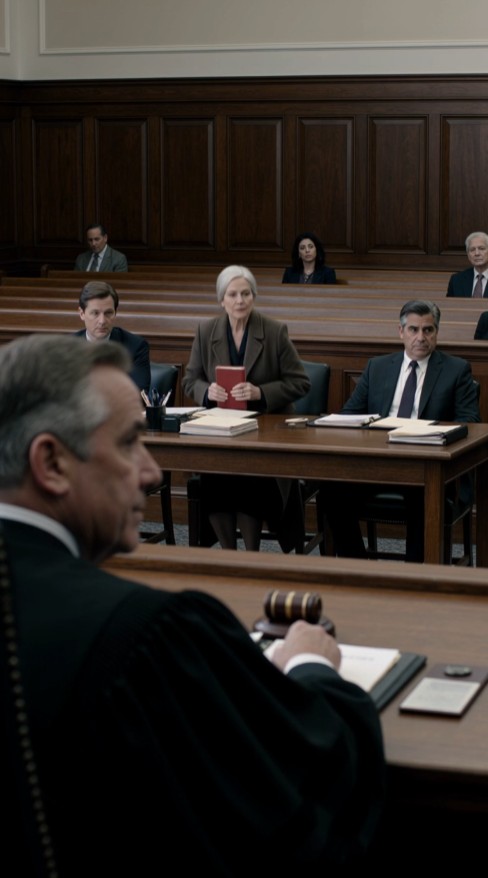
The courtroom fell silent when seventy-nine-year-old Margaret Sullivan stood from the back row and raised a tiny red notebook.
“Your Honor, that farmhouse doesn’t belong to him.”
Across the courtroom, wealthy property developer Richard Whitmore leaned back in his chair and laughed.
“Who let her in here?”
Richard had spent six months fighting for ownership of a valuable farmhouse and nearly forty acres of surrounding land. His attorneys were confident. The documents appeared to show that the property had been transferred to him decades earlier.
Margaret wore a faded brown coat and carried a handbag with a broken clasp.
She had no expensive lawyer sitting beside her.
But she had something Richard didn’t expect.
Thirty-one years of records.
The judge instructed Margaret to approach through the proper procedure so the documents could be examined.
She placed the red notebook on the table.
Inside were handwritten dates, payment records, receipts, and signatures stretching back more than three decades.
Then she removed a faded photograph.
It showed Richard as a young man standing outside the farmhouse beside a little girl in a yellow dress.
Richard stopped smiling.
“Where did you get that?”
Margaret looked directly at him.
“You remember her, don’t you?”
Richard said nothing.
Then Margaret whispered:
“Tell the judge what happened to your sister.”
Several people gasped.
Richard had spent years telling business associates that he was an only child.
But the photograph showed otherwise.
And what Margaret revealed next threatened not only his claim to the farmhouse, but the story he had told about his family for thirty-one years.
The Farmhouse Everyone Wanted
The farmhouse stood on a hill outside Brookfield, surrounded by apple trees, open fields, and a narrow stream.
For generations, the property had belonged to the Whitmore family.
Richard’s father, Henry, had inherited it from his parents and spent much of his life maintaining the land.
Although the house was modest, its location had become increasingly valuable.
A new highway was being planned nearby, and commercial developers had begun purchasing neighboring properties.
Richard recognized an opportunity.
He wanted to demolish the farmhouse and develop the land into a luxury residential community.
But there was a problem.
The property records were complicated.
For years, Margaret Sullivan had been listed as the person responsible for managing the farmhouse and paying certain expenses.
Richard claimed she was merely a caretaker.
Margaret insisted that the property had been entrusted to her for someone else.
When Richard attempted to take possession, the dispute reached court.
He arrived believing the case would be resolved quickly.
Then Margaret opened her notebook.
The Little Girl in the Photograph
The photograph was taken thirty-one years earlier.
Richard was twenty-three.
Beside him stood his eight-year-old sister, Emily.
They were standing on the farmhouse porch, smiling beneath a wooden sign their father had carved.
Margaret had taken the picture herself.
She had worked for the Whitmore family as a housekeeper and later helped Henry manage the property.
Emily had been especially close to her.
The little girl loved feeding the chickens, picking apples, and sitting with her father while he repaired old furniture.
Richard, however, had never been interested in farm life.
He wanted to become wealthy.
He dreamed of building companies, buying expensive cars, and moving to the city.
As the years passed, he and his father argued frequently about money.
Then Henry became seriously ill.
And everything changed.
The Promise Henry Made Before He Died
Several months before his death, Henry called Margaret into his study.
He was worried about Emily’s future.
Richard had already left home and was struggling with debts from an unsuccessful business venture.
Henry feared his son might eventually sell the family property to cover those obligations.
He wanted Emily to have somewhere safe to return to when she became an adult.
So Henry arranged for the farmhouse and surrounding land to be held for Emily’s benefit under a formal trust.
Margaret was appointed to help administer the property until Emily reached adulthood, working alongside a professional trustee.
Henry also left a separate inheritance for Richard.
The arrangement was documented through legal paperwork.
But Henry asked Margaret to keep additional personal records.
“I don’t want Emily to grow up believing she has nothing,” he told her.
Margaret promised she would protect the farmhouse.
Then Henry died.
And the family began falling apart.
The Day Emily Disappeared From the Farm
After Henry’s funeral, Emily went to live with relatives while arrangements for her care were being finalized.
Richard was angry about the inheritance.
He believed that as the eldest son, he should control the entire property.
He accused Margaret of influencing his father.
Then, during a heated argument, Richard announced that he was leaving town.
Shortly afterward, Emily was taken to live with an aunt in another state.
Margaret received occasional letters at first.
But the correspondence eventually stopped.
The aunt moved.
Addresses changed.
And Margaret lost contact with the little girl.
Richard later told acquaintances that Emily had died when she was young.
He never mentioned having a sister again.
Margaret suspected the story was false, but she had no reliable information about Emily’s whereabouts.
For years, she continued helping manage the farmhouse.
And every payment she made was recorded in the red notebook.
The Thirty-One Years of Records
Margaret opened the notebook to its first page.
The date was written in blue ink.
Below it was an entry for a roof repair.
The next page documented property taxes.
Then came insurance payments, maintenance expenses, and deposits made into the trust’s account.
Margaret had kept copies of receipts beside many entries.
Some pages contained notes from meetings with the original trustee.
Others included correspondence concerning attempts to locate Emily.
But the most important pages were near the back.
They documented a series of unusual transactions that occurred after the professional trustee retired.
Richard had approached a successor administrator, claiming Emily was deceased and that he was entitled to the property.
The records included copies of documents submitted to support that claim.
Margaret believed something was wrong.
She had never seen proof of Emily’s death.
And she remembered Henry’s instructions clearly.
So she preserved everything.
When Richard eventually began proceedings to take full ownership, Margaret knew she couldn’t remain silent.
The Document That Changed the Hearing
The judge examined the materials and asked that the relevant originals and certified records be produced for verification.
Margaret explained that she had already provided copies to the court through the opposing legal team, but she had retained the notebook to establish the chronology.
Richard’s attorney objected to treating handwritten notes as conclusive proof.
The judge agreed that the notebook alone couldn’t establish ownership.
But several entries pointed to documents that had not yet been fully reviewed.
Among them was a certified copy of Henry’s original trust agreement.
It identified Emily as the principal beneficiary of the farmhouse.
More importantly, it contained conditions governing any transfer or sale.
Richard’s claim depended on the assertion that Emily had died without descendants.
But the supporting death document raised questions.
The identifying information didn’t match the birth records of Emily Whitmore.
The judge ordered further examination of the discrepancy.
Richard shifted uncomfortably in his seat.
Margaret turned another page.
“There’s something else, Your Honor.”
The Letter That Nobody Expected
Inside the notebook was a sealed envelope dated three months earlier.
Margaret had received it from a woman named Emily Carter.
The letter began:
“Dear Mrs. Sullivan,
You may not remember me, but I remember you.
I remember the apple orchard, the wooden swing, and the kitchen where you used to bake bread.
My name was Emily Whitmore when I lived at the farmhouse.
I have spent years trying to understand what happened to my father’s property.
Recently, I discovered documents suggesting that my brother may have told people I died.
I want you to know that I’m alive.
And I have a daughter of my own.”
The courtroom became completely silent.
Margaret had finally found Emily.
After decades of searching, the little girl in the photograph had written to her.
And she was no longer a child.
She was thirty-nine years old.
The Woman Waiting Outside the Courtroom
Margaret looked toward the judge.
“Your Honor, Emily is here.”
Richard turned sharply.
“What?”
Margaret nodded toward the courtroom entrance.
A woman stood beside a teenage girl.
She had dark hair, familiar brown eyes, and a small scar near her chin.
Margaret recognized her immediately.
It was Emily.
The woman Richard had spent years claiming was dead.
Emily entered with her legal representative after being called to participate in the hearing.
Richard stared at her.
For several seconds, he couldn’t speak.
Then he whispered:
“Emily?”
She looked at him calmly.
“Hello, Richard.”
He lowered his eyes.
The little girl in the photograph had grown into a woman.
And she had returned for the home their father wanted her to have.
What Really Happened to Emily
Emily explained that after Henry’s death, she had been sent to live with her aunt, Patricia.
The move was supposed to be temporary.
But Patricia eventually became her legal guardian and moved to another state.
Emily grew up believing that the farmhouse had been sold to pay her father’s debts.
She was told that Richard had moved away and wanted no contact.
As a teenager, she occasionally asked about Margaret.
But Patricia claimed she didn’t know where the former housekeeper lived.
Years later, Emily married and took her husband’s surname.
She became a school librarian and raised a daughter named Sophie.
After Patricia’s death, Emily found an old box of family documents.
Inside was a copy of Henry’s trust agreement.
She began investigating.
And for the first time, she learned that her father had intended the farmhouse to remain available for her benefit.
She also discovered correspondence suggesting that Richard had been informed of her address years earlier.
But he never contacted her.
Instead, he continued pursuing control of the property.
The Question Emily Asked Her Brother
Richard sat silently as Emily spoke.
Then she turned toward him.
“Why did you tell people I died?”
Richard looked away.
Emily waited.
Finally, he answered.
“Because I thought the property should have been mine.”
The admission brought murmurs from the gallery.
Richard continued.
“I worked for years to build my business. Father left you the farm even though you were just a child.”
Emily stared at him.
“So you decided I didn’t exist?”
Richard didn’t answer.
She shook her head.
“I wasn’t asking you for money, Richard.”
Her voice trembled.
“I wanted to know why my brother never came looking for me.”
Richard lowered his head.
For the first time, the wealthy businessman appeared smaller than the elderly woman who had interrupted the hearing.
The Judge’s Decision
The court did not issue a final ownership ruling based solely on Margaret’s notebook or Emily’s appearance.
Instead, the judge ordered additional verification of the trust documents, the disputed death record, and the chain of property transactions.
The immediate request to transfer possession to Richard was denied pending that review.
The proposed sale and demolition were placed on hold through appropriate interim orders.
Over the following months, investigators examined the records.
They confirmed that Emily was alive and that the disputed death document did not refer to her.
The original trust agreement remained legally relevant, and Richard’s claim to sole ownership could not be supported as presented.
The court ultimately recognized Emily’s beneficial interest under the trust, subject to the required administrative proceedings.
Separate questions about misleading statements and improper documents were referred for further examination.
For Richard, the result was devastating.
He had entered the courtroom expecting to obtain a valuable property.
Instead, the proceedings exposed the sister he had concealed and the records he had relied upon.
The Notebook Margaret Almost Threw Away
After the hearing, Emily approached Margaret outside the courthouse.
The elderly woman stood beside the steps, holding the tiny red notebook.
Emily began crying.
“Mrs. Sullivan?”
Margaret looked up.
For a moment, she saw the little girl who used to run through the farmhouse garden.
“Oh, Emily.”
They embraced.
Margaret held her tightly.
“I looked for you.”
Emily nodded through tears.
“I know that now.”
Margaret showed her the notebook.
“I kept all the records because your father asked me to protect the house.”
Emily touched the worn red cover.
“You did.”
Margaret smiled sadly.
“There were times I thought about throwing it away. Nobody seemed to care anymore.”
Emily shook her head.
“I’m glad you didn’t.”
Then Sophie stepped forward.
“Mom, is this the lady who taught you how to make apple pie?”
Emily laughed through tears.
“Yes, sweetheart.”
Margaret looked surprised.
“You remember that?”
Emily smiled.
“Every bit of it.”
The Farmhouse Finally Opens Again
Several months later, Emily returned to the farmhouse with Margaret and Sophie.
The property had remained largely unchanged.
The porch needed repairs.
The garden was overgrown.
And the wooden swing beneath the apple tree had disappeared.
But the house was still standing.
Emily stepped through the front door.
The familiar smell of old wood filled the hallway.
She remembered her father sitting at the kitchen table.
She remembered Margaret kneading bread.
And she remembered running upstairs to her little bedroom beneath the roof.
Sophie looked around.
“Mom, you really lived here?”
Emily nodded.
“When I was little.”
Sophie smiled.
“It’s beautiful.”
Emily looked toward the window.
“It needs a lot of work.”
Margaret laughed.
“It always did.”
The Discovery in Henry’s Old Study
While sorting through the farmhouse, Emily discovered a small wooden box inside her father’s old desk.
The box contained several photographs and a handwritten note.
It was addressed to her.
“My dearest Emily,
One day, when you’re older, I hope you’ll sit beneath the apple tree and remember how much we loved you here.
This house isn’t valuable because of its land or its walls.
It’s valuable because of the memories we made inside it.
I want you to have a place where you always know you belong.
Even when life changes.
Even when people disappoint you.
You will always have a home here.
Love, Dad.”
Emily sat on the edge of the old wooden chair.
Tears rolled down her cheeks.
For thirty-one years, she believed her childhood home had been lost.
Now she was reading a letter from her father explaining why he had tried to protect it.
Sophie sat beside her.
“Mom?”
Emily smiled through tears.
“Yes?”
“Can we fix it?”
Emily looked around the room.
Then she nodded.
“I think that’s exactly what Grandpa would have wanted.”
The Choice Emily Made About the Farm
Emily didn’t want to turn the property into an expensive estate.
She also didn’t want to preserve every broken board simply because it was old.
Instead, she arranged for the farmhouse to be inspected and restored where practical.
The roof was repaired.
The porch was strengthened.
And the garden was cleared.
Sophie helped plant flowers beside the kitchen windows.
Margaret visited whenever she could.
The family also restored the old apple orchard.
But Emily made one decision that surprised the neighbors.
She set aside part of the property for a small community garden and educational program.
Local children could visit, learn about growing food, and participate in supervised activities.
Emily explained that her father had always helped neighbors.
She wanted the farmhouse to continue that tradition.
Richard’s Final Visit
Nearly a year after the hearing, Richard returned to Willow Street.
He parked outside the restored farmhouse.
For several minutes, he remained in his car.
Then he walked toward the porch.
Emily was working in the garden when she saw him.
She stood slowly.
“Richard.”
He nodded.
“Emily.”
The conversation was uncomfortable.
Richard admitted that his obsession with the property’s value had damaged their relationship.
He acknowledged that his decisions had contributed to decades of separation.
He didn’t ask her to forget what happened.
And Emily didn’t offer immediate forgiveness.
But she listened.
Finally, Richard looked toward the apple tree.
“I remember Father building that swing.”
Emily nodded.
“So do I.”
For a moment, they stood quietly.
Then Richard said, “I’m sorry.”
Emily looked at him.
“I needed you to be my brother.”
His eyes filled with tears.
“I know.”
She took a breath.
“I don’t know what our relationship will look like now.”
Richard nodded.
“I understand.”
“But maybe we can begin by telling the truth.”
He lowered his head.
“I’d like that.”
The Last Entry in the Red Notebook
On Margaret’s eightieth birthday, Emily invited her to the farmhouse for dinner.
Sophie decorated the kitchen with flowers.
A homemade apple pie sat in the center of the table.
Margaret smiled when she saw it.
“You remembered my recipe.”
Emily laughed.
“Of course.”
After dinner, Emily handed Margaret a small wrapped gift.
Inside was a new leather-bound notebook.
Margaret looked confused.
“What’s this for?”
Emily smiled.
“You spent thirty-one years writing down everything needed to protect this house.”
She opened the notebook.
On the first page was a photograph of Margaret standing beside Emily and Sophie on the restored farmhouse porch.
Beneath it were the words:
“The promise was kept. Now the memories begin again.”
Margaret began crying.
Then she reached into her handbag and removed the original red notebook.
Its cover was faded.
Its pages were worn.
But the records inside had helped preserve a family’s history.
Margaret opened to the final blank page.
With trembling hands, she wrote:
“Today, Emily came home.”
The Farmhouse That Was Worth More Than Money
For thirty-one years, Margaret Sullivan had protected a small red notebook filled with receipts, signatures, and records of payments.
To Richard Whitmore, the notebook initially looked worthless.
He believed his wealth, attorneys, and property documents would guarantee him ownership of the valuable farmhouse.
But Margaret’s records led to a much larger discovery.
The property had been placed in trust for Richard’s younger sister, Emily.
And Emily was alive.
The little girl in the photograph had grown into a woman with a family of her own.
When she returned, she didn’t see the farmhouse as a business opportunity.
She saw the home where her father had loved her.
A place she believed was lost forever.
A wealthy businessman laughed when an elderly housekeeper interrupted his court hearing with a tiny red notebook.
But the notebook contained thirty-one years of records connected to a farmhouse he was trying to claim.
Then the woman produced a photograph showing the businessman beside his younger sister, whom he had spent years telling people was dead.
When the sister appeared in court, the disputed ownership documents were examined, and the truth about their father’s final wishes was finally revealed.
And in the end, the most valuable thing Margaret had protected wasn’t the farmhouse or the land surrounding it.
It was a father’s promise that his little girl would always have somewhere to call home.