
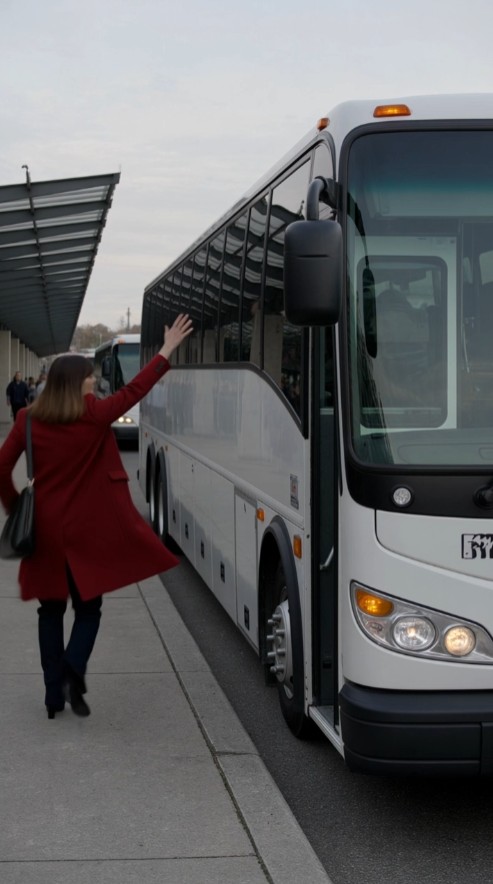
Forty passengers were waiting impatiently when a woman in a red coat ran toward a bus that was seconds away from leaving the terminal.
“STOP THAT BUS!”
The driver, Michael Turner, lowered his window.
“Ma’am, what’s the problem?”
The woman pointed beneath the vehicle.
“There’s someone in the luggage compartment.”
Several passengers laughed. One man complained that they were already twenty minutes late.
Michael looked toward the storage doors.
“That’s impossible. We finished loading.”
But the woman refused to move.
She knelt beside the stationary bus and pressed her ear toward the compartment.
“Just listen.”
Michael reluctantly stepped down from the driver’s seat.
For several seconds, there was nothing but the noise of engines and people talking.
Then he heard it.
Three faint knocks.
A pause.
Three more.
Michael’s expression changed.
He immediately switched off the engine, secured the vehicle, and called the terminal supervisor.
When the luggage compartment was opened, everyone fell silent.
A young employee was crouched among the suitcases, trembling and struggling to catch his breath.
His name was Daniel Carter.
He was twenty-three years old.
And he had been trapped inside while loading the passengers’ luggage.
As workers helped him out, Daniel began crying.
“I thought you were going to drive away.”
Then he reached into his pocket and handed the woman a folded piece of paper.
She read the first line.
Her face changed.
“The rear wheel was damaged before departure. I reported it. Please don’t let this bus leave.”
But the warning wasn’t the only surprise.
Because when Daniel finally looked at the woman who had heard his knocking, he recognized something about her.
Something connected to a terrible accident that happened fifteen years earlier.
The Woman Nobody Wanted to Listen To
The woman in the red coat was sixty-two-year-old Helen Brooks, a retired emergency medical technician.
She had arrived at the terminal that morning to collect her granddaughter, whose earlier bus had been delayed.
Helen wasn’t planning to travel.
She was simply waiting near the departure bays when she noticed an unusual sound.
At first, she thought someone was tapping on a metal railing.
Then she heard it again.
Three knocks.
A pause.
Three more.
The sound appeared to come from beneath a large coach parked beside the terminal.
Helen stopped walking.
She listened carefully.
Something about the rhythm troubled her.
It sounded deliberate.
Not like loose equipment rattling.
Not like luggage shifting.
Like someone asking for help.
She approached the terminal staff and explained what she had heard.
But everyone was busy preparing for departure.
One employee suggested it was probably a mechanical noise.
Another told her passengers were already boarding.
Helen insisted that the compartment needed to be checked.
Nobody acted.
Then she saw the driver closing the doors.
And she began running.
How Daniel Became Trapped
Daniel Carter had worked at the terminal for only six months.
He was a quiet young man who took his responsibilities seriously.
His duties included organizing luggage, helping drivers prepare for departure, and reporting visible damage or equipment concerns.
That morning, he was assigned to a coach carrying forty passengers to a city nearly three hours away.
While loading suitcases, Daniel noticed a problem near the rear wheel.
A section of the tire’s sidewall appeared damaged.
He reported it to the loading supervisor and wrote down the vehicle number, the time, and his observations.
The supervisor said he would notify the driver.
Daniel returned to his duties.
While placing a large suitcase farther inside the luggage compartment, he crawled into the storage space to reposition several bags.
Someone outside closed the compartment door without realizing Daniel was still inside.
The latch engaged.
Daniel was trapped.
At first, he shouted.
But the terminal was noisy.
Engines were running.
Passengers were talking.
And announcements echoed through the building.
Nobody heard him.
He tried his phone, but its battery was nearly empty.
His calls failed before he could reach anyone.
Then he began knocking against the metal door.
Three times.
A pause.
Three more.
He repeated the signal until his hands hurt.
The Warning Written on the Paper
Daniel had written the note before he became trapped.
It was intended for the vehicle supervisor.
The first line read:
“Bus 217 — visible damage to rear tire sidewall. Vehicle requires inspection before departure.”
Below it, Daniel had recorded the time and the loading bay number.
Helen showed the note to Michael.
The driver’s expression changed.
“Why wasn’t I told?”
The terminal supervisor took the paper and contacted the fleet maintenance team.
The bus was kept out of service while a qualified mechanic inspected it.
The passengers were directed to the waiting area.
Several complained.
Others began asking what was happening.
Michael explained that a worker had been trapped in the luggage compartment and that a mechanical safety concern was being checked.
The mood changed immediately.
The people who had laughed at Helen only minutes earlier began looking toward the bus with concern.
The Damage Nobody Had Checked
The mechanic inspected the rear wheel and confirmed that the tire had significant sidewall damage.
The defect required the tire to be replaced before the coach could safely operate.
The maintenance team also reviewed the loading procedures and the compartment door.
Although there was no evidence that the tire would necessarily have failed during that journey, allowing the bus to depart without addressing the visible defect would have created an unacceptable risk.
Michael was shaken.
He hadn’t received Daniel’s report.
He had also been preparing to leave without realizing an employee remained inside the luggage compartment.
Two serious problems had been discovered before departure.
Both could have been prevented by better communication and proper checks.
The terminal manager ordered the coach removed from service.
A replacement vehicle was arranged for the passengers.
Then attention returned to Daniel.
The Young Man Who Couldn’t Stop Shaking
Daniel sat inside the terminal office while medical personnel assessed him.
He was frightened and exhausted but had no obvious serious injuries.
Helen waited nearby.
When Daniel finally looked up, he whispered, “Thank you.”
She smiled.
“I’m glad I heard you.”
He shook his head.
“I kept knocking. Nobody answered.”
Helen pulled a chair closer.
“Sometimes it takes a little while for someone to notice.”
Daniel looked at her red coat.
Then his expression changed.
“Have we met before?”
Helen shook her head.
“I don’t think so.”
Daniel studied her face.
Then he asked something unexpected.
“Did you used to work on ambulances?”
Helen looked surprised.
“Yes. For more than thirty years.”
Daniel swallowed.
“Were you working fifteen years ago?”
She nodded.
“Why?”
He reached into his wallet.
And removed an old photograph.
The Photograph That Changed Everything
The photograph showed a woman in a red emergency-services jacket kneeling beside a little boy.
The child had dark hair and a small bandage near his forehead.
Behind them stood an ambulance.
Helen stared at the picture.
She recognized the uniform immediately.
It was hers.
The boy was sitting on a blanket, holding a small toy car.
She looked toward Daniel.
“Where did you get this?”
His eyes filled with tears.
“That’s me.”
Helen covered her mouth.
Daniel explained that fifteen years earlier, when he was eight, he had been traveling with his parents when their car was involved in a serious road accident.
Emergency services arrived.
His father was injured.
His mother was frightened.
And Daniel had become trapped in the rear passenger area.
He remembered calling for help.
But the sounds of traffic and emergency vehicles made it difficult for responders to hear him.
Then a woman in a red jacket approached.
She listened near the car.
And she heard him.
That woman was Helen.
The Signal Helen Remembered
Helen sat completely still as Daniel continued.
“You told me to knock three times if I could hear you.”
She stared at him.
The memory returned.
A frightened little boy.
A damaged car.
And three faint knocks from inside.
Helen had used simple signals to communicate with Daniel while responders worked to reach him safely.
After he was freed, she stayed beside him until he was reunited with his mother.
Before leaving, a colleague took a photograph of Helen and Daniel with his parents’ permission.
Daniel’s family kept the picture for years.
He never forgot her.
And he never forgot the three knocks.
When he became trapped inside the bus compartment, he remembered the signal.
So he used it again.
Helen began crying.
“Daniel?”
He nodded.
“You saved me when I was eight.”
His voice broke.
“And today, you saved me again.”
The Promise Daniel Made as a Child
Daniel explained that after the accident, he became fascinated by emergency workers.
He remembered how calm Helen had been and how she reassured him while he waited to be freed.
For years, he wanted to become a firefighter or paramedic.
But his family struggled financially.
When he finished school, he needed to work.
He accepted the terminal job while saving money for further training.
Still, he kept the photograph.
It reminded him of the woman who once told him something he never forgot.
“When you’re frightened, don’t give up trying to be heard.”
Helen wiped her eyes.
“I remember telling you that.”
Daniel smiled through tears.
“I never forgot.”
Then he looked toward the bus outside.
“When I was trapped, I was so scared. But I kept knocking because I thought someone might hear.”
Helen reached for his hand.
“And someone did.”
The Passengers Who Came Back to Apologize
While Daniel recovered, several passengers approached the terminal manager.
They wanted to know whether the young luggage handler was okay.
One man had shouted angrily when Helen first demanded that the bus stop.
His name was Robert Ellis.
He asked whether he could speak with her.
Helen agreed.
Robert stood awkwardly near the office doorway.
“Ma’am, I owe you an apology.”
Helen looked up.
He continued.
“I laughed when you said someone was inside. I thought you were holding everyone up for nothing.”
She nodded.
“I understand.”
Robert shook his head.
“No. I should’ve listened.”
He glanced toward Daniel.
“That young man could have been taken away inside the compartment.”
Helen answered gently.
“The important thing is that the driver stopped and checked.”
Robert looked toward the replacement bus.
Then he said, “I’m going to remember this.”
The Investigation That Followed
The bus company reviewed the incident.
Investigators established that Daniel had correctly reported the visible tire damage.
But the information had not reached the driver before departure.
They also found that the luggage compartment had been closed without a final personnel check.
The company introduced additional procedures.
Loading staff were required to confirm they had exited storage spaces before doors were secured.
Supervisors had to document safety concerns and ensure drivers received them.
And drivers were instructed to verify that luggage compartments were clear before departure.
The terminal also established a clearer way for passengers and bystanders to report urgent concerns.
Management acknowledged that Helen’s warning had initially been dismissed.
That failure became part of the staff training.
The Letter Helen Received One Week Later
A week after the incident, Helen received an envelope at her home.
Inside was a handwritten letter from Daniel.
“Dear Mrs. Brooks,
I don’t know whether you remember everything about the accident fifteen years ago, but I remember you.
I remember your voice.
I remember how you told me to stay calm.
And I remember the three knocks.
When I was trapped inside the bus, I thought nobody would hear me.
Then someone did.
And somehow, it was you again.
I don’t believe I’ll ever be able to explain what that means to me.
Thank you for helping me when I was a child.
And thank you for refusing to walk away when I needed help again.
With gratitude, Daniel Carter.”
Helen read the letter twice.
Then she placed it beside the old photograph.
For fifteen years, she had wondered what happened to some of the children she helped during her emergency-services career.
Now one of them had found her again.
And the reunion had happened in the most unexpected way.
The Young Man Who Finally Followed His Dream
Several months later, Daniel contacted Helen with good news.
He had been accepted into a training program for emergency medical services.
After the incident, he decided he didn’t want to keep postponing his dream.
His family supported him.
The terminal company helped him arrange a more flexible work schedule while he studied.
Helen was delighted.
“I always thought you’d make a good helper,” she told him.
Daniel laughed.
“You knew me for about twenty minutes when I was eight.”
Helen smiled.
“Sometimes that’s enough to see someone’s character.”
He shook his head.
“Well, I hope I can make you proud.”
She answered immediately.
“You already have.”
The Reunion at the Training Ceremony
Nearly two years later, Helen attended Daniel’s emergency medical technician certification ceremony.
She sat beside his mother in the front row.
Daniel had worked hard to complete his training.
When his name was called, he stepped forward to receive his certificate.
Then he looked toward Helen.
She smiled proudly.
After the ceremony, Daniel approached her.
“I brought something for you.”
He handed her a small framed photograph.
On one side was the picture of Helen helping him after the car accident when he was eight.
On the other was a new photograph of the two of them standing outside the bus terminal after his rescue.
Beneath the pictures were the words:
“Fifteen years apart. The same three knocks. The same person who listened.”
Helen began crying.
Daniel hugged her.
Then he whispered, “Now it’s my turn to help people.”
The First Time Daniel Heard Someone Knocking
During his first year working in emergency services, Daniel attended a call involving a person trapped inside a damaged building.
The rescue team was already on scene.
Daniel helped with patient assessment after firefighters gained access.
Later, he told Helen about the experience.
He had heard knocking from behind a closed door while responders coordinated the rescue.
The sound immediately reminded him of his childhood accident and the bus terminal.
He told his colleagues.
And when the trapped person was brought to safety, Daniel couldn’t stop thinking about how frightened they must have felt.
He called Helen that evening.
“Do you know what I realized today?”
“What?”
“Sometimes the most important thing you can do is believe someone who says they need help.”
Helen smiled.
“That’s a good lesson.”
Daniel paused.
“I learned it from you.”
The Woman in the Red Coat
Helen continued visiting the bus terminal occasionally.
Not because she expected another emergency.
But because Daniel’s story reminded her how meaningful ordinary attention could be.
She often thought about that morning.
Forty passengers were waiting.
The driver was preparing to leave.
Everyone was frustrated about the delay.
And she was the only person who stopped to listen.
The sound was faint.
Three knocks.
A pause.
Then three more.
She could have ignored it.
She could have assumed it was luggage shifting.
She could have listened to the people who laughed at her.
But she didn’t.
She trusted what she heard and asked the driver to check.
That decision helped prevent a dangerous departure.
And it brought her face to face with a boy she had helped fifteen years earlier.
The Sound That Connected Two Rescues
On the anniversary of the bus-terminal incident, Daniel visited Helen at her home.
They sat at the kitchen table looking through old photographs.
Helen brought out the picture from the car accident.
Daniel laughed.
“I can’t believe how small I was.”
Helen smiled.
“You were very brave.”
He shook his head.
“I was terrified.”
“Being brave doesn’t mean you weren’t scared.”
Daniel considered that.
Then he looked at the red coat hanging near her front door.
“Do you still wear that?”
Helen laughed.
“Sometimes.”
He smiled.
“Good.”
“Why?”
“Because I think it brings people luck.”
Helen shook her head.
“It wasn’t the coat, Daniel.”
He looked at her.
She smiled.
“It was the knocking.”
Daniel laughed.
Then he grew quiet.
“No,” he said softly. “It was the person who listened.”
The Bus That Never Left on Time
The forty passengers eventually reached their destination safely on a replacement coach.
The original bus remained out of service until the damaged tire was replaced and the vehicle passed the required checks.
The incident prompted changes in terminal procedures and reminded employees that safety warnings must be taken seriously.
But for Daniel and Helen, the morning meant something far more personal.
Fifteen years earlier, a frightened eight-year-old boy had knocked three times from inside a damaged car.
Helen heard him.
She helped him stay calm until responders reached him.
Years later, that same boy became trapped inside the luggage compartment of a bus.
He knocked three times again.
And the person who heard him was the very same woman.
A woman in a red coat stopped a bus carrying forty passengers after hearing faint knocking from the luggage compartment.
Inside, workers found a young luggage handler who had become trapped while loading suitcases.
He also carried a written warning about a damaged rear tire that needed inspection before the bus could depart.
But the most emotional discovery came when the young man recognized the woman who heard his knocking. Fifteen years earlier, she had helped rescue him from a car accident when he was just eight years old.
And the three-knock signal that helped him communicate with rescuers as a child was the same one that brought someone to his aid again.
Sometimes, the most important thing we can do isn’t something extraordinary. It’s refusing to ignore a quiet call for help, even when everyone else insists there’s nothing wrong.