
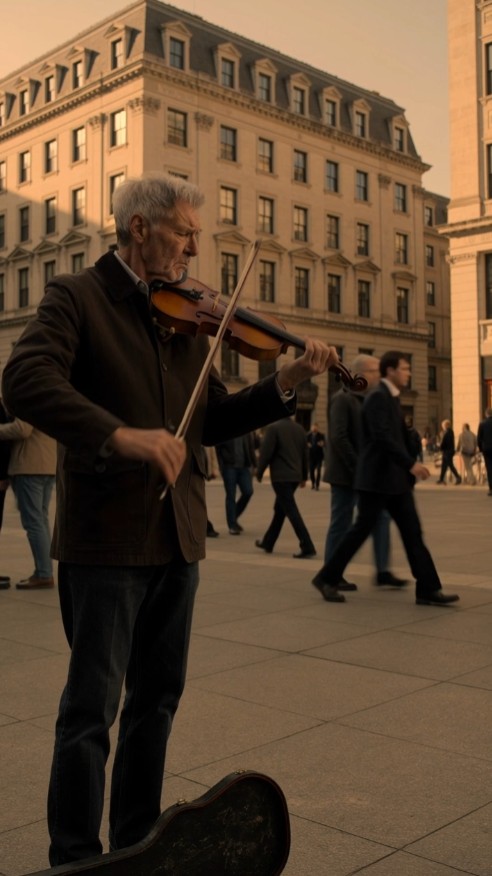
For seventeen years, seventy-four-year-old violinist Arthur Bennett had played the same unfinished melody beside the old fountain in Riverside Square.
Every afternoon, tourists passed, shoppers hurried through the streets, and strangers dropped coins into his open violin case.
Most heard nothing more than a beautiful piece of music.
But for Arthur, the melody was a question he had spent nearly half his life trying to answer.
One Saturday afternoon, a ten-year-old boy suddenly stopped in front of him.
He listened carefully.
Then he shouted, “STOP!”
Arthur lowered his bow.
Several people turned around.
The boy pointed toward his violin.
“That’s my mom’s song.”
Arthur smiled patiently.
“It’s an old tune, son.”
The boy shook his head.
“No. You’re playing it wrong.”
A few people laughed.
Arthur raised his eyebrows.
“Wrong?”
The boy nodded.
“There’s another part.”
Then he closed his eyes and hummed six quiet notes.
Arthur’s bow slipped from his fingers.
His face went pale.
Those six notes had never been published, recorded, or performed in public.
They belonged to a melody he had composed forty-three years earlier with his little sister, Emily.
A sister he hadn’t spoken to in decades.
Arthur knelt beside the boy.
“Who taught you that?”
“My mom.”
He opened his violin case and removed a faded photograph of a teenage girl standing beside him with a violin.
The boy pointed immediately.
“That’s her!”
Arthur’s hands began trembling.
“What’s your mother’s name?”
The child smiled.
“Emily.”
Arthur covered his mouth.
Then he whispered, “Tell her I’m still waiting.”
The boy frowned.
“Waiting for what?”
Arthur looked toward the fountain.
“To finish the song we started together.”
But when the boy’s mother appeared at the edge of the crowd, Arthur discovered that she hadn’t been avoiding him for the reason he had believed.
And the folded piece of sheet music she carried would finally explain why their song had remained unfinished for forty-three years.
The Brother and Sister Who Shared One Violin
Arthur and Emily Bennett grew up in a small house above their father’s repair shop.
Their family had little money, but music filled nearly every room.
Arthur was thirteen when he began learning the violin. His younger sister, Emily, was only eight, but she loved listening to him practice.
Whenever Arthur played, Emily sat on the floor beside him, humming melodies she invented herself.
Their father couldn’t afford a second instrument, so the children shared Arthur’s violin.
Arthur taught Emily how to hold the bow and find simple notes.
She taught him something different.
How to make music feel like a story.
One winter evening, they began composing a melody together.
Arthur created the opening passage.
Emily invented a gentle ending consisting of six notes.
It was simple, almost like a lullaby.
But the children loved it.
They called the piece When We Meet Again.
Every evening, Arthur played the beginning, and Emily hummed the final six notes.
Their father sometimes stood in the doorway listening.
“That’s your family’s song,” he would tell them.
Neither child imagined that one day those six notes would be all that remained of their relationship.
The Argument That Separated Them
As the children grew older, Arthur became increasingly serious about music.
He dreamed of becoming a professional violinist and performing in famous concert halls.
Emily was equally talented, but she wanted a different life.
She loved teaching children and hoped to open a small music school.
When Arthur turned twenty-one, he received an opportunity to study with a respected instructor in another city.
He was thrilled.
But the opportunity required money the family didn’t have.
Their father had recently become ill, and the repair shop was struggling.
Arthur asked whether the family could borrow against the shop to cover his training.
Emily objected.
She worried that their father would lose the business he had spent his life building.
Their disagreement became bitter.
Arthur accused Emily of trying to destroy his future.
Emily accused him of caring more about his career than their family.
Then Arthur said something he regretted for the rest of his life.
“You’ve always been jealous because I’m the real musician.”
Emily went silent.
The following morning, Arthur left.
He took his violin.
He also took the original sheet music they had written together.
But he never included the final six notes.
Those belonged to Emily.
The Letter Arthur Never Received
Arthur’s training eventually led to a successful career.
He performed with orchestras, traveled across Europe, and built a reputation as a gifted violinist.
For years, he told himself that leaving home had been necessary.
But whenever he played the melody he composed with Emily, he remembered their final argument.
He occasionally wrote letters to the family home.
Most received no reply.
Eventually, the repair shop closed, and the property was sold.
Arthur assumed Emily had decided she wanted nothing more to do with him.
What he didn’t know was that she had written to him repeatedly.
After their father died, Emily sent a letter to Arthur’s former music school explaining what had happened.
But Arthur had already moved.
The letter was returned.
She tried another address.
That letter was returned too.
Years passed.
Arthur traveled constantly, and Emily had no reliable way to contact him.
She eventually married, changed her surname, and moved to a different region.
Both siblings believed the other had chosen silence.
And neither knew how to find a way back.
Why Arthur Played Beside the Fountain
Seventeen years before the boy interrupted him, Arthur’s life changed.
After decades of performing, he developed a problem with his hands that made long concerts increasingly difficult.
He retired from professional touring.
For a while, he stopped playing entirely.
Then one afternoon, he visited Riverside Square.
He sat beside the fountain and watched a young girl listening to a street musician.
The scene reminded him of Emily sitting beside him when they were children.
That evening, Arthur took out his violin.
For the first time in months, he played When We Meet Again.
But when he reached the end, he stopped.
He couldn’t remember exactly how Emily had arranged the final six notes.
He knew the melody, but the timing and expression belonged to her.
So he began playing the unfinished piece beside the fountain.
Every afternoon.
He knew it was unlikely Emily would ever hear him.
But he continued anyway.
Somewhere inside him was a hope that the melody might eventually reach her.
The Boy Who Recognized the Song
The ten-year-old boy was named Noah Carter.
He loved music, although he had never taken formal violin lessons.
His mother, Emily Carter, often sang to him before bedtime.
Among his favorite songs was a gentle melody she called When We Meet Again.
Emily rarely explained where it came from.
She simply said she had written it with someone she loved when she was young.
Noah learned the melody by heart.
He sang it while drawing, hummed it during car journeys, and sometimes asked his mother to repeat the ending.
That Saturday, Noah was walking through Riverside Square with his grandmother when he heard a violin.
He stopped immediately.
The opening notes sounded familiar.
Then the musician reached the end and stopped.
Noah frowned.
Something was missing.
He ran toward Arthur.
“STOP!”
And with six quiet notes, he brought forty-three years of separation crashing into a single moment.
The Woman Standing at the Edge of the Crowd
Arthur was still kneeling beside Noah when an older woman approached through the gathered spectators.
She had silver hair tied loosely behind her head and carried a small handbag.
Her hands were trembling.
“Noah?”
The boy turned.
“Grandma, look! He knows Mom’s song!”
The woman stopped.
She stared at Arthur.
Then she whispered, “Arthur Bennett?”
Arthur rose slowly.
“Do I know you?”
She nodded.
“My name is Margaret Carter. I’m Emily’s mother-in-law.”
Arthur felt his heart pounding.
“Is Emily alive?”
Margaret looked surprised.
“Of course.”
Arthur’s eyes filled with tears.
“Does she live here?”
Margaret nodded.
“Only a few streets away.”
Arthur covered his mouth.
For seventeen years, he had played beside the fountain, hoping his sister might somehow hear him.
And all that time, she had been living nearby.
The Truth About the Missing Years
Margaret explained that Emily had moved to the city after her husband received a job offer.
She had spent years teaching music at a neighborhood school.
She was now sixty-nine and preparing to retire.
But she rarely visited Riverside Square.
After developing difficulty walking long distances, she usually stayed near home.
Noah often visited the square with his grandmother on weekends.
That was why he had heard Arthur’s violin before Emily did.
Arthur struggled to speak.
“Does she know I’m here?”
Margaret shook her head.
“I don’t think so.”
He looked down at his violin.
“I thought she hated me.”
Margaret’s expression softened.
“She doesn’t.”
Arthur closed his eyes.
Then Margaret said something that broke his heart.
“She still talks about you.”
The Phone Call That Stopped the Music
Margaret took out her phone.
She called Emily.
Arthur stood beside the fountain, barely breathing.
When Emily answered, Margaret asked her to listen.
Then she handed the phone to Arthur.
“Hello?” a woman’s voice said.
Arthur froze.
The voice was older than he remembered.
But it was unmistakably hers.
“Emily?”
There was a long silence.
Then a trembling whisper.
“Arthur?”
He began crying.
“It’s me.”
For several seconds, neither could speak.
Finally, Emily asked, “Where are you?”
Arthur looked toward the fountain.
“Riverside Square.”
Her voice broke.
“The fountain?”
“Yes.”
Emily began crying.
“Don’t leave.”
Arthur swallowed.
“I won’t.”
She paused.
“Promise?”
He looked at the violin in his hand.
“I’ve been waiting here for seventeen years.”
The Reunion Nobody Expected
Twenty minutes later, a taxi stopped near the square.
A woman stepped out, supported by a walking stick.
She wore a pale blue cardigan and carried a folded piece of paper.
Arthur recognized her before she reached the fountain.
Emily.
His little sister.
For a moment, neither moved.
They had been apart for forty-three years.
Arthur remembered a teenage girl sitting beside him in their father’s shop.
Now she stood before him with silver hair and tears running down her face.
“Emily,” he whispered.
She smiled through tears.
“Hello, big brother.”
Arthur took a step forward.
Then another.
And finally, they embraced.
The small crowd watching nearby became completely silent.
Arthur held his sister tightly.
“I’m sorry,” he whispered.
Emily shook her head.
“So am I.”
He began crying harder.
“I shouldn’t have said those things.”
Emily held his hand.
“We were young.”
Arthur looked at her.
“I thought you’d never forgive me.”
She smiled sadly.
“I forgave you a long time ago. I just couldn’t find you.”
The Sheet Music Emily Had Kept
After they sat beside the fountain, Emily unfolded the paper she had brought.
It was old sheet music.
The edges were worn, and several corners had been repaired with transparent tape.
Across the top were the handwritten words:
When We Meet Again — Arthur and Emily Bennett.
Arthur stared at it.
“You still have this?”
Emily nodded.
“Of course.”
He touched the paper carefully.
It was the original music they had written as children.
But unlike Arthur’s copy, Emily’s contained the final six notes.
And beneath them was a sentence in their father’s handwriting.
“Whatever happens, always finish the song together.”
Arthur began crying.
He remembered their father standing in the doorway of the repair shop, listening to them practice.
He remembered the wooden floor, the smell of sawdust, and Emily’s laughter.
For the first time in forty-three years, those memories didn’t feel impossibly far away.
His sister was sitting beside him.
And the song was finally complete.
The Six Notes Arthur Could Never Forget Again
Arthur lifted his violin.
His hands were trembling.
Emily looked toward him.
“Do you still remember the beginning?”
He laughed through tears.
“I’ve been playing it every day.”
She smiled.
“Then play it for me.”
Arthur raised his bow.
The melody began softly.
People passing through the square gradually stopped.
The familiar notes floated above the fountain.
Arthur played slowly, his eyes fixed on the music.
As he approached the final passage, he looked toward Emily.
She nodded.
Then she began humming.
Six quiet notes.
The same ending she had invented as a little girl more than forty years earlier.
Arthur followed her voice with the violin.
For the first time in decades, he completed the song.
The final note faded into the air.
Nobody spoke.
Then the crowd began applauding.
But Arthur barely noticed.
He was looking at his sister.
And she was smiling.
The Boy Who Brought Them Together
Noah stood beside the fountain, watching his mother and great-uncle.
He looked confused.
“Mom, why are you crying?”
Emily knelt beside him.
“Because you helped me find someone very important.”
Noah pointed toward Arthur.
“Him?”
She nodded.
“That’s my big brother.”
Noah stared at the elderly violinist.
Then he smiled.
“So he’s my uncle?”
Emily laughed through tears.
“Your great-uncle.”
Noah considered that.
Then he walked toward Arthur.
“Do you know any other songs?”
Arthur laughed.
“A few.”
Noah grinned.
“Can you teach me?”
Arthur looked toward Emily.
She smiled.
“I think he’d like that.”
Arthur nodded.
“More than anything.”
The Dinner That Took Forty-Three Years
That evening, Emily invited Arthur home.
For the first time in decades, the brother and sister sat together at a family table.
They talked about their childhood, their father’s repair shop, and the years they had spent apart.
Arthur learned that Emily had raised two children and become a grandmother.
Emily learned about Arthur’s travels, his concerts, and his decision to play beside the fountain.
They shared photographs.
They laughed.
And sometimes, when the conversation turned toward their parents, they cried.
Arthur apologized again for the argument that separated them.
Emily admitted that she had also said things she regretted.
Neither tried to pretend the lost years didn’t matter.
They had missed birthdays, weddings, and important family moments.
Their parents had died without seeing them reconciled.
But they couldn’t change the past.
They could only decide what to do with the time they had left.
And that evening, they made a promise.
No more silence.
The Final Performance at the Fountain
Several months later, Arthur returned to Riverside Square.
But this time, he wasn’t alone.
Emily sat beside him in a folding chair.
Noah stood nearby holding a small violin he had recently begun learning to play.
A modest crowd gathered as Arthur prepared to perform.
He had announced that this would be his final regular street performance.
After seventeen years beside the fountain, he was ready to spend more time with his family.
Arthur looked toward Emily.
“Ready?”
She smiled.
“Always.”
He began playing When We Meet Again.
Emily hummed the melody.
And when the final six notes arrived, Noah joined them with a simple arrangement he had practiced for weeks.
Three generations of music filled the square.
When the song ended, the crowd applauded warmly.
Arthur looked toward his sister.
Then he closed his violin case.
For the first time in seventeen years, he didn’t feel the need to return the following afternoon.
The person he had been waiting for was finally beside him.
The Photograph Arthur Finally Replaced
Arthur kept the faded childhood photograph in his violin case.
It showed him standing beside Emily when they were young.
For decades, it had been his only reminder of their happier years.
But after their reunion, Emily gave him another picture.
It showed the two of them standing beside the fountain, holding the original sheet music.
Noah stood between them, smiling proudly.
Arthur placed the new photograph beside the old one.
One showed the brother and sister before their separation.
The other showed them after finding each other again.
He looked at the pictures often.
Sometimes he still felt sadness for the years they lost.
But now the memories were accompanied by something else.
Gratitude.
Because after forty-three years, the story hadn’t ended with goodbye.
The Song That Was Finally Finished
For seventeen years, Arthur Bennett played the same unfinished melody beside a fountain.
Tourists listened.
Strangers dropped coins.
And most people assumed he was simply an elderly musician earning a little money.
But Arthur had another reason for returning every afternoon.
He was playing a song he wrote with his little sister, Emily, more than forty years earlier.
Their final argument separated them.
Lost letters and changing addresses kept them apart.
And for decades, Arthur believed his sister had chosen never to speak to him again.
Then a ten-year-old boy stopped in front of him and hummed six notes that had never been recorded or published.
Those notes belonged to Emily.
And the boy was her grandson.
A little boy interrupted an elderly street violinist and insisted he was playing a familiar song incorrectly.
Then he hummed six notes that the musician had composed with his younger sister forty-three years earlier.
The boy’s grandmother helped reconnect the siblings, who had spent decades believing the other wanted no contact.
When Emily finally appeared beside the fountain, she brought the original sheet music, including the missing ending and a message from their late father.
And for the first time in forty-three years, brother and sister finished the song together.
Because sometimes, the most beautiful part of a melody isn’t how it begins. It’s finally finding the person who knows how it ends.