
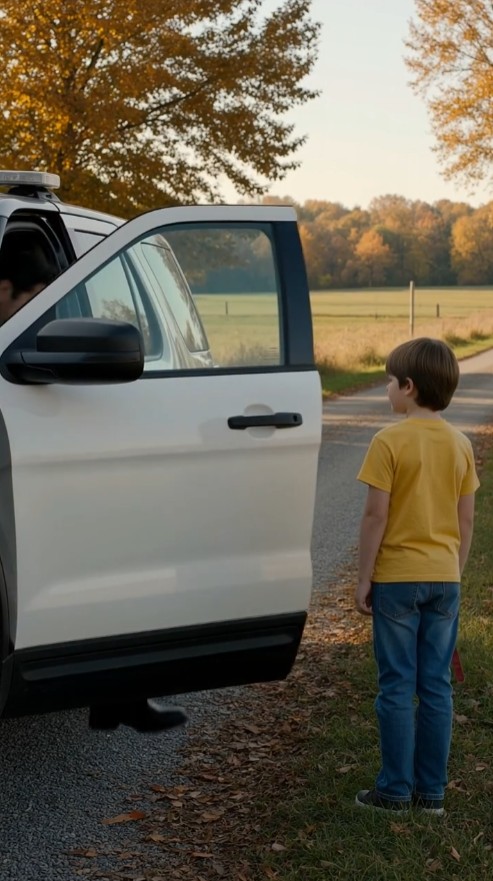
Police Officer Daniel Carter was driving along a quiet country road when a little boy suddenly stepped toward the roadside, holding a faded red dog collar above his head. Daniel immediately slowed his patrol car and stopped, assuming the child was searching for a lost pet. But the boy’s first words made him switch off the engine and step outside.
“He’s still waiting for her,” the boy said, pointing toward a narrow gravel driveway almost hidden by overgrown trees. Daniel asked where the dog’s owner was, but the child shook his head and explained that the collar belonged to an elderly golden retriever living at an abandoned farmhouse nearby.
The boy, who introduced himself as Noah, couldn’t have been older than seven. His shoes were muddy, his jacket was several sizes too large, and he held the collar so tightly that his fingers had turned pale. When Daniel asked whether his parents knew where he was, Noah explained that his grandmother lived across the road and knew he was trying to find help for the dog.
Daniel contacted dispatch to report his location and asked Noah to show him the farmhouse. The child led him along a gravel driveway where weeds had grown through the stones and tree branches nearly touched the ground. At the end stood a weathered two-story house with broken shutters, a sagging porch, and windows covered in dust.
The property appeared abandoned, but an elderly golden retriever sat perfectly still beside the front door. His golden fur had faded to a pale cream color, and gray hairs surrounded his muzzle. He didn’t bark when the visitors approached. Instead, he lifted his head briefly before turning his attention back toward the closed wooden door.
Noah explained that the dog appeared every morning and remained on the porch until sunset. Some neighbors had occasionally left food and water, but nobody knew who owned him. The boy said he had found the faded collar caught on a fence several days earlier and had been trying to find someone who could help.
Daniel knelt beside the animal and noticed that the dog seemed tired but alert. He also noticed deep scratches along one particular floorboard near the door. The marks were concentrated around a small gap where the wood had loosened, suggesting the dog had repeatedly been pawing at the same spot.
When Daniel carefully raised the board, he discovered a narrow compartment containing a small metal box. Inside were several old photographs, a folded envelope, and a police identification card. The card had expired decades earlier, but the photograph was still recognizable.
Daniel stared at it, unable to move.
The man in the photograph was his father, Robert Carter, a police officer who had vanished from his family’s life twenty-two years earlier.
For most of his adult life, Daniel had believed his father had deliberately abandoned him. Now he was standing on the porch of an abandoned farmhouse, holding an identification card that suggested Robert had been connected to a place Daniel had never seen before.
He turned toward Noah and asked who had told him to bring the police officer to the property. The boy looked at the golden retriever, then pointed toward the farmhouse.
“The lady who lives inside said you’d recognize him.”
Daniel slowly raised his eyes toward the locked front door.
And for the first time that morning, he wondered whether the house was really abandoned.
The Father Who Never Came Home
Daniel was nine years old when his father disappeared. Robert Carter had served as a police officer for nearly fifteen years and was known throughout their hometown as a dependable man who rarely missed family dinners. He coached Daniel’s baseball team, repaired bicycles for neighborhood children, and often brought home small wooden toys he made during his free time.
Then, on a rainy Thursday evening, Robert left the house after receiving a telephone call. He told his wife, Margaret, that he needed to speak with someone about an old police matter and promised to return before Daniel went to bed. He kissed his son on the forehead, took his coat, and walked out the front door.
That was the last time Daniel saw him.
Robert’s car was discovered several days later near a rural bus station, but investigators never established where he had gone afterward. The official investigation remained open for years before becoming inactive. Some people believed Robert had left voluntarily, while others suspected he had encountered trouble connected to his work.
Margaret never spoke about those possibilities in front of Daniel. She simply said his father had gone away and that nobody knew why. As Daniel grew older, that uncertainty gradually turned into resentment, especially when he saw classmates attending school events with their fathers.
Eventually, Daniel joined the police department himself. He told people he wanted to help his community, which was true, but part of him also hoped that working in law enforcement might one day help him understand what had happened to Robert.
Now, after twenty-two years, the first meaningful clue had appeared beneath a porch floorboard.
The Woman Behind the Locked Door
Daniel placed the identification card carefully back inside the box and approached the farmhouse door. He knocked several times, announced that he was a police officer, and waited for a response. For several moments, nothing happened.
Then he heard movement from inside.
A woman’s voice answered faintly, asking who was there. Daniel explained that he was checking on the property after discovering a dog on the porch and wanted to make sure the occupant was safe.
The lock turned slowly.
An elderly woman appeared in the doorway, leaning against a wooden walking stick. She looked to be in her late seventies, with silver hair pulled into a loose bun and a pale blue cardigan hanging from her shoulders.
The golden retriever immediately stood and stepped toward her. His tail moved slowly as she reached down to touch his head.
“There you are, Charlie,” she whispered.
Daniel looked from the woman to the dog. The animal had been waiting for her, but the condition of the property made it clear that she needed assistance herself.
The woman introduced herself as Eleanor Whitmore and explained that she had lived in the farmhouse for more than forty years. She had been recovering from a fall and rarely left the house. Although her nephew occasionally brought groceries, the property had become increasingly difficult for her to maintain.
Daniel asked whether she needed medical assistance or help contacting relatives. Eleanor admitted that she had been struggling to manage and had lost access to her telephone after a recent power problem.
He immediately arranged for someone to check on her welfare.
Then he showed her the identification card.
Eleanor’s expression changed.
“Where did you find that?”
“Under your porch,” Daniel answered. “Why do you have my father’s police identification?”
For several seconds, she stared at the photograph. Then her eyes filled with tears.
“Your father was Robert Carter?”
Daniel nodded.
Eleanor gripped the doorframe.
“I’ve been waiting a very long time for someone from his family to come here.”
The Secret Robert Left Behind
Inside the farmhouse, Eleanor led Daniel to a small sitting room filled with old furniture and family photographs. Charlie followed closely, eventually settling beside her chair. Noah remained outside with an arriving officer who had come to help arrange assistance for Eleanor.
Daniel sat across from the elderly woman, holding the metal box on his lap. He was struggling to remain calm, but Eleanor appeared equally overwhelmed by the encounter.
She explained that Robert had visited the farmhouse several times during the final months before his disappearance. Eleanor’s late husband, Thomas Whitmore, had once worked as a mechanic for the county transportation department and had become involved in a dispute concerning missing public equipment and falsified maintenance records.
Robert had been quietly gathering information about the case. Thomas believed that someone with access to county records was redirecting equipment and concealing financial irregularities. Before he could provide a complete statement, he died following a sudden illness.
Eleanor feared that the evidence her husband had collected would disappear, so she contacted Robert directly. He agreed to review the documents and determine whether there was enough information to justify a formal investigation.
Over several visits, Robert examined receipts, photographs, and handwritten notes Thomas had stored inside the farmhouse. He also left copies of certain documents with Eleanor because he wanted to ensure they would not be lost.
But shortly before Robert disappeared, something happened that frightened them both.
Eleanor received an anonymous telephone call warning her to stop asking questions. Robert later told her that someone appeared to know about their meetings and that he needed to handle the situation carefully.
The final time Eleanor saw him, he left his old identification card and several photographs in a metal box.
“He told me to keep it hidden until he came back,” she explained.
Daniel leaned forward.
“And he never did?”
Eleanor shook her head.
“Not the way he promised.”
The Letter Daniel Was Never Supposed to Find
Daniel opened the metal box again and removed the folded envelope. The paper was yellowed, but the handwriting on the front was unmistakable. His father had written his name in the same careful letters Daniel remembered from childhood birthday cards.
Inside was a letter.
“My dear Daniel,
If you’re reading this, something has happened that prevented me from explaining things properly.
I want you to know that I never intended to leave you or your mother. There are matters connected to my work that have become more complicated than I expected, and I’m trying to make sure I handle them without putting anyone else in danger.
You are still the most important part of my life. I think about our baseball games, the mornings we worked on your bicycle, and the way you always waited by the window when you heard my car coming home.
I don’t know when I’ll be able to explain everything, but please remember that being absent is not the same as forgetting.
Whatever happens, I love you.
Dad.”
Daniel stopped reading.
For twenty-two years, he had carried the belief that his father had chosen to walk away. He had imagined Robert building another life somewhere, forgetting the son who waited for him every evening.
Now he held a letter suggesting that his father had been frightened, uncertain, and desperate to explain something he couldn’t safely discuss.
Daniel wiped his eyes and looked toward Eleanor.
“Why didn’t you send this to me?”
She lowered her head.
“I tried.”
Eleanor explained that she contacted the police shortly after Robert disappeared and provided information about his visits. She believed the investigators would contact his family and examine the documents. However, communication between the different parties became confused, and she never received confirmation that the materials had been reviewed.
Years later, she considered contacting Daniel herself, but she had no current address and feared that reopening the matter would create further problems. Eventually, the box remained hidden beneath the porch, while the rest of her life continued around the unanswered mystery.
Then Charlie had begun scratching at the loose floorboard.
And a seven-year-old boy had finally noticed.
The Photograph That Revealed Another Clue
Among the documents was a photograph showing Robert standing beside Eleanor’s husband near a small railway maintenance building. Daniel recognized his father’s face immediately, but another detail caught his attention.
Behind the two men was a dark green pickup truck with a distinctive white stripe running along its side.
Daniel had seen that vehicle before.
He remembered it from one of the earliest reports in his father’s disappearance file. A witness had described a similar truck parked near the rural bus station where Robert’s abandoned car was discovered.
Daniel contacted his supervisor and explained what he had found. The department arranged for the documents to be collected, properly recorded, and reviewed by investigators. The discovery reopened questions about Robert’s final movements and whether the old county equipment investigation was connected to his disappearance.
Over the following weeks, detectives examined the surviving records, interviewed former employees, and traced the history of the vehicle. Several people connected to the original dispute had died, but others were still living in the region.
One former county employee remembered that Robert had been preparing to meet an informant on the evening he disappeared. The meeting was supposed to take place near a maintenance depot outside town.
The employee also remembered something else.
Robert had been carrying a small blue notebook containing copies of financial transactions.
That notebook had never been recovered.
The Discovery at the Old Maintenance Depot
Investigators obtained access to the former county maintenance depot, which had been sold years earlier and was now used for agricultural storage. The building had undergone several renovations, but one rear office remained largely unchanged.
During the search, detectives found an old metal filing cabinet containing documents from the period surrounding Robert’s disappearance. The records included vehicle assignments, equipment transfers, and correspondence concerning the disputed maintenance accounts.
One envelope contained a handwritten reference to Robert’s meeting with the informant. Another document confirmed that the green pickup truck had been assigned to a county supervisor who was later dismissed during an unrelated financial investigation.
The evidence suggested that Robert had been investigating genuine misconduct, but it still did not establish what happened to him afterward.
Then a retired dispatcher contacted the department after hearing that the case had been reopened.
She remembered receiving an unusual call the morning after Robert disappeared. A man had requested assistance arranging temporary accommodation for an injured person who was reluctant to provide his full name.
The caller mentioned a small rehabilitation facility in another county.
Investigators followed the lead.
And what they discovered changed Daniel’s understanding of his father’s disappearance once again.
The Man Who Remembered Robert Carter
The facility had closed more than a decade earlier, but its archived records were still available through the organization that had operated it. Investigators found documents indicating that a man matching Robert’s description had been admitted shortly after his disappearance.
He had suffered a serious head injury and significant confusion following an incident near the maintenance depot. The available records showed that his identity had initially been recorded incorrectly and that attempts to establish his family contacts were incomplete.
Later, the man was transferred to a long-term care facility in another part of the state.
Daniel could hardly believe what he was hearing.
His father had not simply vanished without a trace. There had been records, transfers, and people who knew pieces of the story, but nobody had connected them properly.
Investigators carefully verified the details before allowing Daniel to visit.
The man was now seventy-six years old.
And according to the facility’s staff, he had spent much of the past two decades living with lasting memory difficulties.
When Daniel received confirmation that the man was Robert Carter, he sat in his car outside the police station and cried.
His father was alive.
The Reunion Twenty-Two Years in the Making
Daniel traveled to the care facility on a quiet Tuesday morning. He carried the photographs from Eleanor’s box, his father’s old identification card, and the letter that had changed everything.
A staff member led him into a peaceful common room overlooking a garden. Several residents sat near the windows, reading or watching birds gather beside a fountain.
At the far end of the room sat an elderly man wearing a gray sweater.
His hair was white, his shoulders were narrow, and his hands trembled slightly as he turned the pages of a magazine.
Daniel recognized him immediately.
“Dad?”
The elderly man looked up.
For several seconds, he seemed uncertain.
Daniel stepped closer and knelt beside his chair.
“It’s me. Daniel.”
Robert stared at him.
His expression slowly changed.
“Danny?”
Daniel began crying.
Nobody had called him Danny in twenty-two years.
He reached for his father’s hand.
“I’m here.”
Robert looked at him for a long moment before tears appeared in his eyes.
“You got so big.”
Daniel laughed through his tears.
“Yeah, Dad. I did.”
The two men held each other as the staff quietly stepped away.
There were no dramatic explanations or instant solutions. Robert’s memory was incomplete, and his health required continuing support. But he recognized his son, and for Daniel, that moment meant more than any answer he had imagined finding.
The Truth About the Night Robert Disappeared
As the investigation continued, detectives reconstructed the events surrounding Robert’s disappearance.
Evidence suggested that Robert had met someone connected to the county equipment investigation near the maintenance depot. During the encounter, he suffered a serious injury, although the surviving evidence was insufficient to establish every circumstance conclusively.
The confusion that followed contributed to his identity being recorded incorrectly when he entered medical care. Because he struggled with memory and communication, efforts to contact his family were unsuccessful.
The police investigation into his disappearance had focused heavily on the abandoned vehicle and the possibility that he had left voluntarily. The fragmented medical information was never properly connected to the missing-person case.
The discoveries exposed serious gaps in how records had been handled and shared.
Daniel felt anger when he learned how many opportunities had been missed. But he also understood that no amount of anger could restore the years his father had lost.
What mattered now was ensuring Robert received the care and support he needed while allowing their relationship to grow again.
The Golden Retriever’s Real Story
Several weeks after meeting his father, Daniel returned to Eleanor’s farmhouse to thank her.
Charlie was waiting on the porch.
The old golden retriever lifted his head when Daniel approached and wagged his tail slowly.
Eleanor had recovered enough to move around more comfortably with assistance from relatives and local support services. The farmhouse was being repaired, and Charlie’s veterinary checkup had confirmed that he needed some additional care but could remain with her.
Daniel sat beside Eleanor and asked a question that had troubled him since the beginning.
“Why did Charlie keep scratching that floorboard?”
Eleanor smiled sadly.
“Because Robert used to sit there.”
Daniel looked confused.
She explained that Robert often visited the farmhouse after long shifts. He would sit on the porch beside the old door, drinking coffee while discussing the case with Thomas.
Charlie wasn’t alive when Robert first visited. But years later, Eleanor had stored several of Robert’s belongings in the same compartment beneath the porch.
The dog had recently become interested in the loose board, perhaps because of odors, small animals beneath the porch, or simply because it moved when he scratched it. Eleanor didn’t know exactly why.
What mattered was that Charlie had drawn Noah’s attention to a place nobody had checked in years.
“And the boy?” Daniel asked.
Eleanor smiled.
“Noah has been helping me for months. He brings Charlie water when I’m unable to come outside.”
She explained that Noah had found the collar after Charlie lost it near the fence. When Eleanor saw a police car passing on the road, she asked the boy to get the officer’s attention because she needed assistance and wanted someone to examine the old documents.
She didn’t know that the officer would be Robert Carter’s son.
That coincidence had changed everything.
The Little Boy Who Brought a Family Together
Daniel visited Noah and his grandmother the following weekend.
He wanted to thank the boy personally.
Noah was sitting on the porch drawing pictures of dogs when Daniel arrived.
The child looked surprised to see him.
“Did you find the dog’s owner?”
Daniel smiled.
“I found something even more important.”
He showed Noah a photograph taken during his visit to the care facility. It showed Daniel sitting beside Robert, both smiling toward the camera.
Noah studied the picture.
“That’s the man on the card.”
Daniel nodded.
“He’s my dad.”
The boy looked up.
“Was he lost?”
Daniel swallowed.
“For a very long time.”
Noah thought about that before asking another question.
“Did you find him?”
Daniel smiled through tears.
“Yes, buddy. I found him.”
Noah grinned.
“Good.”
Then he returned to his drawing, apparently satisfied that the mystery had been solved.
Daniel watched him for a moment, realizing that an ordinary act of kindness from a little boy had helped reconnect a family separated for more than two decades.
The Father and Son Who Started Again
Over the following months, Daniel visited Robert regularly. Sometimes they looked through old photographs, while other days they sat together in the garden without speaking much.
Robert’s memory varied from day to day. On some mornings, he clearly remembered Daniel as a young boy and asked about baseball games they had played together. On other days, he struggled to understand how so many years had passed.
Daniel learned not to force those conversations.
Instead, he brought familiar objects, played music his father once enjoyed, and told stories about his childhood.
He also introduced Robert to his grandchildren, who had grown up believing their grandfather disappeared long before they were born.
The first visit was emotional.
Robert watched the children playing in the garden and asked Daniel who they were.
“My kids,” Daniel answered.
Robert looked toward him.
“You have children?”
Daniel nodded.
“Two.”
Robert smiled slowly.
“Then I’m a grandfather.”
Daniel put his arm around him.
“Yes, Dad. You are.”
A Final Visit to the Farmhouse
One autumn afternoon, Daniel arranged for Robert to visit Eleanor’s farmhouse, with permission and assistance from his care team.
Charlie was lying on the porch when they arrived.
The old dog stood slowly and approached the visitors.
Robert looked toward the house with a strange expression.
For several moments, he said nothing.
Then he pointed toward the porch.
“Tom used to sit there.”
Eleanor covered her mouth.
Thomas had been her husband’s name.
Daniel looked toward his father.
“You remember?”
Robert nodded faintly.
“Coffee. We had coffee.”
He glanced toward Eleanor.
“I’m sorry I never came back.”
Tears filled her eyes.
“Oh, Robert.”
She reached for his hand.
“We wondered what happened to you.”
Robert couldn’t explain everything. Much of the past remained fragmented in his memory.
But as he sat on the porch, he appeared comfortable.
Charlie settled near his feet.
And Daniel watched three lives, separated by decades of uncertainty, share a peaceful afternoon together.
The Photograph Daniel Kept Beside His Badge
On the anniversary of discovering the metal box, Daniel placed a framed photograph on his desk at the police station.
It showed Robert sitting on Eleanor’s porch with Charlie resting beside his chair. Daniel stood behind them, one hand resting on his father’s shoulder, while Noah smiled proudly near the steps.
The photograph wasn’t perfect. Robert had looked away from the camera, Charlie had moved just before the picture was taken, and Noah was laughing at something outside the frame.
But Daniel loved it.
For twenty-two years, he had carried an unanswered question about his father. He had imagined betrayal, abandonment, and countless explanations that left him feeling unwanted.
Now he understood that Robert had never simply chosen to forget him.
His father had been alive, living with serious memory difficulties, while a series of failures and incomplete information prevented the family from finding him.
Daniel couldn’t recover the childhood years they lost. But he could make sure the years remaining were filled with visits, photographs, and the quiet moments they had once taken for granted.
Whenever someone asked about the picture, Daniel told them about an elderly golden retriever, a loose porch floorboard, and a little boy who stepped toward a police car holding a faded red collar.
He always ended the story the same way.
“Sometimes the smallest act of kindness opens a door you thought was closed forever.”
And whenever Daniel visited his father, Robert still smiled when he heard the familiar greeting.
“Hey, Dad. It’s Danny.”
Sometimes Robert remembered everything.
Sometimes he remembered only the voice.
But he always reached for his son’s hand.
And after twenty-two years, that was enough.