
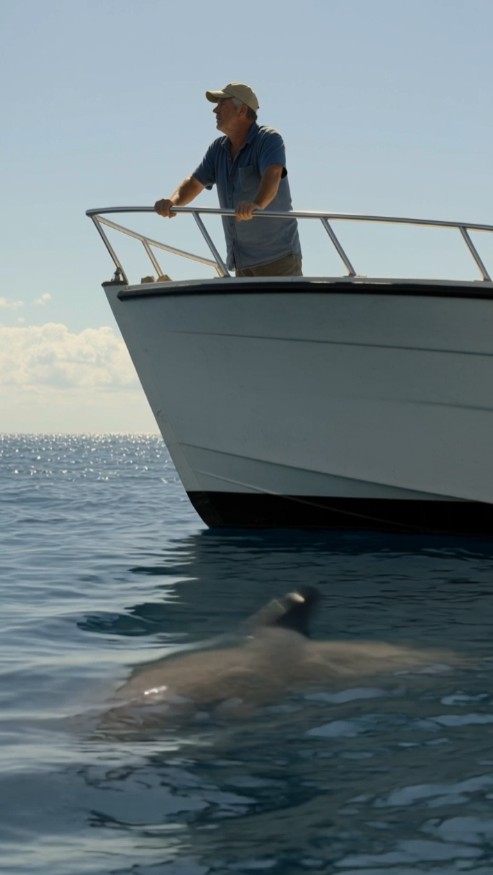
A fisherman was preparing to start his engine when a dolphin suddenly surfaced beside his boat and struck the water with its tail. At first, he assumed the animal was playing, but when he attempted to move away, the dolphin returned and began swimming repeatedly between his vessel and an old orange buoy floating several hundred feet offshore.
The fisherman, Daniel Harris, had spent more than twenty years working along the coast and was familiar with the dolphins that occasionally followed fishing boats. He had seen them leap through waves, chase schools of fish, and approach vessels out of curiosity. But this dolphin was behaving differently, repeatedly circling the same area before returning to the side of his boat.
“What are you trying to show me?” Daniel asked, watching the animal disappear beneath the surface.
Seconds later, the dolphin surfaced beside the buoy and splashed again. Daniel followed its movements with his eyes, noticing that the orange marker appeared to be pulling slightly against its mooring line. At first, he thought the buoy had caught a piece of drifting seaweed, but then he noticed a thin fishing line moving beneath the water.
There was no fishing rod nearby, no other vessel, and nobody holding the line. Daniel leaned over the side of his boat and followed it with his eyes until he spotted a small gray shape moving beneath the surface.
It was a baby dolphin.
The young animal’s tail appeared to be tangled in discarded fishing line connected to a larger mass of debris below. It struggled to swim freely, periodically rising toward the surface before being pulled back by the tension around its body.
Daniel immediately switched off his engine and contacted the local marine wildlife rescue service. He provided his location, described what he could see, and explained that an adult dolphin was remaining close to the trapped calf.
When the rescue team arrived, the adult dolphin was still swimming near the orange buoy. One trained diver carefully entered the water to assess the entanglement, while another remained aboard the rescue vessel to monitor the conditions.
The diver approached the calf slowly and followed the fishing line downward, expecting to find a simple knot caught around the buoy’s mooring rope.
But several feet below the surface, he stopped.
A much larger gray shape was suspended beside the underwater structure, partially hidden by discarded rope and fishing net.
It was another dolphin.
And it was barely moving.
The diver immediately signaled for additional assistance.
What had begun as a rescue involving one trapped calf had suddenly become a race to save two animals.
The Morning Everything Changed
Daniel had left the harbor shortly after sunrise, expecting a routine fishing trip along a sheltered stretch of coastline. The weather was calm, visibility was good, and the water reflected the pale orange light of the early morning sun.
He had planned to check several fishing locations before returning home around midday. His boat was small but well maintained, and he carried the communication and safety equipment required for the journey.
As he approached an older navigation buoy near the edge of a shallow reef, he noticed a dolphin swimming nearby. The animal surfaced several times, then moved directly toward his boat.
Daniel slowed his engine and watched.
Dolphins occasionally approached fishing boats in the area, particularly when fish were gathering nearby. However, this animal remained unusually close and repeatedly returned to the same buoy.
At first, Daniel thought it might be following a school of fish. But after several minutes, he realized its movements were concentrated around a particular section of water.
The dolphin would surface near the boat, swim toward the orange marker, circle it, and return.
When Daniel moved closer to investigate, he noticed the thin fishing line beneath the surface.
Only then did he understand that something might be trapped.
The Calf Beneath the Buoy
Through the clear morning water, Daniel could see the small dolphin struggling several feet below the surface. Its body moved awkwardly, and a length of discarded fishing line appeared to be wrapped around its tail.
The animal could still move, but each attempt to swim away tightened the line against something below.
Daniel knew that dolphins needed to reach the surface to breathe. The calf’s restricted movements therefore made the situation particularly concerning.
He resisted the temptation to jump into the water and attempt to free it himself. Marine animals can become frightened or injured during untrained rescue attempts, and the surrounding ropes created additional hazards.
Instead, Daniel remained in his boat and contacted professionals.
The rescue coordinator asked him to keep his engine off, maintain a safe distance, and report any changes in the animals’ movements.
Daniel continued watching the calf while the adult dolphin circled nearby.
Several times, the larger animal moved close to the youngster before returning toward the buoy.
Daniel couldn’t know exactly what the adult dolphin understood or intended, but its repeated presence near the trapped calf was impossible to ignore.
He hoped the rescuers would arrive before the situation became worse.
The Rescue Team Makes a Difficult Discovery
The marine rescue team arrived aboard a specially equipped vessel carrying trained divers, animal-handling equipment, and underwater cutting tools.
Their coordinator, Emma Collins, examined the area before allowing anyone into the water. The buoy was connected to an old mooring system, and several strands of discarded fishing line were visible near the surface.
The team first assessed the calf’s condition and the position of the entanglement.
One diver entered the water while a second prepared to assist if necessary.
The diver approached the buoy slowly, keeping clear of the loose lines. The calf appeared frightened and struggled whenever the diver moved too close.
After several attempts to examine the fishing line, the diver noticed that it continued downward into a larger bundle of rope and torn netting.
He followed it carefully.
Then he saw another dolphin.
The larger animal was entangled near the buoy’s underwater anchor, with sections of fishing net wrapped around its body and tail.
It appeared exhausted, and its movements were limited.
The diver returned to the surface and urgently informed Emma.
“There are two dolphins trapped,” he reported.
Emma immediately contacted additional marine wildlife specialists.
The rescue had become more complicated than anyone expected.
The Larger Dolphin Nobody Had Seen
The second dolphin was an adult, considerably larger than the calf near the surface. Its position beneath the buoy made it difficult to see from the boat, especially when sunlight reflected across the moving water.
The animal appeared to be caught in several overlapping sections of discarded fishing gear.
Some strands had become twisted around the buoy’s mooring line, while others were tangled around the dolphin’s tail.
The adult’s movement was restricted, and it could not easily reach the surface.
The rescue team understood that time was critical.
Dolphins must surface regularly to breathe, and prolonged entanglement can quickly become life-threatening.
The divers coordinated their approach, first examining how the lines were connected to avoid making the situation worse.
Emma instructed the team to proceed carefully and maintain continuous communication.
They needed to free the animals without causing the netting to tighten or allowing loose ropes to create additional hazards.
Meanwhile, Daniel watched from his fishing boat as the rescue team worked.
The free-swimming adult dolphin continued circling nearby, occasionally surfacing beside the orange buoy.
Daniel wondered whether the animal had been remaining in the area because both dolphins were trapped.
He would never know for certain.
But the possibility made the rescue feel even more urgent.
The First Attempt to Free the Adult
The divers began by carefully removing loose sections of netting that had become attached to the mooring structure.
They worked slowly, ensuring that the trapped dolphin was not pulled into a more dangerous position.
The adult animal moved weakly as the divers approached.
At one point, it attempted to twist away, causing several strands of line to tighten.
The team paused and adjusted its approach.
Rather than trying to pull the animal free, they focused on releasing the tension around the trapped sections.
One diver supported the affected area while the other used specialized cutting equipment to remove small sections of discarded line.
Piece by piece, the netting began to loosen.
Then the dolphin moved.
Its tail shifted slightly, and one of the ropes slipped away.
Emma watched closely from the surface.
The animal was showing signs that it still had enough strength to move, but the team needed to work quickly.
After another careful cut, the final section of line restricting the adult’s tail came free.
The dolphin moved toward the surface.
For several seconds, everyone aboard the rescue vessel watched anxiously.
Then the animal surfaced and took a breath.
A wave of relief passed through the team.
But the rescue was not over.
The calf remained trapped.
The Baby Dolphin’s Most Dangerous Moment
Once the adult dolphin was free, the team turned its attention to the calf.
The youngster was still caught by a thin line that had tightened around its tail.
Although it had managed to reach the surface intermittently, the animal appeared increasingly tired.
The divers approached carefully, avoiding sudden movements that could frighten it.
One rescuer assessed the visible line while another monitored the dolphin’s position and breathing opportunities.
The calf struggled briefly, then became still enough for the team to examine the entanglement.
The line had wrapped around the narrow part of its tail and was attached to a section of damaged netting beneath the buoy.
The rescuers carefully relieved the tension before removing the remaining strands.
For a moment, the calf didn’t move.
Daniel watched from his boat, barely breathing.
Then the little dolphin flicked its tail.
It moved forward.
And for the first time since Daniel spotted it, the calf was swimming without being pulled back by the discarded fishing gear.
The youngster rose toward the surface.
It took a breath.
Then disappeared beneath the water again.
Emma smiled with relief.
Both trapped dolphins were free.
The Moment the Three Dolphins Came Together
The rescue team remained nearby to monitor the animals after the entanglements were removed.
The calf surfaced several times, its movements appearing more coordinated than before.
The larger rescued dolphin swam slowly through the area, while the free-swimming adult continued moving nearby.
Then something happened that Daniel would remember for the rest of his life.
The calf approached the larger dolphin.
For several seconds, the two animals swam close together.
The third dolphin moved toward them, and all three surfaced within a short distance of one another.
Daniel watched as the animals moved away from the buoy in the same direction.
The calf remained near the adults.
The rescued dolphin appeared to be swimming more freely, although the team knew its recovery could not be judged from a few minutes of observation.
For Daniel, the sight was deeply emotional.
Only a short time earlier, two dolphins had been trapped beneath the orange buoy.
Now all three were moving through open water.
Several rescue workers smiled quietly.
Nobody approached the animals.
They allowed the dolphins space while continuing to observe from a safe distance.
What the Rescuers Found Underwater
After the dolphins had moved away, the team examined the buoy and the surrounding area.
They discovered a significant amount of abandoned fishing gear tangled around the old mooring system.
Several lengths of monofilament line had become twisted together with rope and sections of damaged netting.
The debris had likely accumulated over time as discarded or lost fishing equipment drifted through the area.
The buoy’s underwater structure had created a point where loose material could catch and become trapped.
For marine animals, such debris can be extremely dangerous.
Dolphins, seals, sea turtles, and other wildlife can become entangled while swimming or searching for food.
Even relatively thin fishing line can restrict movement, interfere with swimming, or cause injuries.
The rescue team collected the loose debris that could be removed safely and reported the remaining material to the appropriate harbor and marine authorities.
They also recommended inspecting the buoy’s condition and determining whether it should be repaired or replaced.
Daniel watched the workers bring several tangled bundles aboard.
He was shocked by how much discarded line had accumulated in such a small area.
The Fisherman Who Couldn’t Forget What He Saw
Daniel returned to the harbor later that afternoon.
He had caught very few fish, but the day’s events remained vivid in his mind.
He remembered the first splash beside his boat, the adult dolphin circling the orange buoy, and the moment he spotted the calf struggling beneath the surface.
He also remembered the diver urgently signaling for assistance after discovering the second trapped dolphin.
At home, Daniel told his wife what had happened.
She listened as he described the rescue, occasionally asking questions about the animals and the discarded fishing gear.
When he finished, she looked at him.
“What if you’d started your engine and left?”
Daniel shook his head.
“I don’t know.”
He sat quietly for several moments.
The thought troubled him.
He had almost dismissed the dolphin’s repeated movements as ordinary behavior.
If he had left without looking more closely, the trapped animals might not have been discovered in time.
That evening, Daniel contacted several friends who regularly fished in the area.
He told them about the rescue and encouraged them to report abandoned fishing gear or distressed marine animals whenever they encountered them.
The Marine Rescue Team’s Follow-Up
Over the following days, Emma and her colleagues reviewed the information collected during the rescue.
The team documented the condition of the fishing gear, the location of the entanglement, and the visible behavior of the dolphins.
They also examined underwater footage recorded during the operation.
The footage showed the larger dolphin trapped near the buoy’s anchor while the calf struggled closer to the surface.
The rescue team believed both animals had become caught in the same collection of discarded gear, although it was impossible to determine precisely how or when the entanglements occurred.
The free-swimming adult had remained nearby throughout the operation.
Emma explained that dolphins are social marine mammals and may remain close to companions, including calves or other members of their group.
However, she emphasized that rescuers could not determine the exact relationship between the three dolphins from the encounter alone.
The team also couldn’t establish whether the dolphin’s movements toward Daniel’s boat were an intentional request for help or simply behavior associated with remaining near the trapped animals.
What mattered was that Daniel had noticed something unusual and contacted trained professionals.
His decision allowed the rescuers to investigate and respond.
The Photograph That Spread Through the Harbor
One member of the rescue team had taken photographs during the operation.
A particularly striking image showed the orange buoy floating in the foreground while three dolphins surfaced farther away.
The photograph was shared with the local marine conservation organization as part of an educational campaign about lost fishing gear.
The organization used the incident to explain how discarded lines and nets can remain dangerous long after they are abandoned.
The rescue attracted attention throughout the harbor community.
Other fishermen began reporting old fishing equipment they encountered near mooring areas and underwater structures.
Several volunteers joined organized shoreline cleanups, collecting discarded line, damaged rope, and other debris from accessible areas.
Daniel participated in one of the cleanup events.
He had spent decades working on the water, but the rescue changed the way he looked at seemingly harmless pieces of floating equipment.
A few feet of fishing line could become a serious hazard when caught around an animal’s body.
And a larger bundle of discarded netting could endanger multiple animals at once.
A Surprise Near the Same Buoy
Several weeks later, Daniel returned to the same stretch of coastline.
The old orange buoy had been inspected, and the hazardous debris had been removed.
The morning was calm, with gentle waves moving across the water.
Daniel slowed his boat as he passed the area.
He remembered the frightened calf and the exhausted adult dolphin caught beneath the surface.
Then he noticed movement in the distance.
Three dolphins surfaced near the edge of the reef.
One appeared smaller than the others.
Daniel stopped and watched.
The animals swam together for several minutes before disappearing beneath the waves.
He couldn’t know whether they were the same dolphins rescued weeks earlier.
The ocean was home to many animals, and there was no reliable way for him to identify them from his position.
Still, he smiled.
He hoped the rescued calf and the two adults were somewhere nearby, swimming freely through the open water.
For a moment, he imagined the frightened youngster from that morning moving confidently beside its companions.
Then he quietly continued his journey.
The Little Dolphin That Started Everything
The rescue became a story Daniel often shared with younger fishermen.
He explained that the dolphin near his boat had behaved differently from the animals he usually encountered.
It repeatedly returned to the orange buoy, remained in the area, and surfaced close enough for him to notice the moving fishing line.
That observation led him to discover the trapped calf.
When the marine rescue team arrived, divers found a second dolphin entangled much deeper beneath the buoy.
Both animals were eventually freed.
For Daniel, the most important lesson was not that dolphins could somehow communicate with people in a way humans fully understood.
It was that unusual animal behavior deserved careful attention, particularly in areas where lost fishing gear could create hazards.
He encouraged people to keep their distance from distressed wildlife, avoid attempting dangerous rescues, and contact trained specialists when an animal appeared trapped.
The incident also reminded him that the ocean contained dangers that were not always visible from the surface.
A floating buoy could appear ordinary.
Yet beneath it, discarded fishing gear had created a trap capable of endangering more than one animal.
The Day the Ocean Gave Them a Second Chance
On the anniversary of the rescue, Daniel visited the marine conservation center where Emma worked.
The organization had prepared a small display explaining the dangers of abandoned fishing gear.
Among the photographs was an image of the rescue operation.
It showed a diver near the orange buoy, with the tangled netting visible beneath the surface.
Beside it was another photograph showing three dolphins swimming away after the rescue.
Daniel stood in front of the display for several minutes.
Emma approached him.
“Hard to believe it’s been a year,” she said.
Daniel smiled.
“I still think about that morning.”
Emma nodded.
“So do we.”
They discussed the improvements made around the harbor, including additional debris collection efforts and educational programs encouraging responsible fishing practices.
Daniel looked toward the photograph of the dolphins.
“Do you ever wonder what happened to them?”
Emma smiled gently.
“All the time.”
She explained that marine rescuers rarely receive complete answers about every animal they help.
Some dolphins are identified again through long-term monitoring programs, while others simply disappear into the ocean after their rescue.
Without reliable identification, the team couldn’t confirm what happened to the three animals.
But Daniel remained hopeful.
He had seen the calf and both adults moving freely away from the buoy.
And that was a moment he would never forget.
The Dolphin That Refused to Leave
The morning began like any other fishing trip.
Daniel Harris was preparing to start his engine when a dolphin surfaced beside his boat and struck the water with its tail.
He initially thought the animal was playing, but it repeatedly returned and swam toward an old orange buoy.
When Daniel looked more closely, he noticed discarded fishing line moving beneath the surface.
A baby dolphin was trapped near the buoy, struggling against the line wrapped around its tail.
Daniel immediately contacted a marine wildlife rescue team.
But when a diver followed the line downward, he discovered something far more serious.
A second dolphin, much larger than the calf, was entangled beneath the buoy in a mass of discarded fishing gear.
The rescue team worked carefully to free both animals.
After the entanglements were removed, the calf and the two adults were observed swimming through the area together.
For Daniel, the sight was unforgettable.
What began as an unusual encounter with a dolphin had become a rescue involving two trapped marine animals.
And it all started because he noticed something that didn’t seem right.
Years later, whenever Daniel told the story, he remembered the orange buoy, the thin fishing line, and the moment the diver urgently called for assistance.
But the image that stayed with him most was much simpler.
Three dolphins surfacing together.
Then disappearing into the open ocean.
Free from the discarded lines that had nearly prevented them from swimming away.
And although Daniel never knew whether the dolphin had deliberately drawn his attention to the buoy, he was grateful he had followed the unusual movements long enough to discover what was happening beneath the water.
Because sometimes, the difference between danger and safety begins with someone noticing what everyone else might have overlooked.