
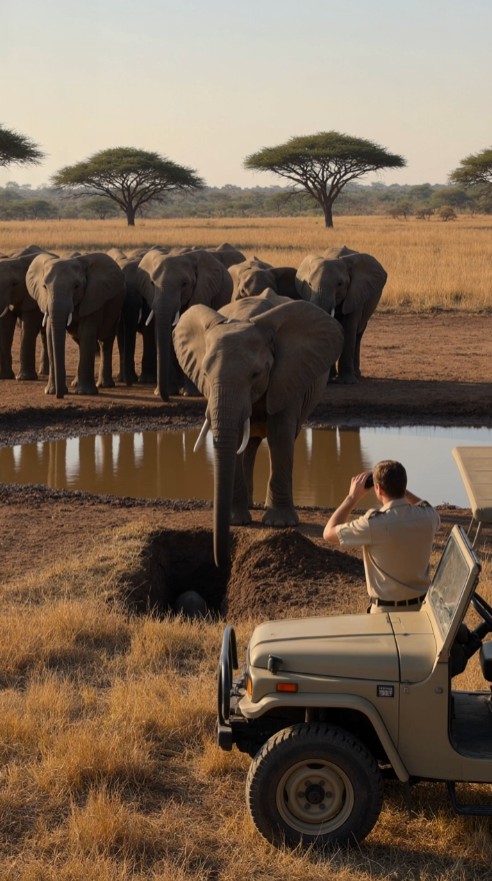
The elephants had been standing beside the dried-up waterhole for nearly four hours.
The afternoon sun was growing hotter, the muddy ground was beginning to harden, and there was barely enough water left for the animals to drink.
Yet the herd refused to move.
At the front stood a massive female elephant, her ears moving slowly as she watched a deep trench near the edge of the waterhole.
Behind her, several adult elephants and their young remained close together.
None appeared willing to continue toward the next water source.
For wildlife ranger Samuel Okoro, something didn’t make sense.
He had spent eighteen years monitoring elephants across the reserve. During the dry season, herds normally traveled considerable distances searching for reliable water and vegetation.
Remaining beside an almost empty waterhole during the hottest part of the day was unusual.
Samuel raised his binoculars.
The largest female lowered her trunk toward the trench.
Then she lifted it again.
A moment later, a faint, high-pitched cry came from below.
Samuel froze.
He adjusted his binoculars and looked more carefully.
Something small was moving in the mud.
A baby elephant.
Its body was partly hidden by the steep sides of the trench, and its feet slipped every time it tried to climb toward the surface.
The calf was trapped.
Samuel immediately contacted the reserve’s wildlife response team.
He knew that approaching a distressed elephant herd could be extremely dangerous, particularly when a mother was protecting her young.
The rangers remained at a safe distance and watched carefully while specialists prepared a rescue.
After assessing the terrain and the elephants’ positions, the team used an excavator to create a gentle slope at one end of the trench.
Then everyone withdrew.
The calf made its first attempt.
Its feet slipped.
It slid backward into the mud.
At the top, the mother remained near the edge.
The youngster tried again.
This time, it moved a little farther.
Then, with one final effort, the calf found solid footing and climbed out.
The mother approached and extended her trunk toward the youngster.
Behind her, the herd began to move.
Within minutes, the calf was walking between two adults as the elephants slowly left the waterhole.
Samuel lowered his binoculars.
He had spent years watching wild animals, but the sight left him unusually emotional.
The herd had remained near the trapped calf instead of continuing its journey.
And now the youngest member was moving safely with the group again.
But what Samuel discovered afterward revealed that the waterhole had been hiding a much larger danger.
The Waterhole That Had Sustained Generations
The rescue took place in a fictional wildlife reserve called Kijani Plains, a vast protected landscape of grassland, acacia woodland, and seasonal water sources.
For decades, elephants had traveled through the reserve using familiar routes between feeding grounds and watering areas.
During the rainy season, shallow depressions filled with water.
Small streams crossed the grasslands.
And seasonal pools formed near the lower valleys.
But as the dry season progressed, many water sources gradually disappeared.
Elephants often traveled farther to find water.
Older females played an important role in guiding herds through familiar landscapes.
Their experience helped the group navigate changing conditions and locate resources.
One of the reserve’s most frequently visited waterholes was known as Acacia Pool.
It had once been a broad, shallow depression where elephants, antelope, and other wildlife gathered during the cooler hours.
But several years of irregular rainfall had changed its appearance.
The edges became steeper.
Mud accumulated in the deepest sections.
And repeated use by large animals altered the surrounding ground.
By the time Samuel arrived that afternoon, the pool was nearly empty.
Only a narrow strip of muddy water remained.
The Herd Samuel Recognized
Samuel had been monitoring this particular elephant herd for several seasons.
The rangers identified individual animals through photographs, ear patterns, tusk characteristics, and other visible features.
The largest female was known in the monitoring records as Mara.
She was an experienced matriarch with a small notch along the edge of her right ear.
The herd included several adult females, younger elephants, and calves.
Samuel had watched them move through the reserve many times.
He knew that Mara was usually cautious around vehicles.
She rarely remained in one location longer than necessary during the hottest hours.
That was why her behavior at the waterhole caught his attention.
The adult elephants were not drinking.
They appeared focused on the muddy trench.
Several shifted position repeatedly.
One younger female approached the edge before stepping back.
Mara stood closest.
Every few minutes, she lowered her trunk toward the opening.
Samuel wondered whether an animal had fallen into the mud.
Then he heard the cry.
The Baby Elephant Beneath the Muddy Edge
The trapped calf was very young.
Its ears were small, its movements unsteady, and its trunk was still developing the coordination needed for everyday tasks.
Samuel estimated that it was only a few months old.
The youngster had apparently stepped too close to a soft section of the waterhole.
The ground beneath it gave way.
The calf slid into a narrow trench created by erosion and repeated pressure from large animals.
The trench wasn’t filled with deep water.
But its steep, slippery sides made escape difficult.
Each time the calf tried to climb, its feet lost traction.
Mud collected around its legs.
The youngster could still stand, but it was becoming exhausted.
Samuel watched it attempt to reach the edge.
The calf raised its trunk.
Mara moved closer.
Then the young elephant slipped backward.
Samuel felt his stomach tighten.
The longer the animal remained trapped, the greater the risk of exhaustion and dehydration.
He needed the specialist team to arrive quickly.
Why the Rangers Couldn’t Simply Pull It Out
One of the newer rangers suggested approaching the trench with ropes.
Samuel immediately explained why that would be dangerous.
The herd was protective.
Mara remained near the trapped youngster.
Any sudden movement by humans could cause the adults to react defensively.
A frightened elephant could injure a rescuer unintentionally or deliberately while trying to protect the calf.
There was also the risk of harming the youngster.
Pulling an elephant calf from unstable mud without appropriate equipment and expertise could cause additional injury.
The safest approach was to assess the site, keep people away from the herd, and allow trained specialists to determine how to create an exit.
Samuel contacted the reserve’s veterinary and wildlife response team.
He described the location.
The trench depth.
The condition of the calf.
And the behavior of the surrounding elephants.
Then he waited.
The Arrival of the Rescue Team
The response team arrived with a veterinarian, experienced wildlife officers, and a machine operator familiar with working around sensitive habitats.
The veterinarian, Dr. Amina Ndlovu, examined the situation from a distance.
She observed the calf’s movement through binoculars.
The youngster appeared tired but alert.
It was still attempting to climb.
Amina also studied the surrounding adults.
The herd had shifted slightly away from one side of the trench, creating a possible opportunity to work.
The team discussed several options.
Direct handling was considered too risky while the protective adults remained nearby.
Instead, they decided that modifying the slope could give the calf a chance to escape independently.
The excavator would work from a carefully selected position, avoiding direct contact with the youngster.
The team planned to stop immediately if the elephants approached or the calf became distressed.
After preparations were complete, the machine moved slowly toward the safer end of the trench.
The Excavator and the Waiting Herd
The excavator operator worked with exceptional care.
He removed a small amount of compacted soil from one side of the trench and gradually shaped the bank into a wider incline.
The goal was not to lift the calf mechanically.
It was to create a route the animal could climb.
Samuel watched Mara closely.
The matriarch moved several steps away, but she remained attentive.
The other elephants stood behind her.
The calf called intermittently from below.
The machine operator paused whenever the animals shifted toward the work area.
The process took time.
But eventually, the steep wall became a gentler slope with a firmer surface.
Amina assessed the result.
Then she instructed the team to withdraw.
The excavator moved away.
The rangers returned to their vehicles.
And the rescue team waited.
Now the calf would have to climb on its own.
The First Attempt
The youngster noticed the newly shaped slope.
It turned toward the opening and began walking through the mud.
Its legs moved slowly.
The first few steps looked promising.
Then its rear foot slipped.
The calf lost its balance and slid backward.
Samuel leaned forward inside the vehicle.
“Come on, little one.”
The calf stood again.
Its trunk moved across the muddy ground.
At the top, Mara remained near the edge.
Another adult elephant stepped closer before stopping several feet away.
The youngster tried a second time.
This time, it reached a slightly higher point.
But the mud beneath one foot gave way.
It slipped again.
Samuel looked toward Amina.
She continued observing carefully.
The calf was still attempting to move.
The team decided to give it more time rather than intervene unnecessarily.
The Final Climb
On the third attempt, the calf approached the slope from a slightly different angle.
Its front feet reached a firmer patch of soil.
Then its rear feet followed.
For several seconds, it seemed uncertain.
The calf shifted its weight.
Its trunk stretched forward.
And gradually, it moved higher.
Samuel barely breathed.
The youngster reached the final section.
One foot slipped.
But this time, it recovered.
Then, with another effort, the calf climbed onto solid ground.
Samuel smiled.
The rescue team remained inside their vehicles, allowing the elephants space.
Mara approached the youngster.
She extended her trunk and touched its back.
The calf moved toward her.
For several moments, the adult remained beside it.
Then another elephant joined them.
The youngster stood between the two adults.
And for the first time in hours, the herd began moving away from the waterhole.
The Moment That Stayed With Samuel
Samuel watched through his binoculars as the elephants traveled toward the acacia woodland.
The rescued calf walked slowly.
Its movements were still unsteady, but it was keeping pace.
Mara remained close.
Another adult walked on the opposite side.
The larger herd followed behind.
The rangers did not attempt to approach for photographs.
They allowed the animals to leave without further disturbance.
Samuel had witnessed many wildlife rescues.
Some involved injured birds.
Others involved antelope caught in fencing or animals trapped in abandoned structures.
But this incident felt different.
The elephants had remained near the trench for hours.
The adults appeared unwilling to continue without the youngster.
And once the calf escaped, the group resumed moving.
Samuel understood that animal behavior should be interpreted carefully.
He couldn’t know exactly what each elephant understood or intended.
But the observations were consistent with the strong social bonds and protective behavior elephants often show toward young members of their groups.
The Discovery Beneath the Waterhole
After the herd moved away, the rescue team returned to inspect the trench.
They wanted to determine how the calf became trapped and whether other animals might face the same danger.
What they found worried them.
The trench was not simply a natural depression.
It had formed along an old erosion channel that had deepened over several seasons.
Beneath the mud were pieces of compacted soil, exposed roots, and a layer of slippery clay.
The combination created a dangerous surface.
Animals approaching the remaining water could easily lose their footing.
The steep bank offered few safe exit points.
Samuel examined the area with Amina.
Several sets of animal tracks led toward the trench.
Some tracks suggested that other animals had struggled near the same edge.
The rescued calf might not have been the first to experience difficulty.
The team realized the waterhole required additional attention.
The Reserve’s Hidden Problem
During the following week, rangers inspected other seasonal waterholes across Kijani Plains.
Several showed similar signs of erosion.
As water levels dropped, the banks became steeper.
Mud collected in narrow channels.
And animals had fewer safe places to enter or leave the remaining pools.
The problem was especially concerning for young elephants and smaller wildlife.
Samuel prepared a report documenting the risks.
The reserve’s management team reviewed the findings and developed a plan for improving dangerous access points where appropriate.
The goal was not to alter every natural waterhole.
Natural landscapes change over time, and wildlife can often navigate them without assistance.
But areas with unusually hazardous conditions caused or worsened by human activity required careful assessment.
At Acacia Pool, the team decided to preserve a safe, gently graded exit route.
The changes would reduce the chance of another animal becoming trapped.
The Matriarch Named Mara
Several days after the rescue, Samuel reviewed the photographs taken during the monitoring operation.
Mara appeared in many of them.
Her distinctive ear notch made her easy to recognize.
Samuel remembered watching her guide the herd across dry grasslands during previous seasons.
She was one of the oldest females in the group.
Her movements often appeared to influence the direction of the others.
When she stopped, several elephants stopped.
When she began walking, younger members frequently followed.
That afternoon at the waterhole, Mara remained near the trapped calf.
Samuel couldn’t confirm whether she was the calf’s biological mother.
Elephant herds often include related females and their young, and several adults may participate in protecting calves.
But the closeness between Mara and the youngster was unmistakable.
The rangers had observed a group responding to the difficulty of one of its smallest members.
The Importance of Elephant Families
Amina later explained the incident during a training session for new wildlife officers.
Elephants are highly social mammals.
In many populations, related females and their calves live in close-knit groups led by experienced matriarchs.
Young elephants may receive attention and protection from multiple adult females.
This social structure can provide valuable support during challenging conditions.
Calves learn by watching older animals.
They remain close to their mothers and other herd members while developing the skills needed to navigate the environment.
The rescue at Acacia Pool illustrated the importance of recognizing those relationships.
Rangers had to consider the entire herd when planning their response.
The goal wasn’t simply to free the calf.
It was to allow the youngster to return to the group safely.
The Photograph That Traveled Through the Reserve
One of the wildlife officers captured a photograph from a safe distance shortly after the calf escaped.
It showed the youngster walking between two adult elephants.
The surrounding grass was dry.
Dust rose softly beneath their feet.
And the herd stretched into the distance.
Samuel looked at the photograph for a long time.
It showed no dramatic machinery.
No rescue equipment.
And no people.
Only elephants moving together.
For him, that was the most meaningful image from the entire operation.
The rescue team had done its work.
Now the animals were continuing their lives.
The Search for Water
The dry season continued.
Rainfall remained limited, and the elephants traveled through increasingly dry areas.
Rangers monitored water availability and animal movement.
They recorded sightings of Mara’s herd at several locations.
Each observation helped the reserve understand how the elephants were adapting to changing conditions.
Samuel hoped to see the rescued calf again.
But he knew the herd could travel across a large area.
There was no guarantee he would encounter them.
Still, he kept an eye on the monitoring reports.
Whenever a ranger mentioned a large female with a notch in her right ear, Samuel asked whether any calves were nearby.
The First Sighting After the Rescue
Nearly three weeks later, another patrol reported seeing Mara’s herd near a shallow stream.
The elephants had gathered beneath a group of acacia trees.
A younger calf was visible close to the matriarch.
Samuel reviewed the photographs.
The youngster appeared similar in size and markings to the calf rescued from the trench.
But he wanted a clearer identification before drawing conclusions.
He compared the images with those taken at Acacia Pool.
The calf had a small irregular patch of lighter skin near one ear.
The same feature appeared in the new photographs.
The evidence suggested it was the rescued youngster.
Samuel smiled.
The calf had survived the weeks following the rescue and appeared to be moving normally with the herd.
For him, that was wonderful news.
The Young Ranger Who Asked a Question
During an evening patrol, a newly recruited ranger named Elias asked Samuel about the rescue.
He had seen the photographs and heard other staff discussing the elephants.
“Do you think the herd understood the calf was trapped?”
Samuel considered the question.
“We know they remained nearby while the youngster struggled.”
Elias nodded.
“But did they stay because they loved it?”
Samuel smiled.
“Elephants form strong social bonds. Their behavior shows us that young animals matter to the group.”
He paused.
“But we should be careful about claiming we know exactly what an animal is thinking.”
Elias looked toward the grassland.
“So what made that rescue special to you?”
Samuel thought for a moment.
“The calf got out.”
He smiled.
“And it went back to the herd.”
The Schoolchildren Who Heard the Story
Several months later, Samuel visited a local school to speak about wildlife conservation.
He brought photographs of elephants, antelope, and other animals living in the reserve.
The students were especially interested in the rescue at Acacia Pool.
Samuel explained how the calf became trapped and how the team created a safer slope.
He emphasized that wild elephants should never be approached by untrained people.
He also described the importance of protecting natural habitats and reducing unnecessary hazards.
One little girl raised her hand.
“What happened to the baby?”
Samuel smiled.
“We saw a calf that appeared to be the same youngster a few weeks later.”
“Was it okay?”
“It looked healthy and was walking with the herd.”
The girl smiled.
“Good.”
Then she asked whether the elephants had waited for their friend.
Samuel explained that the calf belonged to a social group and that the adults remained nearby during the incident.
The children listened carefully.
For many of them, it was their first opportunity to learn about elephant family relationships.
The Rain Finally Arrived
Weeks later, the first significant rain swept across Kijani Plains.
Clouds gathered over the reserve.
The wind changed.
And water began collecting in shallow depressions across the grassland.
The dry earth absorbed the rain.
Small streams returned.
And several seasonal waterholes gradually refilled.
Samuel watched the weather with relief.
Rain would help restore vegetation and improve water availability for wildlife.
At Acacia Pool, the water level began rising again.
The safer exit route remained visible along one edge.
Rangers continued monitoring the area to ensure it remained suitable for animals.
The trench that had trapped the calf was no longer an immediate hazard in the same way.
But the reserve planned to keep inspecting the location as conditions changed.
The Herd Returns to Acacia Pool
One morning, several months after the rescue, Samuel received a radio message.
Mara’s herd had been spotted near Acacia Pool.
He joined the patrol and approached the area using an established observation route.
From a safe distance, he watched the elephants gathering near the water.
Mara stood near the center of the group.
Several young elephants were playing in the shallow water.
And one smaller calf remained close to an adult female.
Samuel raised his binoculars.
He noticed the familiar lighter patch near the calf’s ear.
He smiled.
The youngster appeared healthy.
It moved through the shallow water, lifted its trunk, and followed the adults toward the grass.
Samuel watched quietly.
Months earlier, he had seen a calf struggling beneath the steep muddy bank.
Now an elephant resembling that youngster was moving freely beside the herd.
It was the ending he had hoped for.
The Ranger’s Favorite Memory
Samuel had spent eighteen years working with wildlife.
He had witnessed beautiful moments.
Newborn animals taking their first steps.
Migrating herds crossing open grasslands.
And exhausted animals recovering after receiving help.
But the rescue at Acacia Pool became one of his favorite memories.
Not because it was the most dangerous rescue.
Or because the machinery was impressive.
But because of what happened after the calf escaped.
The youngster climbed onto solid ground.
An adult approached and touched it with her trunk.
Another elephant moved beside them.
And then the herd began walking again.
The scene lasted only a few minutes.
But Samuel remembered it clearly.
The Calf Who Wasn’t Left Behind
The story began with a mystery.
An entire elephant herd remained beside a nearly empty waterhole despite the growing heat.
Rangers couldn’t understand why the animals refused to move.
Then Samuel heard a faint cry from a muddy trench.
A young elephant had slipped into a deep, slippery channel and couldn’t climb out.
The largest female remained near the edge.
Other herd members waited nearby.
A specialist rescue team arrived and carefully created a gentler slope using an excavator.
Then the rescuers withdrew.
The calf tried to climb.
It slipped.
Tried again.
And eventually found its footing.
The youngster reached solid ground.
The adult female approached.
Another elephant joined them.
And the herd resumed its journey.
Later, rangers discovered that erosion had created a dangerous trench that could trap other animals.
The reserve improved the hazardous access point and began monitoring similar waterholes.
Several weeks afterward, an elephant calf resembling the rescued youngster was observed moving normally with Mara’s herd.
For Samuel, the experience offered a memorable example of the social bonds that help elephants survive.
The Quiet Moment at Sunset
One evening, Samuel returned to Acacia Pool after completing a long patrol.
The waterhole was quiet.
Birds gathered along the muddy edge.
The afternoon heat was fading.
He parked his vehicle at a safe observation point and looked toward the place where the calf had been trapped.
The trench had been reshaped.
The dangerous slope was gone.
Grass had begun growing around the edges.
Samuel remembered the small elephant struggling to climb.
He remembered Mara standing close.
And he remembered the moment the youngster finally reached solid ground.
Then he looked toward the horizon.
Far in the distance, a group of elephants was moving across the grassland.
He couldn’t tell whether it was Mara’s herd.
He didn’t need to.
The sight reminded him that every animal belonged to a larger living world.
A world of families, familiar routes, seasonal changes, and relationships that humans were only beginning to understand.
Samuel smiled.
He had entered the reserve that morning expecting an ordinary patrol.
Instead, he witnessed a calf return to its herd after hours of danger.
And the image that stayed with him wasn’t the excavator or the rescue vehicles.
It was a small elephant walking between two adults.
Safe.
Together.
And continuing toward the next waterhole.
Sometimes the most meaningful ending to a wildlife rescue is simply watching the animals disappear into the distance, exactly where they belong.