
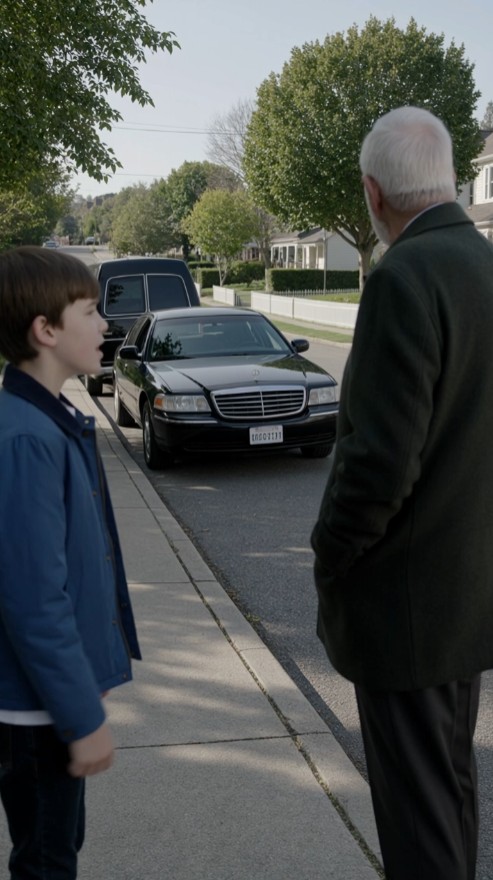
The funeral procession was moving slowly through the quiet streets when nine-year-old Oliver suddenly pulled away from his mother’s hand and ran toward an elderly stranger.
“STOP! THAT’S NOT MY GRANDPA’S COAT!”
His mother, Laura, hurried after him.
“Oliver! Come back!”
But the boy refused to move.
He stood in front of an elderly man wearing a dark green winter coat, pointing toward the pocket.
The man looked confused.
“What’s wrong, son?”
Oliver’s voice trembled.
“That’s my grandpa’s coat. He wore it every winter.”
His grandfather, William Harper, had died just three days earlier at the age of eighty-four.
Oliver had been especially close to him.
Every Saturday, William took his grandson for walks, told him stories about his childhood, and taught him how to use an old brass compass.
But the compass had disappeared from William’s care-home room shortly before his death.
Now Oliver was staring at the familiar green coat.
And he knew exactly what should be inside its pocket.
“My grandpa always kept something in there.”
The elderly stranger hesitated.
Then he reached inside.
He removed a small brass compass.
Laura covered her mouth.
She recognized it immediately.
Her father had carried that compass for more than forty years.
“Where did you get that?” she whispered.
The man looked toward her.
His eyes filled with tears.
“Your father gave it to me.”
He introduced himself as Samuel Brooks, an old friend of William’s.
Samuel explained that he had visited William at the care home a week earlier.
During their final conversation, William gave him the green coat and asked him to carry the compass until the right moment.
“He told me to give this to his grandson.”
Oliver carefully accepted it.
As he turned the compass over, he noticed something scratched into the brass casing.
It wasn’t a date.
It wasn’t a direction.
It was an address.
17 Willow Street.
Laura stared at the engraving.
She knew that street.
Her father had grown up there.
But the family home had been empty for decades.
Samuel looked at her.
“Your father wanted Oliver to find something.”
Laura shook her head.
“What could possibly be there?”
Samuel swallowed.
“Your father went back to that house every year.”
He paused.
“And he never went alone.”
Laura felt a chill.
“Who went with him?”
Samuel’s eyes filled with tears.
“Someone he loved very much.”
Then he said something that changed everything Laura believed about her father’s past.
“Your father had a younger brother. And for forty years, they’ve been keeping a promise nobody else knew about.”
The Grandfather Who Always Carried a Compass
William Harper had spent most of his life working as a railway engineer.
He was a quiet, thoughtful man who rarely spoke about his childhood.
He loved gardening, old maps, and long walks through the countryside.
But his greatest joy in later life was spending time with Oliver.
The boy visited every weekend.
Sometimes they played board games.
Other times, William took him to the park and explained how to recognize directions without using a telephone.
He taught Oliver how to find north using a compass.
The old brass instrument fascinated the child.
Its glass surface was scratched, and the metal casing had darkened with age.
But William treated it like a treasure.
“Why don’t you buy a new one, Grandpa?” Oliver once asked.
William smiled.
“Because this one has a story.”
“What story?”
His grandfather looked toward the horizon.
“A very old one.”
Oliver begged him to explain.
But William always gave the same answer.
“One day, when you’re older.”
Now William was gone.
And the compass had returned with an address carved into its back.
The Green Coat
William owned several jackets, but Oliver always remembered the dark green coat.
It was heavy, slightly faded, and had large pockets.
William wore it during nearly every winter walk.
When Oliver was younger, he used to hide small stones and pinecones inside one of the pockets.
His grandfather pretended not to notice.
Sometimes William would reach inside and act surprised.
“What’s this? A whole forest in my coat?”
Oliver would laugh.
The coat became part of their Saturday tradition.
That was why the boy recognized it immediately during the funeral procession.
He didn’t understand why a stranger was wearing something that belonged to his grandfather.
But Samuel had a reason.
William had given him the coat during their final meeting.
And he had made one unusual request.
“Please wear it when the family gathers.”
Samuel initially refused.
But William insisted.
“He’ll recognize it,” William told him.
“Who?”
“My grandson.”
Samuel remembered the conversation clearly.
William had smiled faintly.
“Oliver notices things other people miss.”
The Friend Nobody Knew
Samuel Brooks was eighty-two years old.
He had known William since childhood.
The two boys grew up on Willow Street in a small neighborhood where families often shared meals and helped one another.
Samuel lived three houses away from William.
They attended the same school.
Played football together.
And spent summer afternoons exploring the nearby fields.
But when William moved away as a young adult, their lives took different directions.
Samuel remained in the neighborhood and eventually became a carpenter.
William began his railway career and later married.
For many years, they saw each other only occasionally.
Then, nearly forty years earlier, William contacted Samuel about something important.
He wanted help restoring the old family house.
Samuel agreed.
But he soon discovered that William had another reason for returning.
A reason he never discussed with his daughter.
The House at 17 Willow Street
William’s childhood home was a narrow two-story building with a small garden and a wooden porch.
His parents had purchased it shortly after marrying.
William grew up there with his younger brother, Edward.
The brothers were nearly inseparable.
William was older by five years.
He was serious and protective.
Edward was playful, curious, and always asking questions.
They spent their childhood building wooden toys, exploring the neighborhood, and sitting beneath an apple tree in the garden.
Their father worked as a carpenter.
He taught both boys how to use tools safely and repair simple household objects.
Their mother loved music and often played an old upright piano in the sitting room.
The house was filled with ordinary family memories.
But everything changed when Edward turned sixteen.
The Argument That Separated Two Brothers
As the boys grew older, their father became ill.
Financial pressure increased.
William began working to help support the family.
Edward wanted to continue studying music.
He dreamed of becoming a professional pianist.
But William believed his younger brother needed to find steady employment.
The disagreement created tension.
One evening, the brothers argued.
William accused Edward of avoiding responsibility.
Edward accused William of trying to control his life.
The conversation became bitter.
Edward packed a small bag and left.
He moved to another city, hoping to build a career.
William expected him to return within weeks.
But he didn’t.
Months passed.
Then years.
Their mother continued writing letters to Edward.
William rarely replied when his brother contacted the family.
He was too proud to apologize.
And Edward was too hurt to return.
By the time their parents died, the brothers had spent years apart.
William later regretted the argument deeply.
But he didn’t know how to repair the relationship.
The Letter William Found
Almost forty years before Oliver’s discovery, William returned to Willow Street to sort through his parents’ belongings.
The family home had been empty for some time.
Most of the furniture was covered in sheets.
Dust gathered along the windows.
And the garden had become overgrown.
While examining an old desk, William discovered a letter addressed to him.
It had been written by his mother shortly before her death.
Inside, she described how much Edward missed his brother.
She explained that Edward had continued writing even when William refused to answer.
Then she included one final request.
William, I know you both believe too much time has passed.
But brothers should never become strangers because of one argument.
If you can find your way back to each other, please do.
William sat beside the desk and cried.
The following week, he began searching for Edward.
The Reunion Nobody Knew About
Samuel helped William locate his younger brother.
Edward was living several hours away.
He had never become a famous pianist, but he spent many years teaching music.
He had married and raised a family.
When William finally contacted him, Edward was surprised.
For a moment, neither knew what to say.
Then William apologized.
He explained that he regretted the argument and the years of silence.
Edward listened.
Then he admitted that he had made mistakes too.
They agreed to meet.
The reunion took place at 17 Willow Street.
Samuel was there to help open the house.
When Edward arrived, William stood waiting beneath the old apple tree.
The brothers looked at one another.
They were no longer young men.
Their hair had begun turning gray.
And decades of life had passed between them.
Then Edward smiled.
“You’re still taller than me.”
William laughed through tears.
“And you’re still late.”
They embraced.
For the first time in years, the brothers were together again.
The Promise Beneath the Apple Tree
After their reunion, William and Edward made a promise.
Every year, on the anniversary of their mother’s birthday, they would return to Willow Street.
They would spend the afternoon together.
No arguments.
No excuses.
Just two brothers sharing memories.
Samuel helped them maintain the old house.
The building remained mostly empty, but they kept one room clean.
They placed two chairs beside the window.
And every year, they brought a small picnic.
Sometimes they talked about childhood.
Other times, they simply sat quietly.
Edward occasionally brought a portable keyboard and played songs their mother loved.
William listened.
He had once criticized his brother’s dream of becoming a musician.
Now he admired the joy music had brought into Edward’s life.
Their yearly visits became one of William’s most treasured traditions.
But he never told Laura.
Why William Kept the Secret
Laura had grown up believing her father was an only child.
William rarely spoke about his family.
When she was young, he avoided difficult memories from his past.
Later, he became embarrassed about the years he had spent refusing to speak to Edward.
He worried that explaining the history would require admitting how stubborn and unkind he had been.
As time passed, the omission became harder to correct.
Edward also preferred privacy.
He had built a separate life and didn’t want to create confusion within William’s family.
The brothers convinced themselves that their annual visits were enough.
But as William grew older, he began regretting the secrecy.
He wanted Laura to know Edward.
And he wanted Oliver to understand the meaning of the compass.
The Compass From Their Father
The brass compass had originally belonged to William and Edward’s father.
He used it during camping trips and woodworking excursions.
When William was twelve, his father gave it to him.
But he made an unusual request.
“Whenever you use this, remember that finding your way home is more important than knowing which direction you’re facing.”
William treasured those words.
Years later, after Edward left, the compass became a painful reminder of the family he had lost.
During their reunion at Willow Street, William showed it to his brother.
Edward recognized it immediately.
“You’re still carrying Dad’s compass?”
William nodded.
“Every day.”
Edward smiled sadly.
Then he asked whether they could make a new memory with it.
They took the compass outside and stood beneath the apple tree.
Samuel photographed them together.
It was the first picture of the brothers in decades.
William later placed the photograph inside a wooden box in the old house.
The Annual Visits
For nearly forty years, William and Edward returned to Willow Street.
Some years, they stayed only an hour.
Other years, they spent the entire afternoon together.
They repaired the porch.
Trimmed the apple tree.
And occasionally shared stories with Samuel.
The visits became especially meaningful as they grew older.
Edward developed difficulty walking and began using a cane.
William’s health also declined.
But whenever possible, they continued meeting.
Samuel usually drove them.
He kept the old house secure and arranged for essential maintenance.
To neighbors, the building appeared largely abandoned.
But one room remained carefully preserved.
Inside were photographs, letters, and small objects from the brothers’ childhood.
William called it their memory room.
The Last Visit
Several months before his death, William asked Samuel to take him to Willow Street.
His health had weakened, and he was living in a care home.
Edward had also become frail.
Samuel arranged the visit with their families’ knowledge of the outing, though its deeper purpose remained private.
The brothers sat beside the old window.
They drank tea.
Shared memories.
And listened to a recording of their mother’s favorite song.
Then William reached into his green coat and removed the brass compass.
He placed it on the table.
Edward looked confused.
“What are you doing?”
William smiled.
“I think it’s time.”
Edward shook his head.
“You’ve carried that thing your whole life.”
William nodded.
“Now someone else should have it.”
He explained that Oliver loved the compass.
He wanted his grandson to inherit it.
But he also wanted Oliver to discover the family history hidden inside the old house.
Edward became emotional.
“You want him to know about us?”
William nodded.
“All of it.”
The Address Engraved on the Compass
During that final visit, William asked Samuel to help engrave the address of the family home onto the back of the compass.
17 Willow Street.
The engraving was small but clear.
William wanted it to be discovered naturally.
He knew Oliver was curious.
He knew the boy loved examining the compass.
And he believed his grandson would ask questions.
Samuel wondered why William didn’t simply tell Laura the truth.
William looked down.
“Because I’ve waited too long.”
He paused.
“And I don’t know how to begin.”
Samuel encouraged him to write a letter.
William agreed.
He spent several evenings recording the story of his childhood and his relationship with Edward.
Then he placed the letter inside the wooden box at Willow Street.
The Care-Home Visit
One week before William died, Samuel visited him at the care home.
William was resting in his favorite chair.
The green coat hung beside the wardrobe.
He smiled when Samuel arrived.
“Did you bring the photograph?”
Samuel nodded.
He handed William a recent picture of the two brothers beneath the apple tree.
William studied it carefully.
Then he asked Samuel to take the coat.
Samuel refused at first.
“It’s yours.”
William smiled.
“I know.”
He explained that he wanted Oliver to recognize the coat during the family’s gathering.
The compass would be inside.
And Samuel would explain where it came from.
William also asked him to make sure Laura received the letter.
Samuel agreed.
Before leaving, he asked whether William had any regrets.
The elderly man looked toward the window.
“Only that I spent so many years being too proud to say I was sorry.”
Then he smiled.
“But at least I found my brother again.”
The Funeral Procession
Three days after William’s death, the family gathered to say goodbye.
Laura was exhausted by grief.
Oliver struggled to understand why his grandfather would no longer take him on Saturday walks.
He carried a small photograph of William inside his jacket.
As the funeral procession moved slowly through the neighborhood, Oliver noticed an elderly man standing nearby.
The stranger wore a familiar dark green coat.
Oliver immediately recognized it.
He shouted for the procession to stop.
Laura rushed after him.
Samuel stood confused as the boy approached.
Then Oliver pointed toward the pocket.
“My grandpa kept something in there.”
Samuel remembered William’s request.
He reached inside.
And removed the compass.
The moment had finally arrived.
The Journey to Willow Street
After the funeral, Laura and Oliver met Samuel privately.
He explained William’s request and showed them the address engraved on the compass.
Laura recognized Willow Street.
She remembered her father mentioning the neighborhood when she was a child.
But she had never visited the house.
Samuel told her about Edward.
Her father’s younger brother.
Laura was stunned.
“My father had a brother?”
Samuel nodded.
“Yes.”
“Why didn’t he tell me?”
Samuel looked sad.
“He was ashamed of how many years they lost.”
Laura struggled to understand.
Then Samuel handed her a key.
“Your father wanted you to see something.”
The following afternoon, they traveled to 17 Willow Street.
The House That Had Been Waiting
The old house stood behind a small wooden fence.
Its paint had faded, and the garden was overgrown.
But the front porch had recently been repaired.
Samuel unlocked the door.
Inside, the air smelled faintly of old wood.
Several rooms were empty.
But the sitting room was different.
Two chairs stood beside the window.
A small table held a vase of dried flowers.
And photographs covered one wall.
Laura stepped closer.
She saw her father as a young man.
Beside him stood another boy.
They looked remarkably alike.
Then she noticed a recent photograph.
William and an elderly man were sitting beneath an apple tree.
Both were smiling.
Samuel pointed toward the second man.
“That’s Edward.”
Laura began crying.
She had never known her uncle existed.
The Wooden Box
Oliver noticed a small wooden box on the table.
A brass plate was attached to the lid.
It read:
For Oliver — When You Find Your Way Here.
The boy looked toward his mother.
“Can I open it?”
Laura nodded.
Inside were photographs, letters, and an old toy train.
There was also an envelope addressed to Laura.
She opened it carefully.
The handwriting belonged to her father.
My dear Laura,
There is something I should have told you many years ago.
I had a younger brother named Edward.
We grew apart because I was too stubborn to admit I was wrong.
For years, I convinced myself that silence was easier than apologizing.
Then I found a letter from your grandmother, and I realized how much time I had wasted.
Edward and I found each other again.
We returned to this house every year.
I should have told you.
I should have introduced you.
I hope you can forgive me.
Laura stopped reading.
Her eyes filled with tears.
Then she continued.
I want Oliver to have the compass because it belonged to my father.
And I want him to understand something I learned too late.
Being right is never worth losing someone you love.
If you ever find yourself separated from family by pride, please don’t wait forty years to make things right.
Love, Dad.
Laura pressed the letter against her chest.
The Man Waiting in the Garden
Samuel looked toward the window.
“There’s someone else here.”
Laura turned.
An elderly man stood beneath the apple tree.
He leaned on a cane.
His face was lined with age.
But his eyes looked familiar.
Samuel opened the back door.
“Edward?”
The man smiled.
“I’m here.”
Laura stepped outside.
For several moments, she couldn’t speak.
Then Edward looked toward her.
“You must be Laura.”
She nodded.
He began crying.
“Your father talked about you all the time.”
Laura covered her mouth.
Edward continued.
“He was so proud of you.”
Then he looked toward Oliver.
“And this must be the little explorer.”
Oliver held up the compass.
Edward smiled through tears.
“Your grandfather told me you loved that thing.”
Oliver nodded.
“Did you know him when he was little?”
Edward laughed softly.
“Better than anyone.”
The Stories William Never Told
They spent the afternoon in the garden.
Edward told Laura stories about William’s childhood.
He described the boy who used to protect him from bullies.
The teenager who taught him to repair bicycles.
And the young man who worked extra hours to help their parents.
Laura listened in amazement.
She had known her father as a serious, dependable man.
But Edward remembered a different side of him.
A mischievous older brother.
A talented carpenter.
And someone who loved making people laugh.
Oliver asked endless questions.
Did Grandpa climb trees?
Did he ever get in trouble?
Was he good at football?
Edward answered every one.
For the first time since William’s death, Oliver laughed while talking about his grandfather.
The Photograph Beneath the Apple Tree
Before leaving, Samuel showed them the photograph taken during the brothers’ reunion nearly forty years earlier.
William and Edward stood beneath the apple tree.
Both were smiling through tears.
William held the brass compass.
Edward rested a hand on his brother’s shoulder.
Laura studied it carefully.
She realized the photograph captured a moment her father had carried privately for decades.
A moment of forgiveness.
A second chance.
And the beginning of a relationship rebuilt after years of silence.
Edward smiled.
“That was the day your father finally said he was sorry.”
Laura looked toward him.
“What did you say?”
Edward laughed.
“I told him he was thirty years late.”
Then his smile softened.
“And I hugged him anyway.”
Oliver’s New Saturday Tradition
After the discovery, Laura began visiting Edward regularly.
Oliver loved spending time with his great-uncle.
Edward taught him stories about the family and showed him how their grandfather used to repair wooden toys.
They also began visiting Willow Street.
On Saturday mornings, Oliver carried the compass.
He walked around the garden, checked the direction of the sun, and listened to Edward describe the neighborhood as it had been decades earlier.
Sometimes they sat beneath the apple tree.
Other times, they looked through photographs inside the house.
Oliver missed his grandfather deeply.
But learning about William’s childhood helped him feel connected to him.
He began understanding that his grandfather had been more than the elderly man who took him for walks.
He had once been a child.
A brother.
A son.
And a young man who made mistakes and learned from them.
The Compass Finds Its Purpose
Several months later, Oliver asked Edward why William always carried the compass.
Edward smiled.
“It belonged to our father.”
Then he repeated the words their father once told William.
“Finding your way home is more important than knowing which direction you’re facing.”
Oliver thought carefully.
“But a compass tells you directions.”
Edward nodded.
“It does.”
“Then what did he mean?”
Edward smiled gently.
“Sometimes people get lost without going anywhere.”
Oliver frowned.
Edward continued.
“Your grandfather and I lived far apart for years because we were too proud to apologize.”
He pointed toward the compass.
“When we finally found each other, we came back here.”
Oliver looked toward the house.
“So this was home?”
Edward nodded.
“For both of us.”
The Reunion William Had Hoped For
On what would have been William’s eighty-fifth birthday, Laura organized a family gathering at Willow Street.
Edward attended with his children and grandchildren.
For the first time, the two branches of the Harper family met.
They shared photographs.
Compared memories.
And discovered similarities between relatives who had never known one another.
Oliver was delighted.
He had grown up believing he had very few extended family members.
Now he had cousins, a great-uncle, and stories stretching back generations.
During the gathering, Laura read a short passage from William’s letter.
She spoke about forgiveness and the importance of staying connected.
Then she raised the brass compass.
“My father wanted this to bring us together.”
She looked around the garden.
“And it did.”
The Last Secret in the Box
As the afternoon continued, Oliver returned to the wooden box.
He noticed a small folded note beneath the old toy train.
His name was written on it.
He opened it.
Dear Oliver,
If you’re reading this, you found the house.
I knew you would.
You always noticed the little things.
The stones beside the path.
The birds in the trees.
And the compass in my coat pocket.
I wanted you to know where I came from.
But more importantly, I wanted you to know that people can make mistakes and still find their way back.
Take care of your family.
Ask questions.
And never be afraid to say you’re sorry.
Love, Grandpa.
Oliver read the letter slowly.
Then he handed it to Laura.
His eyes filled with tears.
“Grandpa knew I’d find it.”
Laura hugged him.
“Yes, sweetheart.”
She smiled through tears.
“He knew you would.”
The Green Coat
Samuel eventually returned the green coat to Laura.
She had it cleaned and carefully stored it with William’s belongings.
But Oliver asked whether he could keep it someday.
Laura smiled.
“Of course.”
The coat was much too large for him.
But he loved its deep pockets and familiar smell.
Sometimes he placed the compass inside one pocket and imagined walking beside his grandfather again.
He remembered the Saturday mornings.
The jokes.
And the stories.
But now he also remembered Willow Street.
The apple tree.
And the brother William had loved.
The coat no longer represented only loss.
It had become the beginning of a discovery.
The Boy Who Stopped the Funeral Procession
The mystery began when nine-year-old Oliver saw an elderly stranger wearing his grandfather’s dark green coat during a funeral procession.
He recognized it immediately.
His grandfather William had worn the coat every winter.
And Oliver knew that a small brass compass belonged inside its pocket.
When the stranger produced the compass, Oliver and his mother were stunned.
The man, Samuel Brooks, explained that William had given him the coat shortly before his death.
He had also asked Samuel to deliver the compass to Oliver.
Scratched into the back was an address.
17 Willow Street.
The house where William grew up.
Samuel revealed that William returned there every year with his younger brother Edward.
A brother Laura never knew existed.
Decades earlier, William and Edward had been separated by a bitter argument.
They eventually reunited and promised to visit their childhood home every year.
But William remained ashamed of the years they lost and never told his daughter the truth.
Before his death, he prepared letters and photographs explaining everything.
He wanted his family to discover the story.
And he trusted Oliver’s curiosity to lead them there.
The compass brought Laura and Oliver to Willow Street.
There, they found the letters.
The photographs.
And Edward himself.
William was gone.
But his final gift reunited a family that had been separated for decades.
The Last Walk
One Saturday afternoon, Oliver stood beneath the apple tree at Willow Street.
He held the brass compass in his hand.
Edward sat nearby.
Laura was inside preparing tea.
The sun filtered through the branches.
Oliver looked toward the old house.
Then he asked:
“Uncle Edward, do you think Grandpa knew we’d all come here?”
Edward smiled.
“I think he hoped.”
Oliver looked down at the compass.
The needle settled toward north.
He turned it over.
The engraved address caught the sunlight.
17 Willow Street.
Then Oliver smiled.
“Grandpa always said this compass could help me find my way.”
Edward nodded.
“He was right.”
Oliver looked toward the house, where he could hear his mother laughing with relatives.
Then he slipped the compass into his pocket.
For the first time since the funeral, he felt something warmer than sadness.
He still missed his grandfather.
He always would.
But William had left him more than an old coat and a brass compass.
He had given him the story of a family.
A lesson about forgiveness.
And a place where people who had been separated for decades could finally come together.
Oliver walked toward the house.
Behind him, the apple tree moved gently in the afternoon breeze.
And inside, a family that had once been divided was sharing stories around the same table.
The little boy had stopped a funeral procession because he recognized his grandfather’s coat.
He never imagined that the compass hidden inside would lead him to people he didn’t know existed.
But sometimes, the most important things we inherit aren’t money, houses, or possessions.
Sometimes they’re the stories that help us understand where we belong.
And sometimes, finding our way home begins with learning how someone else found theirs.