
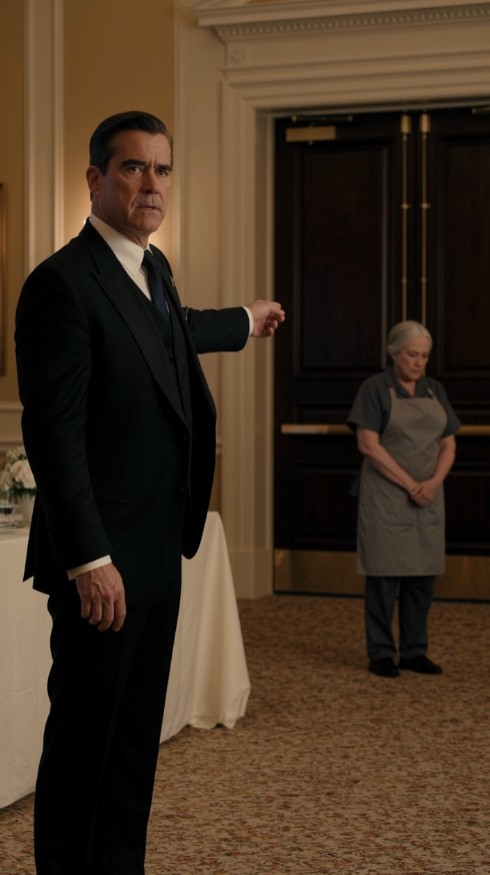
The ballroom fell silent when millionaire CEO Richard Harrison pointed toward an elderly woman standing near the back entrance.
“Security, please escort her outside.”
The woman was seventy-four years old. She wore a simple gray cleaning uniform, and her hands showed the effects of decades of physical work.
Her name was Margaret Wilson.
She had worked at Harrison Technologies for eighteen years.
Richard barely recognized her.
“This is a private awards ceremony,” he said impatiently. “Employees who aren’t on the guest list shouldn’t be here.”
Margaret lowered her eyes.
“I’m sorry, sir. Someone told me I should come.”
Two security officers approached.
But before they reached her, a young woman stood up from a table near the front.
“Sir, she’s our guest.”
Richard frowned.
“Who invited her?”
“I did,” the woman replied.
Another employee stood.
“And me.”
Then another.
“I invited her too.”
Within seconds, nearly two hundred employees were standing.
Executives, engineers, accountants, receptionists, and department managers.
Richard stared at the room.
“What exactly is going on?”
A young woman named Amanda Brooks walked toward the microphone.
Her hands were trembling.
“Five years ago, when I started working here, I was sleeping in my car.”
The room became completely quiet.
“I couldn’t afford an apartment. Some days, I couldn’t even afford lunch.”
Amanda pointed toward Margaret.
“Every evening, this woman left a warm meal for me in the staff kitchen.”
Margaret covered her mouth.
Amanda continued.
“She never asked why I needed it. She never embarrassed me. She just made sure I had something to eat.”
A man near the front stood up.
“She helped my family when my wife lost her job.”
Another employee raised his hand.
“She brought groceries when my son was sick.”
Then another.
“She stayed after her shift to help me prepare for my first interview.”
Richard looked toward Margaret.
For eighteen years, he had walked past her in the hallways.
He had never learned her name.
Now almost everyone in the ballroom was standing because of her.
Amanda turned toward the CEO.
“Tonight, we’re celebrating the people who made this company successful.”
She paused.
“We’re not starting without the woman who helped us survive.”
The audience erupted in applause.
Richard slowly approached Margaret.
He apologized and invited her to join him onstage.
But before she could move, an elderly man stood up near the founder’s table.
It was eighty-six-year-old Edward Harrison, the man who had established the company forty-three years earlier.
He rarely attended public events anymore.
Yet he was staring directly at Margaret.
Then he said something that made Richard turn pale.
“There’s something about this woman that even our CEO doesn’t know.”
Edward reached into his jacket and removed an old photograph.
“Forty-three years ago, I was the one who had nothing.”
He raised the photograph.
“And this woman was the reason this company ever existed.”
The Company That Started in a Garage
Harrison Technologies was now a successful engineering and technology business with hundreds of employees.
Its headquarters occupied a modern glass building overlooking the city.
The company had international clients, impressive annual revenue, and a reputation for developing reliable industrial equipment.
Richard Harrison had served as CEO for seven years.
He was ambitious, disciplined, and focused on expanding the business.
Under his leadership, the company had grown considerably.
But employees often complained that the workplace had become less personal.
Richard knew performance figures, financial reports, and department targets.
He rarely knew the people behind them.
The company’s founder, Edward Harrison, had built the business differently.
In 1983, Edward was a forty-three-year-old engineer struggling to support his family after losing his job.
He had an idea for a small manufacturing business.
But he lacked the money to pursue it.
Banks rejected his applications.
Potential investors showed little interest.
And the bills continued arriving.
Eventually, Edward began repairing equipment from a rented garage.
He had no employees.
No proper office.
And barely enough money to keep the electricity running.
Then one afternoon, a young woman named Margaret Wilson appeared at his door.
The Woman Who Cleaned the Garage
Margaret was thirty-one at the time.
She worked several part-time jobs, cleaning offices and helping at a neighborhood café.
She had recently moved into the area with her husband and two young children.
One evening, she noticed Edward working alone in the garage.
The lights remained on long after neighboring businesses closed.
Tools covered the workbenches.
Boxes filled the floor.
And Edward appeared exhausted.
Margaret knocked on the open door.
“Are you looking for someone to clean this place?”
Edward laughed.
“I can’t afford anyone.”
Margaret glanced around.
“Well, you certainly need help.”
He smiled.
“That part is true.”
She offered to help organize the workspace for a modest payment whenever he could afford it.
Edward hesitated.
Then agreed.
Within a week, Margaret had transformed the cluttered garage into a cleaner, more practical workspace.
But she soon realized Edward had a much bigger problem.
The Evening Margaret Found Him Crying
One winter evening, Margaret arrived to find Edward sitting alone beside his desk.
An unopened bill lay in front of him.
His hands covered his face.
She quietly asked whether he was alright.
Edward shook his head.
“I think I’m going to lose everything.”
He explained that an important customer had delayed payment.
He couldn’t afford essential materials for a new order.
And without those materials, he couldn’t complete the project that might save his business.
Margaret listened.
Then she asked how much he needed.
Edward told her.
It was a considerable sum for someone living paycheck to paycheck.
Margaret didn’t promise anything.
She simply told him to go home, eat dinner, and get some rest.
The following morning, she returned carrying an envelope.
Inside was money she and her husband had saved over several years.
Edward stared at it.
“I can’t take this.”
Margaret shook her head.
“It’s a loan.”
“But what if I can’t pay you back?”
She smiled.
“Then we’ll work something out.”
Edward was speechless.
Margaret placed the envelope on his desk.
“Just promise me something.”
“What?”
“If this business succeeds, don’t forget the people who helped you build it.”
The Promise Edward Made
Edward accepted the loan after documenting the arrangement.
He purchased the materials he needed and completed the customer order.
The payment allowed him to keep operating.
Gradually, new orders arrived.
He hired his first two employees.
Then three more.
Within several years, the garage had become a small manufacturing company.
Edward repaid Margaret in full, with additional interest.
But he never forgot what she had done.
He offered her a permanent position.
Margaret accepted, initially working in facilities maintenance.
As the company expanded, she continued helping wherever she was needed.
She welcomed new staff.
Helped organize workplace events.
And quietly supported employees experiencing difficult circumstances.
Edward often told her that she had played an important part in the company’s survival.
Margaret always dismissed the praise.
“You did the hard work.”
Edward disagreed.
“We both did.”
Why Margaret Left the Company
After thirteen years, Margaret resigned.
Her husband had developed a serious illness, and she needed more time to care for him.
Edward offered additional flexibility and assistance.
But Margaret wanted to focus on her family.
She left with warm wishes from the employees who knew her.
Over the following years, the company continued growing.
Edward eventually stepped back from daily operations.
Other executives assumed leadership responsibilities.
As time passed, fewer employees remembered the garage where everything began.
The company history celebrated Edward’s engineering achievements and business decisions.
But Margaret’s contribution was rarely mentioned.
Edward regretted that omission.
Still, he assumed Margaret was enjoying retirement with her family.
Then, several years later, she returned.
The Cleaner Who Came Back
Margaret’s husband died after a long illness.
She had used much of her savings to cover household expenses.
By her mid-fifties, she needed stable employment again.
She contacted the company.
The facilities department had an opening.
Margaret applied.
She didn’t ask for a management position or special treatment.
She simply wanted to work.
The hiring team offered her a cleaning role.
Edward had already withdrawn from most daily operations and didn’t learn immediately that she had returned.
Margaret preferred it that way.
She didn’t want colleagues treating her differently because of her past connection to the founder.
She put on her gray uniform and began working.
For the next eighteen years, she became one of the company’s most dependable employees.
The Lunch That Changed Amanda’s Life
Amanda Brooks joined Harrison Technologies at twenty-three.
She had recently completed her studies and was excited about her first professional job.
But her financial circumstances were difficult.
A family emergency had consumed her savings.
She couldn’t afford an apartment deposit.
For several weeks, she slept in her car while searching for affordable accommodation.
She arrived at work early so nobody would notice.
She avoided conversations about where she lived.
And she often skipped lunch to save money.
One evening, Margaret found Amanda sitting alone in the staff kitchen.
The young woman was staring at an empty lunch container.
Margaret gently asked whether she had eaten.
Amanda insisted she was fine.
Margaret didn’t pressure her.
The following evening, she left an extra meal in the kitchen refrigerator with Amanda’s name on it.
The next day, another appeared.
Then another.
Eventually, Amanda asked why.
Margaret smiled.
“Because nobody should have to work all day hungry.”
The Conversation Amanda Never Forgot
One evening, Amanda finally told Margaret the truth.
She explained that she was sleeping in her car.
She was embarrassed and frightened.
She worried that her employer might judge her.
Margaret listened without interrupting.
Then she helped Amanda identify local housing assistance resources and encouraged her to seek support from appropriate services.
She also helped her prepare a realistic budget.
For several weeks, Margaret continued bringing meals.
She never discussed Amanda’s situation with coworkers.
And she never asked for anything in return.
Eventually, Amanda found shared accommodation.
Her circumstances improved.
She received a promotion.
Then another.
Five years later, she was a respected project manager.
But she never forgot the woman who helped her through the hardest months of her career.
The Employees Margaret Helped
Amanda wasn’t the only person Margaret supported.
Over eighteen years, she had quietly helped dozens of colleagues.
When an employee’s wife lost her job, Margaret organized a discreet grocery collection with his permission.
When a young father struggled to balance work and childcare, she helped him find information about community support services.
When a new receptionist felt overwhelmed before her first interview for a permanent role, Margaret stayed after work to practice questions with her.
She also remembered birthdays.
Checked on employees returning from illness.
And made newcomers feel welcome.
Her kindness was practical.
Sometimes it was a meal.
Sometimes it was a conversation.
And sometimes it was simply remembering someone’s name.
Margaret never considered these actions extraordinary.
She believed people should look after one another.
The Award Ceremony
Every year, Harrison Technologies organized an awards ceremony celebrating employee achievements.
The event took place in an elegant ballroom.
Senior managers delivered speeches.
Employees received recognition for innovation, leadership, and years of service.
The latest ceremony was intended to celebrate the company’s strongest financial year.
Richard wanted everything to appear professional.
He reviewed the guest list personally.
He approved the seating arrangements.
And he insisted that the evening reflect the company’s success.
But Amanda and several colleagues noticed that the recognition program overlooked many people who supported daily operations.
Cleaning staff.
Maintenance workers.
Reception employees.
And other colleagues who rarely received public attention.
Amanda decided something needed to change.
The Invitation Nobody Expected
Amanda proposed a special employee appreciation segment.
She spoke with colleagues from several departments.
They began sharing stories about Margaret.
Some had known her for years.
Others had only recently learned how much she helped people.
The more Amanda listened, the more remarkable the pattern became.
Margaret had supported employees across different departments and generations.
Amanda contacted the event coordinator and arranged an invitation for her.
Margaret was confused.
“Why would I go to an awards ceremony?”
Amanda smiled.
“Because you’re part of this company.”
Margaret initially declined.
She didn’t own formal evening clothing.
Amanda reassured her that she could attend comfortably.
Margaret eventually agreed.
But on the evening of the ceremony, she became self-conscious and arrived wearing her usual work uniform.
She stood quietly near the back.
Then Richard noticed her.
The CEO’s Mistake
Richard was reviewing the seating arrangements when he saw Margaret standing near the exit.
He assumed she had entered the ballroom without authorization.
He approached her.
“This is a private event.”
Margaret looked embarrassed.
“I’m sorry. I was invited.”
Richard frowned.
“By whom?”
She began searching her pocket for the invitation.
But he was already speaking to security.
“Please escort her outside.”
The security workers approached calmly.
Before anything else happened, Amanda stood.
“Sir, she’s our guest.”
Richard turned toward her.
“Who invited her?”
“I did.”
Then another employee stood.
“And I did.”
Another followed.
“Me too.”
Soon, nearly two hundred employees were standing.
They had agreed to support the recognition segment, but none expected Richard to try to remove Margaret before it began.
Now their support became impossible to ignore.
The Speech That Silenced the Ballroom
Amanda walked toward the microphone.
She looked nervous.
But she knew what she wanted to say.
“Five years ago, I was sleeping in my car.”
The room became quiet.
She explained how difficult her first months at the company had been.
Then she described Margaret’s kindness.
The warm meals.
The practical support.
And the dignity with which Margaret treated her.
“She never asked for recognition.”
Amanda looked toward the elderly cleaner.
“She just helped.”
Other employees began sharing their own experiences.
A department manager described the groceries Margaret helped organize.
A receptionist remembered how Margaret practiced interview questions with her.
A technician spoke about the encouragement she offered after a difficult family situation.
By the time the employees finished, Margaret was crying.
Richard stood motionless.
He had no idea so many people owed something important to the elderly woman he had just asked to leave.
The Apology
Richard approached Margaret.
For the first time that evening, he seemed unsure what to say.
“Mrs. Wilson, I owe you an apology.”
Margaret looked up.
He continued.
“I made an assumption about whether you belonged here. I was wrong.”
The ballroom remained quiet.
Richard offered her a seat and asked whether she would be comfortable joining him onstage.
Margaret hesitated.
She didn’t enjoy public attention.
But Amanda gently encouraged her.
The audience applauded as Margaret walked toward the front.
Then Edward Harrison stood.
He had been watching silently from a table near the stage.
And now he was ready to reveal something nobody expected.
The Founder Stands Up
Edward was eighty-six years old.
He had founded Harrison Technologies forty-three years earlier.
Although he remained an important figure in the company’s history, he rarely attended large events.
He had watched the evening unfold with growing emotion.
When Richard apologized, Edward slowly rose from his chair.
“Richard, there’s something you don’t know about this woman.”
His son looked confused.
Edward reached into his jacket and removed an old photograph.
It showed a younger Edward standing outside a small garage.
Beside him was a woman in a work apron.
Margaret.
Edward raised the photograph.
“Forty-three years ago, this company almost failed before it began.”
He paused.
“And Margaret was the person who helped me keep it alive.”
The Envelope From 1983
Edward explained how he lost his engineering job and started the business in a rented garage.
He described the unpaid bills.
The rejected financing applications.
And the customer order he nearly couldn’t complete.
Then he told the audience about Margaret.
She cleaned the garage.
Helped organize the workspace.
And eventually lent him money she had saved with her husband.
Edward held up a second object.
An old envelope.
Inside was a copy of their original loan agreement.
The audience listened in silence.
Richard looked stunned.
He knew the company’s founding story.
But he had never heard about Margaret.
Edward turned toward his son.
“You know about the garage.”
Richard nodded.
“But you don’t know why we were able to stay in it.”
The Secret Margaret Kept
Margaret had never spoken publicly about the loan.
She didn’t want employees to feel obligated to her.
She didn’t want special privileges.
And she didn’t want her kindness to become a story about money.
When the business succeeded, Edward repaid her.
As far as she was concerned, the matter was settled.
But Edward saw it differently.
He believed her support had helped create the opportunity for everything that followed.
He also knew she had remained loyal to the company through difficult personal circumstances.
Edward looked toward Margaret.
“You helped build this company before we could even afford a sign on the door.”
Margaret shook her head.
“Edward, you don’t have to say all that.”
He smiled.
“Yes, I do.”
The Promise That Was Finally Remembered
Edward reminded Margaret of the promise she made him repeat in the garage.
“If this business succeeds, don’t forget the people who helped you build it.”
Margaret began crying.
She remembered the evening clearly.
The cold garage.
The unpaid bills.
And the frightened engineer who thought his dream was over.
Edward turned toward the audience.
“For years, I told myself I had kept that promise.”
He paused.
“But looking around this room, I realize we have not always done enough.”
He looked toward the cleaning staff standing near the back.
Then toward the reception employees and maintenance workers.
“A company isn’t built only by the people who sign contracts.”
He continued.
“It’s built by everyone who makes the work possible.”
The audience began applauding.
The CEO’s Realization
Richard had spent years concentrating on financial growth.
He knew how much the company earned.
He knew which departments were profitable.
And he knew how to negotiate major contracts.
But he had never considered how many employees relied on quiet acts of support from their colleagues.
His father looked toward him.
“Do you know how many people in this room Margaret has helped?”
Richard shook his head.
“No.”
Edward nodded.
“Neither do I.”
Then he smiled.
“That’s the point. She didn’t keep count.”
Richard looked toward Margaret.
For the first time, he understood that the elderly cleaner’s contribution couldn’t be measured by a job title.
The Award Nobody Expected
The event coordinator brought an additional award folder to the stage.
Amanda had prepared it with colleagues before the ceremony.
It wasn’t part of the official executive recognition program.
It was a message from employees.
Inside was a certificate titled:
The Heart of Harrison Technologies.
Beneath the title were nearly two hundred signatures.
Employees from every department had written their names.
Some added personal messages.
Others simply wrote:
Thank you, Margaret.
Richard read the certificate.
Then handed it to her.
Margaret covered her mouth.
For eighteen years, she had cleaned the building quietly.
She never imagined that so many people remembered what she did.
Margaret Finally Speaks
The audience encouraged Margaret to say a few words.
She was nervous.
She had never spoken before so many people.
But she stepped toward the microphone.
“I don’t really know what to say.”
The room became quiet.
Margaret smiled through tears.
“I came here tonight because Amanda said I should.”
A few people laughed gently.
Then she continued.
“I’ve worked with many wonderful people in this building.”
She looked around the ballroom.
“Some of you have helped me too.”
Margaret described the colleagues who supported her after her husband’s death.
The people who checked on her when she was ill.
And the friendships that made difficult days easier.
Then she said something simple.
“I never thought I was doing anything special.”
She paused.
“I just didn’t want anyone to feel alone.”
The Decision That Followed
The ceremony changed the way Richard approached his role.
He began meeting employees across departments rather than relying solely on management reports.
He asked staff what challenges they faced.
And he listened.
Over the following months, the company reviewed its employee assistance policies.
It introduced clearer access to confidential support services, financial counseling resources, and emergency assistance.
It also improved recognition programs to include employees from every operational department.
Richard acknowledged that these changes should have happened earlier.
He didn’t present them as a favor to Margaret.
He described them as responsibilities of a company that wanted to treat its workforce fairly.
The Conversation Between Father and Son
Several days after the ceremony, Richard visited Edward at home.
The two sat in the garden.
For a while, they spoke about ordinary family matters.
Then Richard mentioned Margaret.
“Why didn’t you ever tell me about the loan?”
Edward looked surprised.
“I did.”
Richard frowned.
“When?”
Edward smiled sadly.
“When you were younger. You were always more interested in how much the company was worth.”
Richard looked down.
He remembered hearing stories about the garage.
But he had focused on Edward’s business achievements rather than the people who helped him.
Edward continued.
“I built the company because I wanted to create something useful.”
He paused.
“But people gave me the chance to do that.”
Richard nodded.
For the first time, he understood that his father’s greatest achievement wasn’t only building a successful business.
It was remembering the people who made the journey possible.
Amanda’s Promotion
Several months later, Amanda was promoted to a senior project leadership position.
The promotion was based on her performance and professional achievements.
But her willingness to speak up during the ceremony also influenced how colleagues viewed her leadership.
Amanda continued supporting new employees.
She remembered what it felt like to arrive at work frightened and financially insecure.
She began volunteering with a local career development organization.
Whenever someone asked why she cared so much about helping others, she told them about Margaret.
The elderly cleaner who left warm meals in the staff kitchen.
The woman who noticed her struggle without making her feel ashamed.
Amanda hoped to pass that kindness forward.
The Retirement Margaret Never Wanted
As Margaret approached seventy-five, her family encouraged her to reduce her working hours.
She enjoyed her job.
But the physical demands had become more difficult.
The company offered her an opportunity to transition into a less demanding employee support role if she wished.
Margaret considered it carefully.
She didn’t want a ceremonial position with no real responsibilities.
She wanted to contribute meaningfully.
Eventually, she agreed to work part-time assisting with staff orientation and workplace support activities.
Her experience made her especially good at helping new employees feel comfortable.
She continued learning colleagues’ names.
Remembering birthdays.
And offering encouragement.
But now, she had more time to rest and spend with her grandchildren.
The Photograph in the Lobby
On the company’s forty-fourth anniversary, a new historical display was installed in the main lobby.
It included photographs from the early years.
The rented garage.
The first employees.
The original equipment.
And Edward standing beside Margaret in 1983.
Beneath the photograph was a short description explaining how early staff and supporters contributed to the business’s survival.
Margaret insisted that the display also recognize the other people who worked in the garage.
Edward agreed.
The company expanded the exhibition to include stories from several founding employees.
For the first time, visitors could see a fuller picture of how Harrison Technologies began.
The Young Employee Who Stopped to Read
One morning, a newly hired engineer paused beside the historical display.
He studied the photograph of Margaret and Edward.
Then he noticed Margaret walking through the lobby.
He recognized her from the image.
“Excuse me, Mrs. Wilson?”
Margaret turned.
“Yes?”
He smiled.
“I just read your story.”
She laughed softly.
“Oh, that old thing.”
The young engineer shook his head.
“It’s incredible.”
Margaret smiled.
Then she asked him how his first week was going.
He admitted that he was nervous.
The company was much larger than his previous workplace.
Margaret listened.
Then she reassured him.
“Give yourself time.”
She smiled.
“Everyone starts somewhere.”
The Letter Edward Gave Margaret
Several weeks later, Edward invited Margaret to his home.
He wanted to give her something privately.
It was a handwritten letter.
He had spent several evenings preparing it.
Margaret opened the envelope.
Dear Margaret,
Forty-three years ago, I believed I had reached the end of my dream.
You saw someone who needed help and chose to offer it.
I repaid the money you lent me, but I could never fully repay the faith you showed.
You reminded me that business is not only about ideas, equipment, or profit.
It is about people.
I am sorry that your contribution went unrecognized for so long.
Thank you for believing in me before anyone else did.
Your friend, Edward.
Margaret read the letter quietly.
Then she smiled through tears.
“You don’t owe me anything.”
Edward nodded.
“I know.”
He paused.
“But I wanted you to know.”
The Awards Ceremony One Year Later
One year after the unforgettable incident, Harrison Technologies held another awards ceremony.
The ballroom was filled with employees and their families.
Richard approached the microphone.
He spoke about the company’s performance and future plans.
Then he looked toward Margaret, who sat beside Amanda near the front.
He smiled.
“Last year, I made a mistake that taught me something important.”
The room became quiet.
Richard continued.
“I judged someone’s place in this room by the uniform she was wearing.”
He paused.
“That was wrong.”
He explained that leadership required paying attention to people whose work often went unnoticed.
Then he introduced a new recognition segment honoring contributions across all departments.
Margaret applauded alongside the other employees.
She was pleased that the ceremony had changed.
But she was even happier to see colleagues receiving recognition they deserved.
The Final Conversation
After the event, Margaret stood beside a window overlooking the city.
Amanda approached her.
“Are you okay?”
Margaret smiled.
“Just thinking.”
“About what?”
Margaret looked toward the ballroom.
“How much this place has changed.”
Amanda nodded.
Then she said:
“You changed it.”
Margaret shook her head.
“No, sweetheart.”
She smiled.
“We all did.”
Amanda embraced her.
For a moment, she remembered the evenings when she slept in her car.
The warm meals in the staff kitchen.
And the woman who never made her feel embarrassed.
She had entered Harrison Technologies hoping to build a career.
Instead, she found someone who taught her what kindness looked like.
The Woman the CEO Had Never Noticed
The story began when millionaire CEO Richard Harrison ordered security to remove an elderly cleaner from the company’s awards ceremony.
He believed she didn’t belong at the private event.
But nearly two hundred employees stood up in her defense.
They revealed that Margaret Wilson had helped them through financial difficulties, family problems, and personal challenges.
Her kindness had quietly changed lives throughout the company.
Then Edward Harrison, the company’s founder, revealed an even older secret.
Forty-three years earlier, Margaret had supported him when his business was close to failure.
She had lent him money, helped maintain his early workspace, and encouraged him not to abandon his dream.
Edward later repaid the loan.
But the company gradually forgot her contribution.
Now the founder was determined to make sure the truth was recognized.
Richard apologized.
Margaret received an award signed by her colleagues.
And the company began reviewing how it supported and recognized employees.
The evening became a reminder that the people who contribute most to a workplace aren’t always the ones with the most impressive titles.
The Last Light in the Building
One quiet evening, Margaret returned to Harrison Technologies after attending a staff gathering.
Most employees had gone home.
The hallways were nearly empty.
She walked through the lobby and stopped beside the historical display.
There was the photograph.
Edward standing outside the old garage.
Margaret beside him.
Both younger.
Both smiling.
She remembered the day it was taken.
The smell of machine oil.
The cluttered workbench.
And the frightened engineer who thought his dream was over.
She smiled.
Then she noticed another photograph beside it.
It had been taken at the awards ceremony.
Nearly two hundred employees were standing.
Amanda was speaking into the microphone.
And Margaret stood near the back in her gray uniform.
The caption beneath it read:
THE PEOPLE WHO BUILD A COMPANY ARE NOT ALWAYS THE PEOPLE WHO OWN IT.
Margaret stood quietly for a moment.
Then she heard footsteps.
Richard was walking toward the exit.
He noticed her beside the photographs.
“Good evening, Margaret.”
She smiled.
“Good evening, Mr. Harrison.”
Richard shook his head gently.
“Richard is fine.”
They stood together looking at the display.
Then he said:
“I used to walk through this building without noticing half the people who worked here.”
Margaret looked toward him.
“And now?”
Richard smiled.
“Now I’m trying to do better.”
Margaret nodded.
“That’s all any of us can do.”
They walked toward the doors together.
Outside, the evening lights reflected against the glass building.
Margaret had spent decades working in places where people rarely noticed her.
She never became wealthy.
She never held an executive title.
And she never expected public recognition.
But she had something no award could fully measure.
The gratitude of people whose lives she touched.
And on the night two hundred employees stood up for her, the company finally understood something its founder had known from the beginning.
A successful business may be built with money and ideas, but the people who make it worth building are the ones who care for each other.