
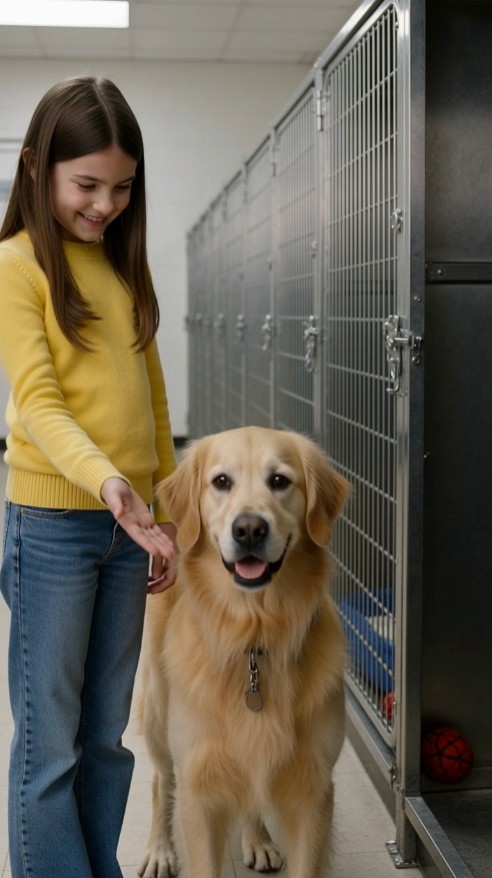
Eight-year-old Lily Anderson had been waiting two years for the day her father would finally let her adopt a dog.
She had imagined bringing home a playful puppy, buying colorful toys, and running through the garden with her new best friend.
But when she arrived at the Green Valley Animal Shelter, she fell in love with a golden retriever named Max.
Max was five years old.
He had soft golden fur, gentle brown eyes, and a tail that wagged whenever Lily approached.
He had spent nearly a year at the shelter without finding a permanent family.
Now someone had finally chosen him.
The adoption paperwork was approved, the shelter worker prepared his leash, and Lily knelt beside the kennel.
“Come on, Max. We’re going home!”
Max wagged his tail.
He walked toward the open door.
Then suddenly stopped.
He turned around and approached the neighboring kennel.
Inside lay an elderly black Labrador.
His muzzle was gray.
His movements were slow.
And his name was Charlie.
Charlie was thirteen years old.
He had lived at the shelter for nearly a year.
During that time, dozens of families had walked past his kennel.
Some wanted puppies.
Others wanted younger, more energetic dogs.
Charlie was friendly, but his age and medical needs made finding a suitable adopter difficult.
Max pressed his nose against the divider.
Charlie slowly lifted his head.
The two dogs touched noses through the bars.
Lily looked confused.
“Daddy, why won’t Max come?”
The shelter worker, Emma, watched quietly.
Then she explained something the family hadn’t known.
“Because Charlie is his best friend.”
Lily turned toward the elderly Labrador.
Her eyes filled with tears.
“Will Charlie be all alone if Max leaves?”
Emma hesitated.
“He’ll still have us looking after him.”
Lily looked toward her father.
Then asked one simple question.
“Daddy, why can’t we take both of them home?”
Her father, Daniel Anderson, looked at the two dogs.
He had come to adopt one golden retriever.
He had never considered taking home a thirteen-year-old Labrador.
But what happened next would change his family’s life and give Charlie something the shelter staff feared he might never experience again.
The Dog Who Had Waited Almost a Year
Max arrived at Green Valley Animal Shelter eleven months earlier.
His previous owners had experienced major changes in their housing circumstances and could no longer provide appropriate care.
The family surrendered him reluctantly.
Max was healthy, affectionate, and comfortable around people.
Shelter staff expected him to find a home quickly.
But adoption inquiries came and went.
Some families wanted smaller dogs.
Others preferred puppies.
A few visitors liked Max but ultimately chose another animal.
As the months passed, Max became familiar with the shelter routine.
He learned when meals arrived.
He recognized the staff members.
And he greeted visitors with an enthusiastic wag of his tail.
But there was one animal he appeared especially attached to.
The elderly black Labrador in the neighboring kennel.
Charlie.
The Labrador Nobody Chose
Charlie had arrived at the shelter after his longtime owner, seventy-nine-year-old Margaret Lewis, moved into a care facility that couldn’t accommodate him.
Margaret had adopted Charlie when he was a puppy.
For thirteen years, he had been her constant companion.
He accompanied her on gentle walks.
Rested beside her favorite chair.
And slept near her bedroom door.
When Margaret could no longer care for him, she was devastated.
Her relatives tried to arrange a suitable home, but none could commit to his long-term medical and practical needs.
Eventually, Charlie entered the shelter.
The staff treated him with care.
They provided comfortable bedding, appropriate food, veterinary attention, and gentle exercise.
But Charlie struggled with the change.
He was accustomed to a quiet home.
The unfamiliar sounds and activity of the shelter were difficult for him.
For several weeks, he spent much of his time resting quietly at the back of his kennel.
Then Max arrived.
The Friendship Between Two Kennels
Max and Charlie were initially housed near each other.
Shelter workers noticed that Max frequently approached the dividing fence.
He wagged his tail whenever Charlie moved closer.
At first, Charlie seemed uninterested.
He remained on his bedding.
But after several days, he began responding.
When Max approached, Charlie slowly stood.
He walked toward the divider.
And the two dogs sniffed one another.
Staff later introduced them carefully during supervised activities after assessing their compatibility.
The dogs appeared comfortable together.
Max was younger and more energetic.
Charlie preferred moving slowly.
But they enjoyed spending time in the same outdoor area.
Max often rested near Charlie.
And Charlie seemed more relaxed when Max was nearby.
The shelter team began referring to them as the unlikely pair.
The Nights Max Stayed Close
One shelter worker, Emma Davis, noticed something especially touching.
Whenever Charlie became unsettled during busy evenings, Max often moved toward the side of his kennel nearest the older dog.
He lay down there.
Sometimes Charlie moved closer too.
The two rested on opposite sides of the divider.
Emma couldn’t know exactly what either dog was thinking.
But their behavior suggested they had developed a strong social attachment.
Whenever possible, staff arranged supervised time together.
Charlie began showing more interest in walks and enrichment activities.
Max seemed happiest when the older Labrador joined him.
Over the months, their friendship became one of the shelter’s most familiar sights.
The Little Girl Who Wanted a Dog
Lily Anderson had been asking her father for a dog since she was six.
Every birthday, she made the same wish.
A dog.
She drew pictures of dogs.
Read books about them.
And watched videos about animal shelters.
Her father, Daniel, wanted to make sure the family was ready before adopting.
He worked as an electrician and spent many hours away from home.
Lily’s mother, Rachel, worked part-time at a local school.
They also had a small garden and an older family cat named Oliver.
Daniel wanted to ensure any dog they adopted would fit their household, including the cat, and receive appropriate exercise, supervision, and veterinary care.
Eventually, the family decided they were ready.
Lily was delighted.
She spent the entire evening before the shelter visit talking about names.
But she had no idea the dog she would choose already had a best friend.
The First Meeting
When Lily entered Green Valley Animal Shelter, she was overwhelmed by the number of dogs.
Some barked excitedly.
Others watched quietly.
Several were resting.
Emma explained that every animal had different needs and that finding a suitable match mattered more than choosing the first dog that appeared friendly.
Lily listened carefully.
Then she noticed Max.
The golden retriever stood near his kennel door, wagging his tail.
Lily approached with Emma’s guidance.
Max sniffed toward her hand.
She smiled.
“Hi, handsome.”
Emma arranged a supervised introduction in a quiet visiting area.
Max was gentle and relaxed.
He enjoyed being petted.
And he appeared comfortable around Lily and her parents.
The family spent time discussing his temperament, history, and care requirements.
By the end of the visit, Lily was certain.
“Daddy, he’s the one.”
The Adoption Decision
Daniel and Rachel reviewed the adoption information.
They asked about Max’s health.
His behavior around children.
And whether he had been assessed with other household animals.
Emma answered their questions and explained that introductions to their family cat would need to be managed carefully.
The family agreed.
They completed the shelter’s adoption process.
Lily was almost bursting with excitement.
She had already picked out a bed for Max.
A blue leash.
And a collection of toys.
When the adoption arrangements were finalized, Emma brought Max toward the exit.
Lily knelt beside him.
“Let’s go home!”
Max followed her for a few steps.
Then turned back.
The Kennel Next Door
Max walked toward Charlie’s kennel.
He pressed his nose near the divider.
Charlie slowly rose from his bedding.
The elderly Labrador approached.
The dogs sniffed one another.
Then Max sat down.
Emma gently encouraged him toward the exit again.
Max stood and moved a few steps.
But he kept looking back.
Lily watched.
“Why is he doing that?”
Emma explained that the dogs had spent months together.
They were accustomed to one another.
And Max might be unsettled by the sudden separation from a familiar companion.
Lily looked toward Charlie.
The older dog was standing quietly near the kennel door.
She noticed his gray muzzle.
His tired eyes.
And the gentle way he watched Max.
“Does Charlie have a family?”
Emma shook her head.
“Not yet.”
The Question That Changed Everything
Lily turned toward her father.
“Daddy, why can’t we take both?”
Daniel was surprised.
Two dogs would mean additional expenses.
More space.
More veterinary appointments.
And greater responsibility.
Charlie was also much older than Max.
He had age-related mobility concerns and needed ongoing medical monitoring.
Daniel didn’t want to make an emotional decision without understanding those needs.
He knelt beside Lily.
“Sweetheart, adopting two dogs is a big responsibility.”
She nodded.
“I know.”
He continued.
“Charlie needs special care.”
Lily looked toward the Labrador.
“Then we can help him.”
Daniel glanced toward Rachel.
His wife was watching the two dogs.
She looked thoughtful.
Then she asked Emma a question.
“What exactly would Charlie need if someone adopted him?”
The Conversation in the Shelter Office
Emma invited the family into the adoption office.
She explained Charlie’s health history.
The elderly Labrador had arthritis and needed a comfortable resting environment, appropriate exercise, and regular veterinary care.
He was generally gentle with people.
But staff recommended a calm household and careful introductions to other animals.
Emma also emphasized that Charlie’s remaining lifespan was uncertain.
Older dogs could require significant medical attention.
Daniel listened carefully.
He asked about treatment costs and the adjustments the family might need to make.
Rachel asked whether the shelter could help assess how both dogs might adapt to their home.
Emma explained the available support, including a trial arrangement and follow-up guidance if the family met the shelter’s requirements.
The decision couldn’t be made solely because the dogs appeared attached.
It needed to be right for both animals and the family.
Daniel appreciated her honesty.
The Little Girl’s Promise
While the adults spoke, Lily sat near the window.
She was thinking about Charlie.
She remembered the older dog slowly standing to greet Max.
She imagined him returning to his bedding after his best friend left.
When Daniel approached, she looked up.
“Daddy, I know Charlie is old.”
He nodded.
“And I know he might need medicine.”
“Yes.”
Lily took a breath.
“But old dogs still deserve a family.”
Daniel felt his throat tighten.
She continued.
“Even if he can’t run with me, I can sit with him.”
Rachel wiped her eyes.
Daniel looked toward Emma.
Then he asked whether they could spend more time getting to know Charlie.
Meeting Charlie
The family was introduced to Charlie in a quiet area.
The Labrador approached slowly.
His tail moved gently.
He allowed Lily to sit nearby and offered his head for a soft scratch.
Max joined the supervised introduction.
The dogs appeared relaxed together.
Daniel watched carefully.
Charlie wasn’t energetic like Max.
He didn’t jump or chase toys.
But he was affectionate.
And when Lily sat beside him, he leaned gently against her leg.
She smiled.
“Hi, Charlie.”
The old Labrador looked up.
Lily whispered:
“Would you like to come home with us too?”
Charlie rested his head near her knee.
Daniel looked toward Rachel.
For the first time, he began seriously imagining both dogs in their home.
The Decision
The Anderson family didn’t leave the shelter immediately with both dogs.
Instead, they worked with Emma to evaluate whether their household could support the pair.
They discussed their schedules, budget, veterinary arrangements, and how to introduce the dogs safely to their cat.
After careful consideration, Daniel and Rachel decided to proceed with a shelter-supported trial placement for Charlie alongside Max.
If the arrangement worked well, they intended to complete Charlie’s adoption too.
When Emma explained the plan, Lily began crying with happiness.
“Both of them?”
Daniel smiled.
“If everyone settles safely, yes.”
Lily hugged him.
“Thank you, Daddy.”
Then she turned toward the dogs.
Max was resting beside Charlie.
For the first time that afternoon, Lily no longer worried about separating them.
The Shelter Staff’s Reaction
Emma shared the news with the other shelter workers.
Several gathered near the office to wish the dogs well.
They had spent months caring for Charlie.
Some had worried that his age would make adoption difficult.
Others had become attached to his gentle personality.
Now he had a genuine opportunity to live in a family home again.
One volunteer began crying.
Another smiled and said:
“I never thought they’d leave together.”
Emma watched Max and Charlie as they prepared for the journey.
The younger dog wagged his tail.
Charlie stood beside him.
The pair were carefully secured for transport.
Lily waved goodbye to the shelter workers.
Then the family drove home.
The First Evening
The Andersons had prepared separate comfortable resting spaces for the dogs.
Charlie received a supportive bed in a quiet area.
Max had his own bed nearby.
The family followed the shelter’s guidance and introduced both dogs gradually to their new surroundings.
Their cat, Oliver, remained in a separate safe space during the initial adjustment.
Charlie explored slowly.
He sniffed the furniture.
Drank water.
And eventually settled on his bed.
Max investigated the room and returned to rest nearby.
Lily sat on the floor at a respectful distance.
She watched them quietly.
For months, the dogs had slept in a busy shelter.
Now they were resting in a peaceful home.
The Night Lily Couldn’t Sleep
That evening, Lily woke and walked quietly toward the living room with her mother.
She wanted to check on the dogs.
Rachel reminded her to let them rest.
But when they reached the doorway, Lily stopped.
Max was sleeping on his bed.
Charlie was resting beside him.
Their beds were close enough that the dogs could see and smell one another.
Lily smiled.
“They’re together.”
Rachel nodded.
“Yes, sweetheart.”
Lily looked toward Charlie.
“Do you think he’s happy?”
Rachel smiled gently.
“I think he’s settling in.”
Lily nodded.
Then she whispered:
“Goodnight, Charlie.”
The old Labrador lifted his head briefly.
Then rested again.
The First Veterinary Appointment
During the following week, the family took Charlie to a veterinarian.
The doctor reviewed his medical history and examined his mobility.
Charlie needed ongoing arthritis management and a suitable exercise routine.
The veterinarian recommended gentle activity, weight monitoring, and adjustments to keep him comfortable.
The family discussed appropriate care and follow-up appointments.
Daniel understood that Charlie’s medical needs might become more significant with age.
But he was prepared.
The decision to adopt him was no longer just a touching idea.
It was a commitment.
A responsibility the whole family had chosen.
The Trial Period
Over the following weeks, both dogs adjusted to the Anderson home.
Max enjoyed walks and playtime.
Charlie preferred shorter outings and long naps.
The family gradually introduced the dogs to Oliver, their cat, using controlled separation and supervised exposure.
The process required patience.
But eventually, the animals became comfortable sharing the household.
Max often rested near Charlie.
Charlie appeared content with the quieter routine.
The shelter checked in regularly.
The family reported that both dogs were eating, resting, and adapting well.
When the trial period ended, Daniel and Rachel completed Charlie’s adoption.
Lily was delighted.
Now both dogs officially belonged to the family.
The Photograph That Went Back to the Shelter
Rachel took a photograph of Max and Charlie sleeping beside the living-room fireplace.
Max lay on one side.
Charlie rested on the other.
Lily sat between them, smiling.
She sent the photograph to Emma with a short message.
Both boys are doing wonderfully. Charlie has settled into his new bed, Max is loving the garden, and Lily couldn’t be happier.
Emma showed the photograph to the other shelter workers.
Several became emotional.
For nearly a year, they had watched the two dogs develop their friendship.
Now they were living together in a permanent home.
The image became one of the shelter’s favorite adoption updates.
Charlie’s First Birthday With the Family
Several months later, the Andersons celebrated Charlie’s fourteenth birthday.
They weren’t certain of his exact birth date, so they used the estimated date recorded in his adoption documents.
Lily made a paper banner.
Rachel prepared a dog-safe birthday treat approved for Charlie’s dietary needs.
Max received a small treat too.
Charlie moved slowly toward the family.
His tail wagged gently.
Lily sat beside him.
“Happy birthday, Charlie.”
She carefully placed a new soft blanket near his bed.
Daniel watched.
He remembered the moment Lily first asked whether they could adopt both dogs.
At the time, he worried about the responsibility.
Now he couldn’t imagine the house without Charlie.
The Letter From Charlie’s Previous Owner
One afternoon, Emma contacted the family.
With permission, she shared a letter from Charlie’s former owner, Margaret Lewis.
Margaret had recently learned that Charlie was adopted.
She wanted to thank the family.
The letter read:
Dear Anderson Family,
I cannot tell you how relieved I am to know Charlie has a home again.
He was my companion for thirteen wonderful years.
When I moved into care, leaving him was one of the hardest things I ever experienced.
I worried that nobody would want an old dog.
Thank you for seeing the gentle friend I have always known.
Please give him a little scratch behind his ears for me.
With gratitude, Margaret.
Lily read the letter with her mother.
Then she asked whether they could send Margaret a photograph.
Rachel agreed.
The Visit to Margaret
After arranging the visit through Margaret’s family and care facility, the Andersons brought Charlie to see his former owner.
Margaret was sitting in a garden area when they arrived.
As Charlie approached on his leash, she began crying.
“Charlie?”
The old Labrador looked toward her.
His tail moved.
He walked closer.
Margaret gently stroked his face.
“Oh, my boy.”
Lily watched quietly.
She understood that Charlie had another person who loved him deeply.
Margaret looked toward Daniel and Rachel.
“Thank you for taking care of him.”
Daniel smiled.
“He’s part of our family now.”
Margaret nodded through tears.
“That’s all I ever wanted.”
The Two Children Who Loved Him
During the visit, Margaret told Lily stories about Charlie as a puppy.
She described how he used to carry slippers around the house.
How he loved watching birds from the garden.
And how he once fell asleep inside an empty laundry basket.
Lily laughed.
She had only known Charlie as an elderly dog.
Now she could imagine him young and playful.
Margaret smiled.
“He was always gentle.”
Lily nodded.
“He still is.”
Then she showed Margaret a photograph of Max and Charlie sleeping together.
Margaret looked surprised.
“He has a friend?”
Lily smiled.
“His best friend.”
The Bond That Continued
As the months passed, Max and Charlie remained close.
Max enjoyed energetic activities appropriate for his age.
Charlie preferred rest and gentle walks.
The family respected their different needs.
Sometimes Max lay beside Charlie’s bed after returning from a long walk.
Other times, Charlie followed him slowly into the garden.
The dogs didn’t need to do everything together.
But they appeared comfortable sharing their space.
Lily enjoyed sitting beside them with a book.
She often read aloud while Charlie rested.
Max sometimes placed his head on her feet.
For Lily, having two dogs felt even better than the dream she originally imagined.
The Difficult Conversation
One evening, Daniel sat beside Lily on the sofa.
Charlie had recently needed additional veterinary care.
Although he was comfortable, his age meant that his health would require continued monitoring.
Daniel wanted Lily to understand what adopting an elderly animal meant.
He explained that Charlie might not live as long as Max.
Lily became quiet.
“Because he’s old?”
Daniel nodded.
“Yes.”
She looked toward Charlie.
Then asked:
“Does that mean we shouldn’t have adopted him?”
Daniel shook his head.
“Not at all.”
He explained that caring for an older dog could still bring happiness, even when the time together might be shorter.
Lily thought carefully.
Then said:
“Charlie waited a long time for a home.”
Daniel nodded.
“And now he has one.”
The School Presentation
At school, Lily’s teacher asked students to prepare a short presentation about kindness.
Lily chose to tell Max and Charlie’s story.
She showed photographs from the shelter.
Then explained that Max had been selected for adoption but appeared reluctant to leave his elderly companion.
She described how the family carefully considered whether adopting both dogs was possible.
And how Charlie eventually joined them at home.
At the end of her presentation, Lily said:
“Sometimes an animal isn’t the youngest or the fastest.”
She paused.
“But that doesn’t mean it doesn’t deserve love.”
Her classmates applauded.
Several students later asked their parents about volunteering at local animal shelters.
The Shelter’s Senior Dog Program
The Green Valley Animal Shelter used Max and Charlie’s story to help explain the needs of older dogs.
Staff emphasized that senior animals could make wonderful companions, but potential adopters needed to understand their medical, financial, and practical responsibilities.
The shelter expanded its educational materials about senior pet adoption.
It also highlighted the importance of considering established social bonds between animals when making placement decisions.
Emma was pleased.
She knew not every family could adopt two dogs.
And not every bonded pair needed to remain together in every circumstance.
But Max and Charlie’s successful placement showed why careful matching mattered.
The Afternoon Max Refused to Play
One afternoon, Lily took Max into the garden with his favorite ball.
Usually, the golden retriever was eager to play.
But that day, he glanced toward the house.
Charlie was resting inside after a veterinary appointment.
Max appeared less interested in chasing the ball.
Lily sat beside him.
“Are you worried about Charlie?”
Max rested his head near her knee.
She gently stroked his fur.
Then she brought him inside.
Max settled on his bed near Charlie.
The older Labrador lifted his head.
After a moment, both dogs relaxed.
Lily watched quietly.
The sight reminded her of the shelter.
Max sitting near the dividing fence.
Charlie resting on the other side.
Only now, there were no kennel bars between them.
A Year After Adoption
On the first anniversary of the dogs’ adoption, the Anderson family returned to Green Valley Animal Shelter.
They brought photographs and a donation of supplies for the animals still waiting for homes.
Emma greeted them warmly.
Max appeared excited by the familiar surroundings.
Charlie moved slowly but comfortably beside him.
Several staff members recognized the pair.
They were delighted to see them together.
Lily handed Emma a drawing.
It showed two dogs lying beside a fireplace.
Above them were the words:
BEST FRIENDS BELONG TOGETHER.
Emma smiled.
Then she hugged Lily.
“Thank you for giving them a chance.”
The Day Charlie Needed Extra Care
As Charlie grew older, he began having more difficulty moving comfortably.
The veterinarian adjusted his care plan.
The family provided supportive bedding and made small changes around the house.
They placed non-slip mats where needed.
They reduced unnecessary stairs.
And they made sure he had easy access to water and a quiet resting area.
Max gradually adjusted to Charlie’s slower pace.
The family continued giving each dog individual attention.
Lily learned that caring for animals meant more than playing with them.
It meant recognizing when they needed rest.
Following veterinary guidance.
And making sure they were comfortable.
She became proud of helping with Charlie’s daily routine under her parents’ supervision.
The Final Winter
During his fifteenth year, Charlie’s health declined.
He became more tired and required frequent veterinary assessment.
The Anderson family worked closely with his veterinarian to monitor his comfort and quality of life.
They spent quiet evenings together.
Lily often sat beside his bed, reading stories aloud.
Max rested nearby.
The family knew Charlie’s time might be limited.
They focused on keeping him comfortable and surrounded by familiar people.
One afternoon, the veterinarian explained that Charlie’s condition had progressed and that his comfort could no longer be maintained adequately.
After a difficult conversation, the family made a compassionate end-of-life decision with veterinary support.
They stayed with Charlie in a calm, familiar environment.
Lily gently stroked his head.
She whispered:
“You’re home, Charlie.”
He was surrounded by the family who loved him.
The Empty Bed
The days after Charlie’s passing were difficult.
Lily missed his slow footsteps.
His gentle expression.
And the quiet way he rested beside her while she read.
Max also appeared unsettled by the change in routine.
He occasionally approached Charlie’s empty bed and sniffed it.
The family maintained Max’s usual exercise, meals, and companionship while allowing him time to adjust.
Daniel explained to Lily that animals can respond differently to the loss of a familiar companion.
Nobody could know exactly what Max understood.
But the family could support him through a consistent, reassuring routine.
Lily kept Charlie’s favorite blanket.
She folded it carefully and placed it inside a memory box.
The Letter Lily Wrote
One evening, Lily sat at her desk and wrote Charlie a letter.
Dear Charlie,
I’m glad Daddy said yes.
I’m glad you came home with Max.
I know you were old when we met.
But you were the best old dog in the world.
I loved reading beside you.
I loved how you rested your head on my knee.
And I loved that Max was your friend.
Thank you for being part of our family.
Love, Lily.
She placed the letter beside a photograph of the two dogs.
Then she hugged Max.
For a moment, she remembered the shelter.
The open kennel door.
And the golden retriever who kept looking back.
The Photograph That Stayed on the Wall
The Anderson family framed a photograph taken shortly after the adoption.
Max and Charlie were lying beside the fireplace.
Their heads rested close together.
Lily sat behind them, smiling.
Beneath the photograph, Rachel added a small inscription.
TWO FRIENDS. ONE HOME.
The picture remained in the living room.
Whenever visitors asked about it, Lily told the story.
She explained how Max was ready to leave the shelter but kept returning toward Charlie.
How her family learned about their friendship.
And how they decided, after careful consideration, to adopt both dogs.
She always smiled when describing Charlie’s first night at home.
The old Labrador finally resting peacefully beside his best friend.
The Return to the Shelter
Several years later, Lily returned to Green Valley Animal Shelter as a teenage volunteer.
She helped staff prepare enrichment activities and organize donated supplies.
She learned about animal care, safe handling, and the responsibilities of adoption.
One afternoon, Emma showed her an elderly dog that had recently arrived.
The dog was quiet and cautious.
Several visitors had already passed by without showing interest.
Lily sat nearby, following the shelter’s guidance.
She remembered Charlie.
The gray muzzle.
The slow movements.
And the way he looked at Max through the kennel divider.
Then she smiled.
“Hi, sweetheart.”
Emma watched her.
“You remember Charlie, don’t you?”
Lily nodded.
“Every day.”
The Choice That Changed Everything
The story began when eight-year-old Lily Anderson chose a golden retriever named Max at an animal shelter.
Max had waited nearly a year for adoption.
But when staff opened his kennel, he repeatedly turned toward the neighboring enclosure.
Inside was Charlie, a thirteen-year-old black Labrador who had become his close companion.
The shelter team explained that the two dogs had developed a strong attachment during their time together.
Lily asked her father whether they could adopt Charlie too.
Her parents carefully considered the elderly dog’s health, the family’s resources, and the responsibility involved.
After a successful trial placement, they adopted both dogs.
Charlie spent his remaining years in a loving home beside Max.
He enjoyed quiet walks, comfortable afternoons, and the affection of a family who understood his needs.
And Lily learned that the value of an animal’s companionship wasn’t measured by its age.
The Dog Who Looked Back
Years after Charlie’s passing, Lily still remembered the moment Max stopped at the shelter door.
At the time, she was a little girl who wanted a dog.
She thought bringing Max home would be the happiest day of her life.
But the golden retriever kept looking back.
He wouldn’t leave the neighboring kennel without showing interest in the older Labrador inside.
That moment changed the family’s plans.
And it gave Charlie the chance to spend his final years in a home.
One quiet afternoon, Lily sat in the garden with Max.
The golden retriever was older now.
His muzzle had begun turning silver.
He rested beside her while she looked through old photographs.
She found one taken at the shelter.
Max stood beside the kennel divider.
Charlie looked toward him.
Lily smiled sadly.
Then she looked at Max.
“You remember him?”
Max lifted his head.
She gently stroked his fur.
“I do too.”
The afternoon sunlight moved across the garden.
Lily closed the album.
Then she leaned against Max and smiled.
She had once believed that adopting a dog meant choosing the one she liked best.
But Max and Charlie taught her something deeper.
Sometimes love asks us to notice someone who has been overlooked.
Sometimes kindness requires patience, preparation, and a willingness to accept responsibility.
And sometimes, the most meaningful part of bringing someone home is making sure their happiness matters too.
Charlie had waited nearly a year for a family.
Max had found one.
But when the golden retriever turned back toward his elderly friend, a little girl asked a question that changed both their lives.
“Daddy, why can’t we take both?”
And because her family took that question seriously, Charlie finally experienced what every shelter animal deserves.
A safe place.
Gentle care.
And people who loved him for exactly who he was.