
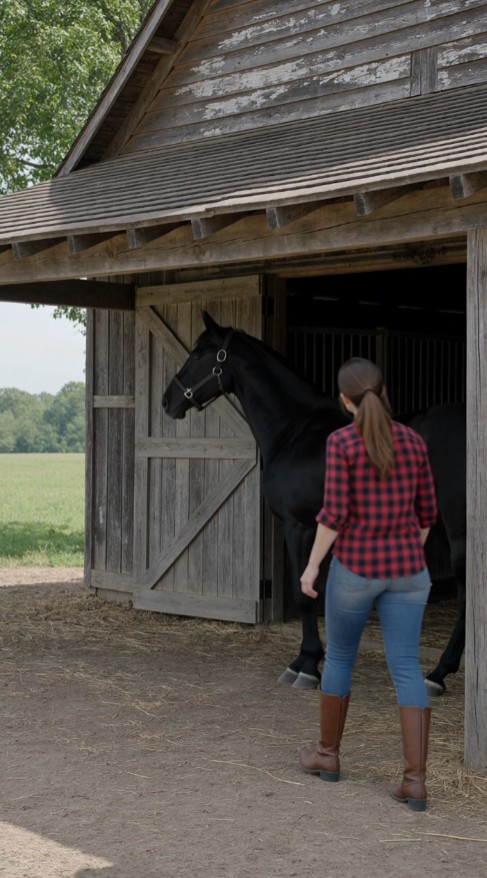
For eleven years, I had trusted my black horse, Thunder, with my life.
I raised him from a foal.
I knew his habits, his moods, and the familiar sound of his hooves crossing our farmyard.
He was powerful, weighing more than a thousand pounds, but he had always been gentle around me.
Until one morning when he suddenly became a horse I barely recognized.
He pinned his ears back.
Blocked the entrance to our old wooden barn.
And reared when I tried to walk past him.
“Thunder! What’s wrong with you?”
I was frightened.
I thought he might be sick, injured, or reacting to something I couldn’t see.
Then he looked upward.
A thin stream of dust fell from the beam above the barn doorway.
The roof creaked.
And I noticed something that made my stomach tighten.
One of the old wooden supports had shifted.
I stepped backward.
A sharp cracking sound came from inside the building.
Then I heard another noise.
A faint cry.
It came from behind the closed door of the farthest stall.
At first, I thought an animal was trapped.
But then the sound came again.
And this time, I recognized a single word.
“Mom?”
My blood ran cold.
Because my seven-year-old daughter, Ellie, was supposed to be inside our farmhouse.
And the voice coming from the dangerous barn sounded exactly like hers.
The Horse I Raised From a Foal
My name is Sarah Mitchell, and my husband, James, and I have spent most of our married life running a small farm.
We keep several horses, a few goats, and chickens.
Our property has been in James’s family for three generations.
The old barn was built by his grandfather.
It had thick wooden posts, weathered siding, and enormous double doors that creaked whenever they opened.
For years, it served us well.
Thunder came into our lives shortly after we moved there.
He was a small black foal with long legs, curious eyes, and an unusually confident personality.
He followed me around whenever I entered his paddock.
As he grew, we spent countless hours training together.
I taught him to respond to familiar cues.
He learned to stand calmly for grooming, cooperate with routine handling, and follow a consistent schedule.
We developed a strong bond.
But I never forgot that he was a large, powerful animal.
Even a familiar horse can react unpredictably when frightened or in pain.
That morning reminded me why respecting his behavior was so important.
The Little Girl Who Loved Thunder
Ellie was seven and had grown up surrounded by animals.
She adored Thunder.
She loved brushing him under adult supervision and bringing him treats when we allowed it.
Her favorite activity was helping me organize the grooming brushes.
She insisted that each one had a special place.
Thunder’s largest brush belonged in the blue bucket.
The softer brush went in the yellow one.
And the old wooden comb, which she called the royal comb, was reserved for special occasions.
Ellie believed Thunder understood everything she said.
Sometimes she stood beside the fence telling him stories about school.
Thunder would lower his head and listen quietly.
I often joked that he was the most patient listener on the farm.
But we had strict rules.
Ellie wasn’t allowed to enter the barn or handle horses alone.
She needed an adult with her.
Especially near stalls, gates, and equipment.
Until that morning, she had always followed those rules.
The Storm That Damaged the Barn
Three nights before the incident, a powerful storm crossed our county.
Wind shook the windows.
Rain pounded the roof.
And branches fell across the driveway.
The following morning, James and I walked around the property checking for obvious damage.
The barn looked mostly intact from outside.
A few roof shingles had loosened.
One gutter had bent.
And water had collected near the rear wall.
We arranged for a contractor to inspect the building.
But the earliest appointment available was several days away.
James moved the larger equipment away from the affected side.
We planned to avoid unnecessary activity near the old rear storage section.
What we didn’t know was that part of the roof framing had been weakened.
An aging support joint had deteriorated behind the interior cladding.
The storm had placed additional stress on it.
And the damage was far more serious than we realized.
The Morning Everything Changed
The morning began like any other.
James left early to collect feed and replacement fencing supplies.
I prepared breakfast and checked on Ellie.
She was sitting in the kitchen drawing pictures of the horses.
I told her I was going outside to finish the morning chores.
She nodded.
I reminded her to stay in the house.
Then I went to the paddock.
I checked the water troughs.
Fed the chickens.
And made sure the horses had access to their usual feed and water.
Thunder was standing near the barn.
At first, I didn’t think anything of it.
But when I started walking toward the entrance, his behavior changed.
He lifted his head.
His ears went backward.
And he moved directly into my path.
“Move, sweetheart.”
I spoke gently.
He didn’t respond as usual.
Instead, he shifted sideways and blocked the doorway again.
The Warning I Didn’t Understand
I tried moving around him.
Thunder turned sharply.
His body became tense.
I stepped away.
Then he reared.
Not directly over me, but close enough to frighten me badly.
“THUNDER!”
My heart began pounding.
I had never seen him react that way when I approached the barn.
I considered whether he might be injured.
Perhaps he had been frightened by something inside.
Or maybe an unfamiliar animal had entered the building.
I reached toward the nearby gate latch.
Thunder stamped his front hoof.
Then let out an unusually loud neigh.
This time, he wasn’t looking at me.
He was staring above the entrance.
I followed his gaze.
A small cloud of dust fell from the wooden beam.
Then came a long, low creak.
I stepped backward.
One of the roof supports appeared to have moved.
Suddenly, Thunder’s behavior made more sense.
There was something wrong with the barn.
The First Crack
The sound came from deep inside the building.
A sharp crack.
Then another.
I stared at the roof.
A section near the entrance seemed lower than I remembered.
Dust drifted through a gap in the siding.
I knew enough about old farm structures to recognize that something was seriously wrong.
I backed farther away.
Thunder moved into the open yard.
Then I heard the sound that changed everything.
A faint cry.
At first, I thought it was one of the goats.
But it came again.
“Help!”
I froze.
The sound was coming from the far stall.
Then I heard:
“Mom?”
My knees weakened.
“Ellie?”
A frightened voice answered.
“Mommy, I’m here!”
For a moment, I couldn’t understand what I was hearing.
My daughter was inside the barn.
And part of the roof was beginning to fail.
Why Ellie Went Inside
Later, Ellie explained what happened.
After I left the house, she noticed that her favorite stuffed rabbit was missing.
She remembered leaving it in the barn the previous afternoon while helping me put away grooming supplies.
She knew she wasn’t supposed to go inside alone.
But she believed she could retrieve it quickly.
She walked across the yard.
Entered through the side door.
And went toward the storage shelves near the far stall.
She found the rabbit beneath a small bench.
Then she heard a loud creaking sound above her.
Dust began falling.
Startled, she moved into the nearest empty stall.
The door swung partly shut behind her.
Its old latch caught.
Ellie tried to open it.
But the handle was stiff.
She began calling for me.
The storm-damaged structure continued shifting.
And nobody heard her.
Until Thunder reacted outside.
The Decision I Couldn’t Make
Every instinct in my body told me to run into the barn.
My daughter was frightened.
She was trapped.
And I could hear her crying.
But the roof was visibly unstable.
I remembered the cracks.
The falling dust.
And the enormous weight of the wooden beams above the entrance.
If I rushed inside, I could be seriously injured.
Worse, I might trigger further movement or become trapped myself.
I backed away from the building and called emergency services.
My voice was shaking.
I explained that a child was inside an old barn with suspected structural failure.
The dispatcher asked for our address.
Then instructed me to stay clear of the unstable building and avoid entering.
I told her Ellie was trapped in a stall.
She assured me that emergency crews were being sent.
Then she asked me to remain on the line.
Talking to Ellie
I moved to a safe position where I could still hear my daughter.
“Ellie!”
“Mommy!”
“I’m here, sweetheart.”
She was crying.
“I can’t get the door open!”
I fought to keep my voice steady.
“Help is coming.”
She asked whether she should climb over the stall partition.
I immediately told the dispatcher what Ellie was asking.
Following the dispatcher’s guidance, I told Ellie not to climb or attempt to move through the damaged structure.
I encouraged her to remain where she was unless responders instructed otherwise.
She began crying harder.
“I’m scared.”
“I know, sweetheart.”
My throat tightened.
“But I’m right here.”
Thunder stood nearby in the open yard.
His body was still tense.
He occasionally looked toward the barn.
For the first time that morning, I was grateful he hadn’t allowed me to approach him carelessly.
The Sound Above Her Head
While we waited, another creaking sound came from the barn.
It was louder than before.
I looked toward the roof.
The damaged section had shifted again.
Ellie screamed.
“Mommy!”
I nearly ran forward.
But the dispatcher warned me to remain outside the danger zone.
I stopped.
My hands were shaking so badly that I could barely hold the phone.
“Ellie, keep talking to me!”
She answered between sobs.
“Okay.”
I asked her to tell me about the stuffed rabbit.
She said she was holding it.
I asked what color its ears were.
“Pink.”
I told her to keep her attention on my voice.
The conversation helped both of us endure the wait.
Thunder’s Strange Reaction
Thunder began moving around the open yard.
He walked several steps toward the barn, stopped, and backed away.
His ears moved constantly.
He seemed highly alert.
I couldn’t tell whether he was reacting to the noises, the unstable structure, or Ellie calling from inside.
Horses have sensitive hearing and can respond strongly to unfamiliar sounds and environmental changes.
But I couldn’t know exactly what Thunder understood.
What I did know was that his unusual behavior had stopped me from walking directly beneath the damaged entrance.
His reaction had given me time to notice the falling dust and creaking beams.
And that may have prevented me from entering at the worst possible moment.
The Firefighters Arrive
The first emergency vehicles arrived several minutes later.
Firefighters assessed the barn from outside.
They established a safety perimeter and asked me to explain where Ellie was located.
I pointed toward the rear stall.
One firefighter spoke to her from a safe position.
She answered.
The crew then evaluated the building’s damaged supports and considered possible access routes.
The main entrance was unsafe.
Part of the roof framing had shifted.
Entering through that doorway could expose rescuers to falling structural components.
But there was another possibility.
The barn had a small rear service door leading toward the storage area.
It wasn’t used often.
But it was closer to the stall where Ellie was trapped.
I told the firefighters about it.
They examined the rear section.
Then began planning a controlled rescue.
The Door Behind the Barn
The rear service door was partly obstructed by old equipment.
It also opened near a section of wall that showed signs of movement.
The firefighters worked carefully.
They used their training and equipment to assess the safest available route.
I waited outside.
Every second felt endless.
I could hear radios.
Instructions.
And occasional sounds from the building.
Then one firefighter called toward the stall.
“Ellie, can you hear me?”
“Yes!”
“Good. We’re coming to help you.”
I covered my mouth.
Tears filled my eyes.
For the first time since hearing her voice inside the barn, I felt hope.
The Rescue
The crew reached the area near the stall.
They confirmed Ellie’s location.
Then worked to open the damaged latch without placing her beneath an unstable section.
The barn creaked again.
My heart nearly stopped.
But the firefighters continued according to their rescue plan.
Finally, I heard a voice over the radio.
“We have the child.”
I began crying.
A few moments later, a firefighter emerged from the rear access area carrying Ellie.
She was wrapped in a protective blanket.
Her face was streaked with tears.
And her stuffed rabbit was still clutched tightly against her chest.
“Mommy!”
I hurried toward her only after responders confirmed the area was safe.
I wrapped my arms around her.
I couldn’t speak.
I simply held her.
The Collapse That Followed
Shortly after Ellie was brought to safety, another loud crack came from the barn.
Everyone moved farther away.
Then part of the roof collapsed into the central aisle.
A heavy beam struck the floor.
Dust rose above the damaged structure.
The sound was enormous.
I held Ellie tightly.
She buried her face against my shoulder.
The firefighters kept everyone clear until the remaining hazards could be assessed.
I stared at the broken roof.
The section that had fallen was close to the area I had intended to enter that morning.
And the main doorway was now partly blocked by debris.
I thought about Thunder.
The way he had moved into my path.
The way he had reared.
And the moment I saw dust falling from above the entrance.
My legs began trembling.
The First Thing Ellie Asked
After emergency medical personnel checked Ellie, she sat beside me near the farmhouse.
She was frightened but had no apparent serious injuries.
James had returned after receiving my call.
He held us both.
Then Ellie asked a question.
“Is Thunder okay?”
I looked toward the paddock.
Our black horse was standing near the fence.
He was unharmed.
I nodded.
“He’s okay, sweetheart.”
Ellie sighed with relief.
Then whispered:
“I heard him outside.”
I looked at her.
“What?”
She nodded.
“He was making loud noises.”
I remembered his neighing.
She may have heard him through the barn walls.
For a moment, I wondered whether Thunder had heard her crying before I did.
There was no way to know.
But the thought stayed with me.
What the Structural Inspector Found
Later that afternoon, qualified professionals assessed the damaged barn.
The findings were worse than we expected.
An old support connection had deteriorated.
Moisture had affected portions of the timber.
And the recent storm had contributed additional stress.
The roof had begun transferring weight unevenly.
That placed greater strain on the already weakened entrance area.
The structure was no longer safe to use.
The inspector explained that serious structural failures can develop gradually before becoming visible.
The signs may not always be obvious to someone standing outside.
In our case, the falling dust, shifting beam, and unusual creaking were important warning signs.
We were told not to enter the building again until the hazards had been professionally addressed.
The Conversation With James
That night, after Ellie fell asleep, James and I sat at the kitchen table.
Neither of us had much appetite.
We were exhausted.
I told him everything.
Thunder blocking the doorway.
The rearing.
The falling dust.
And Ellie’s frightened voice inside.
James listened quietly.
Then he looked toward the window.
Thunder was standing in the paddock beneath the evening sky.
James shook his head.
“If he hadn’t stopped you, you might have walked straight inside.”
I nodded.
“I know.”
He reached for my hand.
Then I began crying again.
For most of the morning, I had been angry at Thunder.
I thought he had suddenly become dangerous.
But his behavior had coincided with a serious threat.
And it stopped me long enough to recognize it.
The Horse I Almost Misunderstood
The following morning, I approached Thunder in the safe paddock.
He lifted his head when he heard my voice.
For a moment, I hesitated.
I remembered him rearing.
The pinned ears.
And the force of his movements.
Even though I loved him, I knew that behavior was dangerous.
I approached calmly and maintained appropriate space.
Thunder relaxed.
He lowered his head.
I gently stroked his neck.
“Hey, sweetheart.”
He stood quietly.
I thought about how frightened I had been.
Then I whispered:
“I’m sorry I didn’t understand.”
Of course, Thunder couldn’t explain what happened.
I didn’t know whether he reacted to the failing structure, unfamiliar noises, or something else.
But his behavior had been different for a reason.
And I was grateful I had paid attention before it was too late.
Ellie Learns an Important Lesson
When Ellie felt comfortable discussing the incident, James and I talked with her about what happened.
We explained that the barn had become unsafe.
She apologized for entering without permission.
I hugged her.
I told her I was glad she was safe.
Then we reviewed our farm rules.
Children must never enter barns, stalls, or animal enclosures without appropriate adult supervision.
Damaged structures must be avoided.
And if something frightening happens, the safest choice is to call for help rather than attempting a risky escape.
We also explained that animals can become dangerous when stressed.
Even familiar horses need space and careful handling.
Ellie listened.
Then asked:
“Was Thunder scared?”
I smiled gently.
“Maybe.”
She looked toward the window.
“Was he trying to help you?”
I thought for a moment.
“We can’t know exactly what he was thinking.”
Then I added:
“But his behavior helped me notice something was wrong.”
The Photograph on Our Wall
Several weeks later, after Ellie had recovered emotionally from the experience, we took a family photograph.
We stood beside Thunder in the paddock.
James held Ellie’s hand.
I stood near Thunder’s shoulder.
The horse was calm.
His black coat shone in the afternoon sunlight.
Ellie smiled.
We framed the photograph and hung it in our living room.
Whenever I looked at it, I remembered the morning of the collapse.
But I also remembered something else.
The relief of seeing Ellie carried safely out of the barn.
The moment she hugged me.
And the knowledge that our family had been given another chance to enjoy ordinary days together.
The New Barn
The old barn couldn’t be repaired economically.
After professional assessment, we arranged for the damaged structure to be demolished safely.
It was a difficult decision.
James’s grandfather had built it decades earlier.
Generations of animals had sheltered beneath its roof.
And many family memories were connected to it.
But safety had to come first.
We planned a new barn with modern structural standards and improved access.
The layout included safer storage areas, appropriate ventilation, and clearer separation between animal spaces and equipment.
We also established a routine inspection and maintenance plan.
The new building would never replace the history of the old one.
But it would help protect the animals and people who depended on it.
The Day Thunder Entered the New Barn
Months later, the new barn was completed.
We introduced the horses to the building gradually.
Thunder approached the entrance cautiously.
He looked around.
Sniffed the unfamiliar surfaces.
And paused.
I allowed him time to investigate.
Then, with appropriate handling, he walked inside.
He seemed curious.
A little uncertain.
But calm.
I smiled.
“Well, what do you think?”
He lowered his head toward the fresh bedding.
Then looked at me.
I laughed softly.
“Good enough.”
For the first time in months, I felt comfortable standing near a barn entrance again.
Ellie’s Gift for Thunder
On Thunder’s next birthday, Ellie made him a special card.
She drew a large black horse standing in front of a red barn.
Above him were bright yellow stars.
At the bottom, she wrote:
“THANK YOU FOR HELPING MOMMY.”
She wanted to hang it inside the stable.
We placed it safely on the wall outside his stall.
Then she helped me prepare his normal feed and an appropriate treat.
Thunder ate happily.
Ellie laughed.
“He doesn’t even know it’s his birthday.”
I smiled.
“Probably not.”
She leaned against my arm.
“But we do.”
I looked toward the card.
Then nodded.
“Yes, sweetheart. We do.”
The Day Ellie Returned to Riding Lessons
For a while after the incident, Ellie was nervous around the barn.
She didn’t want to walk past the place where the old structure had stood.
We didn’t pressure her.
We gave her time.
Eventually, she asked whether she could resume her supervised riding lessons.
We arranged a gentle session with her instructor using an appropriate horse and familiar safety equipment.
Thunder remained part of our family, but we didn’t expect Ellie to handle him alone.
She gradually regained confidence.
After one lesson, she walked toward me smiling.
“Mom, I wasn’t scared today.”
I hugged her.
“I’m proud of you.”
Then she looked toward Thunder in his paddock.
“Can we go say hello?”
I nodded.
“Of course.”
The Story Our Neighbors Remembered
News of the barn collapse spread through our small farming community.
Several neighbors came to help with temporary arrangements for the animals.
Others brought meals while we dealt with repairs and insurance paperwork.
People asked about Ellie.
They asked about Thunder.
And they wanted to know what happened.
I told them the truth.
Thunder had behaved unusually.
He blocked the entrance.
I noticed signs of structural failure.
Then I heard my daughter calling from inside.
Emergency responders rescued her before part of the roof collapsed.
Some neighbors described Thunder as a hero.
Others wondered whether he had sensed the danger.
I understood the curiosity.
But I was careful not to claim more than I knew.
His behavior had made me stop.
And stopping gave me time to notice the warning signs.
That alone was extraordinary to me.
The Letter I Wrote to Thunder
One evening, months after the incident, I sat beside the kitchen window with a notebook.
I began writing a letter.
It wasn’t something I intended to publish or share widely.
I simply wanted to remember how I felt.
Dear Thunder,
Eleven years ago, I brought you home as a young foal.
You were curious, stubborn, and full of energy.
We learned together.
You became one of the most familiar parts of my life.
Then one morning, you frightened me.
You blocked the barn entrance.
You reared.
And I thought something was terribly wrong with you.
I didn’t understand what was happening until I saw the falling dust and heard the roof begin to crack.
Then I heard Ellie calling from inside.
I will never know exactly what you sensed that morning.
But I know that your unusual behavior made me stop.
And because I stopped, I noticed the danger before walking through that doorway.
Thank you for being part of our family.
Love, Sarah.
I folded the letter.
Then placed it in the drawer where we kept important family memories.
A Different Kind of Courage
People often imagine courage as something dramatic.
Running into danger.
Facing something frightening.
Or making a heroic decision.
But that morning taught me another lesson.
Sometimes courage means resisting the instinct to rush forward.
Sometimes it means recognizing that a situation is too dangerous to handle alone.
And sometimes it means calling trained responders instead of putting more people at risk.
I wanted to rescue Ellie myself.
Every part of me wanted to run into that barn.
But the damaged roof could have collapsed while I was inside.
The firefighters had the training and equipment to assess the structure and carry out the rescue.
I will always be grateful for their work.
And I will always remember the horse whose unusual behavior first made me look up.
The Last Visit to the Old Barn Site
A year after the collapse, I walked across the farm toward the new barn.
The morning was quiet.
Sunlight covered the fields.
Thunder was grazing near the fence.
Ellie was inside the house getting ready for school.
I stopped near the place where the old entrance once stood.
For a moment, I remembered everything.
The dust.
The creaking roof.
Thunder blocking my path.
And my daughter’s frightened voice.
“Mom?”
The memory still made my stomach tighten.
But then I looked toward the new barn.
The structure was sound.
The horses were safe.
And my daughter was healthy.
I took a deep breath.
Then walked toward Thunder.
The Horse Who Changed How I Listen
Thunder lifted his head when he saw me.
I called his name.
He walked toward the fence.
His black mane moved gently in the breeze.
I stood beside him.
For eleven years, I had known him as a calm, familiar companion.
That one frightening morning didn’t erase the years of trust between us.
But it reminded me that animals communicate through behavior.
A sudden change can be a sign of fear, discomfort, illness, or something unusual in the environment.
It deserves careful attention.
Not an assumption that the animal has simply become bad.
Not a dangerous attempt to force our way past it.
And not an expectation that we can always know what it is thinking.
Thunder had behaved in a way I had never seen before.
I couldn’t explain every part of it.
But I knew the result.
I stopped.
I looked up.
And I noticed a structural hazard that I might otherwise have missed.
The Day Ellie Asked About the Old Barn
One afternoon, Ellie found a photograph of the original wooden barn.
She brought it to me.
“Mom, do you miss it?”
I looked at the picture.
The old red siding.
The weathered doors.
And the roof that had sheltered animals for generations.
“Yes,” I said.
She sat beside me.
“Even after what happened?”
I nodded.
“It was part of our family history.”
Ellie studied the photograph.
Then looked toward the window.
“Thunder didn’t like it that day.”
I smiled gently.
“He certainly behaved differently.”
She became quiet.
Then asked:
“What if you hadn’t listened?”
I looked at her.
For a moment, I didn’t know what to say.
Then I hugged her.
“I’m very glad I stopped.”
She wrapped her arms around me.
“Me too.”
The Moment That Still Gives Me Chills
Even now, I sometimes replay that morning in my mind.
I remember walking toward the old barn.
Thunder standing directly in my path.
The way he pinned his ears back.
The sudden movement that frightened me.
And the loud neigh that made me stop.
I remember looking toward the roof.
Seeing dust fall.
Hearing the first crack.
Then hearing my daughter call from inside.
Nothing about that morning was ordinary.
And nothing about it ended the way I expected.
The barn was lost.
But Ellie was rescued.
Thunder was safe.
And our family returned home together.
I don’t know whether my horse understood that a roof was failing.
I don’t know whether he heard my daughter before I did.
And I don’t know whether he was reacting to the unstable structure, unfamiliar sounds, or several things at once.
But I know that when he blocked the doorway, I stopped walking.
That pause mattered.
The Final Morning
Several years later, Thunder was older.
His black coat had begun showing a few gray hairs near his muzzle.
He moved more slowly.
But he still recognized my voice.
One morning, I walked toward his paddock carrying his grooming kit.
He lifted his head.
Then came toward me.
I smiled.
“Good morning, sweetheart.”
He stopped beside the fence.
I gently stroked his neck.
Beyond him stood the new barn.
Strong.
Quiet.
And peaceful.
I thought about the old building.
The rescue.
And the moment I believed my beloved horse had suddenly turned against me.
Then I looked into his familiar dark eyes.
For eleven years, Thunder had been my companion.
On the day the barn began to collapse, his unusual behavior became the warning I desperately needed.
I never forgot it.
And neither did Ellie.
I thought my horse was trying to hurt me when he refused to let me enter the barn.
Seconds later, I discovered the roof was beginning to fail.
And behind a closed stall door, my seven-year-old daughter was waiting for help.
The firefighters were the ones who brought Ellie out safely.
But Thunder was the reason I stopped long enough to notice that something was wrong.
Sometimes the animals we know best surprise us.
Sometimes their behavior frightens us because we don’t understand it.
And sometimes the most important thing we can do is recognize that an unexpected warning deserves our attention.
That morning, I thought Thunder had changed.
In reality, the danger was inside the barn.
And the horse I had loved for eleven years helped me notice it before it was too late.