
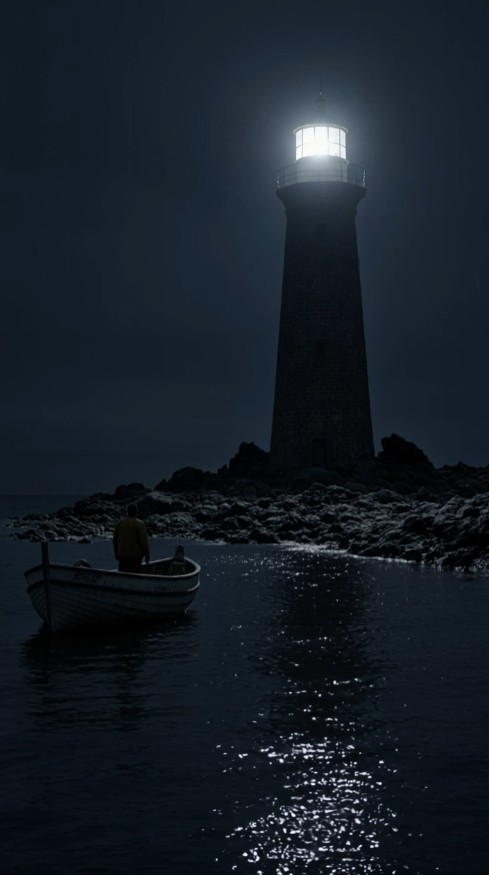
For twenty-seven years, the old lighthouse at Blackstone Point had stood completely dark.
Its windows were covered with salt and dust.
The iron staircase inside had deteriorated.
And the heavy wooden entrance remained secured with a rusted padlock.
Nobody had operated its light since 1999.
But shortly after midnight, something impossible seemed to happen.
The lighthouse began flashing.
Three short bursts.
Three long bursts.
Three short bursts.
Then darkness.
Thomas Bennett, a fifty-two-year-old fisherman returning to the harbor, immediately recognized the pattern.
SOS.
An international distress signal.
His father, Samuel Bennett, had maintained that lighthouse for thirty years.
When Thomas was a little boy, Samuel had taught him how to recognize emergency signals from ships and shore stations.
Now, decades later, Thomas was staring at a signal coming from a building that supposedly had no electricity.
He contacted the coast guard.
A rescue crew arrived at Blackstone Point and approached the tower from the shore.
The main entrance was still locked.
No vehicles were parked nearby.
And the overgrown coastal path appeared undisturbed.
But high above them, another sequence of flashes pierced the darkness.
A rescue officer raised his binoculars.
Behind the glass, something moved.
Someone was holding a portable light.
The crew arranged safe access and began searching the old building.
Minutes later, Thomas received a call.
“Mr. Bennett, do you know anyone named Samuel?”
Thomas froze.
Samuel was his father’s name.
His father had died twelve years earlier.
“Why?” Thomas whispered.
The rescue officer hesitated.
“Because the person inside keeps asking us to find him.”
Then he said something even stranger.
“Thomas, this person says your father made a promise in 1978. And there’s something in the lighthouse that he was never able to return.”
The Lighthouse at Blackstone Point
Blackstone Point was a remote stretch of Atlantic coastline.
Its cliffs rose above a narrow cove, where waves crashed against dark rocks.
For generations, fishing boats had passed the headland on their way into the harbor.
The lighthouse was built in the nineteenth century to help vessels navigate the dangerous waters.
Its rotating beacon once illuminated the coastline every night.
But by the late 1990s, modern navigation systems and a replacement coastal light made the old tower unnecessary.
Its original electrical system was disconnected.
The building was closed.
And access was restricted because of deteriorating stairs and masonry.
For most residents, the lighthouse became little more than a historic landmark.
But to Thomas Bennett, it was part of his childhood.
The Man Who Kept the Light Burning
Thomas’s father, Samuel, began working at Blackstone Point Lighthouse in 1969.
He was a quiet, dependable man who loved the ocean.
He checked equipment.
Maintained the lighting machinery.
Recorded weather observations.
And helped coordinate with maritime authorities when conditions became dangerous.
Samuel treated the lighthouse as more than a job.
He believed its light represented reassurance.
Every night, somewhere beyond the headland, someone might be searching for the harbor.
Someone might be tired.
Lost.
Or frightened by worsening weather.
Samuel often told his son:
“A lighthouse doesn’t choose who deserves to find the shore.”
Thomas remembered those words all his life.
As a boy, he spent countless afternoons helping his father carry supplies and listening to stories about the sea.
One of Samuel’s favorite lessons involved distress signals.
Three short flashes.
Three long flashes.
Three short flashes.
SOS.
Thomas practiced the pattern with a small flashlight until he could recognize it without counting.
He never imagined he would need that lesson after his father was gone.
The Night the Tower Went Dark
When Blackstone Point Lighthouse was decommissioned, Samuel was heartbroken.
He understood that technology had changed.
But he had spent thirty years caring for the tower.
On its final operational night, he invited Thomas to join him.
They stood together beneath the lantern room.
Samuel checked the machinery one last time.
Then watched as the light completed its final rotations.
Afterward, the old system was shut down.
The tower fell dark.
Thomas remembered his father standing silently beside the window.
“Are you sad?” he asked.
Samuel smiled.
“A little.”
Then he placed a hand on Thomas’s shoulder.
“But the important thing isn’t the lamp.”
Thomas looked confused.
Samuel continued.
“It’s that people know what to do when someone needs help.”
Twelve years before the midnight mystery, Samuel died at the age of seventy-four.
Thomas inherited his father’s fishing charts, old photographs, and a small brass compass.
But he never knew about the promise Samuel had made to someone in 1978.
Three Flashes in the Darkness
The night of the incident began quietly.
Thomas had spent several hours fishing offshore.
The weather was calm.
The sea was relatively smooth.
And the harbor lights were visible in the distance.
As his boat approached Blackstone Point, he glanced toward the old lighthouse.
He did this almost every time he returned home.
Even after twenty-seven years, he still expected to see its familiar beam.
But that night, the dark windows suddenly illuminated.
Three short flashes.
Thomas stared.
Then came three longer flashes.
Followed by three short ones.
His hands tightened around the wheel.
He watched the tower.
The light disappeared.
For several seconds, he wondered whether he had imagined it.
Then the pattern appeared again.
SOS.
Thomas immediately contacted maritime emergency services.
He gave his position and reported a possible distress signal from the closed lighthouse.
The Impossible Light
The coast guard operator asked Thomas to confirm what he had seen.
He explained that the lighthouse had been decommissioned decades earlier.
The electrical system was disconnected.
And the building wasn’t open to visitors.
The operator acknowledged the report and began coordinating a response.
Thomas remained offshore at a safe distance.
He watched the tower through binoculars.
Another sequence of flashes appeared.
This time, he noticed something important.
The light wasn’t sweeping across the sea like the old lighthouse lamp.
It came from one stationary point inside the lantern room.
Someone appeared to be using a handheld light.
Thomas felt a chill.
The tower was locked.
The internal staircase had been considered unsafe for years.
Who would climb into it after midnight?
And why would they be signaling for help?
The Search Begins
A coastal rescue team approached Blackstone Point from the landward side.
They knew the tower’s condition was hazardous.
Rather than forcing entry without a plan, they assessed the structure and coordinated safe access with the appropriate authorities.
The main entrance was secured.
The surrounding vegetation had grown thick.
A narrow service path led toward the rear of the building.
The rescuers noticed that part of an old maintenance gate had been disturbed.
Beyond it, a low service opening was partly concealed by vegetation.
A portable battery-powered work light was visible nearby.
The crew realized someone might have entered through a disused access route rather than the main door.
They began a carefully controlled search.
Then the SOS signal flashed again.
The Voice Above the Stairs
Inside the tower, rescue personnel heard someone calling from the upper level.
The voice belonged to an elderly woman.
She sounded exhausted.
The crew communicated with her while evaluating the condition of the internal stairs.
“Ma’am, can you tell us your name?”
A faint answer came from above.
“Eleanor.”
“Are you injured?”
“My ankle.”
The woman paused.
“Please… I need Samuel Bennett.”
The rescue officer looked toward his colleague.
Samuel Bennett.
That was the name Thomas had mentioned when reporting the distress signal.
The officer asked:
“How do you know Samuel?”
The woman answered:
“He promised he’d keep it safe.”
The Woman in the Lantern Room
Her name was Eleanor Hayes.
She was seventy-eight years old.
Her silver hair was wet with sweat, and her coat was covered in dust.
Beside her lay a small backpack containing water, a flashlight, old photographs, and a folded letter.
She had entered the lighthouse earlier that evening.
While climbing toward the lantern room, she slipped on a deteriorated step and injured her ankle.
She couldn’t safely descend.
Her mobile phone had lost power after repeated attempts to call for help.
But she carried a small rechargeable emergency flashlight.
Remembering the signal Samuel taught her decades earlier, she used it to flash SOS toward the water.
For nearly an hour, she waited.
Then she heard the rescue crew calling from below.
Eleanor began crying.
But even after being reassured that help had arrived, she kept asking about Samuel.
The rescuers explained that they would contact his family.
They didn’t yet know that Samuel had died.
The Name Thomas Never Expected
When the rescue officer called Thomas, he explained that an elderly woman named Eleanor Hayes had been found in the tower.
She was being assisted by a specialist team.
She appeared to have an ankle injury.
But she was conscious and able to communicate.
Then the officer asked:
“Did your father know someone named Eleanor Hayes?”
Thomas searched his memory.
The name meant nothing to him.
“I don’t think so.”
The officer continued.
“She says he made a promise in 1978.”
Thomas became quiet.
That was nearly fifty years earlier.
He was only a small child then.
“What promise?”
The officer paused.
“She says your father kept a wooden box in the lighthouse for her.”
Thomas frowned.
“A box?”
“She believes it’s still there.”
The Rescue From the Tower
The rescuers focused first on Eleanor’s safety.
The old staircase was narrow and damaged in several places.
They used appropriate equipment and coordinated a controlled evacuation under the direction of trained personnel.
Eleanor was carefully assisted down from the lantern room.
When she reached the ground, emergency medical staff examined her.
Her ankle was injured, and she was exhausted.
But she was otherwise stable.
Thomas had returned to the harbor and was waiting nearby.
With the responders’ permission, he approached after Eleanor received initial care.
She looked at him.
Her expression changed.
For a moment, she seemed unable to speak.
Then she whispered:
“You have his eyes.”
Thomas stopped.
“Samuel was my father.”
Eleanor covered her mouth.
“Where is he?”
Thomas took a breath.
“I’m sorry. Dad passed away twelve years ago.”
Eleanor closed her eyes.
And began crying.
The Promise From 1978
After Eleanor received medical care, she told Thomas her story.
In 1978, she was thirty years old.
She had been married to a fisherman named William Hayes.
They lived in a small cottage outside Blackstone Harbor.
William was often at sea.
Eleanor worked at the local post office and spent her evenings caring for their young daughter, Anna.
One autumn night, William’s fishing boat experienced mechanical trouble during rough weather.
A rescue operation was launched.
Samuel, who was on duty at the lighthouse, assisted by maintaining communications and providing local information to the relevant authorities.
William survived.
But another crew member, a young man named Peter, died during the emergency.
The loss devastated everyone involved.
Peter had been William’s younger brother.
And he had been engaged to Eleanor’s closest friend, Margaret.
The Box Nobody Claimed
After the incident, William gave Samuel a small wooden box.
It contained Peter’s personal belongings recovered from the boat.
There was a pocket watch.
Several photographs.
A handwritten letter.
And a small silver locket intended for Margaret.
William couldn’t bring himself to deliver the box.
Margaret had moved away shortly after Peter’s death.
Nobody knew how to contact her.
Samuel offered to keep the belongings safe until the family could locate her.
He placed the box in a secure cabinet inside the lighthouse.
Eleanor remembered him saying:
“One day, she’ll want these.”
But life changed.
William died several years later.
Eleanor moved inland to care for her parents.
And contact with Samuel gradually faded.
The wooden box remained forgotten.
Until a letter arrived nearly fifty years later.
The Letter That Brought Eleanor Back
Three months before the midnight incident, Eleanor received a letter from her childhood friend Margaret.
They had lost touch decades earlier.
But Margaret had recently begun researching her family history.
She wanted to recover photographs and personal belongings connected to Peter.
Eleanor immediately remembered the wooden box.
And Samuel’s promise.
She tried contacting the old lighthouse office.
But the facility had been closed for years.
Local officials confirmed that the building was not open to the public.
Eleanor made several inquiries about the archive.
She couldn’t establish whether the box had been transferred or lost.
Her search became increasingly emotional.
Margaret’s health was declining.
Eleanor wanted to find Peter’s belongings while there was still time.
Then she made a dangerous decision.
She went to the lighthouse herself.
Why She Entered the Tower
Eleanor knew she wasn’t supposed to enter the abandoned building.
She also knew the stairs were unsafe.
But she remembered the rear service access from visits decades earlier.
She convinced herself that she would only look inside the lower storage area.
When she arrived, she found the service gate partly open.
She entered with her flashlight.
The interior smelled of damp wood and salt.
Dust covered the floor.
The old machinery stood silent.
Eleanor searched the storage cabinets.
Then noticed that some historical materials had been moved upstairs.
She believed the box might be in the lantern room.
So she climbed.
It was a decision she would later deeply regret.
Near the upper level, one of the deteriorated steps shifted beneath her.
She fell awkwardly and injured her ankle.
Unable to descend safely, she became trapped.
That was when she remembered Samuel’s lesson about distress signals.
The Light Samuel Taught Her
Eleanor had known Samuel for years.
During her visits to the lighthouse, he sometimes explained how maritime signaling worked.
He demonstrated the international SOS pattern with a small portable lamp.
Three short flashes.
Three long.
Three short.
He told her it was a signal people could recognize even when ordinary communication failed.
Eleanor never forgot.
Now, trapped high above the coast with an injured ankle and a dead phone, she used her rechargeable flashlight.
She pointed it toward the harbor.
Then began signaling.
Again.
And again.
She didn’t know whether anyone would notice.
But somewhere offshore, Thomas Bennett recognized the pattern.
The same pattern his father had taught him as a boy.
The Question Thomas Asked
After hearing Eleanor’s story, Thomas sat quietly.
He remembered his father’s dedication to the lighthouse.
The careful way Samuel labeled equipment.
His habit of preserving old records.
And his belief that personal belongings should always be returned to their rightful owners when possible.
The wooden box sounded exactly like something Samuel would have protected.
Thomas asked Eleanor:
“Did my father ever tell you where he put it?”
She nodded.
“In a cabinet near the lantern room.”
“Do you remember which one?”
Eleanor closed her eyes.
Then whispered:
“The one marked with a blue anchor.”
Thomas looked surprised.
He remembered that symbol.
As a child, he had seen a small blue anchor painted on a cupboard inside the tower.
He had always assumed it contained maintenance supplies.
Now he wondered what had been hidden there.
The Search for the Blue Anchor
Thomas contacted the local authority responsible for the historic lighthouse.
He explained Eleanor’s account.
Officials agreed to check the surviving inventory and conservation records.
Because the tower was unsafe, no one was permitted to enter casually.
Qualified personnel arranged a controlled inspection of the relevant storage area.
Several days later, Thomas received a phone call.
The archive team had located a narrow wooden cabinet near the upper service room.
Its paint was badly faded.
But a small blue anchor remained visible on the door.
Inside were old maintenance documents.
Several envelopes.
And a wooden box wrapped in cloth.
Thomas held his breath.
“Is there a name on it?”
The archivist answered:
“Peter Hayes.”
The Box That Survived Forty-Eight Years
The wooden box was carefully removed and documented.
Its contents were examined by authorized staff to confirm their condition and ownership history.
Inside was a silver pocket watch.
A faded photograph of two brothers standing beside a fishing boat.
Several handwritten pages.
And a small velvet pouch.
The pouch contained a silver locket.
Engraved on its back were the initials:
P & M.
Peter and Margaret.
Eleanor began crying when she saw the photographs.
She recognized William immediately.
Standing beside him was Peter, smiling in front of the harbor.
He looked exactly as he had in the summer before the accident.
For decades, Eleanor had carried memories of those young men.
Now their faces were looking back at her from a photograph she hadn’t seen in almost half a century.
The Letter Inside the Box
The most important item was a sealed envelope.
On the front, Peter had written:
For Margaret.
The letter had never been delivered.
Eleanor didn’t open it.
She believed Margaret should be the first person to read it.
With the assistance of the relevant authorities and the family’s consent, arrangements were made to return the belongings.
Thomas offered to accompany Eleanor.
He wanted to see the promise his father had made finally fulfilled.
Several days later, they traveled to Margaret’s home.
The Woman Who Waited
Margaret was seventy-six years old.
She lived in a small seaside town several hours away.
Her house overlooked a quiet harbor.
Photographs lined the walls.
She had never married.
Over the years, she built a meaningful life surrounded by friends, nieces, nephews, and neighbors.
But she had never forgotten Peter.
He had been her first great love.
They planned to marry after he returned from that final fishing season.
When the accident happened, Margaret was devastated.
She moved away because the harbor reminded her of everything she had lost.
For decades, she believed Peter’s personal belongings had disappeared with him.
Now Eleanor stood at her door carrying the wooden box.
The Moment Margaret Recognized the Locket
Margaret looked at the box.
Then at Eleanor.
“Where did you find this?”
Eleanor explained the lighthouse.
Samuel’s promise.
The midnight distress signal.
And Thomas’s involvement.
Margaret listened in disbelief.
Then Eleanor opened the velvet pouch.
Inside was the silver locket.
Margaret covered her mouth.
“Oh, Peter.”
She took it carefully.
Her hands trembled as she traced the initials.
“He bought this for me.”
Tears rolled down her cheeks.
“He told me he had something special planned.”
She had never seen the locket before.
But she recognized the description.
Peter had mentioned ordering a gift from a jeweler in the harbor.
It had been intended as a wedding present.
The Letter Peter Never Sent
Margaret opened the envelope.
Inside was a handwritten letter dated only days before Peter’s final voyage.
She began reading.
My dearest Margaret,
Every time I leave the harbor, I count the days until I see you again.
I know our wedding is still months away, but I already feel like the luckiest man alive.
I’ve been thinking about the little house we want.
The garden you keep talking about.
And the kitchen window where you said you’d like to watch the morning light.
I don’t need a grand house or an expensive life.
I only need the chance to share the ordinary days with you.
I’ll be home soon.
And when I return, I have something I want to give you.
All my love, Peter.
Margaret stopped reading.
She pressed the letter against her chest.
For a long moment, nobody spoke.
Then she whispered:
“I waited so long to hear his words again.”
The Photograph With Samuel
At the bottom of the box lay one more photograph.
It showed Peter, William, and Samuel standing together outside the lighthouse.
All three were young.
Samuel was smiling.
His uniform jacket was slightly too large.
Thomas had never seen the photograph.
He stared at his father.
Then laughed softly.
“I’ve never seen him look that young.”
Eleanor smiled through tears.
“He loved this place.”
Thomas nodded.
“He really did.”
Then Margaret turned toward him.
“Your father kept his promise.”
Thomas looked at the wooden box.
Forty-eight years had passed since Samuel agreed to protect the belongings.
Twelve years had passed since his death.
Yet the box remained.
And now it had finally reached the woman it was intended for.
The Secret Written in Samuel’s Notebook
Several weeks later, Thomas began sorting through his father’s old maritime records at home.
He found a notebook from 1978.
Its pages contained weather observations, vessel movements, and personal reminders.
Near the back was a short handwritten entry.
Peter Hayes belongings secured in blue-anchor cabinet.
To be returned to Margaret when contact becomes possible.
Thomas stared at the words.
Then noticed another line written beneath them.
No one should be forgotten simply because the years pass.
Thomas read the sentence several times.
It sounded exactly like his father.
Samuel had always believed that promises mattered.
Even when keeping them was inconvenient.
Even when nobody was watching.
Thomas carefully photographed the entry and shared it with Eleanor and Margaret.
Margaret cried when she saw it.
The Lighthouse Restoration
The midnight rescue drew renewed attention to Blackstone Point Lighthouse.
Residents began discussing the building’s history.
Some remembered Samuel.
Others recalled visiting the tower when it was operational.
The local heritage association proposed a preservation project.
The aim wasn’t to reactivate the old lighthouse as an official navigation aid.
Modern maritime requirements would need to be respected.
Instead, the group wanted to stabilize the structure and create a small historical exhibition.
Qualified specialists assessed the building.
The restoration plan focused on structural safety, conservation, and controlled public access.
Thomas supported the idea.
He wanted future generations to understand the lighthouse’s role in the community.
And he wanted his father’s work remembered.
The Room With the Blue Anchor
As part of the preservation project, the blue-anchor cabinet was restored.
Its original paint was carefully documented.
The cabinet remained part of the historical display.
A small exhibition described the belongings Samuel had protected in 1978.
With Margaret’s permission, photographs of the box and selected documents were included.
The original personal items remained with the family.
A display panel told the story of Eleanor’s midnight distress signal.
It explained how a portable flashlight had been used to send SOS from the closed tower.
And how Thomas recognized the pattern his father had taught him decades earlier.
The exhibition became one of the most meaningful parts of the restored lighthouse.
The Anniversary at Blackstone Point
One year after the rescue, Thomas returned to Blackstone Point with Eleanor and Margaret.
The preservation work had made parts of the site safely accessible under supervision.
The three stood outside the old tower.
Waves crashed against the rocks below.
Seabirds circled overhead.
And the afternoon sun illuminated the lantern room.
Eleanor looked toward the windows.
“I still can’t believe I climbed up there.”
Thomas smiled gently.
“I’m glad you were able to signal for help.”
She nodded.
Then turned toward Margaret.
“And I’m glad we found the box.”
Margaret held the silver locket in her hand.
She looked toward the sea.
“So am I.”
The Letter Thomas Wrote to His Father
That evening, Thomas sat at his kitchen table.
He placed his father’s brass compass beside an old photograph.
Then opened a notebook.
He began writing a letter he knew Samuel would never read.
Dear Dad,
You taught me many things when I was young.
How to read the weather.
How to respect the sea.
And how to recognize a distress signal.
I never imagined those lessons would matter so much after you were gone.
Last year, I saw an SOS coming from the old lighthouse.
I thought I was imagining it.
But I remembered what you taught me.
Someone was inside.
And that person remembered a promise you made almost fifty years earlier.
We found the wooden box.
We returned Peter’s letter and locket to Margaret.
Your promise was finally fulfilled.
I wish I could tell you in person.
But somehow, I think you’d be happy.
Love, Thomas.
He folded the letter.
Then placed it beside his father’s photographs.
The Three Flashes Nobody Forgot
The extraordinary mystery began when a lighthouse that had been dark for twenty-seven years suddenly began flashing an SOS signal at midnight.
Local fisherman Thomas Bennett recognized the pattern.
His father, Samuel, had maintained the tower for thirty years.
Although Samuel had died twelve years earlier, his lessons remained with Thomas.
When rescue crews entered the abandoned lighthouse, they found an elderly woman named Eleanor Hayes trapped near the lantern room with an injured ankle.
She had used a portable flashlight to signal for help.
Eleanor had entered the building searching for a wooden box Samuel promised to safeguard in 1978.
The box contained belongings from a fisherman who died decades earlier.
Among them was a silver locket and an undelivered letter intended for his fiancée.
With assistance from the relevant authorities, the items were eventually recovered and returned.
The discovery reunited old friends, brought closure to a long-unfinished story, and inspired renewed interest in preserving the historic lighthouse.
The Final Light
Two years after the rescue, Thomas stood outside Blackstone Point Lighthouse during a small community heritage event.
The building had been stabilized.
Historical exhibits were open to visitors.
And a photograph of Samuel hung near the entrance.
Thomas stopped beside it.
His father was standing in front of the tower, smiling beneath his old keeper’s cap.
For a moment, Thomas remembered being a little boy.
Standing beside Samuel.
Holding a flashlight.
Practicing a strange pattern of short and long flashes.
He had thought it was a game.
But Samuel had taken the lesson seriously.
“Three short. Three long. Three short.”
Thomas smiled.
He looked toward the lantern room.
The old navigational lamp would never operate as it once had.
Its official service had ended decades earlier.
But the tower had become a place where people remembered the history of the coast.
And one remarkable night had given it a new story.
Eleanor’s light hadn’t come from the original lighthouse machinery.
It came from a small emergency flashlight.
But it had been enough.
Enough for Thomas to recognize that someone needed help.
Enough for trained rescuers to reach a person trapped inside.
And enough to begin uncovering a promise Samuel had kept for almost half a century.
Thomas touched the brass compass in his pocket.
Then whispered:
“We found it, Dad.”
The ocean continued moving beneath the cliffs.
The evening sky darkened.
And the old lighthouse stood quietly above the shore.
For twenty-seven years, its official light had remained dark.
Then, at midnight, three short flashes, three long flashes, and three short flashes appeared behind the glass.
The signal led rescuers to a trapped woman — and to a forgotten promise made by a lighthouse keeper who had died twelve years earlier.
Thomas had spent his entire life believing his father taught him how to recognize danger at sea.
That night, he discovered his father had also taught him something about keeping promises.
Because some lights are remembered long after they stop shining.
And some acts of kindness continue reaching people long after the person responsible is gone.