
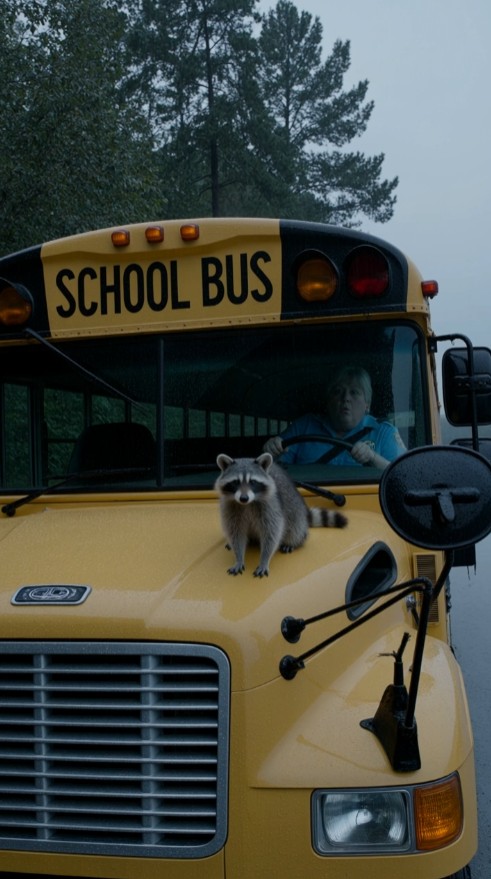
At 7:15 on a rainy Monday morning, a wild raccoon appeared in the middle of a country road.
Margaret Wilson, a school bus driver with eighteen years of experience, immediately pressed the brakes.
Twenty-two children were sitting behind her.
The animal should have run back into the forest.
Instead, it climbed onto the hood of the bus.
And refused to move.
Margaret honked once.
Then again.
The raccoon stood on the hood, looking through the windshield.
A little boy in the second row laughed nervously.
“Why is it staring at us?”
Margaret didn’t answer.
She was watching the animal.
It repeatedly turned its head toward the narrow bridge ahead.
Then looked back toward the bus.
Rain had been falling throughout the night.
The creek beneath the bridge was swollen.
And the road appeared unusually wet near the approach.
Something didn’t feel right.
Margaret contacted transportation dispatch.
“I’m stopped before Miller Creek Bridge. There’s an animal on the bus, and I’m concerned about the road conditions ahead.”
Dispatch instructed her to remain stopped in a safe position while road maintenance personnel inspected the crossing.
The raccoon eventually climbed down and disappeared into the trees.
Minutes later, a county maintenance truck arrived.
A worker named Daniel approached the bridge on foot.
He noticed a narrow crack near the shoulder.
Then something even worse.
The ground beneath the bridge approach had been washed away.
Only a relatively thin section of pavement remained over an expanding cavity.
Daniel immediately stepped back.
“Nobody drives across this bridge!”
Margaret stared through the windshield.
She had crossed that bridge hundreds of times.
And she had almost driven a bus full of children onto the damaged road.
Then Daniel examined the creek beneath the crossing.
Suddenly, he shouted:
“THERE’S SOMETHING ELSE DOWN HERE!”
His coworker hurried over.
Behind a pile of branches trapped against the bridge supports, something small was moving.
Something alive.
And the rising floodwater was getting closer.
The Road Margaret Knew by Heart
Margaret Wilson was fifty-six years old.
For eighteen years, she had driven school buses through the rural outskirts of a small town.
She knew nearly every family along her route.
She remembered which children needed help fastening their seat belts.
Which students always forgot their homework.
And which parents waited beside the road with umbrellas on rainy mornings.
Miller Creek Bridge was part of her regular route.
It wasn’t especially long.
Just a narrow two-lane crossing over a creek that ran through farmland and woodland.
Most mornings, Margaret barely thought about it.
But she always slowed when approaching.
The bridge had limited visibility around the nearby bend.
And deer sometimes crossed the road.
That Monday, the weather was particularly unpleasant.
Heavy rain had continued since Sunday afternoon.
Water filled the roadside ditches.
Mud covered sections of the shoulder.
And the creek was higher than Margaret had ever seen it.
Still, the roadway ahead appeared passable.
Until the raccoon appeared.
The Animal on the Hood
Margaret first saw the raccoon emerge from the trees on the right side of the road.
It ran across the wet pavement.
Then stopped directly in front of her bus.
She braked smoothly.
The bus came to a halt.
Several children leaned toward the windows.
“Look! A raccoon!”
The animal moved closer.
Then climbed onto the hood.
Its wet fur clung to its body.
Its striped tail hung over the side.
And its dark eyes were fixed toward the windshield.
Margaret waited.
She didn’t want to frighten it into running beneath the wheels.
But the raccoon remained.
Then it turned toward the bridge.
Margaret followed its gaze.
The creek was rushing beneath the crossing.
Branches were piled against one of the supports.
And muddy water had reached the road shoulder.
She couldn’t know why the raccoon was behaving that way.
Wild animals can act unpredictably when frightened, displaced by flooding, or searching for food and shelter.
But the encounter gave Margaret time to look carefully at the road.
And that observation made her uneasy.
The Call That Changed Everything
Margaret picked up her radio.
“Dispatch, this is Bus Twelve.”
“Go ahead, Margaret.”
“I’m stopped on Mill Road before Miller Creek Bridge.”
“What’s the problem?”
“An animal came onto the road. But I’m also seeing unusually high water near the bridge approach.”
The dispatcher asked whether the road was visibly flooded.
“Not across the lanes,” Margaret replied. “But the shoulder doesn’t look right.”
Dispatch contacted the county road maintenance crew.
Margaret was instructed to remain in a safe position, keep the children aboard, and avoid the bridge until the crossing could be assessed.
She switched on her hazard lights.
Then addressed the students.
“Everyone, we’re going to be a little late today. Please stay seated.”
The children groaned.
But nobody complained for long.
Because the raccoon was still on the hood.
The Raccoon Disappears
After several minutes, the raccoon climbed down.
It paused beside the roadside ditch.
Then disappeared into the trees.
One child pressed his face close to the window.
“Where did it go?”
Margaret smiled.
“Back to the woods, hopefully.”
But she wasn’t thinking about the animal anymore.
She was staring at the bridge.
There was something strange about the approach.
A dark line stretched across part of the pavement.
At first, she assumed it was an ordinary crack.
Then she noticed that the shoulder appeared lower than the road surface.
Rainwater was moving toward the edge.
Margaret tightened her grip on the steering wheel.
She had driven over that crossing countless times.
But she wasn’t going to risk crossing until someone checked it.
The Maintenance Crew Arrives
A county maintenance truck appeared around the bend.
Two workers stepped out.
Daniel Harris was forty-two and had worked on road maintenance for almost twenty years.
His coworker, Peter, was younger but experienced with storm-related damage.
Margaret explained what she’d noticed.
Daniel approached the bridge from the safest accessible side.
He inspected the shoulder.
Then crouched to examine a crack.
The pavement near the edge had settled.
A small opening exposed darkness beneath the road.
Daniel immediately backed away.
He motioned for Peter to stay clear.
“This approach has been undermined.”
Peter looked concerned.
“How bad?”
Daniel pointed toward the damaged section.
“We can’t tell how far the washout extends without a proper inspection.”
He contacted dispatch.
The bridge was closed immediately.
The Damage Beneath the Pavement
Floodwater had eroded part of the soil supporting the road approach.
From above, the pavement still looked mostly intact.
But beneath it, a cavity had formed.
A heavy vehicle crossing the weakened area could have caused further collapse.
Margaret stared toward the bridge.
Her school bus weighed several tons.
Twenty-two children were aboard.
And only minutes earlier, she had been preparing to drive across.
She felt a chill.
Daniel returned to the maintenance truck and arranged for traffic control.
The children would need another route to school.
Margaret began communicating with the transportation department.
Then Daniel noticed something near the creek.
A faint movement behind the branches piled against the bridge support.
He looked again.
And froze.
Something Under the Bridge
Daniel called Peter.
“Come look at this.”
They stayed on stable ground and used a flashlight to examine the area beneath the bridge.
The creek was moving quickly.
Debris had collected against the concrete supports.
Branches.
Leaves.
Plastic.
And pieces of driftwood.
Then Daniel saw a small striped tail.
A young raccoon was clinging to a branch just above the rising water.
Its fur was soaked.
It looked exhausted.
Then a second small head appeared.
Two raccoon kits.
Both were trapped in debris beneath the bridge.
Daniel immediately contacted the county wildlife response team.
He explained that the animals were stranded near fast-moving floodwater.
He also warned that the bridge approach was unstable.
Nobody should attempt to climb down without appropriate rescue equipment and an assessment of the hazards.
The Connection Margaret Couldn’t Ignore
Margaret watched from her bus.
She could see the maintenance workers pointing toward the creek.
When dispatch updated her about the animals, she felt a strange sensation.
Two young raccoons.
Trapped beneath the bridge.
And an adult raccoon that had appeared near her bus only minutes earlier.
Could they be connected?
Margaret wondered whether the animal on her hood might have been their mother.
But she knew there was no way to establish that from the encounter alone.
The adult raccoon could have been displaced by flooding.
It might have been traveling along the road.
Or reacting to the bus.
Still, the coincidence was remarkable.
The animal had delayed her before she reached a dangerous bridge.
And now rescuers had discovered young raccoons stranded beneath it.
The Children Learn the Truth
Margaret turned toward the students.
“Everybody, I need you to listen.”
The bus became quiet.
“The road ahead has been damaged by the rain.”
A little girl raised her hand.
“Is the bridge broken?”
Margaret chose her words carefully.
“The ground near it isn’t safe enough for us to cross.”
The children looked toward the bridge.
A boy near the back asked:
“What if we went over it?”
Margaret paused.
“That’s why we’re staying here until we have a safe route.”
Then another child spoke.
“Did the raccoon stop us?”
Margaret smiled gently.
“The raccoon made us stop. But we don’t know why it came onto the road.”
She looked toward the bridge.
“What matters is that we noticed something was wrong.”
The Rescue Team
The wildlife team arrived with specialized equipment.
Two responders assessed the creek.
The floodwater was moving quickly.
The bank was muddy.
And the debris could shift unexpectedly.
They coordinated with the county road crew and emergency personnel.
A safe access plan was established from a stable section of the bank.
The rescuers wore appropriate protective equipment.
They used ropes and tools suited to the terrain.
The goal was to reach the stranded animals without entering the strongest current or destabilizing the debris.
The young raccoons were frightened.
One clung tightly to a branch.
The other was wedged behind a piece of driftwood.
The team worked slowly.
Then the first kit was secured.
The First Rescue
The first young raccoon struggled briefly when approached.
The rescuer used appropriate animal-handling equipment to contain it safely.
Its wet fur made it look even smaller.
Once secured, it was moved to a sheltered area for assessment.
The animal was conscious.
It moved its head.
And it appeared responsive.
The second kit was harder to reach.
It was trapped behind a larger branch.
Water rushed beneath it.
The rescuers needed to avoid dislodging the debris suddenly.
A second responder stabilized the working position.
Then the team carefully freed the animal.
After several tense minutes, the second kit was recovered.
Both were transported to a wildlife care team for assessment.
The Third Discovery
As the responders examined the surrounding debris, one specialist noticed another movement.
A smaller raccoon kit was partially hidden inside an opening between the roots of a fallen tree.
It hadn’t been visible from the road.
The animal appeared weak.
Its body was pressed against the wet soil.
The rescuers checked the access route.
Then carefully recovered it.
Three young raccoons had been trapped beneath the bridge.
All were wet and cold.
The wildlife team provided appropriate immediate care and prepared to transfer them for veterinary evaluation.
Margaret heard the update over the radio.
Three kits.
Not two.
She looked toward the trees where the adult raccoon had disappeared.
And hoped the young animals would survive.
A School Bus Full of Quiet Children
By then, the children had stopped complaining about being late.
They watched the emergency vehicles through the windows.
Some whispered to each other.
Others sat silently.
A little boy named Oliver leaned toward Margaret.
“Are the baby raccoons okay?”
She smiled.
“They’ve been rescued. The wildlife team is taking care of them.”
Oliver nodded.
Then asked:
“Will they find their mommy?”
Margaret looked toward the woods.
“I hope so, sweetheart.”
He thought for a moment.
Then whispered:
“I’m glad we didn’t cross the bridge.”
Margaret nodded.
“So am I.”
The Road Closure
The transportation department arranged an alternate route.
A second bus was dispatched to collect the students from a safe transfer location.
Parents were informed about the delay.
County engineers began assessing the damaged bridge approach.
The crossing remained closed.
The initial inspection confirmed significant erosion beneath the road surface.
Temporary barriers were installed.
And repair planning began.
The damage was serious enough that heavy vehicles could not safely use the crossing until the approach had been rebuilt and inspected.
Margaret was relieved that she’d stopped.
But she couldn’t stop thinking about the raccoon.
Its wet fur.
Its strange behavior.
And the way it repeatedly looked toward the bridge.
The Call From the Wildlife Center
Three days later, Margaret received an update.
The wildlife team had examined the three young raccoons.
All were alive.
They had suffered cold stress and exhaustion.
One required additional treatment for a minor injury.
But their conditions were improving.
The team hoped to reunite them with an adult female if it could identify a suitable opportunity.
Margaret asked whether the raccoon on her hood could have been their mother.
The specialist answered carefully.
“It’s possible the adult was associated with them, but we can’t confirm that from what you observed.”
Margaret understood.
She didn’t need a magical explanation.
She was simply grateful that the animals had survived.
The Return to the Creek
After the floodwater receded and the area could be approached safely, wildlife specialists evaluated the original location.
They examined the surrounding habitat.
They looked for signs of adult raccoon activity.
And they assessed whether a reunion attempt would be appropriate.
The three kits were recovering well.
They were active.
Eating.
And gaining strength.
The wildlife team arranged a carefully monitored return to suitable habitat near the area where they had been found.
The operation was conducted away from the public.
Remote monitoring equipment was used where practical.
The goal was to minimize human interference while giving the young animals the best chance of remaining with their own species.
The Night Camera
For the first several hours, the camera recorded only branches moving in the wind.
Then a raccoon appeared.
An adult.
It approached cautiously.
Stopped.
And investigated the area.
The kits responded.
The adult remained nearby.
The wildlife specialists continued observing without interfering.
Later footage showed the young raccoons moving with the adult into the surrounding vegetation.
The response team considered this an encouraging result.
They couldn’t identify the animal as the same raccoon that climbed onto Margaret’s school bus.
But the interaction suggested the kits had an opportunity to rejoin an adult raccoon.
Margaret was delighted when she heard.
“That’s wonderful,” she said.
Then laughed.
“I guess they had quite an adventure.”
The Photograph in Margaret’s Bus
The wildlife center later shared an authorized photograph of the three kits during their recovery.
Margaret printed a copy.
She placed it inside her personal folder at the transportation depot.
When children asked about the raccoons, she showed them the picture.
The kits were sitting close together in a wildlife enclosure.
Their fur looked dry.
Their eyes were bright.
And they appeared much healthier than they had beneath the bridge.
The children loved the photograph.
Oliver asked whether Margaret could hang it in the bus.
She smiled.
“Maybe on our class notice board.”
Then she added:
“But remember, wild raccoons need to stay wild. We don’t try to touch or feed them.”
The Bridge Investigation
County engineers completed their assessment of Miller Creek Bridge.
The bridge structure itself required inspection.
But the most severe damage was to the roadway approach.
Floodwater had eroded supporting material beneath the pavement.
The damage had developed during the heavy rain.
From the road surface, the problem was difficult to recognize.
Engineers recommended repairs to the approach and improvements to drainage and erosion protection.
The county scheduled the work.
Until repairs were completed and the crossing passed inspection, the road remained closed.
The transportation department permanently adjusted its routes during the closure.
Margaret’s bus no longer crossed Miller Creek Bridge.
The Parent Who Wrote a Letter
One week after the incident, a parent named Sarah contacted the school transportation office.
Her daughter had been aboard Margaret’s bus.
Sarah wanted to thank the driver.
She wrote:
Dear Mrs. Wilson,
My daughter told me about the raccoon and the bridge.
She said you stopped because something didn’t seem right.
I cannot imagine how frightening it must have been to discover that the road was unsafe.
Thank you for putting the children’s safety first.
Thank you for waiting for the proper inspection instead of taking a risk.
And thank you for making sure every child got to school safely.
We appreciate you more than you know.
Margaret read the letter after her afternoon shift.
Then quietly placed it beside the photograph of the raccoon kits.
The School Assembly
A month later, the elementary school organized a road and wildlife safety presentation.
A county engineer explained how heavy rain could damage roads.
A wildlife specialist discussed the importance of reporting animals in distress.
And Margaret was invited to speak briefly.
She wasn’t comfortable standing in front of an audience.
But the children encouraged her.
She approached the microphone.
Then smiled.
“I’ve been driving school buses for eighteen years.”
She paused.
“And I have never had a raccoon climb onto my hood before.”
The children laughed.
Margaret continued.
“But the important part of the story isn’t the raccoon.”
The auditorium became quiet.
“It’s that we stopped, looked carefully, and waited for people who knew how to check the bridge.”
Then she smiled.
“And because everyone worked together, the children stayed safe and the wildlife team helped the animals too.”
The Question Nobody Could Answer
After the assembly, Oliver raised his hand.
“Mrs. Wilson?”
“Yes?”
“Did the raccoon know the bridge was dangerous?”
Margaret thought for a moment.
Then answered:
“We don’t know.”
Oliver looked disappointed.
She smiled.
“Wild animals don’t think about roads the same way we do. The raccoon may have been frightened by the floodwater or moving through its habitat.”
He nodded slowly.
Then asked:
“But it made you stop?”
“Yes.”
Margaret smiled.
“And stopping gave me a chance to notice the road.”
Oliver looked pleased.
“So it helped anyway.”
Margaret laughed softly.
“In a way, yes.”
The New Bridge Approach
Several months later, construction crews completed the repairs.
Engineers inspected the rebuilt approach.
The damaged roadway support had been restored.
Drainage improvements were added to reduce future erosion.
And the crossing reopened after officials confirmed it was safe for traffic.
Margaret eventually drove the route again.
The first morning she approached Miller Creek Bridge, she slowed.
She looked toward the trees.
Then the road.
Everything appeared normal.
There was no raccoon.
No damaged pavement.
And no emergency vehicles.
Just a quiet country road.
A clear bridge.
And children talking behind her.
She crossed carefully.
Then continued toward the school.
The Winter After
During the following winter, Margaret noticed animal tracks beside the creek.
The ground was covered in snow.
Several small footprints crossed the muddy bank.
She couldn’t tell what animal had made them.
And she didn’t stop the bus to investigate.
But she remembered the three kits.
She wondered whether they were somewhere in the forest.
Growing stronger.
Learning to find food.
And avoiding the dangers of the road.
She hoped so.
Then she returned her attention to the route.
Because the most important responsibility remained the same.
Getting the children to school safely.
The Last Morning Before Retirement
Years later, Margaret announced that she was retiring.
After more than two decades of school bus driving, she wanted to spend more time with her grandchildren.
The transportation department organized a small farewell gathering.
Former students attended.
Several parents came.
And the county maintenance workers who had inspected Miller Creek Bridge were invited.
Daniel approached Margaret.
“Remember the raccoon?”
She laughed.
“How could I forget?”
He smiled.
“You were right to stop.”
Margaret shook her head.
“I wasn’t sure what was happening.”
Daniel nodded.
“But you didn’t drive onto a road you were worried about.”
She looked toward him.
“And you found the damage.”
He smiled.
“That’s what we’re there for.”
Then he added:
“And those little raccoons were a surprise.”
The Gift From the Children
At the retirement gathering, Oliver stepped forward.
He was older now.
Nearly finished with middle school.
He carried a wrapped box.
“This is from all of us.”
Margaret opened it.
Inside was a framed drawing.
It showed a yellow school bus stopped before a narrow bridge.
A raccoon stood on the hood.
Three smaller raccoons were painted near the creek.
Across the bottom, the children had written:
THANK YOU FOR ALWAYS LOOKING OUT FOR US.
Margaret stared at it.
Then began crying.
She hugged Oliver.
And thanked the students.
It was one of the most meaningful gifts she had ever received.
The Truth About That Rainy Morning
The remarkable incident began when a wild raccoon appeared on a country road and climbed onto the hood of a school bus.
The driver, Margaret, stopped and waited.
While watching the animal, she noticed unusual water conditions near a bridge ahead.
She contacted transportation dispatch and requested a road inspection.
Maintenance workers discovered that floodwater had washed away part of the material supporting the bridge approach.
The road was closed before the bus attempted to cross.
During the inspection, workers also discovered three young raccoons trapped in flood debris beneath the bridge.
Wildlife specialists rescued the animals.
They received veterinary care.
And later monitoring showed the kits moving with an adult raccoon in the surrounding habitat.
The bridge approach was repaired.
The school route was restored.
And Margaret continued driving children safely for years.
The Raccoon Nobody Forgot
When people asked Margaret whether she believed the raccoon had deliberately saved her passengers, she always answered carefully.
“I don’t know what that animal was thinking.”
Then she smiled.
“But I’ll never forget it.”
She remembered the wet fur.
The striped tail.
The animal standing on the hood.
And the way it kept looking toward the bridge.
At the time, she thought it was simply behaving strangely.
But the encounter gave her a reason to stop.
And once she stopped, she noticed conditions that concerned her.
The maintenance workers discovered the damaged road.
The wildlife team found the trapped raccoon kits.
And the twenty-two children on the bus arrived at school safely.
There was no way to prove that the animal had been trying to warn anyone.
But the timing changed the course of that morning.
The Last Thing Margaret Remembered
On her final day as a bus driver, Margaret took one last trip along her old route.
The morning was clear.
The creek flowed gently beneath Miller Creek Bridge.
Sunlight filtered through the trees.
And the road was quiet.
As she approached the crossing, she remembered that rainy Monday.
The raccoon appearing from the forest.
The children whispering.
The unusual water near the road.
And Daniel waving everyone away from the damaged pavement.
Then she remembered the three kits beneath the bridge.
Small.
Wet.
And frightened.
She smiled.
For eighteen years, she had believed she knew every bend in that road.
Every driveway.
Every hill.
Every bridge.
But on one ordinary Monday morning, a wild raccoon reminded her that even familiar places could hold unexpected dangers.
A raccoon climbed onto a school bus and refused to leave.
The driver stopped and noticed something unusual near the bridge ahead.
Minutes later, maintenance workers discovered a dangerous washout beneath the road — and three young raccoons trapped in flood debris below.
Twenty-two children were kept away from the damaged crossing.
Three young animals were rescued.
And one experienced driver went home with a story she would tell for the rest of her life.
Margaret never claimed the raccoon understood the danger to the bus.
She didn’t need to.
Because the lesson was powerful enough without imagining what a wild animal intended.
Sometimes safety begins with one unexpected interruption.
One careful observation.
And one decision not to take an unnecessary risk.
That morning, the raccoon made her stop.
But Margaret’s decision to look, question, and wait for help kept the children safe.