
For twenty years, I’d been fishing along the same stretch of coastline.
I’d seen dolphins following boats, sea turtles surfacing beside the harbor, and hundreds of pelicans diving into the water.
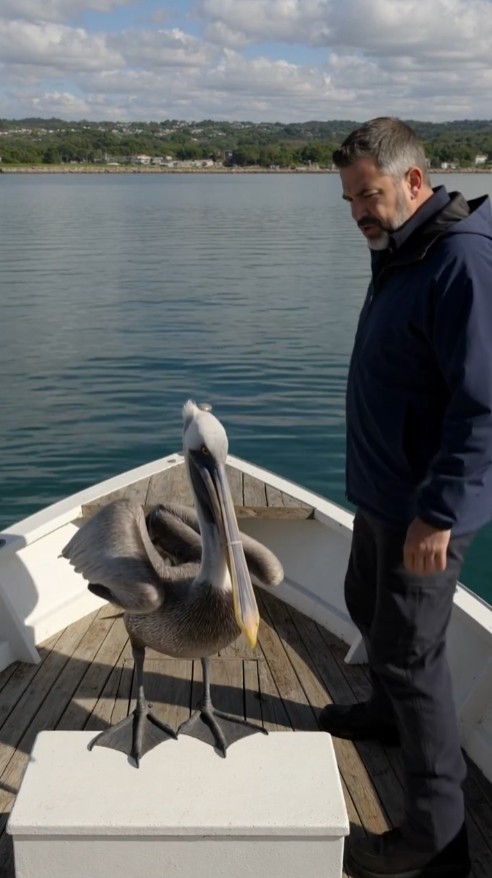
But I’d never seen anything like the enormous brown pelican that landed on my rear deck that morning.
It didn’t try to steal my fish.
It didn’t flap its wings.
It didn’t even move when I stepped away.
Instead, it stood completely still.
Its enormous bill pointed toward the floor.
And every few seconds, it tried to open its mouth.
But couldn’t.
That’s when I saw the fishing line.
A thin strand of nearly invisible monofilament was wrapped tightly around its bill.
The line had cut into the skin near the base.
And the bird appeared exhausted.
I immediately contacted the local wildlife rescue organization.
For almost forty minutes, the pelican remained on my boat while I kept my distance.
When the specialists arrived, they carefully secured the bird.
One rescuer prepared to remove the line.
Then she noticed something strange.
Another length of fishing line ran beneath the pelican’s wing.
She followed it toward the deck.
And stopped.
The line was tangled around an old piece of fishing net.
A length of the same net trailed over the stern and into the water.
The rescuer turned toward me.
“Michael, did this pelican arrive alone?”
I nodded.
“Why?”
She pointed toward the harbor entrance.
Another pelican was circling low over the water.
Again.
And again.
Beneath it, something dark was moving.
She grabbed her radio.
“We need another rescue boat. Right now.”
Then a large shape broke the surface.
A brown pelican struggled once.
Its wings spread unevenly.
And it disappeared beneath the water again.
There was a second bird trapped below the surface.
But when the rescue team reached the location, they discovered something even more disturbing.
The abandoned net wasn’t holding only pelicans.
A young sea turtle was tangled beneath it.
And a heavy fishing trap was dragging the entire mess toward deeper water.
The Morning That Changed Everything
My name is Michael Harris.
I’m fifty-two years old, and I’ve worked as a coastal fisherman for most of my adult life.
I started fishing with my father when I was twelve.
He taught me how to read the weather.
How to recognize changing currents.
And why respecting the ocean mattered just as much as understanding it.
By the time I was thirty, I’d bought a small fishing boat of my own.
Nothing fancy.
A white fiberglass vessel with a working deck, an older engine, and enough equipment for short coastal trips.
I called her Second Chance.
My wife laughed at the name.
She said I should have called it Always Needs Repairs.
But I loved that boat.
It had carried me through hundreds of early mornings.
And on one unforgettable day, it became the temporary refuge of an injured wild pelican.
The Bird That Wouldn’t Fly Away
It was just after seven when the pelican appeared.
The sea was calm.
A light breeze moved across the harbor.
And the morning sun reflected off the water.
I was sorting my equipment when I heard wings overhead.
A large brown pelican circled the boat.
Then descended.
Its webbed feet touched the rear deck.
It folded its wings and remained still.
I expected it to fly away.
Instead, it stared toward the water.
Then turned its head.
That’s when I noticed its bill.
Something was wrong.
The bird attempted to open it.
But the upper and lower parts barely separated.
I moved farther away and examined it from a safe distance.
A thin fishing line was wrapped around the bill.
The bird appeared unable to feed normally.
I knew this was serious.
And I knew I shouldn’t attempt to restrain a large wild pelican by myself.
So I called for professional help.
The Forty-Minute Wait
The wildlife dispatcher asked whether the pelican was injured.
I explained what I could see.
Fishing line around the bill.
Possible additional entanglement beneath one wing.
And signs of exhaustion.
The specialist instructed me to keep my distance, avoid feeding or touching the bird, and prevent unnecessary disturbance.
I secured loose equipment and remained nearby without approaching it.
The pelican occasionally shifted its weight.
Once, it lifted its wings slightly.
Then settled again.
Every few minutes, it attempted to open its bill.
Watching was difficult.
Pelicans depend on their bills and expandable throat pouches to catch and handle fish.
If a line prevents the bill from opening properly, the bird may struggle to eat.
I wondered how long it had been trapped.
Hours?
A day?
Longer?
There was no way to know.
The Rescue Team Arrives
The wildlife rescue boat appeared just before eight.
Two specialists climbed aboard after I gave permission.
Their names were Sarah and Daniel.
Both had experience handling injured coastal birds.
Sarah assessed the pelican’s condition.
Daniel prepared suitable protective equipment and a transport enclosure.
They worked quietly.
The pelican was large.
Its bill could cause injury if mishandled.
And its wingspan made safe restraint important.
The specialists coordinated their movements.
Then carefully secured the bird.
Sarah examined the line around its bill.
“This is tight,” she said.
Daniel looked concerned.
“Any visible wounds?”
“Some irritation and pressure injury.”
She prepared to remove the line.
Then noticed another strand running beneath the wing.
The Line That Led Overboard
At first, Sarah thought the strand was a separate entanglement.
But as she examined the bird, she discovered that it was caught in a small section of netting.
The netting had become tangled around a loose fitting on my rear deck.
Another portion extended over the stern into the water.
It appeared that the injured pelican had dragged part of the debris onto the boat when it landed.
Daniel carefully secured the loose material so it would not tighten around the bird.
Sarah examined the line.
Then looked toward the harbor entrance.
A second pelican was flying low over the water.
It circled the same patch of sea several times.
I had noticed it earlier but assumed it was hunting.
Now Sarah looked concerned.
“Michael, was that bird there when the first one landed?”
“I think so.”
Then we saw something dark beneath the surface.
A wing.
It disappeared.
Then appeared again.
Daniel reached for his radio.
“Possible second entangled bird in the water. Request another rescue vessel.”
The Pelican Beneath the Surface
We watched from the boat.
A dark brown pelican briefly surfaced near a patch of floating net.
It lifted its head.
Then struggled to move.
One wing appeared restricted.
The bird slipped partly beneath the surface again.
Sarah immediately explained that the team needed additional equipment and personnel.
Trying to pull the net from my boat could tighten the entanglement around both birds.
The net also appeared attached to something submerged.
There was no way to know how much weight it carried.
The specialists first secured the pelican aboard my boat so it could be separated from the line safely.
Then they focused on coordinating the second rescue.
I remained at the helm, following their instructions.
I wanted to help.
But I understood that careless action could make the situation worse.
A Dark Shape Below the Net
The second rescue vessel arrived with three additional responders.
They approached the floating debris carefully.
The team used underwater inspection equipment to assess the entanglement.
At first, the screen showed tangled fishing net.
Plastic floats.
Submerged rope.
Then something moved beneath the mesh.
A rounded shell appeared.
A flipper shifted.
One rescuer leaned toward the monitor.
“That’s a turtle.”
A young sea turtle was trapped beneath the net.
Its front flipper was tangled.
And the mesh prevented it from moving freely toward the surface.
Sarah’s expression changed.
Sea turtles need to surface to breathe.
An animal caught underwater can drown if it cannot reach air.
The team now faced an urgent rescue involving several animals and a submerged fishing trap.
The Weight on the Bottom
The responders examined the structure of the debris.
An old fishing trap lay below the floating net.
A length of rope connected the trap to the tangled mesh.
The trap appeared to have become lodged in submerged rocks or other debris.
Currents pulled against the net.
The movement created tension around the animals.
The trapped pelican struggled near the surface.
The turtle remained below.
And the first pelican, now safely restrained aboard my boat, still needed medical treatment.
The team coordinated a plan to manage the line and stabilize the entangled debris without placing people or animals in unnecessary danger.
They couldn’t simply pull everything aboard.
The weight and tension made that unsafe.
Instead, they worked methodically to separate the living animals from the abandoned gear.
The Turtle’s Rescue
The team prioritized releasing the turtle’s restricted flipper and restoring its access to the surface.
Using appropriate rescue equipment, specialists reached the entanglement.
One responder stabilized the section of net.
Another carefully removed the strands holding the turtle.
The animal moved weakly.
Then its flipper came free.
A rescuer guided the turtle toward the surface and secured it for immediate assessment.
I watched from my boat.
The animal’s head appeared above the water.
For a moment, it remained still.
Then it took a breath.
Sarah, watching from nearby, exhaled.
“Good. It’s breathing.”
The turtle was placed in a suitable transport container for urgent veterinary evaluation.
One animal had been freed.
But the pelican in the water was still caught.
The Second Pelican
The second pelican had become tangled around one wing and part of its body.
Every movement tightened the net.
The rescuers needed to prevent the bird from slipping below the surface while they worked.
They used suitable handling equipment to stabilize it.
Then carefully separated the net strands.
The pelican struggled.
Water splashed across the rescue boat.
But the team maintained control.
After several tense minutes, the final section of net was released.
The bird was lifted from the water.
Its wings were supported.
Its bill was free.
And it was breathing.
The rescuers immediately assessed its condition.
The pelican was exhausted.
But alive.
The First Pelican Finally Gets Help
Back aboard my boat, Sarah returned her attention to the original bird.
The line around its bill had caused visible pressure marks.
Fortunately, the team had been able to remove the material without forcing the beak apart.
A brief examination suggested that the bird needed further treatment.
Its condition had likely prevented it from feeding normally.
The specialists secured it in an appropriate transport enclosure.
The second pelican was also prepared for transfer.
Both would receive veterinary care.
The turtle required urgent assessment as well.
For the first time that morning, all three animals were free from the abandoned fishing gear.
I looked toward my empty rear deck.
Forty minutes earlier, a pelican had landed there.
Now I understood how complicated the situation had been.
The Net That Stayed Behind
Once the animals were safe, the response team assessed the remaining abandoned gear.
The net had become tangled around the fishing trap and nearby underwater debris.
Removing it required equipment and a controlled plan.
The specialists marked the location and coordinated with an authorized marine debris recovery team.
The operation would take place when conditions were safe.
The responders explained that lost fishing gear can continue trapping wildlife long after it has been abandoned.
The problem is sometimes called ghost fishing.
Nets and traps may entangle birds, turtles, fish, and marine mammals.
Some remain hazardous for years.
I had spent twenty years fishing.
But seeing the consequences so close to home disturbed me deeply.
The Call From the Wildlife Hospital
Three days later, Sarah called.
I answered immediately.
“How are they?”
She smiled through the phone.
“The turtle is stable.”
I closed my eyes.
“And the pelicans?”
“Both are receiving treatment. One is stronger than the other, but they’re responding.”
I sat down.
For three days, I’d thought about the enormous bird standing on my deck.
Its bill tied almost shut.
Its tired eyes.
And the way it had remained motionless while I waited for help.
Then I remembered the second pelican struggling in the water.
And the turtle trapped beneath the net.
I thanked Sarah.
She told me the animals still had a difficult recovery ahead.
But the early signs were encouraging.
The Wildlife Hospital
The two pelicans were treated at a coastal wildlife rehabilitation center.
The first required care for the injuries around its bill.
The team monitored its ability to open and close its mouth normally.
They also watched whether it could feed successfully.
The second pelican had injuries associated with wing entanglement.
Its feathers were damaged.
And its muscles appeared strained from struggling.
The sea turtle was evaluated for pressure injuries and potential complications from its time trapped underwater.
The rehabilitation team minimized unnecessary handling.
Their goal was to return the animals to suitable habitat once they were healthy enough.
Nothing about the process was immediate.
Recovery required time.
Observation.
And careful veterinary decisions.
The Bird That Started Everything
People who heard the story kept asking me one question.
“Did the pelican land on your boat because it wanted your help?”
I understood why they wondered.
The bird had landed on my deck.
It stayed there for nearly forty minutes.
And its entanglement led rescuers to investigate the fishing gear connected to the other animals.
But nobody could know what the pelican intended.
It may have landed because it was exhausted.
It may have been seeking a stable surface.
Or it may simply have been unable to fly normally because of the line.
Wild animals do not necessarily understand that humans can rescue them.
Still, the encounter was extraordinary.
Whatever caused it to land, its presence led me to call professionals.
And their investigation uncovered a much larger danger.
The Harbor Cleanup
The following weekend, I joined a coastal cleanup organized by the wildlife rescue group.
About forty volunteers gathered at the harbor.
Some walked along the shoreline collecting rubbish.
Others helped staff sort recovered marine debris.
Qualified teams handled hazardous fishing gear.
We collected plastic bags.
Broken containers.
Fragments of rope.
And abandoned fishing line.
Later, the marine debris recovery team successfully removed the hazardous net and trap from the rescue site.
The damaged gear was brought ashore for appropriate disposal.
Seeing it laid out on the dock was shocking.
The net was larger than I’d realized.
Several lines had twisted together.
Old hooks remained attached.
It was easy to understand how a bird or turtle could become trapped.
I looked at the debris.
Then imagined the three animals struggling inside it.
And promised myself I would never treat discarded fishing gear as harmless rubbish again.
The Turtle’s Recovery
After several weeks, the wildlife hospital reported that the sea turtle was recovering well.
Its injured flipper had healed sufficiently.
It was swimming normally.
And it was feeding independently.
The veterinary team determined that it could return to the ocean.
A suitable release location was selected.
The turtle was transported carefully.
Then placed near the shoreline.
It moved toward the waves.
Paused briefly as water washed over its shell.
Then swam away.
I watched from a respectful distance.
The turtle disappeared beneath the surface.
And I felt a kind of relief I’d never experienced before.
It was the first animal from that morning to return home.
The Second Pelican Returns
The pelican rescued from the water required additional rehabilitation.
Its wing had been strained by the net.
The damaged feathers also needed time and assessment.
Eventually, the bird regained strength.
It could extend both wings normally.
And it passed the wildlife center’s release evaluations.
On a clear morning, the team returned it to a suitable coastal habitat.
The bird stepped from its transport enclosure.
Walked toward the open shore.
Then spread its wings.
It lifted into the air.
Its enormous wings moved steadily.
After several strong beats, it began gliding over the water.
I stood beside Sarah.
Watching.
Neither of us spoke.
The bird that had struggled beneath the net was flying again.
The Pelican From My Boat
The first pelican remained at the rehabilitation center longer.
Its bill injuries required careful monitoring.
The team wanted to make sure the bird could catch and swallow food normally before release.
Gradually, its condition improved.
It began feeding independently.
Its strength returned.
And its behavior became more typical of a healthy wild pelican.
Then one afternoon, Sarah called.
“Michael, I have good news.”
I immediately smiled.
“The pelican?”
“Yes.”
She paused.
“It’s ready.”
The Release Day
The wildlife team invited me to observe the release.
We met at a quiet stretch of coastline not far from the harbor.
The weather was beautiful.
The sea was calm.
And the sky was clear.
Sarah and Daniel carried the pelican’s transport enclosure to an appropriate location.
The bird was alert.
Its eyes followed the movement around it.
The team opened the enclosure.
For a moment, the pelican stood still.
I remembered that same posture on my rear deck.
The enormous body.
The folded wings.
The long bill.
But this time, there was no fishing line.
No wound preventing its mouth from opening.
And no reason for the bird to remain trapped.
The pelican stepped forward.
Then opened its wings.
The Flight
The bird spread its wings fully.
For a second, the sunlight illuminated every feather.
Then it lifted from the ground.
One powerful wingbeat.
Then another.
It gained height above the shoreline.
And began gliding over the water.
I watched until it became a small shape against the horizon.
Sarah smiled.
“There it goes.”
I nodded.
My throat tightened.
For weeks, I’d remembered the injured bird standing on my deck.
Now it was flying.
Free.
Exactly where it belonged.
The Photograph I Kept
A wildlife volunteer took a photograph during the release.
It showed the pelican with its wings fully extended.
The ocean stretched behind it.
Its long bill pointed forward.
And the afternoon sun reflected off the water.
I framed the photograph.
Then hung it inside the cabin of Second Chance.
Every morning, before leaving the harbor, I looked at it.
It reminded me of the responsibility people have when working around wildlife.
Lost fishing gear isn’t simply an inconvenience.
It can become a dangerous trap.
And reporting injured animals to qualified rescuers can make an enormous difference.
The Summer After
Several months later, I was fishing near the harbor when a brown pelican landed on a nearby marker buoy.
It stood quietly.
Then opened its wings.
I watched from a distance.
For a moment, I wondered whether it was the same bird.
But I had no way to know.
Pelicans can look remarkably similar.
And there were many living along that coast.
Still, I smiled.
The bird stretched its wings.
Then lifted into the air.
It flew toward the open water.
I watched until it disappeared.
Then returned to my work.
The Conversation With My Father
My father had taught me almost everything I knew about fishing.
By the time the pelican incident happened, he was eighty-one.
He no longer went out on the water.
But he still loved hearing about my trips.
One evening, I showed him the release photograph.
He studied it carefully.
Then asked:
“That’s the bird from your boat?”
I nodded.
“Yes.”
He looked at the picture for a long time.
Then smiled.
“You know what I always told you?”
I laughed.
“About a thousand things.”
He grinned.
Then said:
“The ocean gives us a living. We owe it respect.”
I nodded.
“I remember.”
He handed the photograph back.
“Good.”
What the Rescue Taught Me
Before that morning, I’d seen discarded fishing line many times.
A few strands floating near the dock.
Broken nets tangled around rocks.
Old hooks caught in shoreline debris.
I understood they were a problem.
But I hadn’t fully appreciated how dangerous they could become.
Now I had seen it.
A pelican with its bill bound tightly.
Another bird trapped near the surface.
And a sea turtle unable to reach open water.
All connected to abandoned gear.
The rescue changed how I handled my equipment.
I inspected lines more carefully.
Recovered damaged gear whenever it was safe.
And reported hazardous marine debris that required specialist removal.
I also encouraged younger fishermen to do the same.
The Last Thing I Remember
When I think about that Sunday morning, I always return to the moment the first pelican landed.
Its enormous wings spread above my boat.
Its feet touched the rear deck.
Then it stood motionless.
I thought it was simply exhausted.
When I saw the fishing line around its bill, I knew it needed help.
But I had no idea that the line was connected to a larger net.
Or that another pelican was trapped in the water.
Or that a sea turtle was struggling beneath the surface.
The rescue began with one bird.
Then became something much bigger.
Three animals were freed.
Each received professional care.
And all three eventually returned to their natural habitat.
The Pelican That Changed My Life
For twenty years, I believed I knew the coastline.
I knew the tides.
The currents.
The fishing grounds.
And the birds that followed the boats.
But that morning reminded me that familiarity doesn’t mean we notice everything.
Sometimes danger is hidden beneath the surface.
Sometimes the smallest piece of discarded equipment creates the greatest risk.
And sometimes an unexpected encounter gives us a chance to discover a problem before it’s too late.
A huge pelican landed on my fishing boat with its bill trapped in discarded fishing line.
When rescuers followed a second strand beneath its wing, they discovered another pelican tangled near the harbor entrance.
Then an underwater inspection revealed a young sea turtle trapped beneath the same abandoned fishing net.
Three animals.
One dangerous tangle.
And a rescue that began because a wild bird landed where I could see it.
I will never know why that pelican chose my boat.
Maybe it was exhausted.
Maybe it needed somewhere to rest.
Maybe it simply couldn’t fly any farther.
But I know what happened after it landed.
I called for help.
The rescuers followed the evidence.
And three wild animals got another chance.
I still go fishing.
I still watch the pelicans.
And whenever one glides low over the water, I remember the bird that stood quietly on my rear deck.
Not because I believe it understood what was about to happen.
But because it reminded me that even after twenty years on the ocean, there is always something worth noticing.
Sometimes the most important catch of the day isn’t a fish.
It’s the chance to help return something living to the sea.