
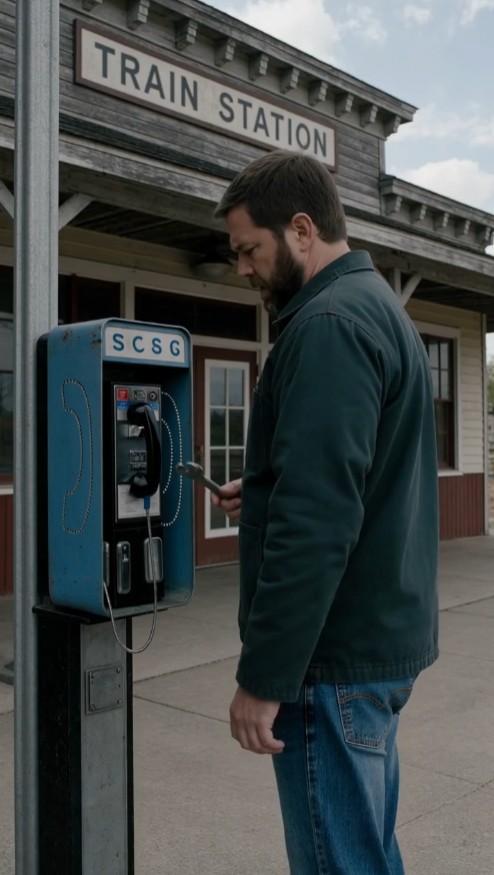
The old blue payphone outside the train station hadn’t rung in years.
Andrew Bennett was forty-six years old and had lived in the small coastal town of Bellhaven his entire life.
That Tuesday morning, he had been sent to remove the telephone.
The town was renovating the station entrance.
The old payphone had become an eyesore, and its cabinet was beginning to rust.
Andrew opened the service panel, checked the bolts, and reached for his wrench.
Then the phone rang.
He froze.
His coworker, Peter, looked up.
“Did you hear that?”
The phone rang again.
Peter laughed nervously.
“That thing still works?”
Andrew hesitated, then lifted the receiver.
“Hello?”
Static crackled.
For several seconds, nobody spoke.
Then an elderly woman’s voice whispered:
“Andrew?”
His stomach tightened.
“Who’s this?”
The woman didn’t answer.
Instead, she asked:
“Is the station clock still five minutes slow?”
Andrew turned toward the building.
The large clock above the entrance showed 8:17.
His watch read 8:22.
It had been running five minutes slow for as long as he could remember.
“Who are you?” he demanded.
The woman took a trembling breath.
“Your father left something beneath that telephone.”
Andrew stopped breathing for a moment.
His father, Thomas Bennett, had worked at the station for thirty-eight years.
He died when Andrew was sixteen.
Nobody had mentioned him in years.
“How do you know my father?”
The woman replied:
“Look beneath the cabinet.”
Peter knelt beside the concrete base.
He noticed a small metal access plate hidden behind the lower mounting bracket.
Two rusted screws held it in place.
Andrew removed them.
Inside was a narrow waterproof compartment.
Something wrapped in faded blue cloth lay at the bottom.
Then the woman spoke again.
“Whatever you do, don’t let the station manager see what’s inside.”
Andrew stared at the bundle.
“Why?”
Her answer made his blood run cold.
“Because thirty years ago, your father was blamed for something he didn’t do.”
The Man Everyone Remembered
Thomas Bennett had been one of Bellhaven Station’s most familiar employees.
For nearly four decades, he worked as a railway porter and station attendant.
He helped passengers carry luggage.
Assisted elderly travelers.
Checked the platform before trains arrived.
And repaired small things around the building when maintenance crews were unavailable.
He wasn’t wealthy.
He never owned an expensive car.
And he didn’t have a particularly impressive job title.
But almost everyone in town knew him.
Andrew remembered walking to the station after school.
His father would be waiting beside the ticket office.
Sometimes Thomas gave him a chocolate bar from the vending machine.
Other times they watched the evening train arrive together.
Andrew loved those moments.
He especially remembered the station clock.
It always ran five minutes slow.
When Andrew asked why nobody repaired it, Thomas smiled.
“Some things around here take longer than they should.”
Andrew never understood the answer.
Not until the morning the payphone rang.
The Winter Everything Changed
Thirty years earlier, Bellhaven had experienced one of its worst winter storms.
Heavy rain battered the coastline.
Flooding disrupted rail service.
And dozens of passengers became stranded at the station.
The station manager at the time was a man named Richard Harlow.
He was strict, ambitious, and determined to keep the railway operating despite the worsening conditions.
Thomas disagreed with several of Richard’s decisions.
The old drainage system near the southern platform had been causing problems for months.
Thomas repeatedly reported it.
He believed the flooding could damage the station’s electrical equipment and create dangerous conditions.
But repairs were postponed.
Then the storm arrived.
And something happened that changed Thomas’s reputation forever.
The Missing Emergency Fund
During the storm, the town organized temporary shelter for stranded passengers.
Local businesses donated food.
Volunteers brought blankets.
And a small emergency fund was collected to cover accommodation and transportation.
The money was kept temporarily in a locked station office.
Several days later, part of it was reported missing.
Richard Harlow accused Thomas of mishandling the fund.
An internal investigation followed.
Thomas denied taking any money.
But the records were incomplete.
The station had been in chaos during the flooding.
Receipts were missing.
And several transactions had never been entered properly.
Although no criminal charge was brought against Thomas, the accusation damaged his reputation.
Some people stopped speaking to him.
Others whispered whenever he passed.
Andrew was only sixteen.
He remembered coming home from school and finding his father sitting alone at the kitchen table.
Thomas looked exhausted.
Andrew asked what was wrong.
His father simply answered:
“Sometimes telling the truth isn’t enough when nobody wants to listen.”
The Woman on the Phone
Andrew held the receiver tightly.
“Tell me who you are.”
The woman hesitated.
“My name is Eleanor Price.”
Andrew searched his memory.
The name sounded familiar.
Then he remembered.
Eleanor had worked at the station’s ticket counter when he was a child.
She was a quiet woman with dark hair who always gave him peppermint sweets.
She left Bellhaven shortly after the storm.
Andrew hadn’t heard from her in nearly three decades.
“Eleanor?”
“Yes.”
“Why are you calling now?”
Her voice trembled.
“Because they’re removing the telephone.”
Andrew looked toward the open compartment.
“And because I promised your father I’d make sure you found what he left.”
The Blue Cloth
Andrew carefully lifted the bundle from the compartment.
The blue cloth was faded but dry.
Inside was a small metal box.
A handwritten label covered its lid.
FOR ANDREW — WHEN THE TRUTH CAN FINALLY BE TOLD.
Andrew recognized the handwriting immediately.
His father’s.
His hands began shaking.
Peter stepped back.
“Andrew, are you okay?”
Andrew barely heard him.
He opened the box.
Inside were several yellowed envelopes.
A photograph.
An old railway key.
And a small cassette tape.
The photograph showed Thomas standing beside a woman and a little girl outside the station.
On the back, someone had written:
December 14 — the night we nearly lost them.
Andrew frowned.
He had never seen the photograph.
Then he looked at the cassette.
A label had been attached to its case.
STATION OFFICE — ORIGINAL RECORDING.
The Tape Nobody Was Supposed to Hear
Eleanor spoke quietly.
“Your father recorded something during the storm.”
Andrew stared at the cassette.
“What?”
“Richard Harlow’s instructions.”
She paused.
“The emergency money wasn’t stolen.”
Andrew felt his heart pounding.
“Then what happened?”
Eleanor explained.
During the flooding, Richard had ordered money from the emergency fund to be used for a private transport arrangement.
Several stranded passengers needed evacuation from the southern platform.
But the station’s official emergency transport contractor couldn’t reach the area.
Richard hired an independent driver.
The payment itself could have been legitimate.
The problem was that Richard had used an unauthorized arrangement and failed to document it.
When auditors later questioned the missing funds, he blamed Thomas.
Thomas had objected to the payment being made without proper records.
He also insisted the transport details be documented.
Richard refused.
But Thomas had retained evidence of the conversation.
The Strange Reason for the Recording
Andrew looked toward the cassette.
“Why would my father record him?”
Eleanor answered carefully.
“Your father had been asked to take responsibility for the emergency accounts. He was worried because the records didn’t match.”
The station had used a small cassette recorder to document operational messages during the storm.
Thomas kept a copy of a conversation about the emergency transport payment.
It wasn’t the only evidence.
Inside the box were duplicate receipts, handwritten instructions, and a passenger transport log.
Together, the documents could show where the missing money went.
Andrew stared at the papers.
“Why didn’t he give these to the investigators?”
Eleanor fell silent.
Then answered:
“He tried.”
The Letter That Was Never Delivered
Andrew opened the largest envelope.
Inside was a letter addressed to the railway’s regional director.
Thomas had written it shortly after the storm.
He described the disputed payment.
The missing records.
And the concerns he’d raised about Richard’s decisions.
Attached were copies of the receipts.
At the bottom was a handwritten note.
Original documents retained pending acknowledgment of receipt.
But the letter had never reached its intended recipient.
Eleanor explained that Thomas attempted to submit evidence through the station’s management channels.
He believed the documents might disappear if he surrendered the only copies.
Eventually, he secured duplicates and placed them in the hidden compartment.
He planned to send the material independently.
But before he could finish resolving the matter, he became seriously ill.
Andrew remembered that period.
His father had been exhausted for months.
Then a sudden medical crisis took his life.
The accusation remained unresolved.
And Andrew grew up believing his father had died under a cloud of suspicion.
The Secret Eleanor Carried
Andrew leaned against the payphone.
“Why didn’t you tell me?”
Eleanor began crying.
“I wanted to.”
She explained that after Thomas died, she attempted to contact his widow.
But Andrew’s mother had left Bellhaven temporarily to stay with relatives.
Eleanor later moved away herself.
She kept copies of some records but lost contact with the family.
Years passed.
The railway changed management.
Old employees retired.
And the disputed fund was largely forgotten.
Eleanor admitted that she had also been afraid.
Richard Harlow had considerable influence within the railway at the time.
She worried that challenging him without all the original documents would cause more trouble for Thomas’s family.
Her silence had weighed on her for years.
Andrew listened.
He understood her fear.
But he couldn’t hide his sadness.
“Thirty years,” he whispered.
Eleanor answered:
“I know.”
Why the Payphone Rang
Andrew finally asked the question that had been troubling him.
“How did you know I’d be here?”
Eleanor explained that she had read a public notice announcing the station renovation and scheduled removal of the old payphone.
The announcement included the date.
She knew Andrew worked for the town maintenance department because she had recently contacted a former Bellhaven resident who still knew the family.
But she hadn’t known whether Andrew personally would be assigned to the job.
She had called the station’s old telephone number after confirming with the telephone provider that the line was still active.
It was being kept temporarily connected during the removal work.
She hoped whoever answered could help her reach Andrew.
When Andrew lifted the receiver, she recognized his voice.
He sounded remarkably like Thomas.
For a moment, she couldn’t speak.
Then she said his name.
And the conversation began.
The Station Manager’s Secret
Andrew asked why Eleanor had warned him not to let the station manager see the box.
She explained that Richard Harlow’s son, Martin, now managed the station.
Martin had worked there for fifteen years.
Eleanor didn’t know whether he had any connection to his father’s actions.
But she worried that the documents might be lost or mishandled if they were passed informally through the same management office.
She wanted them preserved independently.
Andrew understood.
The evidence needed to be handled properly.
He photographed the compartment and its contents before removing anything further.
Peter witnessed the discovery.
They secured the documents.
Then Andrew contacted the town’s legal office for guidance about preserving potentially important historical records.
He didn’t want another mistake to bury his father’s name.
The Investigation Begins Again
The town referred the material to the railway’s current administration and appropriate independent reviewers.
The cassette was examined by an archival audio specialist.
The paper records were scanned and cataloged.
The investigators compared the receipts against surviving financial records from the storm.
Some documents had been lost.
Others were incomplete.
But several important details matched.
The amount recorded as missing corresponded to the independent transport payment.
The passenger log confirmed that a vehicle had been hired during the emergency.
And the recording supported Thomas’s account that he had questioned the undocumented transaction.
The evidence did not establish every detail of Richard Harlow’s conduct.
But it substantially undermined the claim that Thomas had stolen the money.
After a formal review, the railway issued a written statement.
There was no evidence that Thomas Bennett had misappropriated the emergency fund.
The historical allegation against him was withdrawn.
The Day Andrew Read the Statement
Andrew sat in his kitchen holding the railway’s letter.
His wife, Sarah, sat across from him.
For several minutes, he couldn’t speak.
Then he read the final paragraph aloud.
We regret the harm caused to Mr. Bennett’s professional reputation and to his family by an allegation that was not supported by the available evidence.
Andrew stopped.
His voice broke.
Sarah reached for his hand.
He looked toward a photograph of his father hanging near the window.
Thomas was smiling beside an old passenger train.
Andrew had been sixteen when he died.
Thirty years had passed.
And now, at forty-six, he was finally holding something he’d wanted since childhood.
Proof that his father had told the truth.
The Little Girl in the Photograph
But there was still one mystery.
Andrew hadn’t forgotten the photograph inside the metal box.
Thomas standing beside a woman and a little girl.
The inscription on the back:
December 14 — the night we nearly lost them.
When Andrew asked Eleanor, her voice changed.
“That girl was me,” she said.
Andrew looked confused.
“But you were an adult when you worked at the station.”
Eleanor explained that the photograph wasn’t taken during the storm.
It had been taken decades earlier, when she was a child.
The woman beside her was her mother.
Thomas had been a young railway employee at the time.
One winter evening, Eleanor and her mother became stranded after a train service was interrupted by severe weather.
They had little money.
And no relatives nearby.
Thomas helped arrange temporary shelter and contacted people who could assist them.
He brought hot drinks.
Found blankets.
And stayed until they were safe.
Eleanor never forgot.
Years later, when she began working at Bellhaven Station, she immediately recognized him.
And that was why she trusted Thomas when the accusations began.
The Promise
Eleanor explained that Thomas had helped her family long before the disputed emergency fund.
To her, he wasn’t simply a coworker.
He was the man who had once helped her and her mother through a frightening night.
When Thomas became ill, Eleanor visited him.
He told her about the documents hidden beneath the payphone.
He worried that nobody would believe his account after he died.
Eleanor promised to help Andrew find the truth.
But fear, distance, and the passage of time kept her from fulfilling that promise for decades.
Now she was eighty-three.
Her health was declining.
And when she saw the notice about the payphone being removed, she realized the evidence could disappear forever.
She decided she couldn’t remain silent any longer.
The First Meeting
Two weeks after the discovery, Andrew traveled to meet Eleanor.
She lived in a quiet retirement community several hours away.
When he entered her apartment, she stood slowly.
For a moment, she stared at him.
Then she smiled.
“You look so much like Thomas.”
Andrew hugged her.
Neither spoke for several seconds.
Eleanor showed him photographs from her years at Bellhaven Station.
There were pictures of the old ticket office.
The platforms.
And Thomas standing beside the clock.
Andrew had never seen most of them.
They spent the afternoon talking.
Eleanor remembered his father as patient, hardworking, and unusually kind.
She told stories Andrew had never heard.
Some made him laugh.
Others made him cry.
For the first time in thirty years, he felt as though he was learning something new about the father he’d lost.
The Clock That Ran Five Minutes Slow
Before leaving, Andrew asked Eleanor about the station clock.
“Why did you ask whether it was still five minutes slow?”
She smiled.
“Because your father used to joke about it.”
Andrew laughed softly.
Eleanor explained that the clock had been repaired several times over the years.
But it frequently drifted behind.
Thomas always noticed.
He used to tell passengers:
“Don’t trust the station clock. Trust the timetable.”
Then he would smile.
Andrew remembered hearing the joke as a child.
Eleanor continued.
“Your father once said that the clock was proof the world didn’t always keep perfect time.”
She paused.
“But he believed the truth eventually had a way of catching up.”
Andrew looked down.
For thirty years, his father’s story had been left unfinished.
Now it finally had an ending.
The Station Ceremony
Several months later, Bellhaven Station held a small public ceremony.
The railway formally acknowledged the historical error.
The town installed a plaque near the restored entrance.
It honored Thomas Bennett’s decades of service and his assistance to passengers during severe weather emergencies.
Andrew attended with his wife and children.
Eleanor traveled to Bellhaven for the occasion.
She wore a blue coat and carried an old photograph of Thomas.
During the ceremony, Andrew was invited to speak.
He stood near the platform.
The station clock hung above him.
Still five minutes slow.
He smiled through tears.
“My father worked here for thirty-eight years.”
The audience became quiet.
“He wasn’t famous. He wasn’t wealthy. But he believed in doing his job properly.”
Andrew paused.
“For a long time, I thought the last part of his life would always be remembered because of an accusation.”
He looked toward the plaque.
“Today, I know it doesn’t have to be.”
The Payphone’s Final Journey
The old blue payphone was removed from its concrete base after the evidence had been properly documented.
But the town decided not to discard it.
Instead, the cabinet was restored and placed in a small railway history exhibition.
Visitors could learn about the station’s past.
Its workers.
And the changes in communication technology over the decades.
A copy of Thomas’s photograph was displayed beside it.
The original records were preserved in an archive.
Andrew visited the exhibition with his children.
His youngest daughter pointed toward the telephone.
“Dad, is that the phone that rang?”
He smiled.
“That’s the one.”
She looked surprised.
“Who called?”
Andrew knelt beside her.
“Someone who remembered Grandpa.”
The Letter Thomas Left Behind
There was one final item in the metal box.
Andrew had kept it sealed until he felt ready.
It was an envelope with his name written across the front.
Inside was a letter from Thomas.
It had been written shortly before his death.
Andrew opened it one quiet evening.
The handwriting was shaky.
But unmistakable.
Dear Andrew,
If you are reading this, there are things I wish I could have explained to you myself.
I know people have been saying things about me.
I know some of those things may have reached you.
I want you to remember that a person’s reputation can be damaged quickly, but the truth doesn’t change because people stop believing it.
I have tried to do the right thing.
I hope the documents I’ve kept will help you understand.
But even if they don’t, I need you to know something more important.
Being your father has been the greatest privilege of my life.
I am proud of the young man you are becoming.
Don’t let anger make your life smaller.
Look after your mother.
Be kind to people who need help.
And never be ashamed of where you come from.
Love, Dad.
Andrew read the letter twice.
Then placed it against his chest.
And cried.
The Thirty-Year Wait
Andrew had spent most of his adult life carrying unanswered questions.
He wondered whether his father had been treated unfairly.
Why nobody had explained the missing money.
And whether the rumors that followed the family would ever disappear.
The documents didn’t bring Thomas back.
They didn’t return the years Andrew had spent without him.
And they couldn’t erase the pain his family experienced.
But they gave him something important.
A clearer understanding of what had happened.
An official acknowledgment that the accusation was unsupported.
And a chance to remember his father without the shadow of suspicion.
Eleanor had carried the secret for thirty years.
Her phone call finally brought it into the open.
The Last Visit
The following spring, Andrew returned to see Eleanor.
They spent the afternoon looking through old photographs.
She had grown weaker.
But her mind remained sharp.
Before he left, she held his hand.
“Andrew?”
“Yes?”
“Do you forgive me for waiting so long?”
He looked at her.
Eleanor’s eyes filled with tears.
“I should have found you sooner.”
Andrew sat beside her.
“You called when you had the chance to make a difference.”
She shook her head.
“Thirty years.”
He squeezed her hand.
“I know.”
Then he smiled gently.
“But because you called, I got to hear my father’s words again.”
Eleanor began crying.
Andrew hugged her.
And for a moment, neither spoke.
The Station Clock
Andrew still worked for the town maintenance department.
He passed the train station almost every week.
The building had been renovated.
The old benches had been restored.
And the entrance looked better than it had in decades.
But one thing remained unchanged.
The clock.
It still ran five minutes slow.
The town had considered replacing it.
Then decided to preserve it as part of the station’s history.
Andrew liked that.
Whenever he looked at the clock, he remembered the morning the payphone rang.
The elderly woman’s voice.
The hidden compartment.
And the blue cloth wrapped around his father’s evidence.
He also remembered something Eleanor told him.
The truth doesn’t always arrive when we expect it.
Sometimes it takes longer.
Much longer.
But that doesn’t mean it has disappeared.
The Truth Beneath the Telephone
The extraordinary discovery began when a maintenance worker arrived to remove an abandoned payphone outside a coastal train station.
The telephone unexpectedly rang.
When Andrew answered, an elderly woman knew his name and remembered the station clock that ran five minutes slow.
She directed him toward a hidden compartment beneath the telephone.
Inside were documents, a cassette recording, and a letter from his late father.
The evidence related to a thirty-year-old financial accusation that had damaged Thomas Bennett’s reputation.
An independent historical review found that the available evidence did not support the allegation that he had stolen emergency funds.
The railway formally withdrew the accusation and apologized to the family.
The caller was Eleanor Price, a former station employee who had promised Thomas she would help preserve the truth.
The old payphone was restored as a historical exhibit.
And Andrew finally received a letter his father had written decades earlier.
The Last Thing Andrew Remembered
Years after the discovery, Andrew was asked what he remembered most about that morning.
He didn’t mention the hidden cassette.
Or the railway’s apology.
Or the public ceremony.
He smiled.
“The ringing.”
People looked surprised.
He continued.
“That phone hadn’t rung in years.”
He paused.
“I was standing there with a wrench in my hand, thinking about how to remove an old piece of equipment.”
Then he laughed softly.
“And suddenly, someone on the other end knew my name.”
He looked toward the station clock.
“I thought it was the strangest thing that had ever happened to me.”
Then his expression softened.
“But it turned out to be something I needed more than I knew.”
The Call That Came Thirty Years Late
At forty-six, Andrew Bennett believed he knew everything important about his father’s life.
Thomas had worked at Bellhaven Station.
He had been accused of mishandling emergency money.
And he had died before the matter was resolved.
For thirty years, Andrew carried the pain of those unanswered questions.
Then an abandoned telephone rang.
An elderly woman spoke his name.
And beneath the payphone was a collection of documents that changed how the town remembered Thomas.
A payphone nobody had used in years began ringing while workers were removing it.
The caller knew Andrew’s name, his father’s history, and the station clock that always ran five minutes slow.
Then she directed him to a hidden compartment containing evidence that helped clear his father’s name thirty years after his death.
Andrew never forgot that call.
Or the woman who made it.
But the most important thing he discovered wasn’t the cassette tape or the old railway documents.
It was the letter Thomas had written to his son.
A letter that had waited decades to be read.
And in that letter were the words Andrew had needed since he was sixteen.
Being your father has been the greatest privilege of my life.
The old payphone had stood outside Bellhaven Station for nearly forty years.
Most people passed it without noticing.
To the town, it was an abandoned piece of equipment.
To Andrew, it became something entirely different.
It was the place where his father’s unfinished story finally found its ending.