
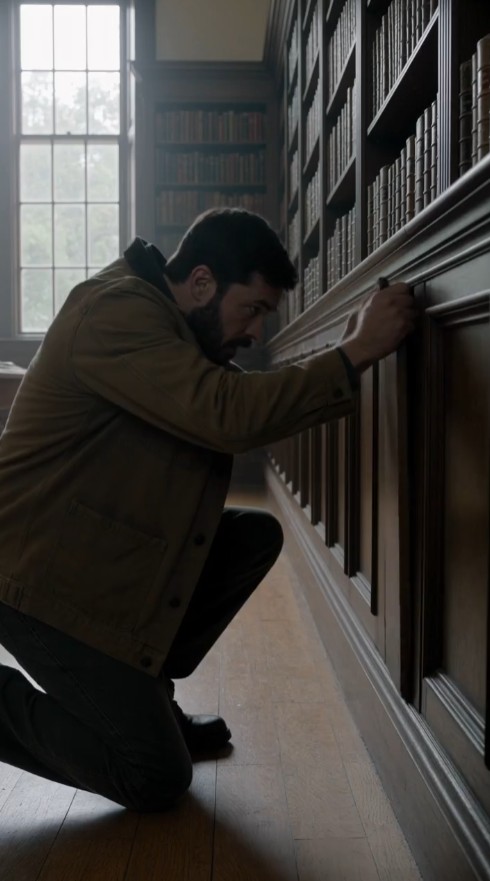
Nathan Miller had been hired to replace the damaged wooden panels inside a century-old library.
It was supposed to be an ordinary renovation job.
Until he removed one loose panel beside a bookshelf.
And something fell onto the floor.
An envelope.
Then another.
Nathan shone his flashlight into the opening.
Dozens of sealed letters were stacked inside a narrow compartment.
Each had a child’s name written across the front.
Some envelopes were yellowed with age.
Others looked much newer.
Nathan called the librarian.
Together, they carefully removed them.
There were forty-seven.
But one was different.
It was white.
Clean.
And sealed with blue tape.
Nathan picked it up.
Then froze.
NATHAN MILLER.
His full name.
Beneath it was a date.
October 12, 1995.
His eighth birthday.
Nathan was thirty-nine now.
He had never worked in this library before.
And his mother had died when he was nine.
His hands began trembling.
He opened the envelope.
Inside was a small brass key.
And a folded note.
My darling Nathan,
If you ever find this, look inside the cabinet beside the north window.
There’s something I never got to give you.
Love, Mom.
Nathan slowly turned toward the far corner of the reading room.
An enormous wooden cabinet stood against the wall.
Its doors were locked.
The librarian, Margaret, followed his gaze.
Then she whispered:
“Nathan… that cabinet belonged to your mother.”
Nathan stared at her.
“What?”
Margaret’s eyes filled with tears.
“Your mother wasn’t just a librarian here. She was the reason those forty-seven letters existed.”
And when Nathan opened the cabinet, he discovered something that would change the lives of dozens of families.
The Library Nobody Wanted to Lose
The Bellwood Public Library had stood on the town square for more than a hundred years.
Its walls were made of red brick.
Tall windows overlooked the old courthouse.
And wooden bookshelves stretched almost to the ceiling.
For generations, children had visited the building after school.
Some came to read.
Others came because their parents worked late.
And a few came because the library was the only quiet place they had.
Nathan remembered passing the building as a child.
But he rarely went inside.
After his mother died, his father moved the family to another neighborhood.
Eventually, Nathan grew up, became a carpenter, and started a small renovation business.
When the town offered him the library restoration contract, he accepted without thinking much about his family’s connection to the building.
He knew his mother had worked there.
But he didn’t know what she had left behind.
The Woman Who Remembered Everything
Nathan’s mother was named Elizabeth Miller.
She began working at the library in the early 1980s.
She loved books.
But she loved helping children even more.
Elizabeth believed every child deserved somewhere safe to sit, read, and feel welcome.
She organized afternoon reading sessions.
Helped students with homework.
And quietly kept extra sandwiches in the staff refrigerator for children who sometimes arrived hungry.
She never made a spectacle of helping anyone.
If a child needed a notebook, she found one.
If someone couldn’t afford a school project, she gathered materials.
If a frightened child needed someone to listen, Elizabeth made time.
Over the years, many children came to trust her.
But Elizabeth had another unusual tradition.
She encouraged young visitors to write letters.
Not to strangers.
Not to the newspapers.
To their future selves.
The Secret Letter Project
Elizabeth called it Letters for Tomorrow.
Every year, children who regularly visited the library could write a private letter about their hopes and dreams.
Some wrote about becoming doctors.
Others wanted to travel.
A few simply wished their families would be happy.
Elizabeth provided paper and envelopes.
She told the children they could seal their messages and choose whether they wanted them kept for the future.
With permission from their families, she stored the letters.
The original plan was to return them when the children became adults.
But the project faced interruptions.
The library changed management.
Families moved away.
And Elizabeth became seriously ill.
Eventually, the letters were placed in a concealed storage space during earlier building repairs.
Most people forgot they existed.
Until Nathan removed the wooden panel.
The Forty-Seventh Envelope
Margaret, the current librarian, carefully arranged the letters across a table.
Forty-six appeared to belong to children who had participated in Elizabeth’s project.
Some dated back to earlier library programs that inspired it.
But Nathan’s envelope was different.
It wasn’t written by a child.
It had been prepared by Elizabeth for her own son.
Margaret explained that the envelope had been added much later than the oldest letters.
She had personally placed it in the compartment several years earlier.
Nathan looked up.
“You knew it was there?”
Margaret nodded.
“Yes.”
“Then why didn’t you tell me?”
Her expression changed.
“Because your mother asked me to keep something safe. And I didn’t know how to explain it.”
Nathan stared at her.
For the first time, he realized the discovery hadn’t been entirely accidental.
The Promise Margaret Made
Margaret had worked alongside Elizabeth when she was a young library assistant.
She admired her kindness.
And when Elizabeth became ill, Margaret helped organize her unfinished projects.
Shortly before her death, Elizabeth entrusted Margaret with a small collection of letters and the key to her cabinet.
She asked Margaret to preserve the children’s messages until they could be returned appropriately.
And she left a separate envelope for Nathan.
Margaret had kept the cabinet locked.
After Elizabeth died, she tried contacting Nathan’s family.
But his father was grieving and didn’t want to revisit the library.
Years passed.
Margaret never felt she had the right moment to approach Nathan.
When she learned that his company had been awarded the restoration contract, she decided to prepare the letters for discovery during the renovation.
She had placed Nathan’s envelope with the older collection and made sure the original cabinet remained untouched.
She hadn’t known exactly when he would remove the panel.
But she hoped he’d eventually find it.
Nathan listened in silence.
Then looked toward the cabinet.
“What’s inside?”
Margaret wiped her eyes.
“Your mother wanted you to see it yourself.”
The Brass Key
Nathan walked toward the north window.
The cabinet was made of dark oak.
Its corners were worn.
The brass handles had lost their shine.
He recognized the workmanship.
His grandfather had built furniture.
And his mother had always loved handmade wooden things.
Nathan placed the small brass key inside the lock.
It turned.
The cabinet doors opened with a soft creak.
Inside were three shelves.
The first held children’s drawings.
The second contained photograph albums.
And the third held a wooden box.
On the box was a handwritten label.
FOR MY NATHAN.
Nathan stopped.
His mother hadn’t called him Nathan when he was little.
She called him Nattie.
He reached for the box.
And began crying before he even opened it.
The Birthday Gift He Never Received
Inside the wooden box was a small model sailboat.
Its hull had been carved by hand.
The mast was painted blue.
And a tiny white sail carried Nathan’s initials.
N.M.
He remembered it immediately.
When he was seven, he’d become obsessed with boats.
His mother promised to help him build one.
They collected small pieces of wood.
Talked about painting it.
And planned to launch it in the pond behind their house.
But Elizabeth became ill before they finished.
Nathan assumed the little boat had been thrown away.
Now it was sitting in front of him.
Completed.
Preserved.
Waiting.
Beneath it was another envelope.
This one had been sealed with a small blue ribbon.
Nathan opened it carefully.
The Letter From His Mother
My darling Nattie,
Happy eighth birthday.
I wish I could promise that every birthday will be easy and every year will be happy.
But life doesn’t always give us those promises.
What I can promise is that you have been loved every day of your life.
You told me you wanted to build houses when you grow up.
You said houses keep people safe from storms.
I think that’s a beautiful reason to build things.
But I hope you remember something else.
People need more than walls and roofs.
They need kindness.
They need someone who listens.
And sometimes they need a place where they feel they belong.
I hope you build those places too.
I love you more than all the stars you could ever count.
Mom.
Nathan sat down on the floor.
He held the letter against his chest.
And sobbed.
The Photograph He Had Never Seen
Margaret quietly approached.
She handed Nathan a photograph.
It showed Elizabeth sitting at a large table inside the library.
Around her were several children.
One little boy sat beside her.
He had messy brown hair.
A missing front tooth.
And a bright red sweater.
Nathan stared.
It was him.
He was seven years old.
He remembered visiting the library once during a summer afternoon.
But he had forgotten the details.
Margaret smiled through tears.
“Your mother wanted you here that day.”
Nathan looked toward her.
“Why?”
“Because she wanted you to see what she loved.”
Margaret paused.
“She wanted you to know that helping other children didn’t mean she loved you any less.”
Nathan looked at the photograph again.
Then at the small sailboat.
He finally understood.
His mother hadn’t simply worked in the library.
She had built a community inside it.
The Names on the Envelopes
After Nathan recovered from the shock, he returned to the reading room.
Forty-six other letters remained.
Each belonged to someone who had once been a child.
Some names were familiar.
Others were not.
Margaret explained that they shouldn’t open the letters casually.
They contained private messages intended for their original writers.
The library contacted its board and sought appropriate guidance about preserving and returning the materials.
Staff began searching historical enrollment and program records to locate the former participants.
Not every person could be found immediately.
Some had moved across the country.
Others had changed surnames.
A few had died.
But the project began attracting attention from former library visitors.
And soon, the first person came forward.
The Boy Who Wanted to Become a Doctor
His name was Michael Turner.
He was fifty-one years old.
When he was eleven, he’d written a letter during one of the library’s early future-letter activities.
He remembered Elizabeth.
He remembered the old reading room.
And he remembered writing a note about his dream.
After his identity was verified, the library returned his sealed envelope.
Michael opened it privately.
Then laughed through tears.
Inside, his younger self had written:
Dear future Michael,
I hope you’re a doctor.
I hope Mom is feeling better.
And I hope you still read books.
Michael had become a nurse.
His mother had recovered from the illness she faced during his childhood.
And he still loved reading.
He looked toward Margaret.
“Mrs. Miller used to help me with my science homework.”
Then he smiled.
“I wish I could tell her I made it into healthcare.”
Nathan stood nearby.
He felt his chest tighten.
His mother had helped a boy believe in himself.
And decades later, that boy still remembered.
The Girl Who Wanted Her Family Back
Another letter belonged to a woman named Rachel.
She had been nine when her parents separated.
During that time, she spent many afternoons at the library.
Elizabeth noticed that Rachel was unusually quiet.
Instead of asking intrusive questions, she invited her to join the letter project.
Rachel wrote to her future self.
When the library returned the letter, Rachel read it privately.
Later, she chose to share part of it with Nathan.
I hope when I’m grown up, I have a house where nobody shouts.
Rachel’s eyes filled with tears.
She had worked hard to build a peaceful home for her own children.
She now volunteered with a family support organization.
“Your mother never knew how much she helped me,” Rachel told Nathan.
“She gave me somewhere I could breathe.”
Nathan couldn’t speak.
He simply hugged her.
The Envelope With No Address
As the library continued locating former participants, one envelope presented a particular challenge.
It was addressed only to:
SAMUEL.
No surname.
No date of birth.
Just a first name.
Margaret remembered a boy named Samuel who visited the library in the late 1960s.
He had moved through several foster homes.
He loved drawing ships.
And he rarely spoke.
But there was no reliable information connecting him to a current address.
The library preserved the envelope.
Then searched through old program records.
Eventually, a retired teacher recognized the name.
Samuel had been placed with a family in another state.
His surname had changed after adoption.
The discovery gave the library a lead.
But they still needed to confirm his identity.
The Man Who Returned After Fifty Years
Several weeks later, an elderly man entered the library.
He walked slowly.
His hair was white.
And he carried an old photograph.
His name was Samuel Reed.
He was sixty-seven years old.
After verifying his connection to the original letter, the library returned the envelope.
Samuel sat at the same wooden table where he had once spent afternoons drawing.
His hands trembled.
He carefully opened it.
Inside was a small picture of a boat.
And a message written in uneven handwriting.
I hope somebody wants me someday.
Samuel stared at the paper.
Then covered his face.
Margaret sat quietly beside him.
After several minutes, Samuel looked up.
“I was adopted.”
His voice shook.
“By a family who loved me.”
He paused.
“I wish that little boy could have known.”
The Story Behind the Cabinet
As the letters were returned, Nathan became increasingly curious about his mother’s work.
Margaret showed him old records.
Photographs.
And handwritten notes Elizabeth had kept.
He learned that she’d helped expand the library’s after-school reading program.
She organized donated books.
Worked with local teachers.
And helped ensure children from struggling families could participate.
The cabinet had originally stored supplies.
But Elizabeth gradually turned it into a place for preserving special projects.
Student artwork.
Photographs.
And the future letters.
When the library renovated part of the reading room years earlier, the envelopes had been moved to the protected wall compartment.
The cabinet remained locked.
And Margaret kept the key as Elizabeth requested.
Now the renovation had brought the project back into the light.
The Question Nathan Couldn’t Answer
One evening, Nathan sat alone in the library.
The workers had gone home.
The tools were packed away.
And sunlight streamed through the tall windows.
He placed the little sailboat on the reading table.
Then read his mother’s letter again.
I hope you build those places too.
Nathan looked around.
For years, he’d measured success by completed projects.
How many rooms he renovated.
How many contracts he finished.
How much money his business earned.
But his mother had seen building differently.
To her, a place mattered because of what happened inside it.
A quiet reading room could become a refuge.
A library table could become someone’s first classroom.
And a letter written by a frightened child could become a reminder that their life had changed.
Nathan began thinking about what he could do.
The Reading Room Project
Nathan approached the library board with an idea.
He wanted to restore the old reading room in his mother’s memory.
But he didn’t want a large memorial plaque or an expensive ceremony.
He wanted something useful.
A welcoming space where children could read, study, and participate in creative activities.
The board supported the proposal.
Nathan offered part of his labor without charge.
Local businesses contributed materials.
Volunteers helped restore furniture.
Teachers donated books.
And former participants in the letter project offered to assist.
The room was redesigned with comfortable seating, accessible shelves, and a small writing table.
Above the entrance, Nathan installed a modest wooden sign.
THE ELIZABETH MILLER READING ROOM.
The Opening Day
When the room reopened, dozens of families attended.
Children explored the shelves.
Parents examined the restored woodwork.
Former library visitors shared memories of Elizabeth.
Nathan stood near the entrance.
In his hands was the little sailboat.
Margaret approached.
“Are you nervous?”
He smiled.
“A little.”
Then he looked around.
“I think Mom would like this.”
Margaret nodded.
“She would love it.”
During the ceremony, Nathan placed the sailboat inside a small protective display case.
Beside it, he included a copy of the letter his mother had written.
He kept the original at home.
The plaque below the display read:
EVERY CHILD DESERVES A PLACE TO BELONG.
The Letters That Finally Came Home
Over the following year, the library continued working to return the remaining envelopes.
Some recipients visited in person.
Others received their letters through carefully verified arrangements.
A few could not be located.
The library preserved those envelopes securely rather than opening them without permission.
Every returned letter represented a childhood memory.
Some were funny.
Some were ordinary.
And some were deeply emotional.
One man discovered he’d once wanted to become a firefighter.
He had become one.
A woman read that she’d dreamed of owning a bookstore.
She now managed one.
Another person found a note asking whether they’d ever learn to feel confident.
That letter made its writer cry.
Not because life had turned out perfectly.
But because the frightened child who wrote it had survived and grown.
The Visit From Nathan’s Father
Nathan’s father, Robert, eventually visited the restored reading room.
He was seventy-one.
For years, he’d avoided talking about Elizabeth.
Losing her had been the most painful experience of his life.
He had loved her deeply.
But after her death, he struggled to remain in places filled with memories.
The library was one of them.
Now Nathan invited him to see the room.
Robert walked through the doorway.
Then stopped.
He recognized Elizabeth’s old cabinet immediately.
He placed a hand against the wood.
“She loved this thing.”
Nathan smiled.
“I know.”
Robert looked toward the sailboat.
His expression changed.
“Where did you find that?”
Nathan told him everything.
The hidden letters.
The key.
The cabinet.
And the message Elizabeth had left.
Robert sat down.
And began crying.
The Memory Robert Had Kept
After a while, Robert told Nathan something he’d never shared.
Elizabeth had worked on the sailboat during the last weeks of her illness.
She was often tired.
But she insisted on finishing it.
Robert helped her sand the wood.
He painted the mast.
And she attached the little sail.
They planned to give it to Nathan for his birthday.
But Elizabeth became too ill before the celebration.
Robert had placed the boat among her belongings.
Later, Margaret offered to preserve it inside the library cabinet with Elizabeth’s other keepsakes.
He agreed.
Then grief made it difficult to return.
Nathan listened quietly.
His father looked toward him.
“I’m sorry I never told you.”
Nathan shook his head.
“Dad, you were doing your best.”
Robert began crying again.
Nathan hugged him.
For the first time in years, they spoke openly about Elizabeth.
Not only about losing her.
But about the person she had been.
The New Letter Tradition
Inspired by the discovery, the library introduced a new version of Elizabeth’s letter project.
Children could write messages to their future selves.
Participation was voluntary.
Parents or guardians provided appropriate permission.
The library established clear procedures for privacy, storage, and eventual return.
Nathan helped build a secure wooden cabinet for the project.
It stood beside the north window.
Near the original cabinet his mother had used.
On the first day, children gathered around a large table.
They wrote about dreams.
Friendships.
Favorite books.
And things they hoped to remember.
Nathan watched them.
Then smiled.
His mother’s idea had returned.
The Letter Nathan Wrote Back
One quiet evening, Nathan sat inside the reading room after closing.
He placed a blank sheet of paper on the desk.
Then began writing.
Dear Mom,
I found your letter.
I found the little boat too.
I’m sorry it took so long.
I wish you could see the man I’ve become.
I build things for a living now.
Houses.
Shops.
Rooms for families.
I think you’d be proud.
But I understand something now that I didn’t when I was little.
You weren’t just talking about buildings.
You were talking about making people feel safe.
I met some of the children you helped.
They remember you.
Even after all these years.
I want you to know that what you did mattered.
And I promise I’ll keep building places where people feel they belong.
Love, Nattie.
He folded the letter.
Then placed it inside his own keepsake box at home, beside the original note from his mother.
The Anniversary
One year after the discovery, Nathan returned to the reading room with his daughter, Lily.
She was eight years old.
Almost the same age he had been when his mother wrote the letter.
Lily examined the little sailboat in its display case.
“Daddy, did Grandma make that?”
Nathan smiled.
“She helped make it.”
Lily looked toward the plaque.
“Did she like books?”
“Very much.”
“Did she like kids?”
Nathan laughed softly.
“She loved helping them.”
Lily thought for a moment.
Then asked:
“Would she have liked me?”
Nathan knelt beside her.
He felt his throat tighten.
“She would have loved you.”
Lily smiled.
Then hugged him.
The Forty-Seventh Letter
Of all the envelopes discovered behind the library wall, Nathan’s remained the most important to him.
Not because it contained money.
Or a mysterious inheritance.
Or some hidden family scandal.
It contained a key.
A small wooden sailboat.
And a letter from a mother who had died when her son was still a child.
It also led him to discover forty-six other letters connected to people who had visited the library decades earlier.
Through those messages, Nathan learned something about his mother’s life that he never fully understood as a boy.
She had made people feel seen.
She had helped frightened children imagine brighter futures.
And she had left behind a project that continued touching lives long after she was gone.
The Last Morning in the Library
Several years later, Nathan returned to the library to complete another small repair.
The building was quiet.
Morning sunlight stretched across the floor.
He walked past the wooden panel where the envelopes had been discovered.
The wall had been restored.
There was no visible sign of the old compartment.
Then he entered the reading room.
Children were sitting around a table.
A librarian was reading aloud.
One little girl raised her hand to ask a question.
The room filled with laughter.
Nathan stopped in the doorway.
For a moment, he imagined his mother standing beside the shelves.
Smiling.
Holding a book.
Helping a child who needed someone to listen.
He looked toward the cabinet.
Then toward the little sailboat.
And felt something he hadn’t expected.
Peace.
The Secret Behind the Wall
The extraordinary discovery began when a thirty-nine-year-old carpenter removed an old wooden panel inside a century-old library.
Behind it were forty-seven sealed envelopes.
Each carried a name.
The oldest dated back decades.
But one envelope was addressed to Nathan himself.
Inside was a brass key and a note from his late mother.
The key opened a locked wooden cabinet that had belonged to her.
Inside, Nathan discovered a birthday gift he’d never received and a deeply personal letter.
He also learned that his mother had organized a project encouraging children to write messages to their future selves.
The forgotten letters were preserved and gradually returned to their rightful owners.
Their stories revealed how much Elizabeth’s kindness had meant to the community.
Nathan eventually helped restore the library’s reading room in her memory.
And a new generation of children began writing letters of their own.
The Message That Waited Thirty Years
When Nathan first saw his name on the white envelope, he thought someone was playing a cruel joke.
He had never worked in the library before.
His mother had died thirty years earlier.
And he couldn’t understand why anyone would hide a letter addressed to him behind an old wooden wall.
But the letter wasn’t a joke.
It was a message from the past.
A message his mother had prepared when he was a little boy.
And one he’d waited most of his life to receive.
Workers removed an old library panel and discovered forty-seven hidden envelopes.
One was addressed to the carpenter who found them, with the date of his eighth birthday written beneath his name.
Inside was a key to his late mother’s cabinet — and a letter that revealed the secret project she’d left behind.
Nathan had spent years believing he remembered his mother only through fading childhood memories.
Now he knew that pieces of her life had survived all around him.
In old photographs.
In handwritten letters.
In the stories of people she had helped.
And in a little wooden sailboat waiting behind a locked cabinet.
The most important discovery wasn’t hidden money or a forgotten treasure.
It was something his mother had tried to teach him before she died.
Buildings can shelter people from the weather.
But kindness can give them somewhere to belong.
And thirty years after losing her, Nathan finally understood what she’d wanted him to build.