
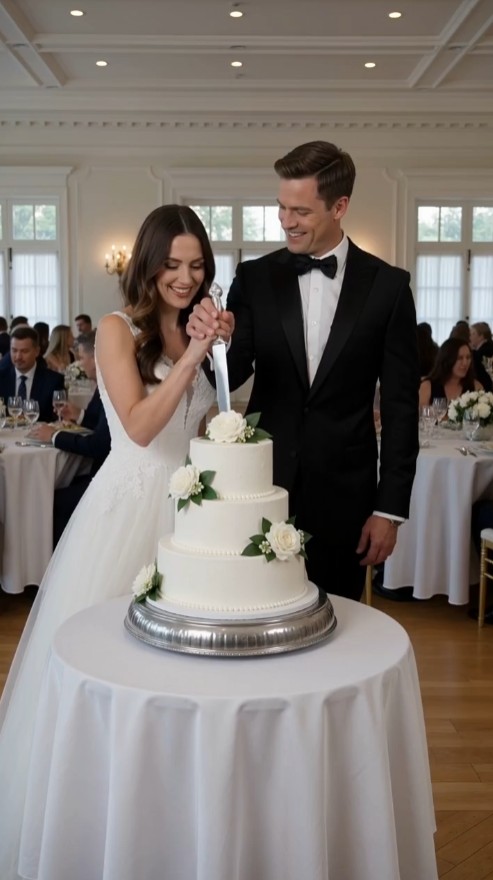
Two hundred wedding guests were cheering as Emily and her new husband, Daniel, prepared to cut their three-tier wedding cake.
The photographer raised her camera.
The music softened.
Daniel placed his hand over Emily’s.
And together, they lifted the silver cake knife.
Then someone screamed.
“WAIT! DON’T CUT THAT CAKE!”
A young waitress came running out of the kitchen.
Her name was Rachel.
She was twenty-three years old and had worked at the wedding venue for less than six months.
Before anyone could react, she reached the cake table and grabbed the knife away from the bride.
The ballroom went silent.
Daniel stepped forward.
“What is wrong with you?”
The wedding planner hurried toward them.
“Rachel! Explain yourself!”
But the waitress wasn’t looking at either of them.
She was staring at Emily.
“You’re allergic to peanuts, aren’t you?”
Emily’s smile disappeared.
“Yes. Severely.”
Rachel swallowed.
“Then please don’t eat that cake.”
A murmur spread through the ballroom.
Earlier that afternoon, the bakery had delivered two nearly identical wedding cakes.
One was specially prepared for Emily’s severe peanut allergy.
The other was intended for a different celebration.
Rachel had just discovered that their delivery labels might have been switched.
She’d tried calling the kitchen manager.
Nobody answered.
So she ran.
The wedding planner immediately contacted the bakery.
Several minutes later, the manager called back.
He confirmed that the delivery labels had been mixed up.
Then Rachel asked which cake contained peanuts.
The man hesitated.
“There’s something else you need to know about that delivery.”
Daniel reached for Emily’s hand.
“What else?”
The bakery manager took a shaky breath.
“The cake that’s supposed to be at your wedding was never delivered to the other venue. We just found it in our refrigerated storage.”
Rachel stared at the phone.
“Then what cake did you send us?”
There was a long silence.
Finally, the manager answered.
“A peanut-butter cake made for a completely different customer.”
Emily’s face went white.
And suddenly, everyone understood why Rachel had stopped her.
But the bakery manager wasn’t finished.
He had just discovered that a second mislabeled dessert had been sent to another event — where guests were already eating.
The Wedding Emily Had Dreamed About
Emily was twenty-eight years old.
She had spent nearly a year planning her wedding to Daniel.
They met four years earlier through mutual friends.
He was warm, funny, and endlessly patient.
She was organized, creative, and loved bringing people together.
Their wedding was held in a beautiful historic ballroom surrounded by gardens.
White roses lined the tables.
Hundreds of candles glowed beneath the chandeliers.
And almost two hundred relatives and friends had traveled to celebrate with them.
But Emily had one serious medical concern.
She had lived with a severe peanut allergy since early childhood.
Even a small exposure could potentially trigger anaphylaxis, a life-threatening allergic reaction.
She carried prescribed epinephrine auto-injectors and had learned to be extremely careful around food.
Daniel understood the risks.
So when they began planning their wedding, they made food safety a priority.
The Special Cake Order
The couple selected a highly recommended bakery.
They explained Emily’s allergy during their first consultation.
The bakery manager documented the requirement and discussed its ability to provide an appropriate cake.
Emily repeatedly emphasized that avoiding direct peanut ingredients wasn’t enough.
Cross-contact with peanut-containing products also had to be prevented.
The couple requested written confirmation of the ingredients and preparation arrangements.
Their order was for a three-tier vanilla cake with raspberry filling and white buttercream frosting.
No peanuts.
No peanut butter.
And no peanut-containing decorations.
The bakery assured them that appropriate procedures would be followed.
Two weeks before the wedding, Daniel called again to confirm.
Everything appeared to be in order.
By the time the wedding day arrived, Emily believed the cake was safe.
The Delivery Nobody Questioned
At approximately 2:30 that afternoon, a bakery delivery van arrived at the venue.
The driver unloaded a large three-tier cake.
It was decorated with white flowers and delicate gold details.
A printed delivery sheet displayed Emily and Daniel’s names.
The kitchen team checked the exterior label and signed the delivery record.
The cake was moved into refrigerated storage.
Later, staff assembled the display table in the ballroom.
Nobody realized that the label attached to the cake’s transport box did not match the contents.
At the bakery, several special orders had been prepared for different events.
During final packing, two labels were attached to the wrong containers.
A third cake, the one actually made for Emily, remained in storage because its matching paperwork had been incorrectly marked as completed.
The mistake went unnoticed.
Until Rachel examined the records.
The Waitress Who Asked Too Many Questions
Rachel had been working since early afternoon.
Her responsibilities included preparing tables, coordinating dessert service, and helping the kitchen staff.
She was relatively new.
But she paid close attention to details.
Earlier that week, the venue manager had reminded staff that the bride had a severe peanut allergy.
Rachel remembered the warning.
She also remembered seeing a handwritten kitchen note about the cake.
Bride: severe peanut allergy. Verify dessert service.
Shortly before the cake-cutting ceremony, she went into the kitchen to collect dessert plates.
That’s when she noticed something unusual.
The bakery delivery sheet listed a different cake identification number from the one written on the kitchen’s event checklist.
Rachel checked the paperwork again.
The numbers didn’t match.
At first, she assumed it was a clerical mistake.
Then she noticed a second delivery label beneath the first.
It had partially detached from the transport packaging.
The label listed a peanut-butter filling.
Rachel felt her stomach drop.
The Thirty Seconds That Changed Everything
Rachel immediately tried contacting the kitchen manager.
No answer.
She called the wedding coordinator.
The line was busy.
Then she heard the ballroom music changing.
The cake-cutting announcement was beginning.
Rachel looked toward the kitchen doors.
Through the glass, she could see Emily and Daniel standing beside the cake.
Daniel placed his hand over Emily’s.
The photographer moved closer.
Rachel shouted to another employee.
“Stop them from cutting the cake!”
But the employee didn’t understand.
The music was loud.
Rachel realized she might not have enough time to find a supervisor.
She ran.
Through the kitchen doors.
Across the ballroom.
Past the wedding coordinator.
And straight toward the cake table.
“WAIT!”
Emily looked up.
Then Rachel intercepted the knife before it touched the frosting.
For one terrible moment, everyone thought she had ruined the wedding.
The Accusation
Daniel stepped between Rachel and Emily.
“Why would you do that?”
His voice echoed across the ballroom.
Rachel was breathless.
“Please. I think the cake might contain peanuts.”
Daniel froze.
Emily took a step backward.
The wedding planner reached the table.
“Rachel, what are you talking about?”
Rachel explained the mismatched identification numbers and the second label.
The planner immediately instructed staff not to serve any part of the cake.
The room grew quiet.
A few guests lowered their phones.
Others whispered anxiously.
Daniel looked toward the beautiful three-tier dessert.
Then toward his wife.
“Are you okay?”
Emily nodded.
“I haven’t eaten anything.”
Rachel felt a small wave of relief.
But they still needed to establish exactly what had happened.
The Bakery’s Confession
The wedding planner called the bakery directly.
After several attempts, the manager answered.
Rachel explained the conflicting labels.
The manager asked for the identification number on the transport container.
She read it aloud.
There was silence.
Then hurried voices in the background.
Someone began checking the bakery’s order records.
The manager returned to the phone.
“I’m very sorry. There has been a serious packing error.”
Daniel stepped closer.
“Is the cake safe?”
The manager hesitated.
“I cannot confirm that.”
Emily immediately moved away from the table.
Then the manager explained that her specially prepared cake had been found in refrigerated storage at the bakery.
The cake delivered to the wedding was a peanut-butter dessert made for another customer.
The exterior decoration had been similar enough that the error wasn’t recognized during delivery.
Rachel closed her eyes.
She’d been right to stop the ceremony.
But then the bakery manager mentioned another mislabeled order.
The Second Event
A second dessert from the same delivery batch had been sent to a corporate celebration across town.
Its packaging had also been incorrectly labeled.
The bakery was trying to contact the event organizers.
Unlike Emily’s wedding, dessert service there had already started.
The manager sounded frightened.
“We’re calling them now.”
Rachel spoke firmly.
“Tell them to stop serving it immediately.”
The wedding planner contacted the other venue through her professional contacts while the bakery continued calling.
Within minutes, staff at the corporate event withdrew the affected desserts.
Fortunately, no allergic reaction was reported there.
The second mistake did not involve a confirmed peanut exposure.
But the incident revealed that the bakery’s packaging and verification procedures had failed across multiple orders.
The wedding venue preserved the relevant paperwork.
The contaminated cake was removed from service.
And the bakery began an urgent internal investigation.
The Bride Who Couldn’t Stop Shaking
Emily sat in a chair near the bridal table.
Daniel knelt beside her.
She looked at the cake.
Then at Rachel.
For several seconds, she couldn’t speak.
Finally, she whispered:
“I was about to eat that.”
Daniel squeezed her hand.
“I know.”
Emily began crying.
She remembered the allergic reaction she’d experienced as a teenager.
The frightening breathing difficulty.
The emergency treatment.
And the long recovery afterward.
She had spent years learning how to protect herself.
She’d carefully planned this wedding.
Asked questions.
Confirmed ingredients.
And trusted that the special arrangements would be respected.
Yet a labeling mistake had brought a peanut-containing cake to her celebration.
And nobody noticed until Rachel checked the records.
Rachel’s Apology
Rachel approached cautiously.
“Emily?”
The bride looked up.
Rachel’s eyes were filled with tears.
“I’m sorry I grabbed the knife.”
Emily stared at her.
Then stood.
For a moment, Rachel feared she was about to be reprimanded.
Instead, Emily hugged her.
“You don’t need to apologize.”
Rachel began crying.
“I didn’t know how else to stop you.”
Emily held her tighter.
“You did stop me.”
Daniel approached.
His expression had changed completely.
“Rachel, I’m sorry I shouted at you.”
She wiped her eyes.
“It’s okay.”
He shook his head.
“No. I didn’t understand what was happening.”
Then he took her hand.
“Thank you for speaking up.”
The Wedding Planner’s Decision
The wedding planner, Victoria, gathered the senior staff.
She instructed them to document the incident and remove the cake from the ballroom.
No food from the questionable delivery would be served.
The venue also reviewed the dessert service records.
Victoria contacted the bakery’s management and requested a written incident report.
The cake-cutting ceremony was canceled.
But the couple still wanted to continue their reception.
Guests had already eaten the catered dinner without incident.
The venue arranged an alternative dessert service using items that could be appropriately verified for Emily’s allergy requirements.
Emily chose not to eat any replacement dessert until she was personally satisfied with the information available.
Her family supported her decision.
Safety mattered more than preserving a wedding tradition.
The Speech Nobody Expected
Later that evening, Daniel approached the microphone.
The ballroom became quiet.
He looked toward Emily.
Then toward Rachel, who stood near the service entrance.
“I want to say something.”
He paused.
“Earlier tonight, I shouted at someone who was trying to protect my wife.”
Rachel lowered her eyes.
Daniel continued.
“I saw a waitress interrupting an important moment.”
He looked toward the empty cake table.
“But I didn’t know what she’d discovered.”
The room was completely silent.
“Rachel noticed something that could have caused a medical emergency.”
He paused.
“And instead of ignoring it because the ceremony had already begun, she acted.”
Then he raised his glass.
“To Rachel.”
The guests stood.
Applause filled the ballroom.
Rachel covered her face and began crying.
The Woman Who Trained Rachel
Rachel hadn’t always been confident enough to challenge someone in authority.
When she first began working in hospitality, she was shy.
She worried about making mistakes.
And she hated drawing attention to herself.
Her grandmother, Margaret, had worked in restaurants for more than thirty years.
She often gave Rachel advice about serving guests.
One lesson stayed with her.
If you notice something that could hurt someone, speak up. Even if people get angry.
Rachel remembered those words when she saw the conflicting cake labels.
She knew interrupting a wedding could cost her job.
But she also knew staying silent could be far worse.
Later that night, she called her grandmother.
When Margaret answered, Rachel began crying.
“Grandma, I think I did something good.”
Then she told her what happened.
The Investigation
The following week, the bakery reviewed its production and delivery procedures.
Investigators confirmed that multiple errors had occurred.
The cakes had similar decorations.
Packaging labels were attached incorrectly.
Final verification had not been completed properly.
And the bakery’s tracking system did not reliably link each finished cake to its corresponding order.
The bakery acknowledged that its allergy-related safeguards had failed.
It issued a formal apology to Emily and Daniel.
The couple requested reimbursement and documentation of the corrective measures.
The bakery suspended the affected ordering and packing process while reviewing its procedures.
Additional checks were introduced for special dietary orders.
Employees received updated training.
But the incident also raised an important concern.
Simply labeling a product as free from an allergen is not enough.
Preventing cross-contact and verifying the correct product throughout preparation, packing, and delivery are essential.
The Interview
Several weeks later, a local reporter heard about the incident.
The venue initially declined to discuss it publicly.
But Emily agreed to share her experience after ensuring Rachel was comfortable participating.
She wanted other couples and event organizers to understand why allergy procedures mattered.
During the interview, the reporter asked Emily:
“Do you believe Rachel saved your life?”
Emily answered carefully.
“We’ll never know exactly what would have happened if I’d eaten the cake.”
She paused.
“But I have a severe peanut allergy, and the cake wasn’t safe for me.”
Then she looked toward Rachel.
“She prevented me from taking that risk.”
The reporter turned toward the waitress.
“Were you frightened?”
Rachel nodded.
“Terrified.”
“Why did you run?”
Rachel answered:
“Because I couldn’t let her cut that cake without knowing what was inside.”
The New Safety Procedure
The wedding venue introduced stronger verification procedures after the incident.
Allergy-related food orders required documented checks before service.
Staff were instructed to report conflicting labels or unclear ingredient information immediately.
Special dietary orders were not to be served until the necessary information had been verified.
The venue also established a clear escalation process for urgent food-safety concerns.
Any staff member could stop a service if they had credible reason to believe a serious hazard existed.
They would not be penalized for raising a concern in good faith.
Victoria later told Rachel:
“You reminded us that safety isn’t only a manager’s responsibility.”
Rachel smiled.
She was relieved that speaking up had led to positive changes.
The Letter From Emily
A month after the wedding, Rachel received a handwritten letter.
The envelope had her name on the front.
Inside was a photograph of Emily and Daniel standing together during their reception.
Both were smiling.
Behind the photograph was a message.
Dear Rachel,
When we planned our wedding, we imagined the flowers, the music, the photographs, and the cake.
We wanted everything to be perfect.
But on that night, you reminded us what mattered most.
I had spent months making sure the food would be safe for my allergy.
You noticed something everyone else had missed.
And you refused to ignore it.
I know it must have been frightening to interrupt a room filled with two hundred guests.
Thank you for choosing our safety over an easy moment.
We will never forget what you did.
With love and gratitude, Emily and Daniel.
Rachel read the letter twice.
Then placed it in a frame beside her bed.
The Unexpected Invitation
Nearly one year later, Rachel received another envelope.
This one contained an invitation.
Emily and Daniel were celebrating their first wedding anniversary.
They planned a small gathering with close family and friends.
At the bottom of the invitation was a handwritten note.
Rachel, we would love for you to join us — this time as our guest.
Rachel stared at the message.
Then laughed through tears.
She had spent her wedding shifts carrying trays, clearing tables, and helping strangers celebrate important moments.
Now someone wanted her at the table.
Not because she was working.
But because she had become part of their story.
The Anniversary Cake
At the anniversary gathering, Emily and Daniel prepared a small cake.
They had arranged an alternative dessert through a provider whose allergen procedures they had carefully reviewed, and Emily had confirmed the relevant information before deciding whether to eat it.
This time, there were no unexpected delivery labels.
No unanswered questions about ingredients.
And no hurried warnings from the kitchen.
Before cutting the cake, Emily smiled toward Rachel.
“Don’t worry. We checked.”
Everyone laughed.
Rachel smiled.
Then Daniel handed her a small gift.
It was a framed photograph.
The picture showed Rachel standing beside Emily and Daniel after the wedding incident.
Beneath it were the words:
THE PERSON WHO WAS BRAVE ENOUGH TO SAY STOP.
Rachel’s eyes filled with tears.
The Lesson Rachel Carried Forward
Rachel continued working in hospitality.
Over time, she became a supervisor.
When new employees joined the team, she helped train them.
She taught them how to communicate with guests.
How to report mistakes.
And why details mattered.
But there was one story she always told.
The wedding cake.
The two hundred guests.
The angry groom.
And the incorrect delivery label.
She never described herself as a hero.
She simply explained that she’d noticed something dangerous and refused to ignore it.
Sometimes, younger employees asked whether she feared losing her job.
Rachel nodded.
“Of course.”
Then she smiled.
“But I would have felt much worse if I stayed quiet.”
The Truth About That Wedding Night
The extraordinary incident began when a waitress noticed conflicting delivery information for a wedding cake.
The bride, Emily, had a severe peanut allergy.
The cake had been specially ordered with strict allergen requirements.
But a bakery packing error resulted in a peanut-butter cake being delivered instead.
Rachel discovered the discrepancy moments before the bride and groom made the first cut.
She urgently interrupted the ceremony.
The groom initially became angry.
But the bakery confirmed that the cake was not the one Emily had ordered.
An investigation also uncovered another delivery-labeling problem affecting a separate event.
Fortunately, no allergic reaction was reported.
The bakery and wedding venue reviewed their procedures.
And Rachel received heartfelt thanks from the newlyweds.
The Last Thing Emily Remembered
Years later, Emily was asked about her wedding.
She smiled when she remembered Daniel’s vows.
The music.
Her father’s speech.
And the moment they walked into the ballroom as husband and wife.
But she also remembered Rachel.
A young waitress running toward the cake table.
Breathing heavily.
Trying desperately to make someone listen.
At first, Emily thought something terrible had happened.
Then she realized Rachel was trying to prevent something terrible from happening.
The memory never left her.
The Waitress Who Refused to Stay Silent
Two hundred guests thought Rachel had lost her mind.
She interrupted the cake-cutting ceremony.
Took the knife from the bride’s hand.
And refused to let anyone serve the dessert.
The groom shouted.
The wedding planner demanded an explanation.
And every person in the ballroom stared.
But Rachel had found conflicting delivery records.
And she knew the bride had a life-threatening allergy.
A young waitress stopped a bride from cutting her wedding cake in front of two hundred guests.
The groom angrily demanded an explanation.
Minutes later, the bakery confirmed that a peanut-butter cake had been delivered to a wedding where the bride had a severe peanut allergy.
The mistake was discovered before Emily ate it.
No emergency treatment was needed.
And the couple continued celebrating their marriage.
But the most important moment of the evening wasn’t the first dance.
Or the wedding photographs.
Or even the cake that was never served.
It was the moment a young employee decided that avoiding embarrassment mattered less than preventing harm.
Rachel had been afraid of getting in trouble.
She knew everyone was watching.
And she knew the bride and groom might be angry.
But she spoke up anyway.
Because sometimes doing the right thing means interrupting the moment everyone else wants to be perfect.
And on Emily’s wedding night, the most important person in the ballroom was the one brave enough to say, “Stop.”