
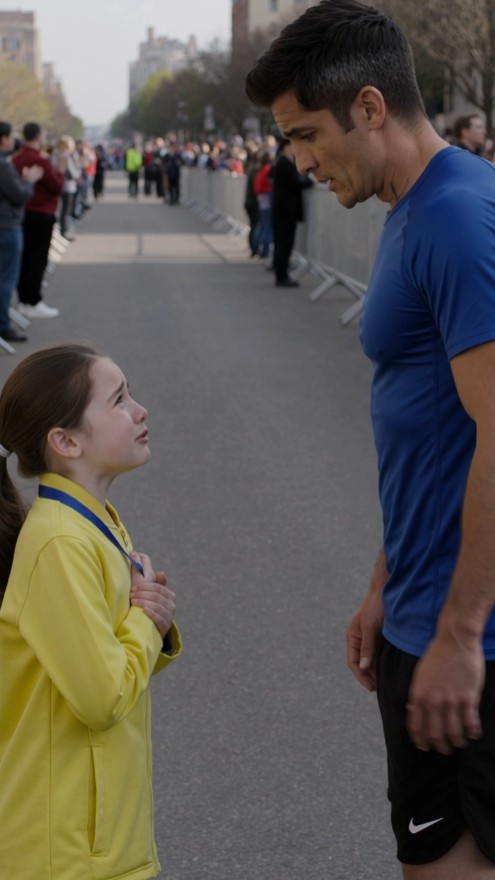
Twenty feet.
That was all that separated Daniel Mitchell from the finish line of his first marathon.
After three years of hospital appointments, kidney failure, transplant surgery, and recovery, he was finally about to accomplish something he’d once believed impossible.
Thousands of spectators lined the course.
His wife, Sarah, was crying behind the barriers.
And his eight-year-old daughter, Emma, was waiting with a homemade sign.
GO, DADDY! YOU DID IT!
Daniel was exhausted.
His legs hurt.
His breathing was heavy.
But he was smiling.
Then suddenly, a little girl ran onto the course.
“DADDY! STOP!”
Daniel stumbled to a halt.
“Emma?”
She stood directly in front of him, tears streaming down her cheeks.
“YOU CAN’T FINISH YET!”
A race volunteer hurried toward her.
Spectators began shouting.
“Get her off the course!”
“Let him finish!”
But Emma wasn’t listening.
She pointed behind her father.
“DADDY, LOOK!”
Daniel turned.
A man in a faded blue jacket was approaching from the spectator area, accompanied by an event official.
He had gray hair.
A familiar smile.
And a face Daniel would never forget.
Daniel covered his mouth.
“Oh, my God.”
The man smiled.
“Hello, Daniel.”
Daniel dropped to his knees.
Because standing before him was the stranger who had donated a kidney to him three years earlier.
The man who had helped give him another chance at life.
And whom he hadn’t seen since their recovery.
Then Emma reached into her little backpack.
She removed a second marathon medal.
It was handmade.
Decorated with blue ribbon.
And carried a message written in a child’s uneven handwriting.
She handed it to the stranger.
“I made this for the person who gave me more birthdays with my daddy.”
The man began crying.
But when he turned the medal over, he discovered something Daniel had never seen.
A message Emma had secretly written weeks earlier.
“Dear Mr. Thomas, I don’t know how to give you a kidney back. So I promise I’ll spend my life making the one you gave Daddy worth it.”
Thomas stared at the words.
Then covered his face.
Because Emma hadn’t just written a thank-you message.
She had made a promise that reminded him of the reason he’d become a donor in the first place.
Three Years Earlier
Daniel Mitchell was thirty-five when his life changed.
He worked as an electrician.
He loved hiking.
Playing football with his friends.
And spending weekends outdoors with Sarah and Emma.
He considered himself reasonably healthy.
But one year, he began feeling unusually tired.
At first, he blamed long working hours.
Then his ankles started swelling.
He struggled with nausea.
And simple activities left him exhausted.
Eventually, medical tests revealed that his kidneys were severely damaged.
His kidney function continued declining despite treatment.
Daniel was referred to a specialist.
The doctor explained that he would need kidney replacement therapy and that a transplant might offer him the best long-term opportunity.
Daniel remembered sitting beside Sarah in the consultation room.
Holding her hand.
And thinking about Emma.
She was only five.
He wondered whether he’d be healthy enough to watch her grow up.
The Nights Emma Remembered
Kidney failure changed the family’s routine.
Daniel began dialysis while being evaluated for transplantation.
Treatments took hours.
Some days, he returned home exhausted.
Other days, he felt well enough to help Emma with homework or read her bedtime stories.
But life became unpredictable.
Emma noticed.
She noticed the days her father couldn’t play outside.
The afternoons Sarah drove him to treatment.
And the evenings when he fell asleep before dinner.
One night, she climbed onto the sofa beside him.
“Daddy?”
“Yes, sweetheart?”
“Are you going to get better?”
Daniel looked toward Sarah.
Then hugged Emma.
“I’m getting help from very good doctors.”
She thought for a moment.
“Can they give you new batteries?”
Daniel laughed softly.
“Not exactly.”
Emma looked disappointed.
Then she hugged him tighter.
“I wish I could fix you.”
Daniel closed his eyes.
“So do I, sweetheart.”
The Search for a Kidney
Daniel was placed on the transplant waiting list after completing the necessary evaluation.
Family members asked whether they could help.
Some underwent initial testing.
But none ultimately became a suitable living donor.
Daniel understood that organ donation was a serious medical decision.
He didn’t want anyone to feel pressured.
He continued dialysis.
Tried to follow his treatment plan.
And focused on staying as healthy as possible.
Months passed.
Then another year.
There were difficult days.
Hospital visits.
Complications.
And periods when hope felt very far away.
Sarah tried to remain positive.
But sometimes Daniel heard her crying quietly in the kitchen.
He knew she was frightened.
So was he.
Then one afternoon, the transplant coordinator called.
The Stranger
A living donor had been approved for Daniel.
The man wasn’t a relative.
Or a close friend.
He was someone who had independently chosen to help a person needing a transplant.
His name was Thomas Reynolds.
He was forty-nine years old.
A high school history teacher.
And a father of two grown children.
Thomas had spent years volunteering with community organizations.
But his decision to explore living kidney donation began after someone close to him died while waiting for a transplant.
The loss stayed with him.
Eventually, he contacted a transplant program and asked whether he could be evaluated as a donor.
After extensive medical and psychological assessments, the transplant team determined that he could proceed.
He understood the risks.
He understood there was no guarantee of a perfect outcome.
And he knew his decision had to be voluntary.
But he wanted to help.
The First Meeting
Daniel and Thomas were introduced through arrangements approved by the transplant program, after both agreed to meet.
Daniel was nervous.
He didn’t know what to say.
How do you thank someone who is willing to undergo major surgery for a person he barely knows?
Thomas walked into the room wearing a blue jacket.
He smiled.
“You must be Daniel.”
Daniel stood slowly.
“Yes.”
Thomas extended his hand.
“Nice to meet you.”
Daniel tried to speak.
But his voice broke.
Thomas smiled gently.
“One step at a time, okay?”
Daniel nodded.
Then asked the question that had been on his mind for weeks.
“Why are you doing this?”
Thomas was quiet for a moment.
Then answered:
“Because I had the chance to help someone.”
He paused.
“And because I know what it’s like to wish there had been another option for somebody you love.”
The Surgery
The transplant operation took place several weeks later.
Both men underwent surgery at the same hospital.
Their medical teams carefully monitored their recovery.
Daniel’s new kidney began functioning.
His doctors remained cautious.
A transplant isn’t a guaranteed cure.
Recipients need ongoing monitoring and medications to prevent rejection.
But Daniel’s early recovery was encouraging.
Over the following months, his health improved.
He regained strength.
His energy gradually returned.
And he was able to spend more time with his family.
Thomas also recovered from his donation surgery under medical supervision.
The two men exchanged messages during the initial recovery period.
But life eventually took them in different directions.
Thomas moved to another state to be closer to his aging parents.
Daniel returned to work.
They lost regular contact.
Yet Daniel never forgot the man in the blue jacket.
The Promise Daniel Made
One afternoon, several months after the transplant, Daniel took Emma for a short walk.
They reached a nearby park.
He sat beside her on a bench.
Children were riding bicycles.
Joggers passed along the pathway.
And a group of runners moved steadily toward the hill.
Daniel watched them.
Before his illness, he’d enjoyed running.
But during dialysis, he’d sometimes struggled just to climb the stairs.
Emma followed his gaze.
“Daddy, what are you looking at?”
“Those runners.”
She smiled.
“Do you want to run?”
Daniel nodded.
“Someday.”
Emma thought for a moment.
“Then you should.”
He laughed.
“It’s not quite that easy.”
But the idea stayed with him.
Later, he spoke with his transplant team about returning to regular exercise.
With appropriate medical guidance, he began rebuilding his fitness gradually.
Walking first.
Then short periods of jogging.
And eventually longer runs.
A marathon became his dream.
The Training
Daniel didn’t become a marathon runner overnight.
His first attempt at jogging lasted less than five minutes.
He stopped.
Bent forward.
And laughed at himself.
Sarah stood nearby.
“How was it?”
Daniel shook his head.
“Terrible.”
She smiled.
“Are you going to try again?”
“Tomorrow.”
And he did.
Over the next two years, he trained carefully.
He attended medical follow-ups.
Followed guidance about hydration, medication, and physical activity.
And adjusted his routine whenever his healthcare team recommended it.
Some weeks were difficult.
Others felt wonderful.
Gradually, he could run farther.
Five kilometers.
Then ten.
Then a half-marathon.
On the day he completed his first half-marathon, Emma ran toward him after the finish.
“Daddy! You did it!”
Daniel picked her up.
Then began crying.
Because he remembered a time when he wasn’t sure he’d ever feel strong enough to run again.
The Marathon Registration
Three years after the transplant, Daniel registered for a marathon.
He wasn’t trying to win.
He didn’t care about finishing among the fastest runners.
He wanted to cross the finish line.
For himself.
For his family.
And for the stranger who had helped make his recovery possible.
When Emma heard about the race, she became excited.
“Can I make a sign?”
Daniel smiled.
“Of course.”
She spent an entire afternoon drawing.
She used blue markers.
Yellow stars.
And bright red letters.
At the center, she wrote:
MY DADDY IS MY HERO.
Daniel hung the sign on the refrigerator.
But Emma wasn’t finished.
She had another idea.
And she didn’t tell him.
The Secret Phone Call
Several weeks before the marathon, Emma overheard her parents talking.
Daniel wondered whether Thomas might be able to watch the race online.
He hadn’t seen him in person for years.
They occasionally exchanged holiday messages.
But Daniel didn’t know whether Thomas could travel.
Emma quietly approached Sarah afterward.
“Mommy?”
“Yes?”
“Can we invite the man who helped Daddy?”
Sarah smiled.
“We can try.”
Emma looked serious.
“I want to give him something.”
“What?”
“A medal.”
Sarah laughed gently.
“Why a medal?”
Emma looked surprised.
“Because Daddy’s going to get one.”
Then she added:
“But Daddy couldn’t run without Mr. Thomas helping him.”
Sarah’s eyes filled with tears.
She hugged Emma.
And promised to help.
The Second Medal
Emma spent the next two weeks making a medal.
She used craft materials, blue ribbon, and a small wooden disc.
Sarah helped her attach everything securely.
On the front, Emma wrote:
THANK YOU FOR GIVING MY DADDY MORE TOMORROWS.
Then she turned it over.
And wrote her private message.
Dear Mr. Thomas,
I don’t know how to give you a kidney back.
But I promise I’ll spend my life making the one you gave Daddy worth it.
I’ll help people.
I’ll be kind.
And I’ll never forget what you did.
Love, Emma.
Sarah read the words.
Then wiped her eyes.
“Sweetheart, that’s beautiful.”
Emma looked up.
“Do you think he’ll like it?”
Sarah hugged her.
“I think he’ll love it.”
The Invitation
Sarah contacted Thomas using the information Daniel had kept from their earlier correspondence.
She explained the marathon.
Then told him about Emma’s surprise.
Thomas was silent for several seconds.
Finally, he said:
“Daniel’s running a marathon?”
Sarah laughed.
“Yes.”
Thomas sounded overwhelmed.
“That’s incredible.”
Then she invited him to attend.
He hesitated.
He had been dealing with family responsibilities.
And traveling wasn’t easy.
But when Sarah mentioned Emma’s handmade medal, his voice changed.
“She made something for me?”
Sarah nodded, although he couldn’t see her.
“She did.”
Thomas paused.
Then answered:
“I’ll be there.”
The Race Morning
On the morning of the marathon, Daniel woke before sunrise.
His running clothes were arranged beside the bed.
His shoes were ready.
And his race number was pinned to his shirt.
Sarah stood in the kitchen preparing breakfast.
Emma appeared wearing a blue jacket.
She was carrying her little backpack.
Daniel smiled.
“What’s in there?”
Emma immediately hugged it.
“Nothing.”
He laughed.
“Nothing?”
She nodded.
“Just my stuff.”
Daniel kissed her forehead.
“Okay, sweetheart.”
He didn’t know the second medal was hidden inside.
He didn’t know Thomas was traveling to the finish line.
And he had no idea that the most emotional moment of his marathon would happen before he crossed it.
The Longest Twenty-Six Miles
The race began shortly after eight.
Daniel started carefully.
He didn’t want to run too quickly.
For the first few miles, he felt strong.
The crowd cheered.
Volunteers offered water.
And other runners encouraged him.
Near the halfway point, he began feeling tired.
His legs grew heavy.
At mile twenty, every step required concentration.
He thought about stopping.
Then remembered the hospital.
The dialysis appointments.
The long nights.
And Emma asking whether doctors could give him new batteries.
He smiled through exhaustion.
Then kept moving.
One mile.
Then another.
Until he finally saw the finish line.
The Last Twenty Feet
The crowd was loud.
Music played.
Spectators waved signs.
Daniel recognized Sarah near the barriers.
She was crying.
Beside her stood Emma.
She held the sign she’d made.
MY DADDY IS MY HERO.
Daniel smiled.
He was almost there.
Then Emma suddenly slipped past a volunteer.
She stepped onto the course.
“DADDY! STOP!”
Daniel immediately slowed.
“Emma?”
She was crying.
“YOU CAN’T FINISH YET!”
The crowd became confused.
A volunteer hurried toward her to clear the course.
Sarah called out.
“Emma, come here!”
But Emma pointed behind her father.
“LOOK!”
The Man in the Blue Jacket
Daniel turned.
An event official was accompanying a man from a designated spectator access point.
The man walked slowly.
He wore a faded blue jacket.
His hair had turned grayer.
And he looked older than Daniel remembered.
But there was no mistaking his face.
Thomas Reynolds.
The man who had donated a kidney three years earlier.
Daniel stared.
For several seconds, he couldn’t speak.
Thomas smiled.
“Hello, Daniel.”
Daniel covered his mouth.
Then dropped to his knees.
“Oh, my God.”
Thomas approached.
Daniel stood with effort and hugged him.
The two men held each other.
Neither spoke.
Around them, people began realizing something extraordinary was happening.
The Reunion
Daniel finally stepped back.
“What are you doing here?”
Thomas laughed through tears.
“Your family invited me.”
Daniel looked toward Sarah.
She smiled.
Then toward Emma.
The little girl was reaching into her backpack.
“I have something.”
Daniel wiped his eyes.
“What is it, sweetheart?”
Emma removed the handmade medal.
She held it toward Thomas.
He looked surprised.
“Is that for me?”
Emma nodded.
Then whispered:
“I made this one for the person who gave me more birthdays with my daddy.”
Thomas covered his mouth.
The spectators standing nearby fell quiet.
Emma gently placed the medal in his hands.
The Message on the Back
Thomas examined the medal.
On the front were the words:
Thank you for giving my daddy more tomorrows.
Then he turned it over.
And read the message.
I don’t know how to give you a kidney back.
But I promise I’ll spend my life making the one you gave Daddy worth it.
I’ll help people.
I’ll be kind.
And I’ll never forget what you did.
Thomas stopped reading.
His hands began shaking.
Then he knelt in front of Emma.
“Did you write this?”
She nodded.
“All by myself. Mommy only helped me spell some words.”
Thomas laughed through tears.
Then hugged her.
For a moment, he couldn’t speak.
The Reason Thomas Became a Donor
Daniel had always known that Thomas chose to donate because of a personal loss.
But he’d never heard the full story.
Standing near the finish line, Thomas finally explained.
Years earlier, his younger sister, Rebecca, had suffered from severe kidney disease.
She waited for a transplant.
But her health deteriorated before a suitable organ became available.
She died at thirty-two.
Thomas had been devastated.
Rebecca left behind a young daughter.
He watched his niece grow up without her mother.
Birthdays.
School plays.
Graduations.
So many moments Rebecca never got to experience.
After her death, Thomas began learning more about living kidney donation.
He eventually decided to be evaluated.
And when he was approved to help Daniel, he felt he had found a meaningful way to honor his sister.
Now Emma stood before him.
An eight-year-old girl thanking him for more birthdays with her father.
Thomas wiped his eyes.
“Your daddy’s very lucky to have you.”
Emma shook her head.
“I’m lucky to have him.”
Thomas hugged her again.
The Finish Line
Race officials had safely paused the small group while making sure other runners could continue without obstruction.
The event official gently guided Emma and Thomas toward the appropriate finish-area access point.
Daniel looked toward the finish line.
He was only twenty feet away.
Thomas smiled.
“Go finish your race.”
Daniel shook his head.
“Not without you.”
Thomas looked surprised.
Daniel continued:
“I’ve spent three years thinking about this moment.”
He paused.
“And I always wanted you to know what you made possible.”
Thomas’s eyes filled with tears.
The official arranged for Thomas and Emma to stand safely beside the finish chute while Daniel completed the race.
They waited near the barriers.
Sarah joined them.
Daniel took a breath.
Then began moving again.
The Moment He Crossed
The crowd cheered.
Daniel walked the final steps.
He crossed the finish line.
And stopped.
He bent forward.
Hands resting on his knees.
Tears falling onto the pavement.
For a few seconds, he couldn’t move.
A race volunteer approached to check on him.
Daniel straightened.
He was exhausted.
But smiling.
Then he received his finisher’s medal.
He held it in his hands.
And looked toward Thomas.
The man in the blue jacket was standing nearby.
Still holding Emma’s handmade medal.
Daniel approached him.
Then placed his own medal beside Emma’s.
Two medals.
One official.
One made by an eight-year-old girl.
Both carrying a story that began in a hospital three years earlier.
The Photograph
A race photographer captured the moment.
Daniel stood in his running clothes.
Thomas wore his blue jacket.
Emma stood between them.
Sarah wrapped one arm around her daughter.
Everyone was crying.
Daniel held his finisher’s medal.
Thomas held Emma’s handmade one.
The picture later became one of the family’s most treasured photographs.
But Daniel said the medals weren’t what made it important.
It was the people.
His wife.
His daughter.
And the man who had volunteered to help save a stranger’s life.
The Conversation After the Race
After Daniel received medical attention and recovered from the immediate exhaustion of the marathon, the family sat together in a quiet area.
Thomas asked how he’d been feeling.
Daniel laughed.
“Right now? Like I never want to run again.”
Everyone smiled.
Then Daniel became serious.
“I don’t know how to thank you.”
Thomas shook his head.
“You don’t have to keep thanking me.”
Daniel looked toward Emma.
“I know. But I want to.”
Thomas smiled.
“Then keep taking care of yourself.”
Daniel nodded.
Thomas continued.
“Enjoy your family. Keep going to your appointments. Live your life.”
He paused.
“That’s more than enough.”
The Dinner
That evening, Sarah invited Thomas to dinner.
The family gathered at a small restaurant.
Daniel moved slowly.
His legs were sore.
Emma laughed every time he stood up.
“Daddy, you walk like Grandpa.”
Daniel grinned.
“Grandpa doesn’t run twenty-six miles.”
Thomas laughed.
For the first time since their surgery, the two men spent hours talking without hospital schedules or medical updates hanging over them.
They discussed work.
Family.
Travel.
And ordinary life.
Thomas showed Emma photographs of his children.
Daniel told him about the training.
Then Emma asked:
“Mr. Thomas, can I ask you something?”
He smiled.
“Of course.”
“Did it hurt when you helped Daddy?”
Thomas answered gently.
“The operation was a big decision, and I needed time to recover. The doctors made sure I understood the risks.”
Emma nodded.
Then whispered:
“Thank you for being brave.”
Thomas reached for her hand.
“Thank you for remembering.”
The School Presentation
Several weeks later, Emma’s teacher invited the family to participate in a school discussion about kindness and community support.
Daniel and Thomas agreed.
They wanted children to understand that organ donation was a serious medical decision, not something anyone should feel pressured to do.
Daniel explained that he had received a kidney transplant after becoming seriously ill.
Thomas described how living donors undergo extensive evaluations to determine whether donation is appropriate.
The children listened carefully.
Then Emma showed them the medal she’d made.
She explained that she wanted to thank Thomas for helping her father recover.
A little boy raised his hand.
“Can anyone give someone a kidney?”
Thomas smiled.
“No. Not everyone can or should. Doctors must make sure it’s medically appropriate, and the decision has to be voluntary.”
Then he added:
“There are many ways to help people. You don’t need to donate an organ to show kindness.”
Emma nodded.
“That’s why I wrote that I want to help people too.”
The Promise Emma Kept
Emma didn’t become a completely different child overnight.
She still played with her friends.
Forgot to clean her room.
And complained about homework.
But she remembered her promise.
She joined school charity activities.
Helped collect supplies for families in need.
And sometimes volunteered with Sarah at community events suited to her age.
When she was older, she learned more about organ donation and patient support organizations.
She never believed she owed anyone a particular medical decision.
But she wanted to live with kindness and gratitude.
The medal remained on Thomas’s bookshelf.
Whenever he saw it, he remembered Emma’s words.
I’ll help people.
I’ll be kind.
And I’ll never forget.
The Anniversary Run
One year later, Daniel participated in another organized running event.
This time, he chose a shorter distance.
He had learned that staying active wasn’t about proving how far he could push himself.
It was about enjoying his health while respecting his medical needs.
Thomas attended again.
Emma held a new sign.
TWO HEROES. ONE VERY LUCKY FAMILY.
Daniel laughed when he saw it.
After the run, the family took another photograph.
No surprise.
No interrupted finish line.
Just four people smiling together.
And the knowledge that their lives had become connected in an extraordinary way.
The Letter Thomas Wrote
On the fourth anniversary of the transplant, Thomas sent Emma a letter.
She was twelve.
Inside was a photograph from the marathon.
And a handwritten message.
Dear Emma,
I still have the medal you made.
It sits on my bookshelf where I can see it every morning.
You told me you wanted to spend your life helping others.
I hope you remember that being kind doesn’t mean you have to do something enormous.
Sometimes it means listening.
Helping a friend.
Or noticing when someone feels alone.
Your father completed a marathon because he worked hard, followed medical advice, and kept believing in what was possible.
I was fortunate to be able to help him along the way.
But the life he builds afterward belongs to him.
And you don’t owe me anything.
You already gave me something precious.
The chance to see how much love can grow from one decision.
Your friend, Thomas.
Emma read it twice.
Then placed it inside a memory box beside her childhood drawings.
The Question Daniel Asked
Years later, Daniel and Thomas sat together during a family barbecue.
Emma was now a teenager.
She was laughing with friends in the garden.
Daniel looked toward Thomas.
“Do you ever regret it?”
Thomas understood the question.
He answered carefully.
“Donation was a serious choice. I thought about it for a long time.”
Daniel nodded.
Thomas continued.
“I had a good medical team. I knew the risks. And I made the decision freely.”
He looked toward Emma.
“I’m glad things worked out well.”
Daniel smiled.
“Me too.”
They sat quietly for a moment.
Then Daniel said:
“She’s growing up fast.”
Thomas laughed.
“Enjoy it. It goes quicker than you think.”
The Medal That Stayed on the Shelf
Thomas never put Emma’s medal away.
It wasn’t professionally made.
The ribbon was uneven.
The writing had faded slightly.
And the wooden disc had a few scratches.
But it meant more to him than expensive awards.
It reminded him of Rebecca.
His sister.
And of the niece who had grown up without her mother.
For years, he’d carried grief that no amount of generosity could erase.
Donation hadn’t brought Rebecca back.
It hadn’t changed the past.
But seeing Daniel with Emma helped Thomas appreciate a future that was possible for another family.
The medal became a symbol of that connection.
The Truth About the Marathon
The emotional moment began when Daniel Mitchell approached the finish line of a marathon three years after receiving a kidney transplant.
His daughter, Emma, unexpectedly stepped onto the course and called for him to stop.
She wanted him to see Thomas Reynolds, the living kidney donor who had helped make his recovery possible.
Thomas had traveled to the race as a surprise arranged by Daniel’s family.
Emma presented him with a handmade medal.
On the back, she’d written a promise to live with kindness and gratitude.
The message reminded Thomas of his late sister, whose struggle with kidney disease had influenced his decision to explore living donation.
After the emotional reunion, event staff helped the family move to a safe position so Daniel could cross the finish line.
He completed the marathon.
And the family shared a moment none of them would forget.
The Last Thing Daniel Remembered
When Daniel thought back to that race, he remembered the pain in his legs.
The sound of the crowd.
The bright finish-line banners.
And the moment he realized he had only twenty feet left.
But the memory that stayed with him most was Emma.
A little girl standing in front of him.
Crying.
Insisting that he couldn’t finish yet.
At first, he thought something was wrong.
Then he turned.
And saw Thomas.
The stranger who had volunteered to help him during the darkest period of his life.
For three years, Daniel had trained to cross that finish line.
He believed the medal would represent everything he’d overcome.
But when Emma handed Thomas her own medal, Daniel understood that the race had become about something much bigger.
The Man Waiting Before the Finish Line
Three years earlier, Daniel wasn’t sure he’d be healthy enough to watch Emma grow up.
He spent long hours in treatment.
He worried about his family.
And he wondered whether life would ever feel normal again.
Then a stranger volunteered to donate a kidney.
The transplant was successful.
Daniel recovered.
And with careful medical follow-up and training, he eventually completed a marathon.
But twenty feet before the finish line, his daughter stopped him.
Not because she wanted to prevent him from achieving his dream.
But because she wanted him to share the moment with someone who had helped make it possible.
An eight-year-old girl ran onto a marathon course and stopped her father just before the finish line.
The crowd shouted for her to move.
But when her father turned around, he saw the stranger who had donated a kidney to him three years earlier.
Then Emma handed the man a second medal.
Not for running.
Not for winning.
But for helping give her family more time together.
On the back, she’d written:
I don’t know how to give you a kidney back.
So I promise I’ll spend my life making the one you gave Daddy worth it.
Thomas kept that medal for the rest of his life.
And Daniel never forgot the moment he stood twenty feet from the finish line, looking at the two people who reminded him what he had been running toward.
He hadn’t trained for years simply to collect a medal.
He’d trained because he wanted to celebrate being alive.
To enjoy ordinary days.
To watch Emma grow.
And to spend more time with the people he loved.
He crossed the finish line that day.
But the greatest gift was the life waiting for him on the other side.