
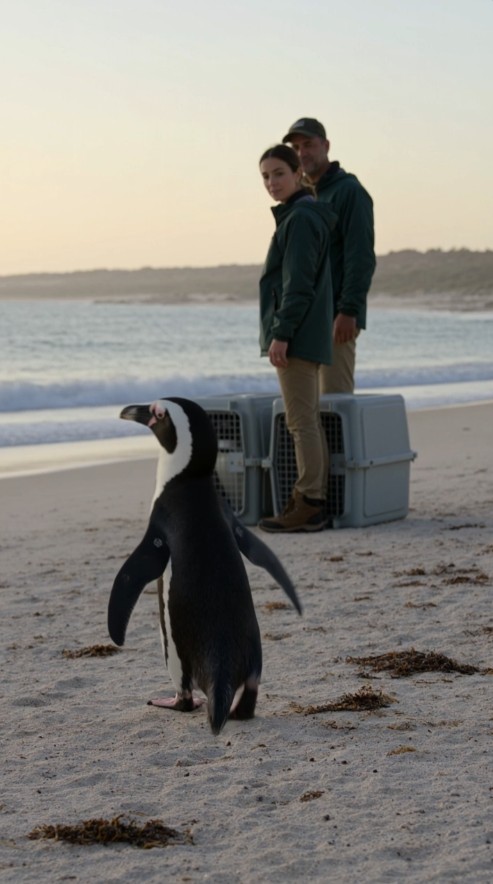
After six months of rehabilitation, Finn was finally ready to return to the ocean.
The young African penguin had been rescued from a beach after becoming tangled in discarded fishing gear.
He had arrived at the wildlife center weak, exhausted, and frightened.
But months of veterinary treatment, careful feeding, and supervised swimming had helped him recover.
Now, on a beautiful morning along the South African coastline, the rescue team opened his transport crate.
Finn stepped onto the sand.
He looked toward the waves.
Then began walking.
The volunteers smiled.
“Go on, little guy.”
But Finn stopped.
He turned around.
And hurried straight back toward the rescue team.
One volunteer laughed softly.
“What’s wrong, Finn?”
Then they noticed where he was going.
A second transport crate stood nearby.
Inside was another African penguin.
Her name was Pebble.
She had been rescued only days after Finn, and the two birds had spent much of their recovery in neighboring rehabilitation areas.
The volunteers opened her crate as planned.
Pebble stepped onto the beach.
Finn turned toward her.
And together, they began walking toward the ocean.
Everyone watched quietly.
But just before they reached the waves, both penguins stopped.
They turned toward the shoreline.
Finn lowered his head.
Pebble stood still beside him.
Then a rescuer noticed something in the sand near their footprints.
Something that hadn’t been visible when the team arrived.
A thin green fishing line was moving beneath the wet sand.
And attached to it was something much larger.
The rescuer followed the line toward a shallow pool between the rocks.
Then froze.
“Everyone, stay back. There’s another animal trapped.”
The team had come to release two penguins.
But their morning was about to become another rescue.
Six Months Earlier
Finn’s story began on a remote beach along the South African coast.
A local beach walker noticed a small African penguin struggling near the water.
At first, the bird appeared to be resting.
Then the walker saw fishing line wrapped around one of its flippers.
The penguin tried to move.
But the line tightened.
Part of the discarded gear was caught beneath a rock.
The bird couldn’t free itself.
The walker contacted a local wildlife rescue organization and kept a safe distance while waiting for help.
When trained rescuers arrived, they carefully secured Finn and removed the visible entanglement.
The penguin was exhausted.
His flipper was swollen.
And several feathers were damaged.
He needed urgent veterinary attention.
The team transported him to a rehabilitation center specializing in seabirds.
Nobody knew how long he’d been trapped.
But they knew he had been fortunate to be found.
The First Days at the Rescue Center
Finn was frightened when he arrived.
He avoided unfamiliar movement.
He was reluctant to eat.
And he struggled to move comfortably.
The veterinary team examined his injuries and began treatment.
They monitored his weight, hydration, and recovery.
His damaged feathers would also need time to recover before he could return to the ocean.
Penguins depend on healthy, waterproof plumage to survive in cold water.
Without it, even a bird that appears energetic can be at serious risk.
Finn was placed in a controlled recovery environment.
Human interaction was kept limited and purposeful.
The goal wasn’t to make him comfortable around people.
It was to help him regain the strength and natural behavior necessary for life in the wild.
During his first week, Finn spent much of his time resting.
Then another penguin arrived.
The Penguin Named Pebble
Pebble was a small female African penguin rescued from a different stretch of coastline.
She had been found weak and underweight.
Her feathers were in poor condition.
And she needed veterinary care before she could return to the water.
The rehabilitation team placed her in a neighboring recovery area.
For several weeks, Finn and Pebble recovered separately while staff monitored their health.
Gradually, both birds became stronger.
Finn began moving more confidently.
Pebble started eating reliably.
And their swimming sessions became longer.
When veterinary assessments indicated that it was appropriate, the team introduced them to a larger rehabilitation area with other compatible penguins.
Finn and Pebble frequently remained near one another.
When one approached the pool, the other often followed.
They rested close together.
Entered the water within moments of each other.
And appeared comfortable sharing the space.
The rescuers couldn’t know exactly what the birds understood about their relationship.
But their behavior became a familiar sight.
The Long Road Back to the Ocean
Rehabilitating a penguin involves far more than treating its initial injury.
The bird must recover sufficient strength.
Maintain an appropriate weight.
Regain healthy feathers.
And demonstrate that it can swim and feed effectively.
Finn’s recovery took longer than expected.
The injury to his flipper improved.
But his plumage still needed attention.
Pebble also required additional time to recover.
The veterinary team continued monitoring both birds.
Weeks passed.
Then months.
There were encouraging days.
And days when the team had to adjust their plans.
Eventually, the birds met the center’s release criteria.
Both were examined.
Their condition was assessed.
And arrangements were made for a carefully managed return to their natural habitat.
The center selected a suitable coastal release location based on conditions and wildlife-management guidance.
After six months, Finn was finally going home.
The Morning of the Release
The rescue team arrived at the beach early.
The sky was pale blue.
A cool breeze moved across the sand.
And waves rolled gently toward shore.
Two transport crates were placed in a quiet area away from visitors.
Inside were Finn and Pebble.
Several trained volunteers stood nearby.
A wildlife veterinarian reviewed the release arrangements.
The team had chosen a location where the penguins could safely reach the ocean.
They checked the immediate surroundings.
Then prepared to open the crates.
Finn’s was first.
He stepped out cautiously.
Paused.
Then looked toward the waves.
One rescuer smiled.
“Come on, Finn.”
The little penguin walked several steps.
Then stopped.
He turned.
And hurried back.
Why Finn Returned
Finn moved directly toward Pebble’s crate.
He stood beside it.
Looked around.
Then shifted his position.
The volunteers exchanged smiles.
Finn had often remained near Pebble during rehabilitation.
His return to the crate was consistent with the behavior they’d observed.
But the team avoided assuming the penguin had human-like intentions.
They couldn’t know whether he was deliberately waiting for Pebble.
He might simply have been responding to familiar visual or social cues.
Still, the moment was touching.
The second crate was opened according to the release plan.
Pebble stepped onto the sand.
Finn turned toward her.
Then both birds began moving toward the sea.
The volunteers stood quietly.
Several raised their cameras.
But nobody expected what happened next.
The Moving Line in the Sand
A wave rolled across the beach.
Water briefly covered the penguins’ footprints.
Then drained back toward the sea.
That’s when one of the rescuers noticed a narrow green line emerging from the wet sand.
At first, it looked like seaweed.
But it moved unnaturally.
The rescuer followed it with her eyes.
The line stretched toward a shallow rocky pool.
Something beneath the water was pulling against it.
“Hold on,” she whispered.
Another volunteer looked toward the rocks.
The line tightened again.
Then a dark shape moved beneath the surface.
The team immediately kept the release area clear.
Finn and Pebble remained near the shoreline while staff assessed the unexpected hazard without crowding the birds.
One rescuer contacted the wildlife response coordinator.
There was another animal in trouble.
The Third Penguin
As the water shifted, the rescuers recognized a small seabird struggling in the shallow pool.
It was another African penguin.
Younger than Finn and Pebble.
Fishing line was wrapped around part of its body.
A loose section had become caught beneath a rock.
Every time the bird tried to move away, the line pulled tight.
The team acted carefully.
Untrained attempts to free entangled wildlife can cause additional injuries to both the animal and rescuers.
The experienced responders assessed the situation.
One prepared a secure transport container.
Another monitored the nearby water.
Then, using appropriate handling procedures, they safely restrained the stranded penguin and removed the entangling material.
The bird was frightened and exhausted.
But alive.
The Unexpected Discovery
Once the third penguin was safely contained, the team examined the fishing line.
It wasn’t an isolated strand.
It was connected to a longer section of discarded fishing gear buried beneath the sand.
Parts of the material had become tangled among the rocks.
The line had formed loops capable of catching animals passing through the shallow water.
The volunteers realized the location presented an additional hazard.
They alerted the appropriate coastal cleanup team.
The rescuers documented the gear and secured the accessible material where it was safe to do so.
The larger removal effort would require careful work to avoid damaging the surrounding habitat.
Meanwhile, the injured penguin needed veterinary treatment.
The release team had arrived expecting a joyful ending for two birds.
Now they were transporting a third bird to safety.
What Happened to Finn and Pebble?
The team confirmed that Finn and Pebble were still fit for release and that the immediate area had been cleared for their safe passage.
The birds had moved away from the dangerous line.
After the disturbance settled, staff allowed them to continue toward the water without unnecessary handling.
Finn approached the waves.
Pebble followed nearby.
A small wave reached their feet.
Finn stepped forward.
Then another wave rolled in.
Both birds entered the water.
For a moment, they bobbed near the shoreline.
Then began swimming.
The volunteers watched as the penguins moved farther from the beach.
Their black-and-white bodies became smaller against the blue water.
Eventually, they disappeared beyond the breaking waves.
Nobody spoke for several seconds.
Then one rescuer whispered:
“Good luck, little ones.”
Back at the Rehabilitation Center
The newly rescued penguin arrived at the wildlife center later that morning.
The veterinary team examined the bird.
It had abrasions caused by the fishing line.
Its feathers were damaged in several areas.
And it showed signs of exhaustion.
The penguin was given supportive care and placed in an appropriate recovery area.
The team nicknamed it Reef.
Its condition required close monitoring.
Reef was initially reluctant to eat.
But over the following days, the bird began showing encouraging signs of recovery.
The staff continued treatment.
They knew rehabilitation might take weeks or months.
There was no guarantee of a successful release.
But Reef now had a chance it might not have had if the entanglement had remained unnoticed.
The Question Everyone Asked
When the story spread among the rescue volunteers, everyone asked the same question.
Had Finn and Pebble somehow led the team to the third penguin?
The sequence was remarkable.
Finn had returned toward Pebble’s crate.
The two birds moved toward the shoreline together.
Then they paused near the area where fishing line was hidden beneath the sand.
The rescuers noticed the line moving.
And discovered Reef.
It was tempting to imagine the penguins knew another bird needed help.
But the rehabilitation team was careful.
They explained that there was no evidence the birds deliberately tried to alert humans.
Penguins can stop, look around, investigate surroundings, and respond to nearby movement for many reasons.
The discovery was likely a fortunate combination of animal behavior and an observant rescue team.
Still, the timing was extraordinary.
And the result was real within the story.
A third penguin had been rescued from dangerous discarded fishing gear.
The Problem Beneath the Waves
The incident drew attention to a broader environmental problem.
Discarded fishing line and abandoned gear can remain dangerous long after they are lost.
Marine animals may become entangled while swimming, feeding, or moving along the shore.
Penguins, turtles, seals, and other wildlife can be injured by discarded material.
Some animals struggle to move.
Others suffer wounds.
And entanglement can interfere with their ability to feed or escape danger.
The rescue team had seen these injuries before.
Finn himself had been found tangled in fishing gear.
Now, on the very day he returned to the ocean, another penguin had been discovered in a similar situation.
The coincidence deeply affected the volunteers.
The Beach Cleanup
Within days, an organized coastal cleanup took place near the release site.
Trained personnel worked with local conservation volunteers.
They removed accessible discarded fishing line and other debris while taking care to protect wildlife and sensitive habitat.
The cleanup team found additional pieces of old rope and fishing material.
Some were buried beneath sand.
Others were caught among rocks.
The material was documented and disposed of appropriately.
The organizers also spoke with local fishing groups about responsible gear handling and reporting lost equipment.
The goal wasn’t to blame every person who worked on the water.
It was to reduce the risk of discarded material harming marine life.
The team hoped fewer animals would arrive at the rehabilitation center with injuries like Finn’s and Reef’s.
Reef’s Recovery
Over the following weeks, Reef gradually improved.
The wounds began healing.
Its feathers recovered.
And the bird became more active.
Veterinary staff continued evaluating its condition.
Eventually, Reef began participating in supervised swimming sessions.
At first, the bird spent only short periods in the pool.
Then longer ones.
As its strength returned, it became more confident in the water.
The staff monitored its ability to swim and feed.
They also assessed whether the damaged plumage was sufficiently restored for release.
Progress wasn’t perfectly steady.
Some days were more encouraging than others.
But the overall direction was positive.
Then, after several months, Reef reached an important milestone.
The veterinary team determined that it was ready to return to the wild.
The Third Release
Reef’s release took place on a quiet morning.
The team selected an appropriate coastal location.
They reviewed the weather and environmental conditions.
Then carried the transport crate toward the shore.
One of the rescuers who had been present for Finn and Pebble’s release was there again.
Her name was Sarah.
She remembered the green fishing line.
The movement beneath the water.
And the exhausted penguin being lifted from the shallow pool.
Now Reef was healthy enough to swim away.
When the crate opened, the bird paused.
Then stepped onto the sand.
It approached the water.
A small wave rolled toward it.
Reef entered the sea.
Then began swimming.
Sarah smiled through tears.
Three penguins had now returned to the ocean.
Finn.
Pebble.
And Reef.
The Photographs That Told the Story
The rehabilitation center created a display about the three birds.
The first photograph showed Finn during his early treatment.
Weak and wrapped safely for examination.
The second showed Pebble swimming during rehabilitation.
The third captured Finn standing near her transport crate on release day.
The fourth showed the green fishing line discovered in the sand.
Then came a photograph of Reef receiving veterinary care.
And finally, an image of the third penguin entering the ocean.
The display explained the risks of marine debris and the work required to rehabilitate injured seabirds.
Visitors often stopped to read it.
Children asked questions.
Parents pointed toward the photographs.
And staff explained how responsible behavior around wildlife could help prevent similar injuries.
The Volunteer Who Never Forgot
Sarah had worked with rescued seabirds for several years.
She’d seen remarkable recoveries.
Injured animals returning to the water.
Weak birds regaining strength.
And exhausted wildlife slowly becoming healthy enough to survive independently.
But Finn and Pebble’s release stayed with her.
Not because she believed the birds had supernatural abilities.
Or because she thought Finn understood exactly what the rescue team was doing.
She remembered it because of the unexpected discovery.
The fishing line.
The trapped penguin.
And the way one release unexpectedly became another rescue.
Sometimes she wondered what might have happened if the line hadn’t moved at that moment.
The team might have missed it.
Another wave might have covered it.
The tide might have changed.
But on that morning, someone noticed.
And Reef was given a chance to recover.
Why the Rescue Team Did Not Follow Finn and Pebble
People later asked whether Finn and Pebble stayed together after entering the ocean.
The volunteers couldn’t know for certain.
Once released, wild penguins may travel, feed, and interact according to their natural behavior.
The birds had often stayed near one another during rehabilitation.
But that didn’t guarantee they would remain together in the wild.
The team’s priority was to return healthy birds to their natural environment.
Not to create a permanent human-managed bond between them.
Staff hoped both would survive and thrive.
Where feasible, conservation programs may use identification or monitoring methods to learn more about released animals.
But the team did not invent a happy ending it couldn’t verify.
Finn and Pebble had been safely released.
That was the achievement they could celebrate.
The Anniversary of the Rescue
One year after Finn and Pebble returned to the ocean, the wildlife center held a small educational event.
Volunteers spoke about seabird rehabilitation.
The dangers of fishing gear.
And the importance of contacting professionals when injured marine animals are found.
A photograph of Finn standing beside Pebble’s crate was displayed near the entrance.
Beneath it was a caption:
ONE RELEASE. ONE UNEXPECTED DISCOVERY. THREE CHANCES TO RETURN HOME.
Sarah stood beside the display.
A young boy approached.
“Did the penguins save the other penguin?”
She smiled.
“We don’t know what they understood.”
The boy looked disappointed.
Sarah continued.
“But their movements helped us notice something unusual.”
She pointed toward the picture of the fishing line.
“And because we checked, we found another bird that needed help.”
The boy smiled.
“That’s still amazing.”
Sarah nodded.
“It is.”
The Lesson the Penguins Left Behind
Finn’s story began with a piece of fishing line wrapped around his flipper.
He was weak.
Exhausted.
And unable to free himself.
A careful beach walker noticed him.
A rescue team responded.
And six months of rehabilitation gave him the strength to return to the sea.
Pebble’s story began differently.
She arrived at the center underweight and in poor condition.
She also received months of care.
The two penguins spent much of their recovery near each other.
Then, on release day, their behavior coincided with the discovery of another bird in trouble.
Reef’s rescue led to treatment.
Recovery.
And a third successful release.
Three different journeys.
Connected by one beach.
And by the people who refused to ignore an animal in need.
The Truth Behind Finn’s Return to the Crate
The emotional moment began when Finn, a rescued African penguin, was released after six months of rehabilitation.
Instead of immediately entering the ocean, he turned and hurried toward the transport crate holding Pebble, another penguin from the same rehabilitation center.
Once Pebble was released, the birds moved toward the water together.
Near the shoreline, both paused.
A rescuer noticed fishing line shifting beneath the wet sand.
The line led to a third penguin trapped in a shallow rocky pool.
Trained responders safely recovered the injured bird.
The third penguin, later nicknamed Reef, received veterinary treatment and was eventually returned to the ocean after rehabilitation.
The rescue team also helped arrange the removal of hazardous discarded fishing gear from the area.
Finn and Pebble’s behavior was not proof that they intentionally sought human help.
But their unusual pause drew attention to a hazard that might otherwise have remained unnoticed.
The Last Thing Sarah Remembered
When Sarah thought about Finn’s release, she remembered the sound of the waves.
The cool morning air.
And the sight of two small penguins walking across the sand.
She remembered smiling when Finn returned toward Pebble’s crate.
Then watching the birds approach the water.
Everything seemed ready for a beautiful ending.
But suddenly, she noticed movement near the rocks.
A thin green line.
Barely visible beneath the wet sand.
She followed it with her eyes.
Then saw something struggling in the water.
What should have been the end of one rescue became the beginning of another.
Sarah never forgot that moment.
Because it reminded her that wildlife conservation wasn’t always about dramatic discoveries.
Sometimes it was about paying attention.
To a small movement.
A piece of debris.
Or an animal that couldn’t free itself.
The Penguins Who Returned to the Ocean
Everyone expected Finn to swim away.
After six months of rehabilitation, he was finally healthy enough to return to the wild.
But instead of entering the water, the little African penguin turned around.
He hurried back toward the volunteers.
Then stopped beside Pebble’s transport crate.
When Pebble was released, the two penguins walked toward the waves together.
And just before reaching the water, both paused.
A rescued penguin returned to the release team instead of immediately swimming away.
He stood near the crate of another rehabilitated penguin, and the two later approached the ocean together.
Then rescuers discovered discarded fishing line leading to a third penguin trapped among the rocks.
The third bird was rescued.
Its injuries were treated.
And after months of rehabilitation, it too returned to the sea.
Finn’s movements didn’t prove he knew another penguin was in danger.
But the unexpected sequence helped the team notice something important.
And that discovery gave another injured bird a chance.
The volunteers had arrived hoping to celebrate two successful releases.
They left knowing a third penguin had been found in time.
The ocean was still full of dangers.
And no rescue team could protect every animal.
But on that quiet morning, a small movement in the sand was enough to change the outcome for one more life.
Finn and Pebble disappeared into the waves.
Reef followed months later.
And three penguins were given the chance to return where they belonged.