
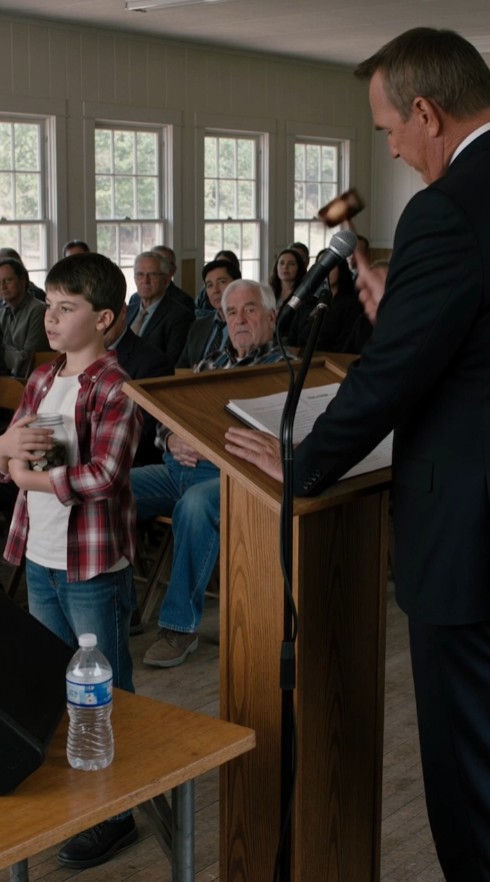
The auctioneer was about to accept another bid when a small voice interrupted him.
“Excuse me, sir.”
The room fell quiet.
Near the back stood a ten-year-old boy holding a glass jar filled with coins.
His name was Caleb.
He wore a faded blue sweater and a pair of sneakers covered in dried mud.
The auctioneer, Robert Mitchell, lowered his microphone.
“Yes, young man?”
Caleb stepped forward.
His hands trembled as the coins rattled inside the jar.
“I want to buy my grandpa’s farm.”
Several people exchanged amused looks.
One man chuckled.
Robert smiled gently.
“And how much are you offering?”
Caleb swallowed.
Then raised the jar.
“Thirty-seven dollars and forty-two cents.”
A few people laughed.
But Caleb continued.
“And I can work every weekend until I pay the rest.”
The laughter stopped.
At the front of the room, seventy-nine-year-old Thomas Bennett lowered his head.
It was his farm.
The same property he’d worked for fifty-three years.
The same house where he’d raised his children.
And the same land where he’d planted an apple tree with Caleb.
Now the farm was being sold because of mounting debts.
The auctioneer knelt slightly so he could look Caleb in the eyes.
“I’m sorry, son. The property costs much more than that.”
Caleb tightened his grip on the jar.
His voice cracked.
“Please. My grandma planted the apple tree outside.”
Then a man in the back row stood.
He was wearing a dark jacket.
He had been quietly bidding throughout the auction.
He approached the front of the room.
Looked at Caleb’s jar.
Then turned toward Robert.
“Before you accept another bid, there’s something everyone here needs to know about that farm.”
The man removed an old photograph from his pocket.
It showed a much younger Thomas standing beside a little boy in front of a burning barn.
Thomas looked up.
His face went pale.
Because he recognized the photograph.
And he recognized the boy.
The stranger was someone Thomas had saved forty years earlier.
But that wasn’t why he’d come.
He was carrying a document that could change the future of the farm.
The Farm on Willow Creek Road
Thomas Bennett had lived on the farm for fifty-three years.
He purchased it when he was twenty-six.
At the time, the property was small and neglected.
The farmhouse needed repairs.
The fences were damaged.
And the fields had not been properly maintained for years.
But Thomas saw potential.
He and his wife, Margaret, spent their first summer repairing the house.
They painted the kitchen.
Fixed the barn doors.
And planted a small vegetable garden.
Money was tight.
But they were happy.
Over the years, they raised three children.
Bought a few animals.
And gradually turned the land into a working family farm.
Thomas worked from sunrise until evening.
Margaret helped manage the household and farm finances.
Together, they built a life filled with ordinary moments.
Sunday dinners.
Harvest celebrations.
And summer evenings beneath the apple trees.
The First Apple Tree
The oldest apple tree stood near the farmhouse.
Margaret planted it during their second year on the property.
She had always wanted an orchard.
Thomas laughed when she brought home the tiny sapling.
“Margaret, it’ll take years before we get any apples.”
She smiled.
“Then we’d better start now.”
They planted it beside the path leading toward the barn.
Over time, the tree grew.
Its branches spread.
Every spring, white blossoms covered it.
And every autumn, the family gathered its fruit.
Margaret made apple pies.
Preserves.
And jars of homemade applesauce.
When the children grew older, the tree became part of their family traditions.
Then the grandchildren arrived.
And Margaret began teaching them the same things she’d taught her own children.
Caleb and His Grandfather
Caleb was Thomas’s youngest grandson.
He loved visiting the farm.
He liked feeding the chickens.
Watching the tractors.
And helping his grandfather carry small tools around the property.
Thomas taught him how to plant seeds.
How to recognize when tomatoes were ready.
And why soil needed care.
One spring afternoon, they planted a new apple sapling together.
Caleb was seven.
He dug a hole that was far too shallow.
Thomas laughed.
“Little deeper, buddy.”
Caleb tried again.
Then helped place the tree in the ground.
When they finished, Thomas handed him a small watering can.
“Your grandma would have loved this.”
Caleb smiled.
“Can we call it Grandma’s tree?”
Thomas nodded.
“Of course.”
From that day, Caleb checked on the little tree whenever he visited.
The Year Everything Changed
The farm began struggling after several difficult agricultural seasons.
Bad weather damaged crops.
Repair costs increased.
And the prices Thomas received for some of his produce weren’t enough to cover expenses.
He borrowed money to keep the operation running.
At first, he believed the next season would improve.
Then another difficult year followed.
A tractor required expensive repairs.
Fuel costs rose.
And several customers reduced their orders.
Thomas tried to manage the growing debt.
He sold unused equipment.
Cut unnecessary expenses.
And worked longer hours despite his age.
But eventually, the financial pressure became overwhelming.
The lender began formal proceedings that could result in the sale of the property.
Thomas consulted advisers and explored his options.
But he couldn’t raise the money needed to resolve the outstanding obligations.
The farm was scheduled for auction.
The Tears Caleb Saw
Thomas tried not to discuss the situation around Caleb.
He didn’t want to frighten him.
Whenever the boy visited, they continued their usual routines.
They checked the apple tree.
Fed the animals.
And worked in the garden.
But Caleb noticed changes.
His grandfather smiled less.
He spent more time looking at paperwork.
And sometimes sat alone near the kitchen window.
One evening, Caleb came downstairs for water.
He found Thomas sitting at the table.
A stack of letters lay in front of him.
His grandfather was crying.
Caleb stopped.
“Grandpa?”
Thomas quickly wiped his face.
“Oh, buddy. What are you doing awake?”
Caleb approached.
“Why are you sad?”
Thomas tried to smile.
“Just thinking.”
Caleb looked at the papers.
“Are we losing the farm?”
Thomas didn’t answer immediately.
Then he nodded.
“I’m trying my best, son.”
Caleb wrapped his arms around him.
The Glass Jar
When Caleb returned home, he began thinking about what he could do.
He didn’t understand mortgages.
Debt restructuring.
Or legal proceedings.
But he understood that the farm cost money.
And he had money saved.
A little.
He kept his coins in a glass jar beneath his bed.
Birthday gifts.
Money from helping neighbors.
Small payments for chores.
And coins he’d found in jacket pockets.
One evening, he emptied everything onto his bedroom floor.
He counted carefully.
Then counted again.
Thirty-seven dollars and forty-two cents.
Caleb stared at the coins.
It didn’t seem like much.
But it was everything he had.
He placed the money back inside the jar.
Then wrote on a piece of paper:
FOR GRANDPA’S FARM.
The Decision to Attend
When Caleb heard that the farm was being sold at an auction, he asked his mother, Emily, whether he could come.
She hesitated.
The sale would be emotional.
Thomas was already struggling.
And Emily didn’t want Caleb to believe he could solve the situation with his savings.
But Caleb insisted.
“Grandpa shouldn’t have to go alone.”
Emily looked at her son.
Then agreed.
She explained that the auction involved legal rules and that Caleb couldn’t simply purchase the farm by raising his hand.
Caleb listened.
But he still wanted to bring the jar.
“Maybe someone will help.”
Emily hugged him.
“I hope so, sweetheart.”
The Auction Begins
The auction was held in a community hall near the county offices.
Several farmers attended.
So did investors.
Local residents.
And people interested in purchasing the land.
Thomas sat near the front.
Emily sat beside him.
Caleb held his jar tightly.
The auctioneer introduced the property.
He described the acreage.
The farmhouse.
The outbuildings.
And the legal conditions of the sale.
Then bidding began.
The offers rose quickly.
Amounts Caleb had never imagined.
He looked toward his grandfather.
Thomas kept his eyes lowered.
Caleb wanted to say something.
But Emily gently squeezed his hand.
“Wait, sweetheart.”
Then the bidding paused.
And Caleb stood.
The Boy With $37.42
“Excuse me, sir.”
The auctioneer looked toward him.
“Yes?”
Caleb walked forward.
The jar rattled in his hands.
“I want to buy my grandpa’s farm.”
A few people chuckled.
Robert asked:
“How much do you have?”
Caleb lifted the jar.
“$37.42.”
Then he added:
“And I can work every weekend until I pay the rest.”
The room became quiet.
Thomas covered his face.
Caleb’s voice trembled.
“Grandpa worked there his whole life.”
He looked toward the auctioneer.
“My grandma planted the big apple tree.”
He swallowed.
“And Grandpa helped me plant another one.”
Robert lowered his microphone.
Caleb continued.
“I don’t want him to lose the place where all our memories live.”
Nobody laughed.
The Stranger in the Back Row
A man stood near the back.
He was in his early fifties.
His name was Daniel Foster.
He wore a dark jacket and held a leather folder.
He had been bidding during the auction.
Most people assumed he was another investor.
But Daniel hadn’t come simply to purchase farmland.
He had traveled more than two hundred miles to attend.
He approached the auctioneer.
Then looked toward Caleb.
“What’s your name, son?”
“Caleb.”
Daniel smiled gently.
“Caleb, I knew your grandfather a long time ago.”
Caleb looked surprised.
“You did?”
Daniel nodded.
Then turned toward Thomas.
“Mr. Bennett.”
Thomas slowly raised his head.
Daniel removed a photograph.
It showed a young farmer standing beside a little boy.
Behind them was a badly damaged barn.
Thomas stared.
Then whispered:
“Daniel?”
The stranger nodded.
“You remember me.”
Forty Years Earlier
In 1986, Daniel was twelve years old.
He lived on a neighboring property with his parents.
One summer afternoon, a fire broke out in a storage building near their home.
Daniel had gone into an adjoining shed to retrieve a bicycle.
When the family realized the structure was filling with smoke, they called emergency services.
Thomas was working nearby.
He noticed the smoke.
Then heard someone shouting that a child was missing.
Thomas immediately alerted others and approached the area.
From a safe access point away from the worst of the fire, he located Daniel and helped guide him outside.
Emergency responders arrived shortly afterward.
The fire caused serious property damage.
But Daniel survived.
His family was overwhelmed with gratitude.
Thomas never considered himself a hero.
He simply told the boy:
“Always help when you can, son.”
Daniel never forgot.
The Man Daniel Became
Daniel’s family eventually moved away.
He grew up.
Finished school.
And established a successful construction business.
Over the years, he worked on residential developments, agricultural buildings, and community projects.
He married.
Raised two children.
And supported several local charities.
But he never forgot the farmer who helped him during the fire.
He kept the photograph.
It stood in his office for decades.
Whenever someone asked about it, Daniel told the story.
The farmer had helped him when he was frightened.
And reminded him that kindness could change a person’s life.
Then, several months before the auction, Daniel learned that Thomas’s farm was in financial trouble.
He contacted the relevant parties to understand the situation.
And began exploring whether he could help.
The Document in Daniel’s Folder
Standing in the auction hall, Daniel opened his folder.
Inside were documents prepared with legal and financial advisers.
He had already obtained approval to participate in the auction.
And he had arranged sufficient funds to make a serious bid.
But that wasn’t all.
He had also discussed an alternative with the lender and the party authorized to conduct the sale.
If Daniel successfully purchased the property, he intended to offer Thomas a long-term arrangement that would allow him to remain in the farmhouse and continue using an agreed portion of the land.
The agreement would need to be properly documented.
And Thomas would have to accept it voluntarily.
Daniel hadn’t come expecting to overturn the auction rules.
He had come prepared to buy the farm legally and protect the family’s connection to it.
The Auctioneer’s Decision
Robert listened carefully.
He couldn’t simply hand the farm to Caleb.
The property was being sold under formal procedures.
Existing obligations and the rights of other parties had to be respected.
But he could pause the proceedings briefly to confirm how the sale would continue.
He lowered his hammer.
Then asked the room for patience.
Daniel approached the officials supervising the auction.
He confirmed his intention to submit a qualifying bid and discussed the applicable terms.
After the brief pause, the auction resumed.
Daniel participated.
Other bidders remained free to bid.
The price increased.
For several minutes, the room was tense.
Then the final competing bidder stopped.
Robert looked around.
He called for additional offers.
None came.
The hammer fell.
Daniel Foster had purchased the farm.
The Promise
Thomas sat motionless.
He didn’t know what to say.
Caleb looked toward Daniel.
“Does that mean Grandpa can stay?”
Daniel knelt beside him.
“That’s what I’m working to make possible.”
Then he turned toward Thomas.
“Mr. Bennett, I want to offer you something.”
Thomas shook his head.
“Daniel, I can’t accept charity.”
Daniel smiled.
“I’m not asking you to.”
He paused.
“Forty years ago, you helped a frightened boy get home safely.”
Thomas looked down.
Daniel continued.
“You never asked for anything in return.”
He placed the old photograph on the table.
“Now I’d like to help make sure you have a home too.”
The Agreement
Over the following weeks, Daniel’s advisers worked with Thomas and his family.
The auction sale was completed according to the required process.
The lender received the appropriate proceeds.
And the outstanding obligations were addressed through the sale.
Daniel then arranged a legally documented long-term occupancy agreement allowing Thomas to remain in the farmhouse.
He also set aside a portion of the land for Thomas and Caleb to use for a small family garden and orchard, subject to the property’s practical requirements.
The remaining farmland would be managed through a separate agricultural arrangement.
Daniel made clear that Thomas would not be required to continue physically demanding farm work.
He wanted the elderly man to enjoy his home safely.
Thomas reviewed the documents with independent advice before signing.
When everything was finalized, he sat at the kitchen table and cried.
Not because he had lost the farm.
But because he could finally stop worrying about being forced to leave his home.
What Happened to Caleb’s Coins?
Caleb never forgot the jar.
He had been ready to give away every cent.
When Daniel visited the farmhouse after the sale, he asked Caleb to bring it.
The boy placed the jar on the table.
Daniel smiled.
“Thirty-seven dollars and forty-two cents?”
Caleb nodded.
“Yes.”
Daniel looked at the coins.
Then toward the window.
“Do you still want to use that money for the farm?”
Caleb nodded again.
Daniel smiled.
“I have an idea.”
He suggested using the money to purchase something Caleb could help care for.
Something that would last.
Something connected to the family.
Caleb thought for a moment.
Then smiled.
“An apple tree.”
Grandma’s Orchard
Several weeks later, Caleb and Thomas visited a local nursery.
With help from his grandfather, Caleb chose a young apple tree suited to the area’s growing conditions.
He paid for part of the purchase using money from his jar.
Daniel offered to cover the remaining cost and necessary supplies.
They planted the tree near the family’s existing orchard.
Thomas helped Caleb position it correctly.
They filled the hole.
Watered the roots.
And placed a protective guard around the young trunk.
When they finished, Caleb stepped back.
“What should we call it?”
Thomas looked toward the older tree Margaret had planted decades earlier.
Then smiled.
“How about Hope?”
Caleb nodded.
“Grandma would like that.”
The Old Photograph
Daniel visited the farm regularly during the first year.
Sometimes he brought his children.
Other times he came alone.
He and Thomas often sat on the porch talking.
They remembered the neighborhood as it had been forty years earlier.
The old roads.
The nearby farms.
And the families who had moved away.
One afternoon, Daniel brought a framed copy of the photograph taken after the 1986 fire.
Thomas studied it.
“I look so young.”
Daniel laughed.
“So do I.”
Then he placed the picture beside a newer photograph.
It showed Thomas, Daniel, and Caleb standing beside the newly planted apple tree.
Two moments.
Forty years apart.
Connected by an act of kindness.
The Neighbors Who Helped
News of the auction spread through the community.
Several neighbors offered help.
Some assisted with repairs around the farmhouse.
Others volunteered to maintain sections of the garden.
A local agricultural adviser helped Thomas identify tasks he could manage safely at his age.
Caleb’s mother arranged additional support so Thomas wouldn’t feel responsible for maintaining the entire property.
The family understood that keeping the farmhouse was only part of the challenge.
Thomas needed a sustainable living arrangement.
Reliable maintenance.
And people he could call when something went wrong.
Daniel helped coordinate those practical details.
The goal wasn’t to recreate the difficult years when Thomas worked from sunrise to sunset.
It was to let him enjoy the place he’d loved for more than half a century.
The First Harvest
The following autumn, Caleb visited the farm with a basket.
The old apple trees had produced fruit.
Thomas stood beside him.
“Ready, buddy?”
Caleb smiled.
“Ready.”
They collected ripe apples together.
Thomas showed him how to choose fruit carefully without damaging the branches.
Caleb carried the basket inside.
Then looked toward the kitchen counter.
“Can we make Grandma’s apple pie?”
Thomas became quiet.
Margaret had died several years earlier.
She had made apple pie every autumn.
The recipe was written on a card inside an old kitchen drawer.
Thomas smiled through tears.
“Let’s try.”
That afternoon, they baked the pie together.
It wasn’t perfect.
The crust was uneven.
And Caleb accidentally spilled flour across the counter.
But when the kitchen filled with the smell of apples and cinnamon, Thomas began crying.
Caleb looked concerned.
“Grandpa?”
Thomas smiled.
“Happy tears, buddy.”
The Letter From Thomas
Several months after the auction, Thomas wrote Daniel a letter.
His handwriting was shaky.
But he wanted to express what he couldn’t easily say aloud.
Dear Daniel,
I remember the day of the fire.
I remember how frightened you were.
I remember helping you reach safety.
But I never imagined that forty years later, you would return to help my family.
You didn’t have to do what you did.
You could have purchased the land and never spoken to me again.
Instead, you gave me something I thought I’d lost.
The chance to grow old in the place my wife and I built together.
I don’t know how many years I have left.
But I know I can spend them watching my grandson’s apple tree grow.
Thank you.
Thomas.
Daniel read the letter in his office.
Then placed it beside the old photograph.
The Visit to Daniel’s Office
One afternoon, Daniel invited Caleb to visit his construction company.
The boy was fascinated by the drawings of buildings.
Maps.
And models.
Daniel showed him how projects were planned.
How engineers worked with architects.
And why careful budgeting mattered.
Caleb listened closely.
Then asked:
“How much money did you have when you were ten?”
Daniel laughed.
“Not much.”
Caleb looked toward him.
“Less than $37.42?”
Daniel smiled.
“Probably.”
They both laughed.
Then Daniel became serious.
“Caleb, you did something important at that auction.”
The boy frowned.
“But I didn’t have enough money.”
Daniel shook his head.
“You showed everyone what that farm meant to your family.”
He paused.
“And you reminded us why we were there.”
The Question Caleb Asked
Caleb thought about that.
Then asked:
“Did Grandpa really save you?”
Daniel nodded.
“He helped me get out when I was frightened.”
Caleb looked impressed.
“Was he scared too?”
Daniel smiled.
“Probably.”
He continued.
“Being brave doesn’t always mean you’re not afraid.”
Caleb nodded.
Then looked toward the photograph on Daniel’s desk.
“Grandpa never told me.”
Daniel smiled.
“Some people don’t talk much about the good things they’ve done.”
The boy considered that.
Then whispered:
“I’m glad you remembered.”
Daniel looked toward him.
“So am I.”
The Birthday Surprise
On Thomas’s eightieth birthday, the family organized a gathering at the farmhouse.
They invited neighbors.
Relatives.
And several friends from the community.
Daniel attended with his family.
There was homemade food.
Birthday cake.
And a large photograph of Thomas and Margaret hanging near the kitchen.
Caleb had prepared a surprise.
He stood beside the table holding his old glass jar.
Everyone became quiet.
Thomas laughed.
“Oh, not that jar again!”
Caleb smiled.
He had filled it with small notes written by family members and neighbors.
Each note contained a memory of the farm.
A birthday celebration.
A summer afternoon.
A lesson learned from Thomas.
Or a kind thing he’d done.
Caleb handed the jar to his grandfather.
“Now it’s full of reasons why everybody loves this place.”
Thomas opened the first note.
Then began crying.
The Apple Tree Grows
Years passed.
Caleb grew taller.
Thomas grew older.
And the apple tree planted after the auction began producing its first fruit.
One spring afternoon, Caleb stood beside it.
He was thirteen now.
The branches were covered in blossoms.
Thomas watched from a bench nearby.
“Looks good, doesn’t it?”
Caleb smiled.
“Yeah.”
Then he looked toward the old tree Margaret had planted.
“Grandma’s tree is still bigger.”
Thomas laughed.
“Give it time.”
Caleb sat beside him.
For a while, they watched the orchard quietly.
Then Caleb asked:
“Grandpa, were you really going to lose all this?”
Thomas nodded.
“Yes.”
Caleb looked toward him.
“But we didn’t.”
Thomas smiled.
“No, buddy.”
He paused.
“We found a way for us to stay.”
The Promise Caleb Made
One evening, Caleb told Thomas he wanted to study agriculture.
He loved the farm.
The trees.
The animals.
And the work involved in caring for land.
Thomas smiled.
“That’s wonderful.”
Then he added:
“But don’t feel you have to become a farmer because of me.”
Caleb looked confused.
“Why not?”
Thomas took his hand.
“Because I want you to choose your own future.”
He paused.
“This place is part of our family.”
“But it doesn’t have to decide everything about your life.”
Caleb thought carefully.
Then smiled.
“I know.”
He looked toward the orchard.
“I just like growing things.”
Thomas laughed softly.
“So did your grandma.”
The Lesson Daniel Never Forgot
Daniel continued supporting several community projects.
He helped fund repairs at a local youth center.
Supported practical training programs.
And encouraged young people to learn construction skills.
When people asked why he cared so much about the community, he often told them about Thomas.
The farmer who helped him during a fire.
He never claimed that one good deed guaranteed a reward.
He knew life wasn’t always fair.
And that many people helped others without ever receiving anything in return.
But he believed remembering kindness mattered.
Thomas had helped a frightened boy because he could.
Forty years later, that boy had become a man with the resources to offer help in return.
The connection was extraordinary.
But the choice was simple.
The Auctioneer’s Memory
Robert Mitchell, the auctioneer, never forgot Caleb.
He had conducted hundreds of property sales.
Some were routine.
Others were difficult.
But he’d never seen a child approach a microphone holding a jar of coins.
He remembered the laughter.
Then the silence.
And the moment Caleb said:
“I can work every weekend until I pay the rest.”
Robert often thought about the boy’s determination.
He also remembered how carefully the adults needed to handle the situation.
An auction involved legal obligations.
The sale couldn’t simply be canceled because a child made an emotional appeal.
But it was possible for someone to participate legally and arrange a compassionate outcome afterward.
That was what Daniel had done.
Robert was grateful to have witnessed it.
The Jar on the Fireplace
Thomas kept Caleb’s glass jar on the fireplace mantel.
The original coins had been used toward planting the new apple tree.
Now the jar held handwritten notes from friends and family.
Beside it stood two photographs.
One showed Thomas and Daniel after the fire in 1986.
The other showed Thomas, Daniel, and Caleb beside the young apple tree.
Visitors often asked about them.
Thomas smiled.
Then told the story.
He described the auction.
The little boy who offered $37.42.
And the stranger who stood up with a photograph from forty years earlier.
But he always finished with something important.
“That boy didn’t save the farm with money.”
He smiled toward Caleb.
“He helped remind everyone why it mattered.”
The Truth Behind the Auction
The extraordinary moment began when ten-year-old Caleb attended the auction of his seventy-nine-year-old grandfather’s farm.
Thomas Bennett had lived on the property for fifty-three years.
After several difficult seasons and mounting debts, he could no longer afford to keep it.
Caleb brought a glass jar containing $37.42.
It was all the money he’d saved.
He offered it to the auctioneer and promised to work every weekend until he could pay the remaining amount.
The offer couldn’t qualify as a legal purchase.
But it moved the people in the room.
Then Daniel Foster, a businessman who had been participating in the auction, stood up.
Forty years earlier, Thomas had helped Daniel escape a dangerous situation during a fire.
Daniel had never forgotten.
He legally purchased the property through the auction process.
Then arranged a documented agreement allowing Thomas to remain in the farmhouse and use part of the land.
Caleb later used his savings toward planting a new apple tree.
And Thomas spent his later years surrounded by the memories and people he loved.
The Last Thing Thomas Remembered
When Thomas was asked about the auction, he rarely mentioned the final sale price.
He didn’t talk about the bidders.
Or the documents.
Or the stressful weeks that followed.
He remembered Caleb.
A ten-year-old boy standing in a crowded room.
Holding a jar full of coins.
His voice trembling.
His eyes filled with tears.
And his determination to save the place where his family had built so many memories.
Thomas remembered wanting to stand up.
To tell Caleb he didn’t need to do that.
That the burden wasn’t his.
But he couldn’t speak.
He was too overwhelmed.
Then Daniel stood up.
And the past returned in a way Thomas never expected.
A little boy he’d helped forty years earlier had grown into a man.
And that man had come back to help him.
The Boy Who Offered Everything He Had
Caleb didn’t understand mortgages.
He didn’t understand legal proceedings.
And he didn’t understand why a farm that had belonged to his family for decades could suddenly be sold.
He only knew that his grandfather was crying.
And that the apple trees mattered.
So he emptied his piggy bank.
Counted every coin.
And walked into the auction carrying $37.42.
A ten-year-old boy offered all his savings to buy back his grandfather’s farm.
The auctioneer explained that the money wasn’t enough, but a stranger stood up and revealed a connection to the elderly farmer from forty years earlier.
That stranger legally purchased the property and arranged for the grandfather to remain in his home.
Caleb’s money didn’t win the auction.
But his courage helped turn the room’s attention toward what was at stake.
And Daniel’s decision gave the family a different future.
The old farmhouse remained.
The orchard continued growing.
And the little apple tree Caleb planted with his grandfather became a reminder of everything that happened.
Years later, Caleb still remembered holding the jar.
His hands trembling.
And his voice nearly disappearing as he made his offer.
He hadn’t been able to save the farm with thirty-seven dollars.
But he’d been willing to give everything he had.
Because sometimes a child’s greatest gift isn’t the amount of money in his hands.
It’s the love that made him offer it.