
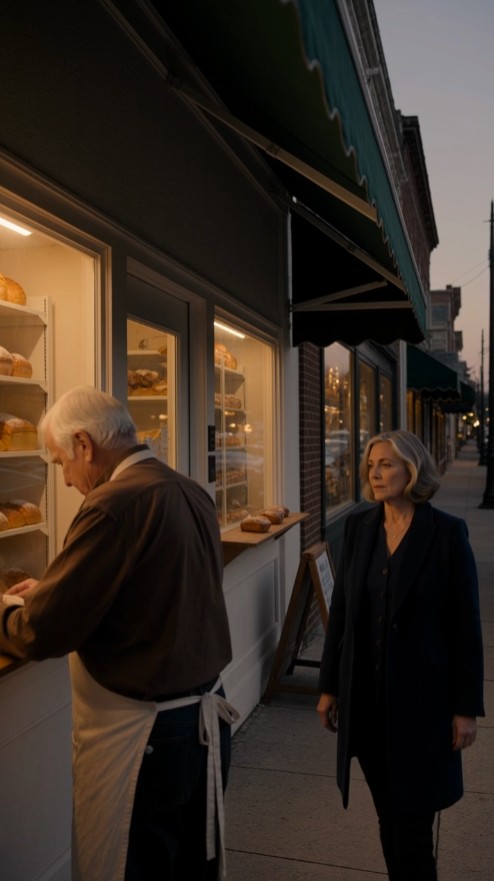
For fifty-two years, Samuel had placed a fresh loaf of bread outside his bakery every evening.
Rain or shine.
Summer or winter.
Even when nobody came to collect it.
The bakery stood on a quiet street, between a florist and an old bookstore.
Samuel was seventy-eight now.
His hands were stiff.
His back ached after long mornings.
And after more than half a century of waking before sunrise, he had finally decided to retire.
The bakery would close forever the following morning.
On his last evening, Samuel cleaned the counter, switched off the ovens, and baked one final small loaf.
He wrapped it in brown paper.
Placed it on the sheltered shelf outside.
Then stood in the doorway, looking down the familiar street.
That’s when a woman approached.
She appeared to be in her early sixties.
She wore a dark coat and carried a small handbag.
When she noticed the bread, she stopped.
Her hands began trembling.
“Excuse me,” she whispered.
Samuel turned.
“Yes, ma’am?”
The woman pointed toward the shelf.
“Do you still leave one out every night?”
Samuel smiled.
“Always.”
Her eyes filled with tears.
“Fifty-two years ago, I was a little girl. My mother and I had nowhere to go.”
Samuel stopped smiling.
The woman continued.
“One snowy evening, you found us sitting behind this bakery.”
His expression changed.
He remembered.
The little girl with the red scarf.
Her mother sitting against the brick wall.
And the loaf of warm bread he’d carried outside.
The woman gently took his hand.
“You thought you were only giving us dinner. But you gave my mother the courage to keep going.”
Samuel’s eyes filled with tears.
Then the woman looked toward a car parked across the street.
Three people stepped out.
An older man.
A younger woman.
And a teenage boy carrying a wooden box.
Samuel stared at the box.
Its lid was faded blue.
One corner was chipped.
And a small brass handle hung from the front.
His breathing changed.
Because he recognized it.
It was the old wooden recipe box his wife, Eleanor, had lost more than fifty years earlier.
And when the woman opened it, Samuel discovered something hidden beneath the recipes.
Something Eleanor had written before she died.
Something he had never been meant to find until the right person returned.
The Bakery on Willow Street
Samuel opened his bakery in 1974.
He was twenty-six years old.
He’d spent years learning to bake from his father, who had worked in neighborhood bakeries for most of his life.
Samuel loved the smell of fresh bread.
The warmth of the ovens.
And the quiet hours before the town woke.
He rented a narrow shop on Willow Street.
The building had a small kitchen.
A wooden counter.
And two large windows overlooking the sidewalk.
Above the entrance hung a simple sign.
SAMUEL’S BAKERY — FRESH BREAD DAILY.
His wife, Eleanor, helped him prepare for opening day.
She painted the sign.
Organized the shelves.
And arranged a little table near the window.
They didn’t have much money.
But they had a plan.
Work hard.
Treat people kindly.
And build a place where neighbors felt welcome.
The Woman Who Believed in Him
Eleanor had married Samuel two years earlier.
She was twenty-five when the bakery opened.
She worked as a school secretary during the week and helped at the shop whenever she could.
Samuel often worried about money.
The rent was high.
The equipment was old.
And some days, business was slow.
But Eleanor always encouraged him.
One evening, after a particularly difficult day, Samuel sat at the kitchen table staring at a stack of bills.
“I don’t know if we can make this work,” he admitted.
Eleanor placed a cup of tea beside him.
Then smiled.
“Can you still bake good bread?”
Samuel looked confused.
“Of course.”
She nodded.
“Then tomorrow we’ll open the doors and try again.”
He laughed softly.
“That’s your business plan?”
Eleanor smiled.
“That, and remembering people matter more than perfect loaves.”
Samuel never forgot those words.
The Winter of 1974
Their first winter was unusually cold.
Snow covered the sidewalks.
The wind pushed through gaps around the shop’s old windows.
And business became unpredictable.
Some mornings, customers arrived before sunrise.
Other days, the bakery remained quiet.
Samuel worked hard to avoid wasting ingredients.
He baked smaller batches.
Sold leftover bread at reduced prices.
And occasionally donated unsold items to a local community organization.
But one snowy evening changed the way he thought about his business.
He had just finished cleaning the ovens when he heard a faint sound outside.
At first, he thought it was the wind.
Then he heard someone coughing.
Samuel stepped through the back door.
And saw two figures sitting against the brick wall.
A woman.
And a little girl.
The Mother and Daughter
The mother was named Ruth.
She was thirty-one.
Her daughter, Clara, was nine.
They had recently lost their housing after Ruth’s employment ended and their temporary arrangements fell through.
They had been trying to reach a relative who might help them.
But transportation problems and bad weather had delayed them.
Now they were stranded in an unfamiliar town.
Their coats were damp.
Their hands were cold.
And Clara was crying quietly.
Samuel approached carefully.
“Are you all right?”
Ruth looked embarrassed.
“We’re sorry. We weren’t trying to cause trouble.”
Samuel shook his head.
“You’re not causing trouble.”
He looked toward Clara.
“Have you eaten?”
The little girl shook her head.
Samuel returned to the bakery.
A few minutes later, he came back carrying a warm loaf of bread.
The First Loaf
Samuel placed the bread in Ruth’s hands.
“It’s fresh.”
She stared.
“We don’t have any money.”
He smiled.
“I didn’t ask for any.”
Ruth’s eyes filled with tears.
Clara looked toward the bread.
“Can we really have it?”
Samuel nodded.
“Of course.”
He also brought them water and helped them contact local services that could arrange a safe place to stay.
Eleanor joined them shortly afterward.
She offered warm clothing from a nearby donation center and helped make the necessary calls.
The family eventually secured emergency accommodation for the night.
Before leaving, Clara reached into her coat.
She removed a small red ribbon.
It had been tied around her hair earlier that day.
She held it toward Samuel.
“For you.”
He looked surprised.
“What’s this for?”
Clara whispered:
“Because you gave us dinner when we didn’t have any.”
Samuel smiled.
Then gently accepted the ribbon.
The Recipe Box
Eleanor kept the bakery’s recipes inside a wooden box.
It was painted pale blue.
The lid was slightly crooked.
And a small brass handle hung from the front.
Inside were handwritten cards.
Bread recipes.
Pastry measurements.
And notes about customers’ favorite orders.
Samuel sometimes joked that the box was the most valuable thing in the bakery.
“Forget the ovens,” he said. “If we lose that box, we’re finished.”
Eleanor laughed.
“Then you’d better learn the recipes by heart.”
After meeting Ruth and Clara, Eleanor added a new card.
It wasn’t a recipe.
It contained only a few words.
One small loaf.
Every evening.
For whoever needs it.
Samuel found the card the following morning.
He looked toward Eleanor.
“What’s this?”
She smiled.
“Our new tradition.”
A Promise Between Husband and Wife
Eleanor explained her idea.
They couldn’t solve every person’s problems.
They couldn’t provide housing to everyone in need.
And they certainly couldn’t afford to give away everything in the bakery.
But they could set aside one small loaf each evening.
Anyone who needed it could take it.
No questions.
No payment.
No explanation.
Samuel listened.
Then nodded.
“One loaf.”
Eleanor smiled.
“Every evening.”
He reached for her hand.
“All right.”
That night, they placed a sheltered shelf outside the bakery.
Samuel baked a small loaf.
Wrapped it carefully.
And left it there.
The following morning, it was gone.
They never learned who took it.
And Eleanor said they didn’t need to know.
The Bread That Became a Tradition
Days became weeks.
Weeks became months.
And the little loaf remained part of the bakery’s routine.
Every evening, Samuel placed it outside.
Sometimes someone collected it within minutes.
Other nights, it remained untouched.
Samuel followed suitable food-safety practices, including discarding bread that had been left too long rather than offering it again.
He didn’t photograph the people who took it.
Didn’t ask for their names.
And didn’t expect thanks.
He simply wanted the bread to be available.
Occasionally, customers asked about the shelf.
“Is that somebody’s order?”
Samuel smiled.
“No.”
“Then what’s it for?”
He always answered:
“Someone who might need it.”
And usually, that was enough.
The Little Girl Who Never Forgot
Clara and her mother eventually left Willow Street.
With help from relatives and local services, Ruth found stable accommodation in another town.
She later returned to work.
Clara resumed school.
Their circumstances improved gradually.
But the little girl never forgot the snowy evening behind the bakery.
She remembered how frightened her mother had been.
How cold their hands felt.
And how Samuel appeared carrying a loaf of warm bread.
Most of all, she remembered something her mother said afterward.
They were sitting in a warm room at the temporary shelter.
Clara was eating the last piece of bread.
Ruth looked toward her.
Then whispered:
“Today somebody helped us. Tomorrow we’ll keep trying.”
For Clara, those words became inseparable from the memory of Samuel’s kindness.
The Letter Ruth Wrote
Several months after leaving town, Ruth wrote to Eleanor.
She thanked the couple for helping her and Clara.
She explained that she had found work.
They were living in a small apartment.
And Clara was doing well in school.
At the end, she added:
I don’t think you understood how frightened I was that evening.
I’d been trying so hard to keep everything together.
When you helped us find somewhere safe and gave Clara something to eat, I finally felt that we weren’t completely alone.
Thank you for treating us with dignity.
Eleanor read the letter at the bakery counter.
Then smiled.
She placed it inside her blue recipe box.
Samuel asked what it said.
Eleanor told him Ruth and Clara were doing well.
But she didn’t read the entire message aloud.
She wanted Ruth’s words to remain private unless she chose to share them.
The Afternoon the Box Disappeared
In 1975, the bakery suffered a small plumbing leak.
Water entered the storage room.
Several shelves were damaged.
The staff hurried to move supplies and important belongings.
Eleanor placed the blue recipe box inside a cardboard carton with other papers.
A volunteer from a nearby community center helped carry some items to a dry storage space.
The cleanup lasted several days.
When everything was returned, the blue box was missing.
Samuel searched everywhere.
He checked the storage room.
The cellar.
And the community center.
But nobody could locate it.
Eleanor was upset.
The box contained years of handwritten recipes.
Family notes.
And small memories from their first years of marriage.
Eventually, they accepted that it might be gone.
Samuel recreated the most important recipes from memory.
And Eleanor began a new collection.
But they never stopped wondering what had happened to the original box.
The Box That Traveled Away
Unknown to Samuel and Eleanor, the carton containing the blue recipe box had been mixed with donated household items during the cleanup.
The community center later transferred those items to another location.
Some were distributed to families.
Others were stored.
The blue box eventually reached Ruth.
She had remained in occasional contact with the community organization that helped her.
When a volunteer offered her a box containing old recipe cards, she recognized Eleanor’s handwriting on one of the papers.
She immediately understood where it had come from.
She contacted the center.
But by then, the bakery’s original storage records had been lost.
Ruth wrote a letter explaining the discovery.
Unfortunately, the letter never reached Eleanor.
So she kept the box safe.
Hoping that someday she could return it.
The Recipes Inside
Ruth treasured the blue box.
She didn’t consider it hers.
She knew it belonged to the couple who had helped her daughter.
But she believed keeping it safe was better than allowing it to be discarded.
Inside were recipes.
Notes.
And several photographs.
One showed Samuel and Eleanor standing outside the bakery on opening day.
Another showed the little shelf where they placed the free loaf.
There was also Ruth’s thank-you letter.
And a small red ribbon.
Clara recognized it immediately.
“Mom, that’s mine!”
Ruth smiled.
“You gave it to the baker.”
Clara nodded.
Then looked toward the box.
“Can we take it back?”
Ruth sighed.
“I’ve been trying to find the right way.”
Years passed.
The family moved several times.
But the blue box always went with them.
The Loss That Changed Samuel’s Life
Samuel and Eleanor continued running the bakery together.
The business gradually became successful.
They hired employees.
Expanded the menu.
And became familiar faces in the neighborhood.
But after many years of marriage, Eleanor became seriously ill.
Samuel cared for her with help from family and medical professionals.
He reduced his hours whenever possible.
And spent evenings sitting beside her.
One night, Eleanor asked:
“Are you still leaving the bread outside?”
Samuel nodded.
“Every evening.”
She smiled.
“Good.”
Then she took his hand.
“Promise me something.”
“Anything.”
“Don’t stop just because I’m not there to remind you.”
Samuel began crying.
He promised.
When Eleanor died several years later, the bakery became quieter.
But the small loaf continued appearing every evening.
The Years Alone
After Eleanor’s death, Samuel struggled with loneliness.
He missed hearing her voice in the kitchen.
He missed her laughter.
And the way she used to write reminders on recipe cards.
Some mornings, he reached for her favorite coffee cup without thinking.
Other times, he looked toward the empty stool beside the counter.
But he kept working.
The bakery gave structure to his days.
Customers greeted him.
Neighbors stopped to chat.
And the familiar smell of bread filled the shop.
Every evening, before closing, Samuel baked one small loaf.
He wrapped it.
Placed it outside.
Then thought of Eleanor.
Sometimes he whispered:
“Another one, darling.”
And switched off the lights.
Fifty-Two Years Later
By the time Samuel turned seventy-eight, the work had become difficult.
His hands were stiff.
His back hurt.
And waking before sunrise every day left him exhausted.
He had trained younger bakers over the years.
But none wanted to take over the entire business.
The building’s owner also planned renovations.
After months of consideration, Samuel decided it was time to close.
He announced the date.
Regular customers were heartbroken.
Some offered to help.
Others asked whether the bakery could continue under new management.
Samuel appreciated their kindness.
But he had made his decision.
He needed rest.
He wanted to spend more time with family.
And he hoped to enjoy the slower pace of retirement.
Yet one question bothered him.
What would happen to the little loaf?
The Final Week
During the bakery’s last week, customers came to say goodbye.
Some brought flowers.
Others left handwritten cards.
One woman told Samuel she’d bought birthday cakes there for thirty years.
A man remembered stopping for bread with his father when he was a boy.
Several former employees returned.
They hugged Samuel.
Thanked him.
And shared memories.
The bakery walls were covered with photographs.
Opening day.
Anniversaries.
Holiday celebrations.
And pictures of Samuel standing proudly beside the ovens.
But among all those memories, one thing remained unchanged.
Every evening, he left a loaf outside.
The Final Loaf
On the last night, Samuel worked alone after the other employees went home.
He cleaned the ovens.
Wiped the counter.
And swept the floor.
Then he prepared a small batch of dough.
Just enough for one loaf.
He kneaded it slowly.
His hands hurt.
But he didn’t rush.
He shaped the dough.
Let it rise.
And placed it in the oven.
When the bread was finished, he removed it carefully.
The crust was golden.
The smell reminded him of Eleanor.
He wrapped the loaf in brown paper.
Then wrote a small note.
For anyone who needs it.
He placed it on the shelf outside.
Then stood in the doorway.
Looking toward the quiet street.
The Woman in the Dark Coat
Samuel was preparing to lock the door when he noticed a woman approaching.
She had silver-streaked hair.
A gentle expression.
And a small handbag.
She stopped beside the shelf.
Then looked toward the bread.
Her hands began shaking.
“Excuse me.”
Samuel turned.
“Yes, ma’am?”
She swallowed.
“Do you still leave one out every night?”
He smiled.
“Always.”
Tears filled her eyes.
She looked toward the bakery.
Then whispered:
“Fifty-two years ago, I was a little girl.”
Samuel became quiet.
The woman continued.
“My mother and I had nowhere to go.”
He stared.
“A snowy night.”
She nodded.
“You found us behind the bakery.”
Samuel’s mouth fell open.
Then he whispered:
“Clara?”
The Little Girl Returns
The woman began crying.
“Yes.”
Samuel stepped closer.
He could hardly believe it.
The little girl in the red scarf.
The child who had accepted the first loaf.
Now stood before him as a woman in her early sixties.
He reached for her hand.
“Look at you.”
Clara smiled through tears.
“I’ve wanted to come back for so long.”
Samuel shook his head.
“You don’t owe me anything.”
She nodded.
“I know.”
Then she looked toward the loaf.
“But I wanted you to know what happened.”
Samuel listened.
Clara told him about her mother’s life.
How Ruth found work.
How they moved into a small apartment.
And how the experience had shaped their family.
Then she said:
“You thought you were giving us one meal. But you helped my mother believe she could face another day.”
Samuel began crying.
The People Across the Street
Clara turned toward the road.
A car was parked beneath a streetlight.
Three people stepped out.
The first was an elderly man named Robert, Clara’s husband.
The second was her daughter, Emily.
The third was her grandson, Jacob.
He carried a wooden box.
Samuel stared.
As they approached, he noticed the faded blue lid.
The chipped corner.
And the brass handle.
His breathing changed.
“No…”
Clara nodded through tears.
“We brought something that belongs to you.”
Jacob carefully placed the box on the bakery counter.
Samuel reached toward it.
Then whispered:
“Eleanor’s recipe box.”
The Box Opens
Samuel lifted the lid.
Inside were dozens of handwritten cards.
Some had faded.
Others were stained.
But he recognized the handwriting immediately.
Eleanor’s handwriting.
He touched the first recipe.
Then the second.
And the third.
His eyes filled with tears.
“I thought we’d lost this.”
Clara nodded.
“My mother kept it safe.”
Samuel looked confused.
She explained how the box had reached Ruth after the bakery’s plumbing leak.
How she’d tried unsuccessfully to return it.
And how it had remained with the family through several moves.
Samuel stared at the contents.
Then noticed a familiar piece of red ribbon tucked between two cards.
He lifted it carefully.
“Your ribbon.”
Clara smiled.
“You kept it.”
He nodded.
“Eleanor put it in the box.”
The Letter Beneath the Recipes
As Samuel looked through the cards, Clara gently removed a folded sheet of paper.
It had been hidden beneath a false cardboard lining.
The paper was yellowed.
The edges were fragile.
And Eleanor’s handwriting filled the page.
Samuel stared.
“What’s this?”
Clara shook her head.
“We didn’t read it.”
She paused.
“My mother found it years ago. She thought it was private.”
Samuel unfolded the letter carefully.
At the top were four words.
“FOR SAMUEL, SOMEDAY.”
His hands began trembling.
Then he started reading.
Eleanor’s Secret Message
My dearest Samuel,
If you’re reading this, perhaps you’ve finally found our old recipe box.
Or perhaps I’ve decided to show you the letter myself.
Either way, there’s something I’ve wanted to tell you.
Do you remember the snowy evening when we met Ruth and Clara?
Of course you do.
You carried bread outside without thinking twice.
You didn’t ask who they were.
You didn’t ask what they’d done.
You simply saw that they were cold and hungry.
And you helped.
Samuel stopped reading.
Tears fell onto the paper.
Then he continued.
The Words Eleanor Never Said
That night, I watched you kneel beside a frightened little girl.
You spoke to her gently.
You gave her bread.
Then you helped her mother find a safe place to stay.
When we returned inside, you acted as though you’d done nothing special.
You washed your hands.
Checked the ovens.
And asked whether I wanted tea.
But Samuel, I want you to know something.
I had never been prouder of you.
Not when we opened the bakery.
Not when we made our first profit.
Not even when our name appeared in the newspaper.
I was proudest of you that night.
Samuel covered his mouth.
Clara began crying beside him.
The Promise Eleanor Hoped He’d Keep
The letter continued.
I know you worry about whether this little bakery will succeed.
You worry about the rent.
The bills.
And whether people will remember our bread.
But I hope you’ll remember something else.
The bakery doesn’t have to become famous to matter.
It only has to be a place where people are treated kindly.
One loaf won’t solve every problem.
But it might help someone get through a difficult evening.
And perhaps that person will find the strength or support they need to keep going.
So when the business is difficult, remember why we started.
And when the day comes that we’re too old to bake, I hope someone else will continue the kindness.
All my love, Eleanor.
Samuel lowered the letter.
For several seconds, he couldn’t speak.
Then he whispered:
“She wrote this when we were young.”
The Truth Clara Wanted Him to Know
Clara reached for Samuel’s hand.
“My mother told me about you until the day she died.”
Samuel looked up.
Clara continued.
“She never forgot that night.”
She explained that Ruth had eventually become a community support worker.
After finding stability, Ruth wanted to help other families experiencing housing insecurity.
She volunteered.
Assisted people in connecting with services.
And helped organize food collections.
Clara grew up watching her mother do those things.
It influenced her own life.
She became a teacher.
Then spent years volunteering with a local food program.
Her daughter Emily later joined a community organization that distributed groceries and prepared meals.
Samuel listened.
Then looked toward the young boy standing beside the counter.
“And you?”
Jacob smiled shyly.
“I help my mom pack food boxes.”
Samuel began crying again.
The Family Photograph
Emily reached into her bag.
She removed a framed photograph.
It showed four generations of the family.
Ruth, seated in a chair shortly before her death.
Clara standing beside her.
Emily holding a small child.
And Jacob smiling at the front.
Beneath the photograph was a message.
“ONE LOAF OF BREAD. FOUR GENERATIONS OF KINDNESS.”
Samuel stared.
Then looked toward Clara.
“Your mother…”
Clara nodded.
“She lived a good life.”
She paused.
“And she always said that people helped her when she needed it.”
Samuel wiped his eyes.
He didn’t know what to say.
He had spent fifty-two years placing bread outside.
Never knowing who might take it.
Now, on the final night of his bakery, he was meeting a family whose lives had continued long after that first snowy evening.
The Question Samuel Asked
Samuel looked toward Clara.
“Why did you wait so long to come back?”
She lowered her eyes.
“At first, my mother didn’t know how to find you after we moved.”
She paused.
“Then life became busy.”
“Work.”
“Children.”
“Moving.”
“And sometimes we thought about coming, but never made the trip.”
Samuel nodded.
Clara continued.
“Last month, Emily saw a notice online that your bakery was closing.”
She looked toward the shelves.
“We couldn’t let the doors close without telling you.”
Samuel smiled through tears.
“I’m glad you came.”
Then he looked toward the blue box.
“And you brought Eleanor home too.”
The Unexpected Offer
Clara took a breath.
“Samuel, there’s something else.”
He looked surprised.
She turned toward Emily.
Her daughter stepped forward.
“We run a community food program.”
Samuel nodded.
Emily continued.
“We work with local bakeries, grocery stores, and volunteers.”
She explained that the program distributed food through supervised, organized channels.
They also helped connect families with housing and community support services.
Then she looked toward the loaf outside.
“We heard about what you’ve been doing every evening.”
Samuel smiled.
“Just one loaf.”
Emily nodded.
“One loaf for fifty-two years.”
She paused.
“We’d like to continue the tradition.”
Samuel stared.
The Promise Continues
Emily explained that the family didn’t intend to take over Samuel’s bakery.
The building was closing.
The equipment would be sold or donated.
And Samuel deserved a peaceful retirement.
But their organization had partnered with a nearby bakery.
The baker had agreed to prepare an additional loaf each evening for a community food distribution point.
The program would manage collection and food safety.
The loaf wouldn’t necessarily be placed outside overnight.
Instead, it would be made available through an accessible, supervised arrangement.
But the idea would remain the same.
Fresh bread.
For someone who needed it.
No payment.
No embarrassment.
And no requirement to explain personal circumstances.
Samuel listened silently.
Then whispered:
“Eleanor would’ve loved that.”
The First Photograph Together
Clara asked whether they could take a photograph.
Samuel nodded.
They gathered near the bakery entrance.
He stood beside the old shelf.
Clara held the blue recipe box.
Emily stood beside her mother.
Robert smiled.
And Jacob carried the final loaf.
Samuel looked toward the camera.
For a moment, he struggled to smile.
His emotions were overwhelming.
Clara gently touched his arm.
“Are you okay?”
Samuel nodded.
Then laughed through tears.
“I think so.”
The photograph was taken.
A seventy-eight-year-old baker.
A woman he’d helped as a child.
And the family that had grown from that frightened little girl.
The Final Night at Samuel’s Bakery
After the photograph, everyone returned inside.
Samuel made tea.
He placed cups on the counter.
Then offered the family the last pastries remaining in the display case.
They talked for more than an hour.
Clara shared memories of her mother.
Samuel told stories about Eleanor.
Emily asked about the bakery’s early years.
And Jacob listened quietly.
Eventually, the clock approached closing time.
Samuel stood.
He looked around the shop.
The shelves were nearly empty.
The ovens were cold.
And the counter was clean.
For the first time in fifty-two years, he knew he wouldn’t return the next morning to bake.
He felt sad.
But not as sad as he’d expected.
Because the final evening had brought him something extraordinary.
A piece of the past.
And a reason to feel hopeful about the future.
The Last Loaf Finds Its Home
Before leaving, Clara approached the shelf outside.
The final loaf remained untouched.
She looked toward Samuel.
“May I take it?”
He smiled.
“Of course.”
Clara picked up the bread.
Then held it against her chest.
“Fifty-two years ago, you gave my mother and me a loaf just like this.”
Samuel nodded.
Clara began crying.
“Tonight, I want to take this one home.”
She paused.
“Not because we need food.”
“But because I want my grandchildren to know where our family learned to help people.”
Samuel reached for her hand.
Then whispered:
“I think that’s the best home this loaf could have found.”
The Morning After
The following morning, Samuel woke at his usual time.
Four-thirty.
For a moment, he forgot that the bakery was closed.
He sat up.
Reached toward his bedside table.
Then looked at the clock.
There was no dough to prepare.
No oven to heat.
And no customers waiting.
He felt strange.
Almost lost.
Then he noticed the blue recipe box on his dresser.
Clara had insisted that it remain with him.
Samuel reached for it.
Opened the lid.
And carefully removed Eleanor’s letter.
He read it again.
Then smiled.
For years, he’d worried about how he would feel when the bakery finally closed.
Now he knew.
He was sad.
But grateful.
The Community Bread Project
Several weeks later, Emily invited Samuel to visit the community food program.
He arrived with Clara.
Inside, volunteers were preparing grocery boxes.
Fresh produce.
Bread.
And other basic supplies.
A baker from a nearby shop brought a tray of fresh loaves.
Samuel watched as volunteers checked the deliveries and prepared them for distribution.
Emily smiled.
“Would you like to see something?”
She led him toward a small display near the entrance.
There was a photograph of Samuel standing outside his bakery.
Beside it was a simple sign.
“THE EVENING LOAF — INSPIRED BY SAMUEL AND ELEANOR.”
Samuel stared.
Then began crying.
The First Evening Loaf
That evening, Samuel watched the program distribute bread to local families.
Some people collected food boxes.
Others arrived through referrals from community organizations.
Volunteers greeted everyone respectfully.
Nobody was required to share their story publicly.
Samuel appreciated that.
He had always believed that kindness should preserve dignity.
A young father arrived with two children.
The volunteer offered him a grocery box and a fresh loaf.
The man thanked her.
Then left.
Samuel stood quietly.
Emily approached.
“What do you think?”
He smiled.
“That’s exactly what Eleanor wanted.”
The Recipe That Became a Gift
Samuel decided to donate copies of several of Eleanor’s bread recipes to the community program.
The originals remained safely in his possession.
But he wanted the volunteers and partner bakeries to have access to the recipes that had meant so much to his family.
He chose the simple country loaf.
The one he’d baked for years.
The ingredients were ordinary.
Flour.
Water.
Yeast.
Salt.
And time.
Samuel laughed when Emily asked whether there was a secret ingredient.
He shook his head.
“No secret.”
Then he smiled.
“Just don’t rush it.”
Emily laughed.
Samuel continued.
“Good bread needs patience.”
He paused.
“Most worthwhile things do.”
The Anniversary Gathering
One year after the bakery closed, Clara organized a small gathering.
Samuel was seventy-nine.
He arrived expecting tea with the family.
Instead, he found a room filled with volunteers and friends from the community food program.
Photographs were displayed on the walls.
One showed Samuel’s bakery in its early days.
Another showed Eleanor standing beside the original bread shelf.
There was also a photograph of Clara as a child with her mother.
And the picture taken on the bakery’s final night.
Emily welcomed everyone.
Then thanked Samuel for the tradition he’d maintained for more than half a century.
Samuel stood quietly.
He wasn’t used to public attention.
But when he looked toward Clara and her family, he smiled.
The Words Samuel Shared
Someone asked Samuel to say a few words.
He hesitated.
Then stepped forward.
“I’m not much of a speaker.”
The room laughed softly.
Samuel looked toward the photographs.
“My wife and I opened a bakery because we wanted to make a living.”
He paused.
“We never expected anything extraordinary.”
Then he continued.
“One snowy night, we met a mother and her little girl.”
“They needed food.”
“And they needed help finding somewhere safe.”
“We did what we could.”
Samuel looked toward Clara.
“I didn’t know I’d see that little girl again.”
His voice broke.
Then he smiled.
“And I certainly didn’t know she’d come back carrying fifty-two years of memories.”
The Letter Samuel Wrote to Eleanor
That evening, Samuel returned home.
He sat at his kitchen table.
Then opened Eleanor’s blue recipe box.
He took out a blank sheet of paper.
And began writing.
My dearest Eleanor,
You’ll never believe what happened.
Clara came back.
The little girl from that snowy night.
She’s grown now.
She has a daughter.
And a grandson.
And they brought your recipe box home.
I found your letter.
I wish I’d read it when you were alive.
But perhaps I needed those words now.
The bakery is closed.
I finally retired.
And I was afraid the evening loaf would end with me.
But it hasn’t.
Clara’s family is helping continue it.
There are other bakers now.
Other volunteers.
And other people who need a little help.
You were right, darling.
One loaf couldn’t solve everything.
But it could be the beginning of something kind.
I love you.
Samuel.
He folded the letter.
Then placed it beside hers.
The New Sign
Several months later, Emily asked Samuel to visit the community program again.
They had installed a new sign.
It was made of wood.
Painted pale blue.
And attached beside the entrance.
Samuel recognized the color immediately.
Eleanor’s recipe box.
The sign read:
THE EVENING LOAF
In honor of Samuel and Eleanor.
For anyone who needs a little help today.
Samuel touched the wood.
Then smiled.
He thought about his wife.
The bakery.
And the snowy evening that had changed their lives.
He had never expected a simple act of kindness to become a tradition lasting more than half a century.
And he certainly hadn’t expected it to continue after the ovens went cold.
The Boy Who Asked About the Bread
During one visit, Jacob approached Samuel.
He was curious about the bakery.
“Mr. Samuel?”
“Yes?”
“Why did you keep leaving bread out even when nobody took it?”
Samuel thought for a moment.
Then smiled.
“Because I didn’t know who might need it tomorrow.”
Jacob nodded.
“But what if nobody ever came?”
Samuel looked toward the young boy.
“Then nobody needed that loaf that evening.”
He paused.
“And that would’ve been a good thing.”
Jacob smiled.
Samuel continued.
“But I wanted the bread to be there, just in case.”
The boy thought carefully.
Then asked:
“Do you think one loaf can really make a difference?”
Samuel smiled.
“Sometimes.”
Then he added:
“But it’s important to remember that people often need more than bread. They need safe places, opportunities, and support too.”
Jacob nodded.
He never forgot the conversation.
The Bakery That Was Gone but Not Forgotten
Over time, the old bakery building changed.
The windows were renovated.
The faded sign was removed.
And another business moved into the space.
Samuel sometimes walked past.
He remembered the smell of bread.
The sound of the ovens.
And Eleanor standing behind the counter.
He felt nostalgic.
But he didn’t regret retiring.
He enjoyed his slower mornings.
Spent more time in the garden.
And occasionally baked at home.
He continued visiting Clara and her family.
Sometimes they invited him to dinner.
Other times they met for tea.
He loved hearing stories about their lives.
And he took comfort in knowing the evening loaf tradition had found a new home.
The Truth Behind the Blue Box
The emotional reunion began when Clara returned to Samuel’s bakery on its final evening.
Fifty-two years earlier, Samuel and Eleanor had helped Clara and her mother, Ruth, during a difficult winter night.
They provided warm bread and helped them connect with emergency accommodation.
The experience inspired Samuel and Eleanor to begin leaving one small loaf outside the bakery every evening.
Over time, the practice became a fifty-two-year tradition.
On the final night, Clara returned with her family.
They brought Eleanor’s old recipe box, which had been accidentally mixed with donated supplies during a plumbing emergency decades earlier.
Ruth had kept it safe.
Inside were handwritten recipes, photographs, Clara’s childhood ribbon, and a letter Eleanor had written for Samuel.
The letter explained how proud Eleanor had been of her husband’s kindness.
It also expressed her hope that the bakery’s charitable tradition would continue.
Clara’s family then revealed that their community food program had arranged to carry on the idea through a nearby bakery.
Samuel retired knowing that the tradition he and Eleanor started would continue in a new, organized form.
The Last Thing Samuel Remembered
When Samuel thought about his bakery’s final evening, he didn’t remember the empty shelves first.
Or the cold ovens.
Or the sound of the door locking for the last time.
He remembered a woman standing beside the little bread shelf.
Her hands trembling.
Her eyes filled with tears.
And the words:
Fifty-two years ago, I was a little girl.
He remembered the snowy evening.
The frightened child.
Her mother.
And the loaf of bread he’d carried outside.
He remembered Clara returning with her family.
And the blue recipe box that had belonged to Eleanor.
Most of all, he remembered the letter.
The words his wife had written decades earlier.
The bakery doesn’t have to become famous to matter.
It only has to be a place where people are treated kindly.
Samuel had spent fifty-two years trying to honor that idea.
And on the night the bakery closed, he discovered that it had mattered to people far beyond what he could see.
The Last Loaf of Bread
Samuel was seventy-eight when he closed his bakery.
For fifty-two years, he’d opened before sunrise.
Kneaded dough.
Served customers.
And placed one small loaf outside every evening.
Sometimes someone took it.
Sometimes nobody came.
But he never stopped.
Then, on the final night, a woman approached.
She looked at the bread.
And began crying.
A seventy-eight-year-old baker discovered that the little girl he’d helped during a snowy night fifty-two years earlier had returned to thank him.
She brought his late wife’s long-lost recipe box, containing a hidden letter explaining why their tradition of giving away bread had mattered so deeply to her.
Then the woman’s family revealed that they had arranged to continue the evening loaf through a community food program.
Samuel had expected his final evening to be quiet.
He thought he’d clean the counter.
Turn off the ovens.
And leave one last loaf outside.
Instead, he received a piece of his past.
A letter from his wife.
And the knowledge that a small act of kindness had remained meaningful for generations.
The bakery closed.
The old ovens went cold.
And the sign above the door eventually disappeared.
But the evening loaf continued.
Prepared by different hands.
Shared through a different organization.
And offered with the same spirit Samuel and Eleanor had cherished.
Fifty-two years earlier, Samuel gave a frightened little girl a loaf of bread.
On the night his bakery closed, that little girl returned as a grandmother — carrying the memories of four generations and a promise that the kindness would continue.
Sometimes the most lasting part of a business isn’t the building, the equipment, or even the recipes.
It’s the way people remember how they were treated when they needed help.