
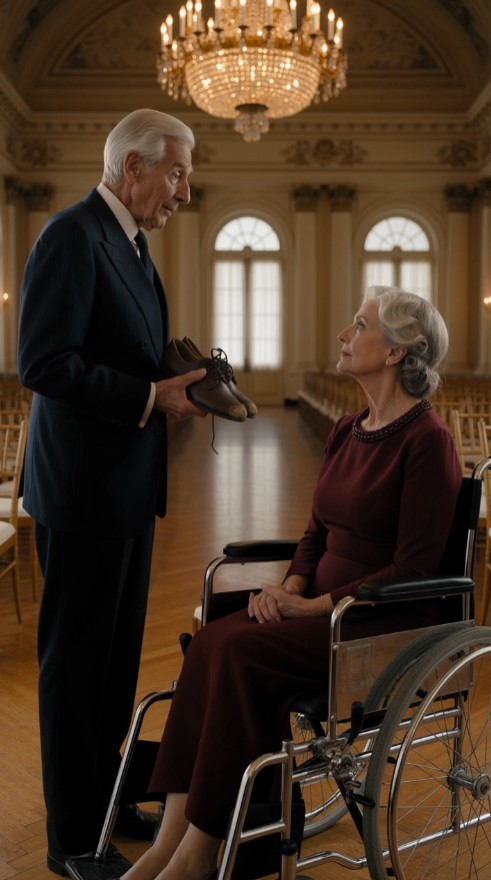
For sixty years, Henry had danced with the same woman.
Through good times.
Through financial struggles.
Through the birth of their children.
And through the quiet years when growing older made everything a little more difficult.
Her name was Clara.
She was eighty-five now.
And although they had shared almost an entire lifetime together, there were days when she no longer recognized the man sitting beside her.
Clara had dementia.
Sometimes she remembered their children.
Sometimes she remembered the little house where they’d raised their family.
Other days, even familiar faces seemed confusing.
But Henry never stopped visiting her care home.
He brought flowers.
Held her hand.
And played the old songs they used to dance to.
Then one afternoon, Henry learned that the ballroom where they’d first met was closing forever.
He made a phone call.
“Could I bring my wife one last time?”
The owner listened to his story.
Then agreed.
On the ballroom’s final evening, Henry arrived carrying two pairs of dance shoes.
His own polished black shoes.
And Clara’s faded silver heels.
He gently wheeled his wife into the empty ballroom.
The lights were dim.
The wooden floor gleamed.
And the room was quiet.
Henry placed Clara’s shoes beside her wheelchair.
Then turned toward the owner.
“Would you play one last song?”
A familiar melody began filling the room.
Henry stood before Clara.
He straightened his jacket.
Bowed like the nervous twenty-two-year-old he’d once been.
Then held out his hand.
“Sweetheart, may I have this dance?”
Clara looked at him.
For several seconds, she said nothing.
Then her face softened.
She smiled.
Gently took his hand.
And whispered:
“Only if you promise not to step on my toes.”
Henry covered his mouth.
Tears streamed down his face.
Because those were almost the exact words Clara had spoken to him sixty-one years earlier, on the night they first met.
But the evening wasn’t over.
The ballroom owner quietly approached Henry.
And handed him a small envelope.
Inside was something the couple had left behind decades earlier.
Something Henry believed had disappeared forever.
Their original wedding dance photograph — and a letter Clara had written to him on their twenty-fifth anniversary.
And when Henry opened the letter, he discovered that his wife had left him a message about a future neither of them could have imagined.
The Night Two Strangers Met
It was 1965.
Henry was twenty-two.
Clara was twenty.
The ballroom was called the Rosewood Dance Hall.
It stood in the center of a small town, above a row of old shops.
Every Saturday evening, couples gathered beneath its crystal chandeliers.
A live band played.
The wooden floor filled with dancers.
And young people came hoping to meet someone special.
Henry wasn’t much of a dancer.
In fact, he was terrified of embarrassing himself.
He had attended the dance with two friends.
They encouraged him to ask someone onto the floor.
But Henry preferred sitting near the wall.
Then he noticed Clara.
She wore a pale-blue dress.
Her dark hair was pinned neatly behind her ears.
And she laughed as she spoke with her friends.
Henry couldn’t stop looking at her.
Unfortunately, he couldn’t find the courage to approach.
So Clara approached him instead.
The First Dance
“Are you going to sit there all evening?”
Henry looked up.
Clara was smiling.
He laughed nervously.
“Probably.”
She held out her hand.
“Well, that seems like a waste of a perfectly good dance floor.”
Henry stared.
“Are you asking me to dance?”
Clara laughed.
“I am.”
He stood.
Straightened his jacket.
And followed her onto the floor.
The band began playing a slow song.
Henry tried to follow the rhythm.
But within seconds, he stepped on Clara’s shoe.
“Oh, I’m sorry!”
She laughed.
“It’s all right.”
A few moments later, he did it again.
Henry looked mortified.
Clara shook her head, laughing.
Then said:
“You’ll have to practice if you’re going to marry me.”
Henry stopped moving.
“Marry you?”
She smiled.
“Well, not if you keep stepping on my toes.”
They both burst into laughter.
And somehow, despite his terrible dancing, Clara agreed to see him again.
The Year They Fell in Love
Their relationship grew quickly.
Henry worked at a local furniture workshop.
Clara was studying to become a schoolteacher.
They didn’t have much money.
But they enjoyed spending time together.
On Sunday afternoons, they walked through the park.
On Friday evenings, they shared dinner.
And every Saturday, whenever possible, they returned to the Rosewood Ballroom.
Henry practiced dancing.
He learned to move more confidently.
And slowly stopped stepping on Clara’s feet.
One evening, after a particularly successful dance, Clara smiled.
“You’re getting better.”
Henry laughed.
“Does that mean you’ll marry me?”
She looked surprised.
Then smiled.
“Are you asking?”
He reached into his pocket.
Inside was a small engagement ring.
And for the first time in his life, Henry wasn’t nervous about asking a question.
Their Wedding Day
Henry and Clara married in 1966.
The ceremony was small.
Their families attended.
A few close friends came.
And afterward, everyone gathered at the Rosewood Ballroom for the reception.
The same place where they’d met.
The owner arranged a special first dance.
Henry wore a dark suit.
Clara wore a simple ivory wedding dress.
When the music began, Henry held out his hand.
“May I have this dance?”
Clara smiled.
“Only if you promise not to step on my toes.”
He laughed.
“I’ve been practicing.”
They danced beneath the chandeliers.
Their friends applauded.
And the photographer captured a beautiful picture.
Henry and Clara standing close together.
Her head resting near his shoulder.
Both smiling.
They treasured that photograph for years.
But during a later move, the original print was lost.
Henry believed they’d never see it again.
The Anniversary Tradition
Every year, Henry and Clara returned to the ballroom on their wedding anniversary.
Sometimes they dressed formally.
Other times they arrived wearing ordinary clothes after a long workday.
But they always danced.
When money was tight, they skipped dinner and paid only the admission fee.
When their first child was born, Clara’s mother watched the baby for an evening.
When their second child arrived, they found another way to make time.
There were years when Henry worked overtime.
Years when Clara was exhausted from teaching.
And years when unexpected bills made everything difficult.
But the anniversary dance remained.
They believed marriage wasn’t only about the happiest days.
It was also about making room for each other during the difficult ones.
Sometimes that room was no bigger than a small space on a crowded dance floor.
Twenty-Five Years Together
In 1991, Henry and Clara celebrated their twenty-fifth wedding anniversary.
They returned to the Rosewood Ballroom.
By then, the building had changed.
The chandeliers were older.
The music was different.
And many of the couples from their younger years no longer attended.
But the wooden dance floor was the same.
Clara wore silver shoes.
Henry wore his favorite dark suit.
They danced to the song from their wedding.
At the end, Clara laughed.
“You’ve finally learned not to step on my feet.”
Henry smiled.
“Only took twenty-five years.”
She kissed him.
Then handed him a small envelope.
“Don’t open this yet.”
He looked confused.
“Why?”
She smiled.
“Because some things are meant for another day.”
Henry placed it in his jacket.
But during the celebration, he left the jacket in the ballroom’s cloakroom.
The envelope slipped from the pocket.
And disappeared.
For years, neither knew what had happened to it.
The First Signs Something Was Wrong
Decades later, Henry began noticing changes in Clara.
At first, they seemed small.
She misplaced her keys.
Forgot appointments.
And sometimes repeated the same question several times.
Henry assumed it was ordinary forgetfulness.
But then she became confused while traveling to a familiar shop.
Another time, she struggled to remember the name of a longtime neighbor.
They consulted healthcare professionals.
After assessments, Clara was diagnosed with dementia.
Henry listened carefully as the medical team explained that her condition could affect memory, communication, and everyday activities.
There would be changes.
Some gradual.
Others unpredictable.
They discussed care options.
Support services.
And ways to maintain Clara’s comfort and dignity.
Henry held his wife’s hand through the appointment.
When they returned home, he made tea.
Then sat beside her.
Clara looked worried.
“Are you frightened?”
Henry nodded.
“A little.”
She squeezed his hand.
“Me too.”
The Years That Changed Their Marriage
As Clara’s condition progressed, everyday life became more complicated.
She sometimes forgot what she’d eaten.
Repeated familiar stories.
And struggled to follow conversations.
There were days when she recognized Henry immediately.
Other days, she looked at him with uncertainty.
That was especially painful.
He was the man she’d married more than half a century earlier.
The person who knew her favorite flowers.
Her favorite music.
And the way she liked her tea.
Yet sometimes she no longer knew his name.
Henry worked with her healthcare team and family to support her.
Eventually, Clara moved into a residential care home where she could receive the assistance she needed.
Henry visited regularly.
He brought photographs.
Flowers.
And recordings of familiar songs.
Sometimes Clara enjoyed the music.
Sometimes she wanted quiet.
Henry followed her cues.
He understood that caring for her meant respecting the person she was in that moment, not demanding that she behave as she had in the past.
The Man With the Flowers
The care home staff came to know Henry well.
He often arrived carrying a small bouquet.
Usually daisies.
Clara had always loved them.
He sat beside her.
Asked about her day.
And listened patiently.
Sometimes they looked through old photographs.
Other times he read aloud.
Occasionally, he played their favorite recordings.
One afternoon, Clara looked toward him and asked:
“Do I know you?”
Henry felt his chest tighten.
But he smiled gently.
“I’m Henry.”
She studied his face.
“Are you my friend?”
He took her hand.
“Yes, sweetheart.”
She smiled.
“That’s nice.”
Henry held her hand for a long time afterward.
The Music That Still Mattered
The care team noticed that Clara sometimes responded positively to familiar music.
She might tap her fingers.
Smile.
Or sway gently while seated.
They incorporated preferred music into appropriate activities, while continuing to observe her comfort and choices.
Henry brought recordings from the years they’d spent dancing.
Sometimes Clara hummed along.
Other times she seemed uninterested.
Her responses varied.
But on one particular afternoon, their wedding song began playing.
Clara looked toward Henry.
Then smiled.
She moved her hand in time with the melody.
Henry gently joined her.
For a few moments, they sat together.
Holding hands.
Listening.
Henry began crying quietly.
The song hadn’t restored all of Clara’s memories.
But it had given them a moment of connection.
And that meant everything to him.
The News About the Ballroom
One morning, Henry received a call from an old friend.
“Have you heard about Rosewood?”
Henry looked confused.
“What about it?”
“The ballroom is closing.”
Henry became quiet.
The building had struggled financially for years.
Fewer people attended dances.
Maintenance costs had increased.
And the owners had finally decided to close.
Henry felt a familiar sadness.
He and Clara had met there.
Celebrated their wedding.
And returned for every anniversary they could manage.
Now the ballroom would disappear from their lives.
He looked toward a photograph of Clara.
Then made a decision.
He wanted to take her back one last time.
The Phone Call
Henry called the ballroom owner, Daniel.
He explained who he was.
“My wife and I have been coming to your ballroom for sixty years.”
Daniel listened.
Henry continued.
“We met there.”
“We had our wedding reception there.”
“And every anniversary, we came back for one dance.”
Daniel smiled.
“That’s wonderful.”
Henry hesitated.
Then said:
“My wife has dementia now.”
His voice broke.
“She lives in a care home.”
Daniel became quiet.
Henry continued.
“I don’t know whether she’ll recognize the place.”
“But I’d like to bring her one last time.”
There was a pause.
Then Daniel answered:
“Mr. Henry, we’d be honored to have you.”
Preparing for the Visit
Henry spoke with Clara’s family and care team.
They discussed whether the outing would be suitable.
Clara’s health.
Her comfort.
Transportation.
And the possibility that an unfamiliar environment might cause distress.
The care team helped arrange a short, supported visit.
There would be no expectation that Clara stand or dance.
She could remain in her wheelchair.
And they could leave at any time if she became uncomfortable.
Henry agreed.
He didn’t want to create a dramatic moment at her expense.
He simply hoped they could share the music in a place that had once meant so much to them.
Then he went home.
Opened an old wooden wardrobe.
And found two pairs of dance shoes.
The Silver Shoes
Henry’s black dance shoes were worn.
The soles had been repaired.
And the leather was creased.
But he’d kept them carefully.
Clara’s shoes were silver.
They had belonged to her for decades.
The heels were low.
The straps delicate.
And the fabric had faded with age.
Henry lifted them from the box.
He remembered Clara wearing them on their twenty-fifth anniversary.
He smiled.
Then sat on the edge of the bed.
For several minutes, he held the shoes in his hands.
He missed the way she used to laugh.
The stories she’d told.
And the teasing remark she’d repeated whenever they danced.
Only if you promise not to step on my toes.
Henry carefully placed both pairs inside a small bag.
Then prepared for the final evening.
The Empty Ballroom
When Henry arrived, the ballroom was quiet.
The tables had been cleared.
The chairs were stacked.
And most decorations had already been removed.
But the wooden dance floor still gleamed beneath the lights.
Daniel greeted him at the entrance.
“Mr. Henry.”
Henry smiled.
“Thank you for letting us come.”
Daniel shook his hand.
“The pleasure is ours.”
Clara sat comfortably in her wheelchair.
A care assistant accompanied them.
Henry gently guided her toward the center of the room.
He looked around.
The chandelier.
The windows.
The old stage.
So much had changed.
Yet he could almost see the young woman in the pale-blue dress standing across the room.
One Last Song
Henry placed Clara’s silver shoes beside her wheelchair.
He didn’t attempt to put them on her.
He simply wanted them nearby as a reminder of the years they’d shared.
Then he turned toward Daniel.
“Would you play our song?”
Daniel nodded.
The music began.
A gentle melody filled the empty ballroom.
Henry stood in front of Clara.
Straightened his jacket.
Then bowed.
Just as he had when they were young.
He held out his hand.
“Sweetheart, may I have this dance?”
Clara looked at him.
For several seconds, she remained quiet.
Henry smiled.
He was prepared for her not to respond.
Then her face softened.
She looked toward his hand.
Gently took it.
And whispered:
“Only if you promise not to step on my toes.”
The Words That Broke His Heart
Henry froze.
He stared at Clara.
The same words.
The same teasing expression.
The sentence she’d spoken on the night they first met.
His eyes filled with tears.
“Oh, Clara.”
He covered his mouth.
Then began crying.
Clara looked toward him.
She seemed concerned.
“What’s wrong?”
Henry shook his head.
“Nothing, sweetheart.”
He smiled through tears.
“I’m just happy.”
She smiled.
Then gently squeezed his hand.
Henry leaned closer.
“I promise I won’t step on your toes.”
Clara laughed softly.
And for one beautiful moment, he heard the laugh he’d loved for sixty years.
Their Dance
Henry didn’t ask Clara to stand.
Instead, he remained beside her wheelchair.
They held hands.
He swayed gently to the music.
Clara moved her hand with his.
At times, she smiled.
At other moments, she simply listened.
The care assistant stayed nearby to ensure Clara remained comfortable.
Daniel watched from the edge of the room.
He quietly wiped his eyes.
Henry looked toward his wife.
He remembered the young woman who had asked him to dance.
The wedding.
The anniversaries.
And the years when they could move together across the entire floor.
Now their dance was smaller.
Just two hands moving gently.
But it was still theirs.
The Owner’s Surprise
When the music ended, Daniel approached.
“Mr. Henry?”
Henry turned.
“Yes?”
Daniel held a small envelope.
“I think this belongs to you.”
Henry looked confused.
Inside was an old photograph.
He stared.
It showed him and Clara dancing at their wedding reception.
Their original wedding photograph.
The one they’d lost decades earlier.
Henry’s hands began trembling.
“Where did you find this?”
Daniel smiled.
“We’ve been sorting through the ballroom archives.”
He explained that the previous owners had kept photographs from weddings and special events.
Among them was a folder labeled with Henry and Clara’s names.
And inside the folder was something else.
A second envelope.
Unopened.
With Clara’s handwriting on the front.
The Letter From Their Twenty-Fifth Anniversary
Henry recognized the envelope immediately.
It was the one Clara had given him in 1991.
The one he’d lost after leaving his jacket in the cloakroom.
He stared.
“I thought this was gone.”
Daniel nodded.
“It was stored with the old records.”
Henry sat down.
His hands trembled as he opened the envelope.
Inside was a letter.
Clara’s handwriting filled the page.
At the top were the words:
“TO HENRY — FOR WHEN OUR DANCING SLOWS DOWN.”
Henry covered his mouth.
Then began reading.
Clara’s Letter
My darling Henry,
Twenty-five years ago, you stepped onto this dance floor and nearly broke my toes.
I thought you were the most nervous man I’d ever met.
But you made me laugh.
And somehow, that was enough.
One year later, I married you.
Since then, we’ve shared so many things.
Good days.
Difficult days.
Beautiful memories.
And plenty of ordinary evenings.
We’ve raised our children.
Built our home.
And tried to make a good life together.
Henry wiped his eyes.
Then continued.
I know we won’t always be young.
One day, our steps may become slower.
We may not be able to dance the way we do now.
But I hope you’ll remember something.
The best part of dancing with you was never the dancing.
It was knowing whose hand I was holding.
Henry stopped.
Tears fell onto the paper.
The Words That Changed Everything
The letter continued.
Someday, perhaps we’ll be old.
Maybe you’ll need a cane.
Maybe I’ll need help walking.
Maybe one of us will forget the steps.
But if music is playing and you’re beside me, I hope you’ll still ask me to dance.
Even if all we can do is sit together and hold hands.
Because that’s what I really want.
Not a perfect dance.
Not a perfect life.
Just you.
Henry could barely breathe.
He looked toward Clara.
She was sitting quietly beside him.
Her silver shoes rested near the wheelchair.
He read the final lines.
“And if there ever comes a day when I can’t remember the music, please remember that I loved dancing with you.”
Forever yours, Clara.
The Man Who Couldn’t Stop Crying
Henry folded the letter.
Then pressed it against his chest.
For several moments, he couldn’t speak.
Daniel stood nearby.
The care assistant quietly offered him a tissue.
Henry looked toward Clara.
She smiled.
“Are you all right?”
He nodded through tears.
“Yes, sweetheart.”
Then he took her hand.
“You wrote me something beautiful.”
Clara looked curious.
“Did I?”
Henry smiled.
“You did.”
He didn’t ask whether she remembered writing it.
He knew that might cause confusion.
Instead, he simply held her hand.
Then whispered:
“You always knew exactly what to say.”
The Second Surprise
Daniel cleared his throat gently.
“Mr. Henry, there’s one more thing.”
Henry looked up.
The owner gestured toward the ballroom entrance.
The doors slowly opened.
Several people walked inside.
Henry stared.
His daughter.
His son.
Their spouses.
And several grandchildren.
They had arranged to attend the final part of the visit after discussing the plan with the care team.
Henry’s daughter, Emily, approached.
“Dad.”
He looked overwhelmed.
“What are you all doing here?”
Emily smiled through tears.
“We couldn’t let you have your final dance without your family.”
Then she handed him a framed photograph.
It showed Henry and Clara dancing on their fiftieth wedding anniversary.
Henry began crying again.
The Family Who Watched Them Dance
The family gathered quietly around the edge of the ballroom.
Nobody expected Clara to recognize everyone.
They greeted her gently.
Allowed her to respond at her own pace.
And followed the care assistant’s guidance.
Clara smiled at some familiar faces.
At other moments, she looked uncertain.
But when the music began again, she turned toward Henry.
He held out his hand.
“One more?”
She smiled.
He took her hand.
Then moved gently beside her wheelchair.
Their children watched.
Some were crying.
Their grandchildren stood silently.
For the first time, several of them understood why their grandparents had treasured the ballroom so deeply.
It wasn’t simply where they met.
It was where they kept choosing to spend time together.
Year after year.
The Photograph That Captured Everything
Before leaving, Daniel asked whether the family would like a photograph.
Henry nodded.
Clara remained comfortably seated.
Henry stood beside her.
He held one of her hands.
The silver shoes rested near the wheelchair.
Behind them was the old ballroom.
The chandelier.
The stage.
And the wooden dance floor.
Their children gathered nearby.
Daniel took the photograph.
Then Henry asked for one more.
“Just the two of us.”
The family stepped aside.
Henry leaned gently toward Clara.
She looked up at him.
He smiled.
And the camera captured the moment.
Two people.
Sixty years of marriage.
And a love that had changed shape without disappearing.
The Last Time the Music Played
As the visit ended, Henry looked around the ballroom one final time.
He remembered the young man he’d been.
Nervous.
Awkward.
And too frightened to ask a beautiful woman to dance.
He remembered Clara walking toward him.
Smiling.
And holding out her hand.
He remembered their wedding.
Their children.
Their anniversaries.
And the many evenings they’d returned to that same floor.
Then he looked toward Clara.
She was resting comfortably in her wheelchair.
The care assistant confirmed that she was ready to leave.
Henry took her hand.
“Time to go, sweetheart.”
Clara smiled.
“All right.”
He looked toward Daniel.
“Thank you for tonight.”
Daniel shook his hand.
“Thank you for sharing your story.”
The Ride Back
During the journey back to the care home, Clara was quiet.
Henry sat beside her.
The old photograph and letter rested safely inside his bag.
After a while, Clara looked toward him.
“Did we have a nice evening?”
Henry smiled.
“We did.”
She nodded.
“Good.”
Then she looked out the window.
A few minutes passed.
She turned toward him again.
“What’s your name?”
Henry felt a familiar ache.
But he smiled gently.
“Henry.”
Clara nodded.
“That’s a nice name.”
He took her hand.
“Thank you.”
She looked toward him.
Then whispered:
“You seem like a kind man.”
Henry smiled through tears.
“I’m trying to be.”
The Photograph Beside His Bed
That night, Henry returned home.
He placed Clara’s letter on the kitchen table.
Then found a frame for their recovered wedding photograph.
He set it beside his bed.
The picture showed two young people dancing.
Henry in his dark suit.
Clara in her wedding dress.
Both smiling.
Then he placed the photograph from the final ballroom evening beside it.
Two images.
Sixty years apart.
In the first, Clara stood in Henry’s arms.
In the second, she sat in her wheelchair while he held her hand.
Henry looked at both.
Then smiled.
The dancing had changed.
But their shared history remained.
The Letter He Read Again
The following morning, Henry opened Clara’s letter.
He read it slowly.
Again.
And again.
He stopped at one particular sentence.
The best part of dancing with you was never the dancing. It was knowing whose hand I was holding.
Henry closed his eyes.
He remembered countless moments.
Clara laughing in the kitchen.
Holding their newborn daughter.
Teaching their son to tie his shoes.
And standing beside him during difficult years.
He thought about how much had changed since her diagnosis.
But he also remembered the warmth of her hand in his.
That was still something they could share.
The Care Home Visit
Several days later, Henry visited Clara again.
He brought flowers.
Her favorite old recordings.
And a copy of the ballroom photograph.
Clara was sitting beside a window.
Henry approached.
“Hello, sweetheart.”
She looked up.
Then smiled.
He sat beside her.
“Would you like to see something?”
She nodded.
He showed her the photograph.
Clara studied it.
For several seconds, she said nothing.
Then she pointed toward the silver shoes beside the wheelchair.
“Those are pretty.”
Henry smiled.
“They’re yours.”
She looked surprised.
“Really?”
He nodded.
“You wore them to lots of dances.”
Clara smiled.
“Did I dance well?”
Henry laughed softly.
“Better than me.”
The Dance Without Music
One afternoon, Henry arrived while Clara was resting in a quiet lounge.
He sat beside her.
They talked for a few minutes.
Then Clara reached toward his hand.
Henry smiled.
He gently held it.
For a while, neither spoke.
There was no music.
No ballroom.
No chandelier.
Only the quiet sound of people moving through the care home.
Then Henry began moving their joined hands slowly.
As though following a familiar rhythm.
Clara smiled.
He looked toward her.
“Is this all right?”
She nodded.
They continued for a few moments.
Henry realized that their anniversary tradition didn’t require a dance floor.
It only required a moment they could both enjoy.
The Ballroom’s Final Photograph
Before the Rosewood Ballroom closed, Daniel prepared a small display celebrating its history.
With the family’s permission, he included the photographs of Henry and Clara.
Their wedding dance.
Their fiftieth anniversary.
And their final visit.
Beneath the pictures was a short caption.
“HENRY AND CLARA — SIXTY YEARS OF DANCING TOGETHER.”
The display became part of a local historical collection documenting the ballroom.
Henry was pleased.
He hoped future generations would remember the place.
Not only for its music.
But for the friendships, marriages, and family memories it had helped create.
He knew the building couldn’t remain open forever.
But its stories could still be preserved.
The Granddaughter’s Question
One evening, Henry’s granddaughter Sophie visited him.
She was sixteen.
She’d been present at the final ballroom dance.
She looked toward the photographs on his wall.
Then asked:
“Grandpa, does it hurt when Grandma doesn’t remember you?”
Henry became quiet.
He thought carefully.
Then nodded.
“Sometimes.”
Sophie looked sad.
He continued.
“But it isn’t something she’s choosing.”
She nodded.
Henry smiled gently.
“Her illness affects how she remembers and understands things.”
Then he added:
“I try to focus on helping her feel comfortable when we’re together.”
Sophie looked toward the photograph.
“Do you think she remembered your first dance that night?”
Henry smiled sadly.
“I don’t know.”
He paused.
“But she said something she’d said a long time ago.”
“And hearing it meant a great deal to me.”
The Anniversary After the Ballroom Closed
The following year, Henry and Clara reached another wedding anniversary.
The Rosewood Ballroom was gone.
The building had been converted for a different use.
But Henry didn’t want their tradition to disappear.
He spoke with Clara’s care team.
They arranged a short, comfortable music session in a quiet room.
Henry brought the old recording.
He also brought their wedding photograph.
When the music began, Clara looked toward him.
He smiled.
Then held out his hand.
“May I have this dance?”
Clara smiled.
She gently took his hand.
They moved together while seated.
It wasn’t the same as dancing across a ballroom floor.
But it was a moment they could share.
And Henry treasured it.
The Promise He Kept
Over time, Clara’s condition continued to change.
There were days when she was tired.
Days when she enjoyed music.
And days when she preferred quiet.
Henry adapted.
He didn’t insist on recreating the past.
Sometimes he simply sat beside her.
Other times they looked at photographs.
He continued visiting.
Bringing flowers.
Holding her hand.
And sharing familiar music when she seemed to enjoy it.
He understood that their relationship had changed.
But his commitment to her remained.
He couldn’t stop her illness.
And he couldn’t make every day easy.
But he could continue offering companionship and care.
Just as they had promised each other decades earlier.
The Truth Behind the Final Dance
The emotional evening began when eighty-seven-year-old Henry returned to the ballroom where he’d first met his wife, Clara.
They had been married for sixty years.
But Clara was living with dementia and needed substantial support with everyday activities.
The ballroom was closing permanently.
Henry arranged one last visit with the owner’s help and appropriate planning from Clara’s care team.
He brought two pairs of dance shoes.
His own.
And Clara’s old silver heels.
When their favorite song began, Henry stood before her wheelchair and asked for a dance.
Clara smiled and repeated the teasing words she’d spoken on the night they met.
Only if you promise not to step on my toes.
The moment moved Henry to tears.
Then the ballroom owner revealed two items discovered in its archives.
Their long-lost wedding photograph.
And a letter Clara had written on their twenty-fifth anniversary.
In the letter, Clara described how much their shared dances meant to her and expressed the hope that they would continue holding hands even when growing older changed what they could do.
Their family joined them for a final photograph.
And Henry left with a beautiful reminder of the life they’d shared.
The Last Thing Henry Remembered
When Henry thought about the ballroom, he remembered the music.
The lights.
And the way Clara smiled.
But the moment that stayed with him most was surprisingly small.
Her hand resting in his.
For years, they’d danced across the wooden floor.
They’d turned.
Laughed.
And sometimes stepped on each other’s shoes.
Now Clara could no longer dance the way she once had.
But she could still enjoy a familiar melody.
A gentle touch.
And a quiet moment with someone who cared about her.
Henry didn’t know exactly what she remembered during their final visit.
He didn’t need to know.
The evening mattered because they had shared it.
And because, for a little while, he could bring a familiar piece of their life into the present.
The Dance That Never Really Ended
Henry was eighty-seven when he entered the empty Rosewood Ballroom.
His wife Clara was eighty-five.
They had been married for sixty years.
But dementia had changed much of their everyday life.
Henry had brought two pairs of dance shoes.
His black shoes.
And Clara’s silver heels.
He placed her shoes beside the wheelchair.
Then asked the owner to play one last song.
The music began.
Henry bowed.
Held out his hand.
And whispered:
“Sweetheart, may I have this dance?”
Clara looked at him.
Then smiled.
“Only if you promise not to step on my toes.”
Henry began crying.
They had first exchanged those words more than sixty years earlier.
But the evening held another surprise.
An elderly husband returned to the ballroom where he’d met his wife sixty years earlier and shared one final dance with her while she remained comfortably seated in her wheelchair.
The owner then presented their long-lost wedding photograph and a letter Clara had written decades earlier, describing her hope that they would keep sharing music even when age changed their ability to dance.
Their children and grandchildren joined them to capture one last family photograph in the ballroom before it closed.
For Henry, the evening brought together the beginning of their love story and the life they were living now.
He still missed the conversations they’d once had.
The memories they used to share.
And the years when Clara could recognize familiar people and places more consistently.
But he remained grateful for the moments they could enjoy together.
The ballroom eventually closed.
The chandeliers were removed.
And the wooden floor became part of the building’s history.
Yet Henry continued visiting Clara.
Sometimes he brought flowers.
Sometimes photographs.
And sometimes music.
He always followed her comfort and wishes.
And whenever she welcomed it, he gently held her hand.
Sixty years earlier, Clara had asked a nervous young man to dance.
On the ballroom’s final night, that same man asked her again.
And although the steps were different, the moment reminded Henry of something Clara had written decades earlier:
“The best part of dancing with you was never the dancing. It was knowing whose hand I was holding.”