
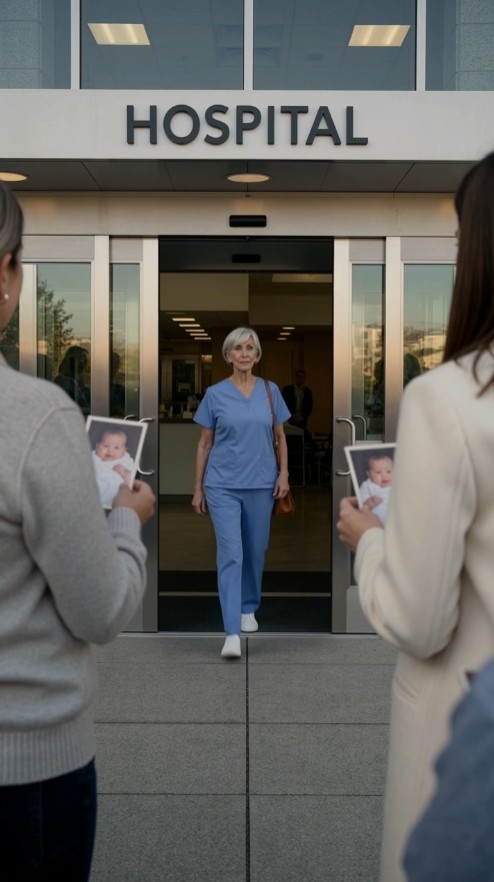
Helen had spent fifty years caring for newborn babies.
She had comforted frightened parents.
Watched tiny hands reach through incubator openings.
Celebrated first breaths without assistance.
And stood beside families during some of the most difficult moments of their lives.
Now, at seventy-four, she was finally retiring.
Her coworkers had organized a small celebration in the hospital break room.
There was a cake.
A bouquet of flowers.
And a handmade card signed by the neonatal unit staff.
Helen smiled as everyone thanked her.
But she didn’t expect anything extraordinary.
After all, she had never worked for recognition.
She had simply tried to care for each baby and family as well as she could.
That evening, she folded her uniform cardigan.
Placed it inside her old handbag.
And walked toward the hospital’s main entrance.
The automatic doors opened.
Helen stopped.
Outside stood thirty-one adults.
Some were holding children of their own.
Others stood beside elderly parents.
And every single person held a photograph of a newborn baby.
Helen stared.
“What is all this?”
A young woman stepped forward.
She was thirty-two.
In her hands was a photograph showing a tiny premature baby inside an incubator.
“Helen, do you remember me?”
Helen shook her head gently.
“I’m sorry, sweetheart.”
The woman smiled through tears.
“You probably don’t.”
She held up the photograph.
“But you held my mother’s hand when I was born.”
Helen covered her mouth.
Then another person stepped forward.
And another.
Each carried a photograph.
Each had a story.
And each had come to thank the nurse who had helped care for them during the earliest days of their lives.
Helen began crying.
But then the crowd slowly parted.
At the back stood a man in his early fifties.
He carried a small wooden box.
He approached Helen.
Then whispered:
“I was the first premature baby you ever helped care for.”
Helen stared.
The man opened the box.
Inside was something she recognized immediately.
A faded blue hospital identification card.
A tiny knitted yellow hat.
And a handwritten letter.
At the top of the letter were six words.
“TO NURSE HELEN — WHEN YOU RETIRE.”
Helen’s hands began trembling.
Because the handwriting belonged to a woman she had never forgotten.
A mother who had spent seventy-three days beside her baby’s incubator.
And who had made Helen a promise more than fifty years earlier.
The Young Nurse Who Was Afraid of Making Mistakes
Helen began working at St. Catherine’s Hospital when she was twenty-four.
It was 1976.
She had recently completed her nursing education.
She was excited.
But also nervous.
The neonatal unit was a demanding environment.
Many babies required specialized care.
Some were born prematurely.
Others experienced complications that needed close monitoring.
Helen quickly learned that caring for newborns required extraordinary attention.
She had to understand equipment.
Recognize changes in a baby’s condition.
Follow treatment plans.
And communicate carefully with families.
But there was something else she learned.
Parents often needed support just as much as their babies needed medical attention.
They were frightened.
Exhausted.
And uncertain about what the coming days might bring.
Helen couldn’t promise them happy endings.
But she could listen.
And she could make sure they understood what was happening.
The Baby in Incubator Seven
During Helen’s first weeks, a premature baby arrived in the neonatal unit.
His name was Daniel.
He had been born much earlier than expected.
His mother, Margaret, was terrified.
Daniel needed specialized care.
He was placed in an incubator.
His breathing required support.
And his medical team monitored him closely.
Helen remembered seeing Margaret standing beside the incubator for the first time.
The young mother was crying.
She pressed her hand against the outside of the transparent wall.
Then whispered:
“He’s so small.”
Helen stood beside her.
“Yes,” she answered gently.
Margaret looked toward her.
“Is he going to live?”
Helen felt her throat tighten.
She wanted to reassure the frightened mother.
But she knew she couldn’t predict the outcome.
Instead, she said:
“He’s receiving the care he needs. We’ll keep you informed, and you won’t have to face this alone.”
Margaret began crying harder.
But this time, she reached for Helen’s hand.
Seventy-Three Days
Daniel remained in the neonatal unit for seventy-three days.
Some days brought encouraging progress.
Other days were difficult.
He needed careful monitoring.
His treatment changed as his condition developed.
And his parents spent long hours at the hospital.
Helen worked alongside doctors, nurses, and other specialists caring for him.
She wasn’t the only person responsible for his recovery.
But Margaret came to trust her calm manner.
Whenever Helen was on duty, she explained the equipment in words the family could understand.
She helped Margaret learn about her baby’s care.
And when appropriate, supported supervised opportunities for the mother to touch and hold her son.
On difficult evenings, Helen sometimes stayed a little longer to answer questions or listen.
Margaret never forgot those moments.
The Tiny Yellow Hat
One afternoon, Margaret arrived carrying a little knitted hat.
It was pale yellow.
She had made it herself.
The hat was tiny.
Much smaller than one intended for a full-term newborn.
Margaret held it toward Helen.
“Do you think he’ll be able to wear this?”
Helen smiled.
“When his care team confirms it’s appropriate, we’ll see.”
Margaret nodded.
Then looked toward the incubator.
“I just wanted to make something for him.”
Helen gently touched her shoulder.
“It’s beautiful.”
The hat became one of the family’s treasured belongings.
Margaret kept it carefully.
Even after Daniel grew too big to wear it.
And many years later, that same little hat would return to the hospital.
Inside a wooden box.
The First Time Margaret Smiled
As Daniel’s condition improved, his care team gradually reduced some of the support he required.
Margaret began feeling more hopeful.
One morning, Helen entered the unit and noticed the young mother smiling.
She was sitting beside her son’s incubator.
“Good morning,” Helen said.
Margaret looked up.
“He opened his eyes.”
Helen smiled.
“Did he?”
Margaret nodded.
“And I think he looked right at me.”
Helen understood that newborn visual development was still limited.
But she also understood how meaningful the moment felt to Margaret.
She smiled warmly.
“That must have been wonderful.”
Margaret laughed through tears.
“It was.”
For the first time in weeks, she spoke about bringing Daniel home.
The Day Daniel Went Home
After seventy-three days, Daniel was finally ready for discharge.
His medical team reviewed the necessary care instructions with his family.
They discussed follow-up appointments.
Feeding.
Safe sleep.
And the signs that would require medical attention.
Margaret listened carefully.
Then she dressed Daniel in the tiny outfit she’d bought before his birth.
Helen came to say goodbye.
Margaret hugged her.
“Thank you.”
Helen smiled.
“You’ve both worked through a lot.”
Margaret began crying.
Then reached into her handbag.
She removed a small card.
On the front was a photograph of Daniel.
On the back, she had written:
You were there when I was most afraid.
I hope one day my son can thank you himself.
Helen smiled through tears.
Then Margaret said something unusual.
“When you retire, I hope he comes back to tell you what became of him.”
Helen laughed softly.
“That’s a long time away.”
Margaret smiled.
“Then we’ll wait.”
The Years That Followed
Helen continued working in the neonatal unit.
Days became months.
Months became years.
And the hospital changed around her.
New medical equipment arrived.
Treatment practices evolved.
The unit expanded.
And new generations of nurses joined the team.
Helen attended training.
Updated her skills.
And adapted to the changes in neonatal care.
But one thing remained constant.
She treated families with patience.
She explained what she could.
Admitted when she didn’t know an answer.
And worked closely with the rest of the medical team.
Some babies stayed for days.
Others remained for weeks or months.
Some families experienced joyful discharges.
Others faced heartbreaking losses.
Helen carried memories of them all.
The Parents Who Never Forgot
During her fifty-year career, Helen cared for thousands of babies.
She couldn’t remember every name.
And she never pretended she could.
But some families remained in touch through thank-you cards and hospital-approved reunion events.
Occasionally, she received a photograph.
A baby she’d once cared for was now starting school.
Or graduating.
Or becoming a parent.
Helen treasured those updates.
She kept a small collection of cards in a box at home, retaining only those families had voluntarily shared for that purpose.
Sometimes she looked through them after difficult shifts.
The photographs reminded her why she had chosen nursing.
But she never imagined that former patients would return together on her retirement day.
The Child Who Was Born During a Snowstorm
Among the thirty-one people waiting outside the hospital was a man named Andrew.
He was forty-four.
His mother had gone into premature labor during a winter storm.
Roads were difficult to navigate.
And the family arrived frightened and exhausted.
Andrew required neonatal care after delivery.
His mother remembered Helen sitting beside her during one especially long night.
Helen explained the monitors.
Helped her understand the care plan.
And reminded her to take breaks.
Now Andrew stood outside the hospital holding his own newborn daughter’s photograph beside the picture of himself as a baby.
He had come to say thank you.
The Twins Who Survived a Difficult Beginning
Two women standing near the front of the crowd were sisters.
Their names were Rachel and Rebecca.
They were thirty-eight.
Both had been born prematurely.
Their parents remembered weeks of uncertainty.
Their babies needed specialized monitoring.
And the family struggled with fear.
Helen was one of the nurses involved in their care.
She helped the parents learn how to participate safely in their daughters’ everyday routines.
Now the twins had returned together.
Each held a photograph of herself inside the neonatal unit.
Rachel smiled through tears.
“We don’t remember being here.”
Rebecca nodded.
“But our parents never stopped telling us about you.”
Helen covered her mouth.
The Mother Who Became a Nurse
Another woman stepped forward.
Her name was Olivia.
She was twenty-nine.
She held a photograph of herself as a newborn.
Beside it was a newer photograph.
Olivia wearing nursing scrubs.
Helen stared.
“You’re a nurse?”
Olivia nodded.
“I am.”
Then she smiled.
“My mother told me how much your kindness meant to her.”
Helen’s eyes filled with tears.
Olivia continued.
“Growing up, I heard stories about the neonatal unit.”
“About the doctors.”
“The nurses.”
“And the people who helped my family understand what was happening.”
She paused.
“That’s one of the reasons I wanted to work in healthcare.”
Helen reached for her hand.
Then whispered:
“That’s a beautiful reason.”
The Final Shift
Helen’s last shift began like any other.
She arrived early.
Changed into her uniform.
Reviewed assignments.
And greeted her coworkers.
Several nurses smiled when they saw her.
“Last day, Helen!”
She laughed.
“Don’t remind me.”
But as the hours passed, she became emotional.
She checked on patients.
Spoke with families.
And completed her documentation.
During a quiet moment, she looked around the neonatal unit.
The familiar equipment.
The nurses’ station.
And the chairs where frightened parents sat.
She remembered her first day.
How nervous she’d been.
How much she’d learned.
And how many people she’d worked alongside.
When her shift ended, she carefully handed over her responsibilities.
Then returned to the break room.
The Small Retirement Cake
Her coworkers had organized a modest celebration.
There were balloons.
A cake.
And a card signed by the staff.
The unit manager gave a short speech.
“Helen, you’ve spent fifty years caring for newborns and supporting families.”
She paused.
“You’ve mentored nurses, adapted to decades of medical advances, and helped create a compassionate environment.”
Helen smiled through tears.
“Thank you.”
Then she laughed.
“I was hoping to sneak out quietly.”
Everyone laughed.
They shared cake.
Took photographs.
And hugged Helen goodbye.
Eventually, she folded her cardigan.
Picked up her handbag.
And walked toward the entrance.
She believed the celebration was over.
The Thirty-One People Outside
The automatic doors opened.
Helen stepped forward.
Then stopped.
Thirty-one adults stood outside.
Each held a photograph.
Some were smiling.
Others were crying.
Helen looked confused.
Then a young woman named Sophie stepped forward.
She was thirty-two.
Her photograph showed a tiny premature baby inside an incubator.
“Helen, do you remember me?”
Helen shook her head gently.
“I’m sorry.”
Sophie smiled.
“You probably don’t.”
Then she said:
“But you held my mother’s hand when I was born.”
Helen covered her mouth.
Sophie continued.
“My mother told me you were the person who helped her understand the equipment.”
“She said you always explained what was happening.”
“And when she was frightened, you listened.”
Helen began crying.
The Stories Begin
After Sophie spoke, another person stepped forward.
Then another.
Andrew showed the photograph taken during the snowstorm.
Rachel and Rebecca held their premature baby pictures.
Olivia explained why she’d become a nurse.
A man named Thomas described how his parents had kept a thank-you card from Helen for decades.
Another woman spoke about the day her family finally brought her home.
Helen listened.
Sometimes she recognized a family name.
Other times she remembered only fragments.
But each story brought back a part of her career.
A shift.
A frightened parent.
A difficult night.
Or the joy of a baby becoming strong enough to leave the hospital.
She looked around at the adults standing before her.
Then whispered:
“You were all so little.”
The Man at the Back
Then the crowd parted.
A man stepped forward.
He was fifty years old.
He wore a dark jacket.
And carried a small wooden box.
His eyes were wet.
He approached Helen.
“Hello.”
Helen smiled through tears.
“Hello, sweetheart.”
The man laughed softly.
“You used to call me that when I was a baby.”
Helen looked surprised.
He continued.
“My name is Daniel.”
She froze.
“Daniel?”
He nodded.
“I was born in 1976.”
Helen stared.
Then whispered:
“Incubator seven?”
Daniel smiled.
“That’s what my mother called it.”
Helen covered her mouth.
He reached toward her.
“I was the first premature baby you helped care for.”
The Wooden Box
Daniel opened the box.
Inside was a faded blue hospital card.
It carried his name.
His date of birth.
And the identification details from his neonatal stay.
Beside it rested the tiny yellow knitted hat his mother had made.
And beneath the hat was a folded letter.
The envelope read:
“TO NURSE HELEN — WHEN YOU RETIRE.”
Helen’s hands trembled.
She recognized the handwriting.
“Margaret?”
Daniel nodded.
“My mother.”
Helen looked toward him.
“How is she?”
His expression softened.
“She died three years ago.”
Helen lowered her head.
“I’m so sorry.”
Daniel nodded.
“Thank you.”
Then he held out the envelope.
“She wanted you to have this.”
The Letter From Margaret
Helen opened the envelope carefully.
Inside was a handwritten letter.
The paper had been folded several times.
The ink had faded slightly.
But the words were clear.
Dear Helen,
If you’re reading this, then you’ve finally retired.
I hope somebody has made you a very large cake.
Helen laughed through tears.
Then continued.
I don’t know whether you remember me.
My name is Margaret.
My son Daniel was born too early in 1976.
He spent seventy-three days in your neonatal unit.
I was frightened every single day.
I didn’t understand the equipment.
I didn’t understand why everything kept changing.
And sometimes I was so afraid that I couldn’t ask the questions I needed to ask.
But you were patient with me.
Helen stopped reading.
Her eyes filled with tears.
Then she continued.
The Promise From Fifty Years Earlier
You never promised that Daniel would be okay.
You never told me not to worry.
Instead, you helped me understand what the medical team was doing.
You listened when I cried.
And you reminded me that I could still be his mother even when I couldn’t hold him whenever I wanted.
I remember the first day I was able to hold him safely.
I remember how carefully everyone helped us.
And I remember you standing beside me.
When Daniel finally came home, I told you I hoped he’d return one day to thank you.
I meant it.
I’ve spent fifty years telling him about the people who helped us.
And I hope that when you read this, he’ll be standing beside you.
Helen looked toward Daniel.
He nodded through tears.
“I’m here.”
The Final Words
Helen returned to the letter.
Daniel grew up.
He learned to ride a bicycle.
He graduated from school.
He fell in love.
And he became a father.
I’ve watched him live a beautiful, ordinary life.
And during every milestone, I remembered the people who cared for him when he was small.
I know many others contributed to his care.
The doctors.
The nurses.
And everyone who worked behind the scenes.
But I wanted you to know how much your kindness meant to me.
You probably won’t remember every baby you cared for.
But some of those families will remember you for the rest of their lives.
With love and gratitude, Margaret.
At the bottom was one final sentence.
“When you retire, look around. I hope you can see how many tomorrows you helped families reach.”
Helen pressed the letter against her chest.
Then began sobbing.
The Man She Once Held
Daniel stepped closer.
For a moment, Helen simply stared at him.
She remembered the tiny baby in incubator seven.
The frightened mother.
The yellow knitted hat.
And the long weeks of care.
Now Daniel stood before her.
Tall.
Healthy.
With silver beginning to appear in his hair.
Helen laughed through tears.
“Look at you.”
Daniel smiled.
“I’m a father now.”
She covered her mouth.
“Are you?”
He nodded.
“Three children.”
Then he reached into his pocket.
And removed a photograph.
It showed Daniel standing beside his wife and children.
Helen stared.
Then whispered:
“Your mother would’ve been so proud.”
Daniel nodded.
“She was.”
The Secret Behind the Gathering
Helen looked around at the thirty-one adults.
“How did you all find each other?”
Sophie smiled.
“We had help.”
She explained that Daniel had contacted the hospital several months earlier.
He wanted to arrange a private thank-you for Helen’s retirement.
The hospital couldn’t share former patients’ confidential information with him.
But with the organization’s cooperation, an invitation was distributed through an alumni-support group and voluntary outreach channels that respected privacy.
Former neonatal patients and families were invited to participate if they wished.
Some lived nearby.
Others traveled from different towns.
Several sent letters because they couldn’t attend.
Daniel helped coordinate the gathering.
And the thirty-one adults standing outside had all chosen to return.
They weren’t the only people Helen had helped care for.
They were simply the ones who could be there that evening.
The Photograph Nobody Expected
Daniel looked toward the hospital entrance.
Then smiled.
“There’s one more thing.”
Helen laughed through tears.
“I don’t think my heart can take another surprise.”
The crowd smiled.
Daniel reached into the wooden box.
He removed a photograph taken in 1976.
It showed a young nurse standing beside an incubator.
Her hair was dark.
Her face looked nervous.
And her uniform was neatly pressed.
Helen stared.
“That’s me.”
Daniel nodded.
“My mother kept this.”
Helen looked at the photograph.
She was twenty-four.
Beginning her career.
Unsure whether she’d become the nurse she hoped to be.
Now, fifty years later, thirty-one adults stood before her.
Each representing a life she’d helped care for during its earliest days.
Helen began crying again.
The Thirty-One Photographs
Sophie stepped forward.
“Helen, we have something for you.”
She held out a large album.
Its cover was dark blue.
On the front were the words:
“FIFTY YEARS OF CARING — THE LIVES THAT CONTINUED.”
Inside were thirty-one pairs of photographs.
On one side, a newborn picture.
On the other, a recent photograph of the same person.
Some showed university graduates.
Others showed parents holding children.
A few showed people at work.
There were teachers.
Mechanics.
Healthcare workers.
Artists.
And people living ordinary lives.
Beneath each pair of photographs was a short message.
Thank you for caring for me when I was small.
Helen turned the pages slowly.
Her hands trembled.
She stopped at one photograph.
Then another.
And another.
Finally, she whispered:
“I never knew.”
The Nurse Who Never Expected Thanks
Helen had never counted how many babies she’d cared for.
She couldn’t have.
Fifty years was a long time.
There had been thousands of shifts.
Countless families.
And many different medical teams.
She knew that outcomes depended on much more than one person.
Doctors.
Nurses.
Respiratory therapists.
Pharmacists.
Nutrition specialists.
And many others worked together to support vulnerable newborns.
Some families had experienced happy recoveries.
Others had endured heartbreaking losses.
Helen remembered that too.
She didn’t believe her career could be measured only by the adults standing outside.
But seeing them reminded her of the families who had trusted the unit during frightening times.
And the importance of offering compassion alongside medical care.
The Question Helen Asked
After several minutes, Helen looked toward the crowd.
“May I ask you something?”
Everyone became quiet.
She smiled through tears.
“Are you happy?”
The question surprised them.
Daniel answered first.
“Most days.”
The crowd laughed softly.
Then he added:
“I’ve had difficult years.”
“But I’ve also had a wonderful life.”
Sophie nodded.
“Me too.”
Others smiled.
Helen looked relieved.
She had spent decades caring for babies during uncertain beginnings.
She understood that no nurse could guarantee what the future would bring.
But she was grateful to see people who had grown up.
Built relationships.
Found interests.
And created lives of their own.
She whispered:
“That’s all I ever wanted for you.”
The Nurse Who Inspired Another Nurse
Olivia approached Helen again.
She held a photograph showing herself wearing scrubs.
“I wanted to tell you something.”
Helen smiled.
“Of course.”
Olivia explained that she now worked in pediatric nursing.
She cared for children and families facing difficult medical situations.
Her mother had often told her about Helen.
The way she listened.
Explained things.
And treated worried parents with respect.
Olivia smiled.
“I try to do that for my patients.”
Helen’s eyes filled with tears.
Then Olivia added:
“I never met you until today, but you’ve been part of the reason I wanted to become a nurse.”
Helen hugged her gently.
The Nurse Who Had Been Helen’s Student
At the edge of the crowd stood another woman.
She wasn’t one of the thirty-one former patients.
Her name was Patricia.
She was sixty-one.
And Helen had helped train her when she joined the neonatal unit decades earlier.
Patricia stepped forward.
“Helen, may I say something?”
Helen smiled.
“Of course.”
Patricia looked toward the group.
“I worked beside Helen for twenty-eight years.”
She paused.
“She taught me how to recognize changes in a baby’s condition.”
“How to communicate clearly.”
“And how to stay calm when families were frightened.”
Then Patricia turned toward Helen.
“You didn’t just care for babies. You helped other nurses learn how to care for them too.”
Helen began crying.
The Walk Through the Crowd
Daniel reached for Helen’s hand.
“Would you like to meet everyone?”
She nodded.
They slowly walked through the gathering.
Each person introduced themselves.
Some showed photographs.
Others shared stories from their parents.
Helen listened carefully.
She asked questions.
Smiled.
And occasionally laughed.
One man showed her a picture of his two daughters.
A woman brought a thank-you card she’d kept since childhood.
Another person explained that his parents had both died, but he’d found photographs from his neonatal stay while sorting family albums.
He wanted to thank the people who’d helped care for him when he was born.
Helen held his hand.
Then whispered:
“I’m glad you came.”
The Hospital Doors
As the gathering continued, Helen glanced toward the automatic doors.
She had walked through them thousands of times.
Some mornings, she arrived feeling rested.
Other days, she was tired.
There had been difficult shifts.
Emergency calls.
And moments when the unit’s staff supported families through loss.
But there had also been celebrations.
Babies gaining strength.
Parents learning to care for their newborns.
And families finally preparing to go home.
Now Helen stood outside those same doors.
Surrounded by adults who had once been tiny patients inside the building.
She looked toward Daniel.
Then said:
“I thought I was just going home.”
He smiled.
“You are.”
Then he added:
“But first, we wanted you to know what you meant to us.”
The Group Photograph
Before everyone left, a photographer took a picture of the gathering.
Helen stood in the center.
Daniel beside her.
The other former patients gathered around them.
Each held a baby photograph.
Some had brought their children, who stood nearby with permission.
The photographer adjusted the camera.
“Everyone ready?”
Helen began laughing.
“I haven’t had this many babies around me in years.”
The crowd laughed.
Then someone called:
“Smile, Nurse Helen!”
She looked around.
Her eyes filled with tears again.
And for the photograph, she gave the biggest smile of the evening.
The First Morning of Retirement
The following morning, Helen woke before her alarm.
For a moment, she thought she had to prepare for work.
Then she remembered.
She was retired.
She lay quietly in bed.
The house was peaceful.
There were no hospital shifts to attend.
No handovers.
And no long hours on her feet.
After breakfast, she sat at her kitchen table.
The blue photo album lay in front of her.
Beside it was Daniel’s wooden box.
Helen opened the album.
She looked through the photographs.
Then unfolded Margaret’s letter again.
You probably won’t remember every baby you cared for.
But some of those families will remember you for the rest of their lives.
Helen smiled.
Then quietly began crying.
The Card She Wrote Back
A few days later, Helen wrote a letter to Daniel.
Dear Daniel,
I don’t know how to thank you for what you did.
When I began nursing at twenty-four, I was frightened of making mistakes.
I wanted to be good at my job.
I wanted families to trust me.
And I wanted the babies in our care to receive the best treatment our team could provide.
I remember your mother.
I remember how hard those seventy-three days were for her.
I remember the yellow hat.
And I remember the joy of seeing you ready to go home.
But I never imagined I’d see you again as a grown man.
Thank you for bringing the photographs.
Thank you for sharing your mother’s letter.
And thank you for letting me see a little of the life you’ve built.
With affection, Helen.
She signed the letter.
Then added one final line.
“Please tell your children that their grandmother was an extraordinary woman.”
The Visit From Daniel’s Family
Several months later, Daniel visited Helen with his family.
His wife came.
So did their three children.
Helen welcomed them into her home.
She served tea.
Prepared biscuits.
And showed them the old photograph from 1976.
Daniel’s youngest daughter stared.
“That’s Daddy?”
Helen smiled.
“Yes.”
The little girl looked amazed.
“He was so tiny!”
Daniel laughed.
“I certainly was.”
Helen nodded.
“Very small.”
Then she showed them the yellow knitted hat.
The little girl held it carefully with permission.
“Grandma made this?”
Daniel nodded.
“She did.”
The child looked toward Helen.
“Did you help Daddy?”
Helen smiled.
“A whole team of people helped care for your daddy.”
Then she added:
“And your grandmother was there for him every day she could be.”
Fifty Years of Changes
As Helen settled into retirement, she sometimes reflected on how neonatal care had changed.
When she began, medical equipment and treatment approaches were very different from those used decades later.
She had witnessed advances in monitoring.
Respiratory support.
Nutrition.
Developmental care.
And family involvement.
She had also seen the growing importance of supporting parents’ participation in their babies’ care whenever medically appropriate.
Helen valued those changes.
She never believed that experience alone was enough.
She had continued learning throughout her career.
Attending training.
Listening to colleagues.
And adapting to evidence-based practices.
For her, being a nurse meant remaining willing to learn.
Even after decades on the job.
The Babies Who Didn’t Come Home
Helen’s retirement celebration was joyful.
But she also remembered families who had experienced loss.
Not every premature baby survived.
And not every medical situation ended as families hoped.
Helen had cared for babies whose lives were heartbreakingly short.
She remembered sitting beside grieving parents.
Helping create keepsakes when appropriate.
And supporting families through difficult conversations.
Those memories remained part of her career.
She knew the thirty-one adults at her retirement celebration represented only one part of the neonatal unit’s history.
She valued the lives of babies who hadn’t survived just as deeply.
Their families had mattered.
Their experiences had mattered.
And the compassion shown during those moments remained important.
Helen kept a quiet place in her heart for them too.
The Small Wooden Box
Daniel eventually told Helen more about the wooden box.
His mother, Margaret, had purchased it years earlier.
She used it to preserve important memories from his early life.
The identification card.
The knitted hat.
The photograph.
And several letters.
When Margaret became seriously ill, she asked Daniel to keep the box safe.
One evening, she told him:
“When Helen retires, I want her to know what happened to you.”
Daniel had been surprised.
He knew his mother was grateful to the hospital.
But he hadn’t realized how much the nurse’s kindness had meant to her.
Margaret explained.
“She didn’t save you by herself.”
“The doctors and nurses all worked together.”
“But she helped me believe I could get through the difficult days.”
Daniel promised to deliver the letter.
And he kept that promise.
The Anniversary of Her Retirement
One year after Helen retired, the hospital invited her to a small alumni gathering.
Several former coworkers attended.
So did a few families who had participated in the retirement surprise.
Helen arrived smiling.
She wore a pale-blue cardigan.
And carried her old handbag.
The hospital had prepared a display honoring five decades of neonatal nursing.
There were historical photographs.
Descriptions of medical advances.
And memories from staff members.
But Helen’s favorite part was seeing the younger nurses.
She listened as they talked about their work.
The challenges they faced.
And the importance of supporting families.
Helen smiled.
Then offered a simple piece of advice.
“Never forget that the parents standing beside those incubators are frightened human beings, not just visitors.”
The Young Nurse’s Question
During the gathering, a newly qualified nurse approached Helen.
“May I ask you something?”
Helen smiled.
“Of course.”
“After fifty years, what do you think matters most?”
Helen considered the question.
Then answered:
“Competence.”
The younger nurse looked surprised.
Helen continued.
“You need to know your work.”
“Keep learning.”
“And communicate clearly with the team.”
She paused.
“But there’s something else.”
The younger nurse listened.
Helen smiled gently.
“Remember that kindness and clinical skill belong together.”
The young nurse nodded.
Then thanked her.
Helen felt grateful that the profession she’d loved would continue in capable hands.
The Unexpected Christmas Card
That winter, Helen received a Christmas card from Daniel’s family.
On the front was a photograph of his three children.
Inside was a handwritten message.
Dear Nurse Helen,
Thank you for helping care for our dad when he was a baby.
We’re glad he grew up.
And we’re glad we got to meet you.
Love, Daniel’s children.
Helen read the card twice.
Then laughed through tears.
She placed it beside the blue photo album.
The photograph from 1976 sat nearby.
A tiny baby in an incubator.
And three smiling children born decades later.
Helen looked at both.
Then whispered:
“Goodness.”
The Memory That Stayed With Her
Of all the moments from her retirement day, Helen remembered Daniel’s wooden box most vividly.
She remembered the little yellow hat.
The faded hospital identification card.
And Margaret’s handwriting.
She remembered the frightened young mother standing beside incubator seven.
The seventy-three days.
And the morning Daniel finally went home.
At the time, Helen hadn’t known what the future would bring.
She couldn’t have imagined the baby growing into a father.
Or his mother keeping the little hat for fifty years.
She had simply gone to work.
Followed the care plan.
Supported the family.
And tried to do her job well.
Now she understood how deeply those ordinary actions had been remembered.
The Truth Behind the Thirty-One Photographs
The emotional retirement surprise began when seventy-four-year-old Helen completed her final shift after fifty years in the neonatal unit.
Her coworkers had organized a small celebration.
But when she walked through the hospital entrance, thirty-one former premature patients were waiting outside.
Each held a baby photograph.
Some also brought their children.
Others were accompanied by family members.
They had gathered voluntarily to thank Helen for her years of nursing care.
One by one, they shared stories about their families’ experiences.
Then Daniel, the first premature baby Helen had helped care for in 1976, approached with a wooden box.
Inside were keepsakes from his seventy-three-day neonatal stay.
A hospital identification card.
A tiny yellow hat.
And a letter from his late mother, Margaret.
Margaret had written the letter so Daniel could deliver it when Helen retired.
It thanked Helen for her compassion during a frightening time.
The box and the gathered former patients gave Helen an unexpected opportunity to see how some of the children she’d helped care for had grown into adults.
The Last Thing Helen Remembered
Helen spent fifty years working at the same hospital.
Thousands of mornings.
Thousands of evenings.
Countless conversations with frightened parents.
She had seen tremendous changes in medicine.
Worked with dedicated colleagues.
And cared for babies whose futures were uncertain.
Some families later returned to thank her.
Others she never heard from again.
And many experiences remained deeply personal.
But on her retirement day, thirty-one adults stood outside the hospital.
Holding photographs of the tiny babies they had once been.
Helen looked at their faces.
Their children.
Their families.
And the lives they had built.
Then she thought about the wooden box.
The yellow hat.
And the mother who had written:
I hope one day my son can thank you himself.
Fifty years later, he had.
The Nurse Who Thought She Was Going Home Alone
Helen was seventy-four when she completed her final shift.
She had worked in the neonatal unit for fifty years.
She’d cared for premature babies.
Supported frightened families.
And helped train generations of younger nurses.
She expected a quiet retirement.
A small cake.
A few goodbyes.
And a walk home.
Instead, the hospital doors opened.
Thirty-one adults were waiting outside.
Each held a photograph of themselves as a baby.
A neonatal nurse retiring after fifty years was surprised by thirty-one adults who had once been premature patients at her hospital.
They returned with baby photographs and personal stories about how her kindness had helped their families during difficult beginnings.
Then the first premature baby she had helped care for approached with a wooden box containing his hospital keepsakes and a letter his late mother had written for Helen’s retirement.
The letter thanked Helen for the care and reassurance she’d provided during seventy-three frightening days.
It also showed her what had become of that tiny baby.
A grown man.
A husband.
A father.
And someone who had carried his mother’s gratitude into another generation.
Helen knew she hadn’t achieved those outcomes alone.
She’d worked alongside medical teams whose knowledge, skill, and dedication were essential.
But the gathering reminded her that the way healthcare professionals treat families can remain meaningful long after a hospital stay ends.
When Helen finally returned home that evening, she wasn’t carrying only her handbag.
She had a blue photo album.
A wooden box.
And thirty-one stories.
Stories that began with tiny babies inside a neonatal unit.
And continued for decades afterward.
Fifty years earlier, Helen helped care for a premature baby named Daniel.
On the night she retired, Daniel returned as a grown man — carrying his mother’s final thank-you and proof of the life that continued after those seventy-three days.
For Helen, it was the most meaningful retirement gift she could have imagined.