
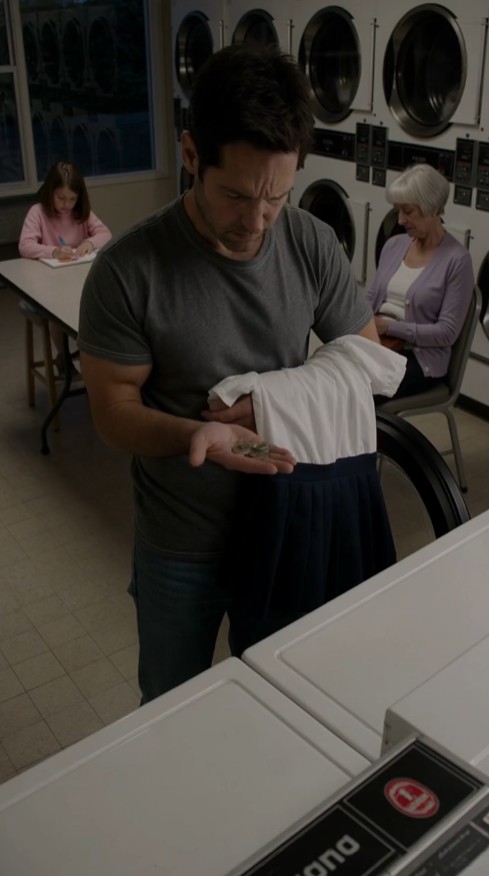
Aaron had six quarters left in his wallet.
Six small coins.
That was all the money he could spare until payday.
He was standing inside a neighborhood laundromat on a rainy Saturday evening, trying to decide which clothes to wash.
His six-year-old daughter, Grace, sat nearby, coloring flowers in a little notebook.
Aaron looked into the laundry bag.
Inside were his stained warehouse uniforms.
Several pairs of socks.
A few towels.
And Grace’s school clothes.
He couldn’t afford to wash everything.
So he made a decision.
He placed his daughter’s clothes into the washing machine.
Then folded his own dirty work uniform and tucked it back into the bag.
He would wear the same shirt again on Monday.
It wouldn’t be comfortable.
But Grace needed clean clothes for school.
Aaron inserted the last six quarters into the machine.
Then sat beside his daughter.
He didn’t notice the elderly woman watching from the next row of washers.
Her name was June.
She was seventy-nine.
And something about the young father’s quiet decision had brought back a memory she hadn’t thought about in years.
June slowly approached.
“Excuse me, young man.”
Aaron looked up.
“Yes, ma’am?”
She pointed toward the washing machine.
“Are those your daughter’s clothes?”
Aaron nodded.
“She has school Monday.”
June glanced toward the laundry bag.
“And yours?”
Aaron gave a tired smile.
“Mine can wait.”
The elderly woman became quiet.
Then she walked toward the change machine.
A minute later, she returned with a handful of quarters.
She placed them beside Aaron.
He immediately shook his head.
“Ma’am, I appreciate it, but I can’t take your money.”
June gently pushed the coins toward him.
“When I was six,” she whispered, “my father used to wash my dresses and wear the same shirt all week.”
Aaron’s eyes filled with tears.
But June wasn’t finished.
She opened her handbag.
Removed a faded photograph.
And placed it in Aaron’s hands.
He looked at the picture.
Then froze.
In the photograph stood a little girl beside a tired-looking man wearing a warehouse uniform.
But it wasn’t the man who caught Aaron’s attention.
It was the woman standing behind them.
A young woman with dark hair and a familiar smile.
Aaron recognized her immediately.
It was his late wife’s grandmother.
The woman Grace had been named after.
And when June explained who she was, Aaron realized the stranger standing before him had been connected to his family for decades.
But the photograph held another secret.
Something his wife had never known.
And it would change the way Aaron remembered the woman he’d lost.
The Father Who Was Trying to Keep Everything Together
Aaron was thirty-six years old.
He worked at a warehouse on the outskirts of town.
His shifts were long.
Sometimes he started before sunrise.
Other days, he worked late into the evening.
The job wasn’t easy.
He spent hours moving packages, checking shipments, and helping prepare deliveries.
By the time he returned home, his feet ached and his shoulders were sore.
But he always tried to smile when he opened the front door.
Because someone was waiting for him.
Grace.
His six-year-old daughter.
She was bright, curious, and loved drawing pictures.
She enjoyed school.
Asked endless questions.
And had recently learned to tie her own shoes.
Aaron loved her more than anything.
But raising her alone had become the greatest challenge of his life.
The Loss That Changed Their Family
Two years earlier, Aaron’s wife, Emily, had died after a serious illness.
She was only thirty-two.
For months, Aaron had tried to balance work, hospital visits, and caring for Grace.
Family members helped whenever possible.
But when Emily died, the house became painfully quiet.
Grace was only four.
She didn’t fully understand what had happened.
She knew Mommy wasn’t coming home.
And she knew Daddy cried sometimes when he thought nobody could see him.
Aaron tried to create a stable routine.
He made breakfast.
Packed lunches.
Helped Grace get dressed.
And read bedtime stories.
Some evenings, he was exhausted.
Other nights, he sat alone at the kitchen table looking at photographs of Emily.
He missed her laughter.
Her advice.
And the way she always seemed to know how to make Grace smile.
But every morning, he got up.
Because his daughter needed him.
The Bills That Never Stopped
After Emily’s death, Aaron struggled financially.
He had lost income during the months when he took time away from work to care for her.
There were outstanding bills.
Rent.
Utilities.
Transportation.
And everyday expenses.
He tried to build his savings again.
But unexpected costs kept appearing.
One month, the car needed repairs.
Another month, Grace needed new shoes.
Then the washing machine in their apartment stopped working.
Aaron couldn’t afford to replace it.
He began taking their laundry to a neighborhood laundromat.
Usually, he managed to wash everything.
But that particular Saturday, money was especially tight.
He had paid the electricity bill.
Purchased groceries.
And filled the car with enough fuel to get to work.
Then he opened his wallet.
Six quarters.
Nothing more.
The Saturday Evening
The laundromat was nearly empty.
Fluorescent lights hummed overhead.
Rows of washing machines lined the walls.
And a small television played quietly above the folding tables.
Grace sat on a plastic chair.
Her coloring notebook rested on her knees.
Aaron opened the laundry bag.
He sorted the clothes carefully.
His work shirts were stained.
One had a small tear near the pocket.
Another smelled faintly of warehouse dust.
He looked toward Grace’s school clothes.
Her favorite blue sweater.
Two clean-looking but worn skirts.
And the white shirt she needed for Monday.
Aaron sighed.
Then placed Grace’s clothes inside the machine.
He tucked his own uniforms away.
Grace looked up.
“Daddy?”
“Yes, sweetheart?”
“Why aren’t you washing your clothes?”
Aaron smiled.
“I’ll do mine another day.”
Grace thought about that.
Then returned to coloring.
She trusted him.
She had no idea how difficult the decision had been.
The Woman in the Purple Coat
June had been visiting the same laundromat for years.
She lived alone in a small apartment nearby.
At seventy-nine, she moved more slowly than she once had.
Her hands were slightly stiff.
And she sometimes used a cane when walking longer distances.
But she remained independent and enjoyed her familiar routines.
On Saturday evenings, she often brought a small load of laundry.
She liked the quieter hours.
And occasionally chatted with neighbors.
That evening, she noticed Aaron counting coins.
She watched him separate the clothes.
Saw him place his daughter’s belongings into the machine.
Then tuck his own uniform back into the bag.
June lowered her eyes.
The scene reminded her of her father.
A man she’d loved deeply.
A man who had once made exactly the same choice.
The Little Girl Who Grew Up With Very Little
June was born in 1947.
Her father, Walter, worked in a factory.
Her mother died when June was young.
For several years, Walter raised his daughter alone.
Money was tight.
He worked long hours.
And sometimes returned home too exhausted to eat dinner.
But every morning, he made sure June had breakfast.
He helped her prepare for school.
And kept her clothes as clean as possible.
June remembered watching him wash her dresses by hand.
Sometimes he wore the same shirt several days in a row.
Whenever she asked why, he smiled.
“Yours are more important today.”
As a child, she didn’t understand.
As an adult, she did.
And now, decades later, she was watching another father make the same sacrifice.
The Coins on the Table
June approached Aaron gently.
She asked about his daughter.
Then about the clothes in his bag.
When Aaron explained that his uniform could wait, June felt tears filling her eyes.
She walked to the change machine.
Returned with several quarters.
And placed them on the table.
Aaron immediately protested.
“Ma’am, I can’t take that.”
June smiled.
“Why not?”
He looked embarrassed.
“You’re a stranger.”
She nodded.
“That’s true.”
Then she added:
“But someone helped my father once when he needed it.”
Aaron looked toward her.
June continued.
“I’ve remembered that kindness for most of my life.”
She gently pushed the coins closer.
“Please let me do the same.”
Aaron looked down.
His eyes began filling with tears.
But before he could answer, June reached into her handbag.
And removed an old photograph.
The Photograph
The picture had faded with age.
The corners were worn.
And the paper had yellowed.
It showed a little girl standing beside a man in a work uniform.
Behind them was a young woman.
She wore a light dress.
Her dark hair was pinned neatly.
And she smiled toward the camera.
Aaron stared.
He recognized that smile.
He had seen it in Emily’s family albums.
He turned toward June.
“Where did you get this?”
June looked confused.
“It’s my father’s photograph.”
Aaron pointed toward the young woman.
“Who is she?”
June smiled.
“Her name was Grace.”
Aaron stopped breathing for a moment.
Grace.
His daughter’s name.
The same name as Emily’s beloved grandmother.
Aaron looked toward the photograph again.
Then whispered:
“That woman was my wife’s grandmother.”
June’s hands began trembling.
The Woman Named Grace
June sat down beside Aaron.
For several seconds, neither spoke.
Then she explained.
When June was six years old, her father Walter had struggled to keep their household together.
One winter, he lost several weeks of work.
They fell behind on rent.
Food became scarce.
And Walter grew increasingly worried.
One afternoon, June became ill at school.
The school contacted her father.
But Walter was working a temporary shift and couldn’t arrive immediately.
A young woman named Grace, who volunteered with a local family-support organization, helped ensure June was safely cared for until her father arrived.
Grace later helped Walter connect with practical assistance.
Food.
Clothing.
And information about local support services.
She also arranged for June to receive a warm winter coat through a community donation program.
Walter never forgot her kindness.
The Promise Walter Made
June remembered her father sitting at the kitchen table one evening.
He had just returned from work.
His hands were rough.
His shirt was worn.
And he looked exhausted.
But he was smiling.
June asked why.
Walter explained that someone had helped him find temporary financial assistance.
They would be able to keep their apartment.
And he had found steadier employment.
June looked relieved.
Then Walter said something she never forgot.
“When somebody helps you through a hard time, remember what it felt like.”
She looked confused.
“What do you mean?”
Walter smiled.
“One day, you might be able to help someone else.”
June nodded.
At six years old, she didn’t fully understand.
But she carried those words for the rest of her life.
The Strange Connection
Aaron continued staring at the photograph.
His wife Emily had often spoken about her grandmother Grace.
She remembered visiting her as a child.
Baking cookies.
Listening to stories.
And helping in the garden.
Grace had died years before Aaron and Emily married.
But Emily treasured her memory.
When their daughter was born, Emily insisted on naming her Grace.
Aaron had agreed immediately.
He loved the name.
And he loved how much it meant to his wife.
Now he was sitting inside a laundromat beside a woman whose family had received help from that very same person.
He looked toward June.
“Emily never knew about this.”
June smiled sadly.
“Perhaps not.”
Then she added:
“Your wife’s grandmother helped us during one of the hardest times of our lives.”
Aaron covered his mouth.
Tears filled his eyes.
The Little Girl Listening
Grace looked up from her coloring notebook.
“Daddy?”
Aaron turned.
“Yes, sweetheart?”
“Why are you crying?”
He wiped his eyes.
Then smiled.
“Because I just learned something beautiful about your great-grandmother.”
Grace looked curious.
“The one I’m named after?”
Aaron nodded.
“Yes.”
June smiled warmly.
“Would you like to hear a story about her?”
The little girl climbed down from her chair.
Then sat beside her father.
June showed her the photograph.
“That woman helped me when I was your age.”
Grace studied the picture.
Then looked toward June.
“Was she nice?”
June began crying.
“Very.”
The Secret Behind the Photograph
June explained that the photograph had been taken shortly after Walter found stable employment.
The family-support organization had arranged a small community gathering.
Grace volunteered to take a picture with Walter and June.
But there was another reason June had kept it.
On the back, Grace had written a short message.
June turned the photograph over.
The handwriting was faded.
But the words were still readable.
Dear June,
Your father works very hard because he loves you.
One day, when you’re grown, I hope you’ll remember that being kind can make somebody’s difficult day a little easier.
With love, Grace.
Aaron stared.
His wife’s grandmother had written those words decades earlier.
And now, more than seventy years after June was born, another little girl named Grace was sitting beside a struggling single father.
June gently placed the photograph in Aaron’s hands.
“I think you should keep a copy of this.”
The Handwritten Name
Aaron looked toward the message again.
Then noticed something near the bottom.
A small signature.
Grace Bennett.
It was the same surname that appeared in Emily’s family records.
There was no doubt.
This was the woman his wife had loved so deeply.
Aaron felt overwhelmed.
He remembered Emily talking about her grandmother.
How she always helped neighbors.
How she shared food with families who needed it.
And how she believed kindness should never make someone feel ashamed.
Aaron looked toward June.
Then whispered:
“My wife used to say her grandmother believed nobody should have to feel embarrassed about needing help.”
June smiled through tears.
“That sounds exactly like her.”
The Moment Aaron Finally Accepted
June gently pushed the quarters toward Aaron.
He looked down.
Then toward his daughter.
Grace was sitting beside him, holding her coloring notebook.
He thought about Monday morning.
The long warehouse shift.
And the stained uniform in his bag.
He also thought about what Emily would have said.
She’d never wanted him to carry every burden alone.
Aaron took a slow breath.
Then picked up the coins.
“Thank you.”
June smiled.
“You’re welcome.”
He paused.
Then added:
“I don’t know how to repay you.”
June shook her head.
“You don’t have to repay me. Just remember this when someone else needs a little help.”
Aaron nodded.
And for the first time that evening, he allowed himself to smile.
The Second Washing Machine
Aaron placed his work uniform into another washing machine.
He inserted the quarters June had given him.
Then started the cycle.
The machine began turning.
Aaron stood quietly.
He watched the water move through the clothes.
Such a small thing.
Clean work shirts.
But that evening, it meant more than he could explain.
For weeks, he had felt as though he was barely managing.
Working.
Paying bills.
Caring for Grace.
Trying not to worry her.
Now a stranger had offered help.
And reminded him that accepting kindness didn’t make him less capable as a father.
He returned to the plastic chairs.
June was showing Grace how to draw a flower.
The Coloring Page
Grace had been coloring a picture of a house.
There were two stick figures standing outside.
One was tall.
One was small.
Both were smiling.
June looked toward the notebook.
“Is that your family?”
Grace nodded.
“That’s me and Daddy.”
June smiled.
“It’s beautiful.”
Grace thought for a moment.
Then picked up another crayon.
She drew a third person beside them.
An elderly woman wearing a purple coat.
June laughed.
“Who’s that?”
Grace smiled.
“That’s you.”
June covered her mouth.
Then began crying.
Grace looked confused.
“Did I do it wrong?”
June shook her head.
“No, sweetheart.”
She wiped her eyes.
“It’s perfect.”
The Conversation They Needed
While the washing machines ran, Aaron and June talked.
He told her about Emily.
How they’d met.
How excited they’d been when Grace was born.
And how difficult life had become after losing her.
June listened.
She didn’t interrupt.
She didn’t offer easy answers.
And she didn’t pretend that a handful of quarters could solve everything.
But she understood what it meant to raise a child while struggling financially.
She told Aaron about her father.
How he’d worked long hours.
How he tried to hide his worries.
And how she only understood his sacrifices after becoming an adult.
Then she said:
“Your daughter won’t remember whether every shirt was perfect. She’ll remember that you cared for her.”
Aaron looked toward Grace.
Then quietly nodded.
The Offer Aaron Didn’t Expect
Before leaving, June asked Aaron whether he’d spoken with anyone about his financial situation.
He admitted that he hadn’t.
He didn’t want to bother relatives.
And he assumed most assistance programs would be difficult to access.
June listened.
Then explained that a local community center helped families connect with food assistance, employment resources, and other services.
She had volunteered there for years.
She offered to give him the public contact information.
Aaron hesitated.
Then accepted it.
June wrote the number on a piece of paper.
“There’s no shame in asking what help is available.”
Aaron nodded.
He folded the paper carefully.
Then placed it inside his wallet.
Beside the few receipts he carried.
The Photograph Goes Home
After the laundry finished, Aaron folded Grace’s clothes.
Then his own work uniform.
Everything smelled fresh.
He placed the clothes inside the bag.
Grace hugged June goodbye.
“Thank you for helping Daddy.”
June smiled.
“You’re very welcome.”
Then the little girl handed her the coloring page.
The drawing showed Aaron.
Grace.
And June.
Standing beside a house.
Above them, in uneven handwriting, were the words:
“NICE PEOPLE HELP.”
June stared.
Then hugged the picture against her chest.
Aaron thanked her again.
And they left the laundromat.
But that wasn’t the last time their paths crossed.
The Phone Call on Monday
On Monday morning, Aaron wore his freshly washed work uniform.
He helped Grace prepare for school.
Made breakfast.
And packed her lunch.
After dropping her off, he looked at the number June had given him.
He hesitated.
Then made the call.
A community support worker answered.
Aaron explained his situation.
His employment.
His household expenses.
And the challenges he’d faced since Emily’s death.
The worker listened.
Then described several programs he might qualify for.
Aaron arranged an appointment.
It wasn’t an instant solution.
But it was a beginning.
And for the first time in months, he felt he had somewhere to turn.
The Community Center
Later that week, Aaron visited the center.
A caseworker helped him review his budget.
They discussed available benefits, school meal assistance, utility support, and local family resources.
Some programs had eligibility requirements.
Others had waiting lists.
But Aaron learned that he wasn’t alone.
There were organizations designed to help working families experiencing financial hardship.
He also discovered that he might be eligible for support he’d never considered applying for.
The caseworker helped him understand the next steps.
Aaron left with information, appointments, and a clearer plan.
He still had bills.
Still worked long shifts.
And still faced difficult choices.
But he no longer felt that he had to manage every problem without support.
The Photograph Emily Had Kept
That evening, Aaron opened a box of Emily’s belongings.
He hadn’t looked through it in months.
Inside were old letters.
Birthday cards.
Photographs.
And a small album from her childhood.
Aaron turned the pages slowly.
Then stopped.
There was a photograph of Emily sitting beside her grandmother Grace.
They were in a garden.
Both were smiling.
Aaron looked toward the photograph June had shown him.
The same woman.
The same gentle expression.
He placed the two pictures side by side.
Then called his daughter.
“Grace, come here.”
She hurried into the room.
He showed her both photographs.
“See this woman?”
Grace nodded.
“That’s Great-Grandma Grace.”
Aaron smiled.
“That’s right.”
Then he told her the story again.
The Night Grace Asked a Question
That evening, Aaron tucked Grace into bed.
She held her favorite stuffed rabbit.
Then looked toward him.
“Daddy?”
“Yes?”
“Why did the lady give us money?”
Aaron sat beside her.
“Because she wanted to help.”
Grace thought about that.
“Did we do something wrong?”
Aaron shook his head.
“No, sweetheart.”
She looked confused.
“Then why did we need help?”
He chose his words carefully.
“Sometimes families have difficult times.”
He paused.
“And sometimes other people can help make things a little easier.”
Grace nodded.
Then asked:
“Can we help somebody someday?”
Aaron smiled.
“Absolutely.”
She looked pleased.
“Good.”
Then closed her eyes.
The Saturday They Returned
The following Saturday, Aaron and Grace returned to the laundromat.
They brought their laundry.
And something else.
A small envelope.
Inside was a printed copy of Emily’s childhood photograph with her grandmother.
Aaron hoped June might be there.
He looked around.
At first, he didn’t see her.
Then Grace pointed toward the folding tables.
“Daddy! There she is!”
June was sitting beside a machine.
Wearing her familiar purple coat.
When she saw them, she smiled.
“Well, hello!”
Grace ran toward her.
Aaron followed.
Then handed her the envelope.
“I wanted to show you something.”
The Two Photographs
June opened the envelope.
She stared at the photograph.
A young girl sitting beside an elderly woman.
Both smiling in a garden.
June looked closely.
Then covered her mouth.
“That’s Grace.”
Aaron nodded.
“My wife’s grandmother.”
June’s eyes filled with tears.
“She looks exactly how I remember her.”
She touched the edge of the photograph.
Then whispered:
“I never saw her again after we moved.”
Aaron sat beside her.
“Emily talked about her all the time.”
June began crying.
He continued.
“She used to say her grandmother believed kindness should be passed along.”
June smiled through tears.
“That’s what she taught my father too.”
The Birthday Invitation
Several months later, Aaron invited June to Grace’s seventh birthday celebration.
The party was small.
A few school friends attended.
There were balloons.
A homemade cake.
And a table covered with drawings.
June arrived carrying a modest gift.
Inside was a set of colored pencils and a drawing notebook.
Grace smiled.
“Thank you!”
June laughed.
“I thought you could use these.”
Aaron watched as his daughter hugged the elderly woman.
He remembered the first Saturday at the laundromat.
The six quarters.
The dirty work uniform.
And the stranger who offered help.
He could hardly believe how much had changed.
The Family Connection
Over time, June became a familiar presence in Aaron and Grace’s lives.
They occasionally met for coffee.
Sometimes Grace showed her school drawings.
Other times June shared stories about her childhood.
She told Grace about Walter.
Her father.
The man who washed his daughter’s dresses and wore the same shirt all week.
She also told her about the young woman named Grace who’d helped their family.
Aaron listened closely.
He learned stories about Emily’s grandmother that his wife had never known.
And he began preserving those memories for his daughter.
The connection didn’t replace Emily.
Nothing could.
But it gave Grace another way to learn about the family history behind her name.
The Job Opportunity
A year after meeting June, Aaron learned about an internal training program at his warehouse.
The program prepared experienced employees for supervisory roles.
He had considered applying before.
But he worried about finding time.
Now, with better access to support and a more stable routine, he decided to try.
He completed the application.
Attended training.
And eventually received a promotion.
The new position offered a modest salary increase and more predictable hours.
Aaron was relieved.
It didn’t make his family wealthy.
But it gave him greater breathing room.
He could save a little each month.
Plan expenses.
And spend more evenings with Grace.
When he told June, she smiled.
“I knew you’d keep going.”
Aaron laughed.
“With a little help.”
June nodded.
“That’s how most of us do.”
The Day Aaron Returned the Kindness
One rainy Saturday, Aaron arrived at the laundromat with Grace.
They noticed a young mother standing beside a washing machine.
She was counting coins.
Her toddler sat nearby in a stroller.
The woman looked worried.
Then placed several items back into her laundry bag.
Aaron recognized the expression.
The hesitation.
The careful counting.
And the quiet embarrassment.
He approached politely.
“Excuse me.”
The woman looked up.
“Yes?”
Aaron smiled.
“I think the change machine gave me a few extra quarters.”
He held out several coins.
“Could you use these?”
The woman looked surprised.
Then smiled gratefully.
“Thank you.”
Aaron nodded.
“You’re welcome.”
He didn’t ask questions.
And he didn’t expect anything in return.
The Woman Who Watched
June was sitting near the window.
She had seen the entire interaction.
When Aaron returned, she smiled.
“Looks familiar.”
He laughed softly.
“Does it?”
June nodded.
Aaron sat beside her.
Then said:
“You told me to remember what it felt like.”
June smiled.
“And you did.”
Grace looked between them.
Then asked:
“What are you talking about?”
Aaron lifted his daughter onto his lap.
He pointed toward the washing machines.
“Remember when June helped us?”
Grace nodded.
“With the quarters?”
“That’s right.”
He smiled.
“Today we helped someone else.”
Grace looked pleased.
Then whispered:
“Nice people help.”
June began crying.
The Photograph on the Wall
Aaron eventually framed two photographs.
One showed June as a little girl beside her father and Emily’s grandmother.
The other showed Grace standing beside June at her seventh birthday party.
He placed them on the living room wall.
Beneath them was a small handwritten message.
“KINDNESS DOESN’T END WITH THE PERSON WHO RECEIVES IT.”
Grace loved the display.
She often asked Aaron to tell the story.
He explained how June’s father had struggled.
How her family received help.
And how decades later, June had helped them.
Grace listened carefully.
Then pointed toward her great-grandmother.
“She started it?”
Aaron smiled.
“She was one of the people who helped keep it going.”
The Truth Behind the Six Coins
The emotional encounter began when thirty-six-year-old Aaron entered a laundromat with his six-year-old daughter, Grace.
He had only six quarters.
Not enough to wash all their clothes.
So he washed Grace’s school uniform and left his own work clothes in the bag.
An elderly woman named June noticed.
She remembered her own father making similar sacrifices when she was a child.
June offered Aaron quarters so he could wash his uniform too.
Then she showed him an old photograph.
In it was June as a little girl, her father Walter, and a young woman who had helped their family decades earlier.
Aaron recognized the woman.
She was his late wife’s grandmother.
The same person his daughter Grace had been named after.
June explained that the woman had helped her father find support during a difficult period.
Her kindness had remained meaningful to the family for decades.
The encounter inspired Aaron to seek practical assistance for his own household.
Over time, his circumstances improved.
And he found ways to offer small acts of kindness to others.
The Last Thing June Remembered
When June thought about that Saturday evening, she remembered Aaron counting the coins.
She remembered his daughter’s school clothes.
And the stained work uniform he couldn’t afford to wash.
But the most meaningful moment came afterward.
When Aaron recognized the woman in her photograph.
June had carried that picture for decades.
It reminded her of her father.
The difficult years.
And the woman who had helped them.
She never imagined she’d meet the granddaughter’s husband in a laundromat.
Or that he’d be raising a little girl named Grace.
But the connection made her feel that the kindness she’d received as a child had come full circle.
She had grown older.
Her father was gone.
And the young woman in the photograph had died years earlier.
But their actions still mattered.
The Father Who Had Only Six Quarters
Aaron was thirty-six.
He worked long shifts.
Raised his daughter alone.
And tried to make every dollar last.
That Saturday, he stood inside a laundromat with six quarters.
He couldn’t wash everything.
So he chose his daughter’s clothes.
His own uniform would have to wait.
Then a seventy-nine-year-old woman approached.
She offered him quarters.
And showed him a faded photograph.
A struggling single father met an elderly woman who recognized his sacrifice because her own father had made the same choice decades earlier.
When she showed him a photograph from her childhood, he recognized his late wife’s grandmother — the woman his daughter had been named after.
The photograph revealed a decades-old act of kindness that connected their families, inspiring Aaron to seek support and eventually help others facing similar difficulties.
The encounter didn’t instantly solve Aaron’s financial problems.
He still needed to work.
Manage bills.
And care for Grace.
But it reminded him that accepting help wasn’t something to be ashamed of.
It also gave him a piece of Emily’s family history.
A story about her grandmother’s kindness.
And the people who had remembered it.
Years later, Aaron still thought about those six quarters.
The washing machine.
And the woman in the purple coat.
He remembered how embarrassed he’d felt when June offered help.
And how relieved he’d been when he finally accepted.
Aaron thought he was choosing between his daughter’s clean clothes and his own work uniform.
He never imagined that the elderly woman who noticed would carry a photograph connecting their families across generations.
And sometimes, what begins as a handful of coins can become a reminder that kindness is worth carrying forward.