
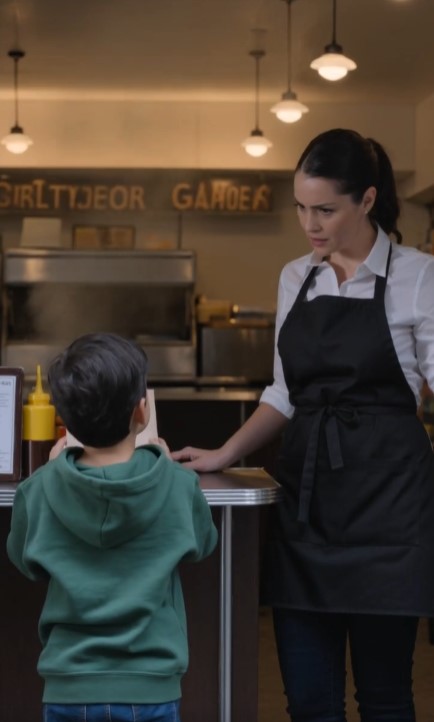
A little boy came to the diner every night and ordered two dinners.
At first, nobody thought much of it.
The diner sat on the corner of a quiet street, squeezed between a closed bookstore and an old pharmacy. Every evening, the same regulars came in for coffee, soup, or pie, and the waitresses knew most of them by name.
Then the boy started coming.
His name was Noah.
He was small, maybe nine years old, with a worn backpack, messy brown hair, and shoes that looked too big for his feet. He always came just before closing, when the dinner rush had faded and only the hum of the refrigerator and the soft clink of dishes filled the room.
He sat at the same booth near the window.
And every night, he ordered the same thing.
Two dinners.
One for himself.
One to-go.
The waitress, Grace, thought the second meal was for his mother.
“Long day at work?” she asked kindly one night, packing the food into a paper bag.
Noah nodded without looking up.
“Something like that.”
He always paid with small bills and coins, carefully counted from a little envelope in his backpack. He never asked for dessert. He never wasted food. He ate quickly, then took the to-go bag and left through the back alley instead of the front door.
Grace noticed that too.
But she told herself not to interfere.
Maybe he lived nearby.
Maybe he was helping someone at home.
Maybe his family was going through a hard time.
Then one cold night, she saw him leave without buttoning his jacket.
Snow was falling softly over the alley, and the wind was sharp enough to make the diner windows shake. Grace watched through the back door as Noah held the warm paper bag against his chest and walked toward the dark space behind the closed bookstore.
Something in her heart told her to follow.
She grabbed her coat and stepped outside.
“Noah?” she called softly.
The boy froze.
He turned around, fear flashing across his face.
“I paid for it,” he said quickly.
Grace’s heart broke a little.
“I know, sweetheart. I’m not here because of that.”
Noah looked down at the bag.
“I just have to bring it to someone.”
Grace expected to see a parent.
Maybe a tired mother waiting in a car.
Maybe a sick relative nearby.
Instead, she followed him behind the bookstore and stopped.
An elderly man sat against the brick wall, wrapped in cardboard and an old blanket. His face was hidden beneath a gray knit cap, and his hands shook from the cold. Beside him was a small pile of belongings in a torn shopping bag.
Noah walked straight to him and held out the warm meal.
“I got chicken tonight,” the boy said gently. “And mashed potatoes.”
The old man looked up slowly.
His eyes softened when he saw the child.
“You shouldn’t be out this late,” he whispered.
Noah sat beside him on an overturned crate.
“My grandma said nobody should eat alone.”
Grace stood frozen near the corner of the building.
The old man took the bag with trembling hands.
Then he looked more closely at Noah’s face.
His expression changed.
The bag slipped from his hands and fell onto the snow.
Noah jumped up.
“Are you okay?”
The old man’s lips trembled.
For a moment, he looked like he had seen a ghost.
“You look like him,” he whispered.
Noah frowned.
“Like who?”
The old man covered his mouth, tears filling his eyes.
“My son.”
Grace stepped forward then, unable to stay hidden.
“Noah,” she said softly, “does your family know you come here?”
Noah lowered his head.
“My grandma gives me dinner money,” he said. “But I save some from lunch too. I don’t tell her because she’ll worry.”
Grace looked at the old man.
“What’s your name?”
The man hesitated.
“Arthur,” he said. “Arthur Bennett.”
Grace remembered that last name.
Noah’s grandmother had come into the diner once, months earlier. Her name was Margaret Bennett. She had talked about raising her grandson after losing contact with her husband many years ago. Grace had not thought much of it then.
Now the pieces began to move in her mind.
“Noah,” she asked carefully, “what was your grandfather’s name?”
The boy shrugged.
“I don’t know. Grandma said he died before I was born.”
The old man’s eyes filled with pain.
Grace’s stomach tightened.
The next morning, she called Margaret.
She did not tell her everything at once. She only asked her to come to the diner.
When Margaret arrived, she looked tired and worried, still wearing her house slippers beneath her long coat.
“Is Noah in trouble?” she asked.
Grace shook her head.
“No. But there is someone you need to see.”
Margaret followed her outside to the alley behind the bookstore.
Arthur was sitting in the same place, holding the untouched paper bag from the night before.
The moment Margaret saw him, she stopped walking.
Her face went white.
Arthur slowly stood, using the wall for support.
“Margaret,” he whispered.
She covered her mouth.
“No,” she breathed. “Arthur?”
Noah stood beside Grace, confused.
“Grandma?”
Margaret began to cry.
For years, she had believed Arthur was dead.
He had disappeared after a terrible accident that took their son’s life twenty years earlier. Grief had broken the family apart. Arthur left home one night, leaving behind only a note saying he could not bear the pain. Months passed. Then years. Someone later told Margaret he had died in another city, and she believed it because believing anything else hurt too much.
But Arthur had not died.
He had been living with guilt, loss, and shame, drifting from place to place until he ended up back in the same town where his family had once lived.
He never knew he had a grandson.
He never knew his son had left behind a child.
And Noah never knew the man he had been feeding in the alley was his own grandfather.
Margaret stepped closer, crying harder with every step.
“You were alive,” she whispered.
Arthur lowered his head.
“I didn’t think I deserved to come back.”
Noah looked from one to the other.
Then he whispered, “He’s my grandpa?”
Margaret nodded through tears.
Noah walked slowly toward Arthur, still holding the warm dinner bag from that morning.
“I brought breakfast,” he said softly.
Arthur broke down.
He dropped to his knees in the snow and pulled the boy into his arms.
“I didn’t know,” he sobbed. “I didn’t know about you.”
Grace stood beside the diner wall, wiping her eyes with her sleeve.
She had followed a child because she was worried.
Instead, she had watched a family find the missing piece of itself.
The diner opened late that day.
Nobody complained.
Grace brought Arthur inside, warmed him with coffee, and placed a plate of eggs in front of him. Margaret sat beside him, holding Noah’s hand, while years of silence slowly turned into words.
There were apologies.
There were tears.
There were questions that could not be answered easily.
But there was also something nobody expected anymore.
A second chance.
In the weeks that followed, Arthur moved into a small room at a local shelter while Margaret helped him get documents, medical care, and support. Noah visited him often, always bringing drawings, school stories, and sometimes a cookie wrapped carefully in a napkin.
Eventually, Arthur came to the diner not as a man hiding from the cold, but as family.
He sat in Noah’s booth near the window.
This time, they ordered three dinners.
One for Noah.
One for Margaret.
One for Arthur.
Grace set the plates down and smiled through tears.
Noah looked at his grandfather and said, “Grandma was right.”
Arthur wiped his eyes.
“About what?”
Noah smiled.
“Nobody should eat alone.”
Sometimes kindness begins as a small meal in a paper bag.
Sometimes a child sees a person the world has stopped seeing.
Sometimes the stranger in the alley is not a stranger at all.
And sometimes, one warm dinner carried through the cold can bring a lost grandfather home.