
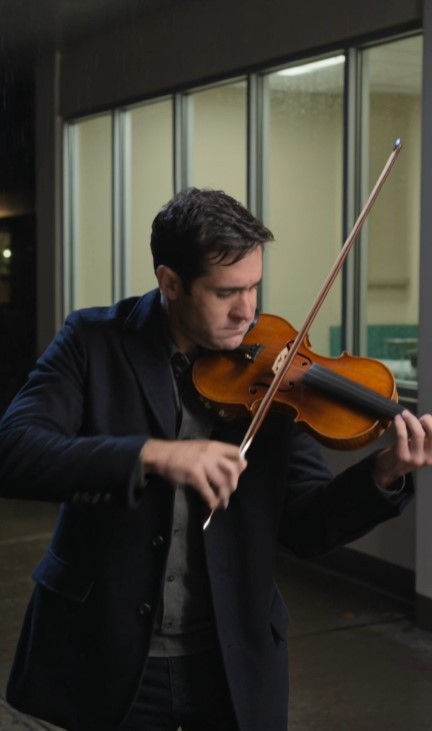
A man played violin outside the children’s hospital every evening.
Rain or snow.
Cold or heat.
He came just before sunset, stood beneath the same window, lifted the violin to his shoulder, and played one song.
Only one.
The melody was soft, slow, and full of sadness, the kind of music that made people stop for a second even if they didn’t know why.
But the man never asked for money.
There was no open case at his feet.
No sign.
No hat.
No jar for coins.
He never spoke to anyone.
When parents walked past, he lowered his eyes.
When security asked what he was doing, he only said, “Playing.”
Then he would return the bow to the strings and begin again.
Some people thought he was strange.
Some thought he was lonely.
Some thought he was just another street musician with nowhere else to go.
But every evening, he stood beneath the same hospital window.
Room 214.
Inside that room was a little girl named Lily.
She was seven years old, small for her age, with tired eyes and a stuffed rabbit tucked beneath her arm. Her mother, Clara, spent every night beside her bed, holding her hand through tests, medicine, and long hours of fear.
For days, Clara barely noticed the music outside.
Hospitals are full of sounds.
Machines.
Footsteps.
Whispers.
Crying.
The violin was just another sound drifting through the glass.
Until one evening, Lily opened her eyes and began humming.
Clara froze.
The melody was faint at first.
Then clearer.
Lily hummed along with every note, as if she had known the song her whole life.
Clara’s hand tightened around the blanket.
“Lily,” she whispered, “how do you know that song?”
The little girl looked toward the window.
“I don’t know,” she said softly. “It feels like home.”
Clara stood slowly.
Her face had gone pale.
That song was not famous.
It was not on the radio.
It was not from a movie.
It was a lullaby.
A private song.
The song Lily’s father used to play before he vanished years ago.
His name was Daniel.
He had been a violinist, gentle and quiet, always making up little melodies for Lily when she was a baby. Every night, he would sit beside her crib and play the same lullaby until she fell asleep.
Then one winter evening, Daniel disappeared after a serious accident on a road outside town.
His car was found damaged.
His violin case was gone.
And Daniel was never found.
Clara searched for months.
Police searched.
Friends searched.
But time passed, and the world slowly told her to accept what her heart could not.
Now, years later, that same melody was rising from the sidewalk below her daughter’s hospital room.
Clara ran.
She left Lily with a nurse and rushed down the hallway, down the stairs, through the lobby, and out into the cold evening air.
The violinist was still there beneath the window.
His coat was worn.
His hair was longer than she remembered.
His face was thinner, older, marked by years she had not seen.
But the song was the same.
Clara stopped a few feet away.
Her voice broke before she could finish his name.
“Daniel?”
The bow stopped.
The man lowered the violin slowly.
For a moment, he only stared at her.
His hands began to shake.
“I know you,” he whispered.
Clara covered her mouth.
He looked confused, frightened, and full of pain.
“I don’t know how,” he said. “But I know your voice.”
Tears streamed down Clara’s face.
“Daniel,” she whispered again. “It’s me. Clara.”
The violin slipped slightly in his hand.
He stepped back as if the name had struck something deep inside him.
“Clara,” he repeated.
Security came closer, unsure what was happening, but Clara raised one hand to stop them.
The man pressed his fingers against his forehead.
“I don’t remember everything,” he said, trembling. “There was a crash. A hospital. Names I couldn’t hold onto. I remembered music. Only music.”
After the accident, Daniel had been found far from town with no identification. Head trauma had stolen pieces of his memory, and confusion carried him through shelters, clinics, and unfamiliar streets. He remembered how to play. He remembered one song. He remembered that the song belonged to someone he loved.
But he did not remember where home was.
So he played it.
Every evening.
Everywhere he went.
Until something inside him brought him to the children’s hospital.
Until he stood beneath Room 214 without knowing why.
Until the daughter he had been trying to find heard him from the window.
Clara grabbed his hand.
“There’s someone you need to see.”
Daniel followed her inside like a man walking through a dream.
When they reached Room 214, Lily was sitting up in bed, still holding her stuffed rabbit.
The moment Daniel stepped through the door, she stared at him.
He stared back.
No one spoke.
Then Lily whispered, “That’s the song.”
Daniel’s face crumpled.
He took one step closer.
Clara said softly, “Lily… this is your father.”
The little girl’s eyes filled with tears.
“My daddy?”
Daniel dropped to his knees beside the bed.
“I’m sorry,” he said, his voice breaking. “I tried to find you. I didn’t know how.”
Lily reached out with her small hand and touched his face.
Then she began humming the lullaby again.
Daniel closed his eyes.
This time, the memory came with it.
A crib.
A tiny hand.
Clara standing in the doorway.
Lily laughing as he played the last note wrong on purpose.
He began to cry so hard he could not speak.
Clara wrapped one arm around him, and Lily held his hand like she had been waiting all her life to do it.
The nurses stood quietly near the door, wiping their eyes.
Security, the same people who had thought he was strange, lowered their heads and stepped away.
The man outside the hospital had not been playing for attention.
He had not been playing for money.
He had been playing the only piece of himself that survived.
And somehow, that song had led him back to the two people his mind had forgotten but his heart had never stopped searching for.
After that night, Daniel did not play outside the hospital anymore.
He played inside Room 214.
Softly.
Gently.
Beside Lily’s bed.
The doctors said familiar voices and comfort helped her rest. Clara said the music brought warmth back into the room. Lily simply called it “Daddy’s song.”
Weeks later, when Lily was strong enough to leave the hospital, Daniel stood by the exit with his violin in one hand and Clara’s hand in the other.
Lily looked up at him and smiled.
“Can you play it at home?”
Daniel’s eyes filled again.
“Yes,” he whispered. “Every night.”
Sometimes love survives what memory cannot.
Sometimes the heart keeps a song long after the mind loses the words.
And sometimes, the melody everyone ignores outside a hospital window is actually a father trying to find his way back home.