
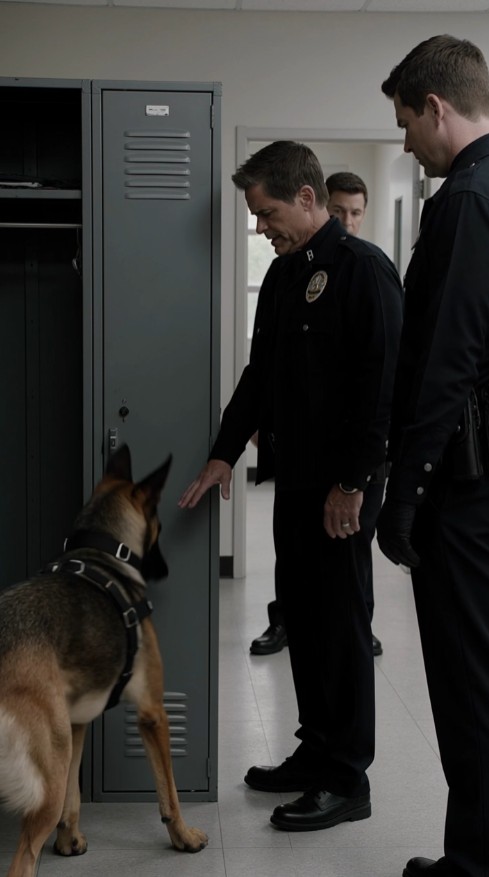
The police station went completely silent when a small pink bracelet rolled out from beneath the chief’s locker.
Six months earlier, nine-year-old Lily Anderson had disappeared while walking home from school.
More than one hundred officers and volunteers had searched for her.
Detectives had examined security footage, interviewed witnesses, and followed dozens of leads.
But nobody had found Lily.
Now her bracelet was lying on the floor of the police headquarters.
And the only reason anyone had noticed it was a German Shepherd named Rex.
“That’s impossible,” Police Chief Robert Harrison whispered.
Officer Daniel Mason slowly knelt beside the bracelet.
He recognized the tiny silver butterfly hanging from its clasp.
Lily’s mother had shown him photographs of it during the investigation.
Her daughter wore it every day.
Mason looked toward his chief.
“Sir… this belongs to Lily Anderson.”
Harrison stared at the bracelet.
“I’ve never seen that before.”
But Rex wasn’t looking at the chief anymore.
The powerful German Shepherd turned toward the doorway.
His ears lifted.
His entire body became rigid.
Then he began growling.
Standing near the door was Deputy Chief Thomas Whitaker.
The second Rex looked at him, Whitaker took a step backward.
“I have a meeting,” he said quickly.
Mason stood.
“Deputy Chief, wait.”
Whitaker reached for the door.
Rex barked sharply.
The deputy stopped.
And that was when Mason noticed something else.
A tiny pink thread was caught on the deputy’s jacket sleeve.
It was the same color as Lily’s missing school backpack.
Mason looked between the thread and the bracelet.
Then he asked the question that would change the investigation.
“Why was a missing child’s bracelet inside the chief’s locker?”
Whitaker didn’t answer.
Instead, he looked toward Chief Harrison.
And whispered:
“Robert, you need to remember what we agreed.”
The chief’s face went pale.
Because suddenly, the missing girl’s case was no longer just about a child who had disappeared.
It was about what someone inside the police department had been hiding for six months.
The Disappearance That Haunted an Entire Town
Lily Anderson disappeared on a rainy Tuesday afternoon in October.
She was nine years old, cheerful, and loved drawing animals.
Her mother, Sarah Anderson, worked as a nurse at the local hospital.
Her father, Michael, was a mechanic.
Lily was their only child.
Every afternoon, she walked home from school along a familiar route.
The journey usually took fifteen minutes.
On the day she disappeared, she left school shortly after three o’clock.
A crossing guard remembered seeing her near Oak Street.
A shopkeeper reported that she stopped outside a bakery.
Then she vanished.
Her pink school backpack was never found.
Neither was the small silver butterfly bracelet her grandmother had given her.
The case shocked the community.
Volunteers searched nearby parks, abandoned buildings, and wooded areas.
Police dogs followed scent trails.
Investigators checked traffic cameras and interviewed local residents.
But the leads gradually disappeared.
After six months, Lily’s parents were still waiting for answers.
The German Shepherd Who Never Forgot Her Scent
Rex was a five-year-old German Shepherd assigned to Officer Daniel Mason.
The two had worked together for three years.
Rex was trained in tracking and locating missing people.
He was energetic, disciplined, and particularly attentive to familiar scents.
When Lily first disappeared, Rex participated in the search.
Investigators provided him with a clothing item belonging to the girl.
The dog followed a trail from the school toward a quiet service road.
But heavy rain complicated the search.
Vehicle traffic had also disturbed the area.
Eventually, the trail ended near an industrial district.
Mason never forgot that day.
He remembered Rex repeatedly returning to one section of the road.
The dog appeared interested in something near an old warehouse.
But the search team found no evidence that Lily had been there.
The warehouse was owned by a company with several local government contracts.
Investigators were told the building was unused.
The search moved elsewhere.
And Lily remained missing.
The Chief’s Locker That Rex Wouldn’t Leave Alone
Six months later, Mason brought Rex to police headquarters after a training session.
The dog was walking calmly through the staff corridor when he suddenly stopped.
His nose moved toward a row of metal lockers.
Chief Harrison was standing nearby, preparing to retrieve his coat.
“Morning, Mason.”
“Morning, Chief.”
Harrison approached his locker.
But Rex stepped in front of it.
Mason tightened the leash.
“Rex, heel.”
The dog refused.
He sniffed around the bottom vent.
Then pawed at the metal.
Several officers laughed.
“Maybe the chief’s hiding treats in there.”
Harrison smiled briefly.
“Not today.”
But Rex began growling.
Not at the chief.
At the locker.
Mason immediately became concerned.
Rex’s behavior was unusual enough that he asked the chief to wait before opening it.
Then the dog struck the lower panel with one paw.
Something small rolled onto the floor.
A pink bracelet.
And the entire corridor went quiet.
The Bracelet Lily Never Took Off
Mason recognized the bracelet because he’d seen it in photographs throughout the investigation.
It was made of pink braided cord with a small silver butterfly charm.
Lily’s grandmother had given it to her for her eighth birthday.
Sarah Anderson once told investigators that Lily rarely removed it.
She wore it to school.
To birthday parties.
And even while sleeping.
During the original search, police had circulated a description of the bracelet.
It was one of the few distinctive personal items Lily had been wearing.
Now Mason was staring at what appeared to be the same bracelet.
He carefully photographed it without touching it further.
Then called the evidence unit.
Chief Harrison looked stunned.
“How did that get there?”
Mason turned toward him.
“Sir, when was the last time you opened this locker?”
“Yesterday.”
“Did you notice anything unusual?”
The chief shook his head.
“No.”
Then Rex suddenly began growling toward Deputy Chief Whitaker.
The Deputy Who Wanted to Leave
Thomas Whitaker had worked for the department for twenty-two years.
He was respected by many officers and had handled several major investigations.
He also supervised the original search for Lily.
When Rex began growling at him, Whitaker looked irritated.
“Control your dog, Mason.”
Mason held the leash firmly.
“He’s under control.”
Whitaker stepped toward the exit.
“I have somewhere to be.”
Mason noticed the pink thread on his jacket.
“Deputy Chief, can you stay for a moment?”
Whitaker stopped.
“Why?”
“We need to establish who had access to this area.”
Whitaker’s expression hardened.
“Are you accusing me of something?”
“No, sir. I’m asking questions.”
The deputy looked toward Harrison.
Then said quietly:
“Robert, you know why this can’t become public.”
The chief stared at him.
“What are you talking about?”
Whitaker didn’t answer.
And the silence between them made Mason increasingly suspicious.
The Evidence That Should Never Have Been in the Locker
Investigators secured the corridor and began examining the bracelet.
The first question was whether it genuinely belonged to Lily.
Her parents were contacted.
Sarah identified the bracelet’s distinctive butterfly charm and a repaired section of the clasp.
A forensic examination later supported the identification.
The second question was how it entered Chief Harrison’s locker.
The locker had a standard key-operated lock.
Harrison possessed one key.
A duplicate was kept in a secure administrative cabinet.
Only a small number of senior staff had access to that cabinet.
Investigators reviewed access records.
They discovered that Whitaker had signed out the duplicate key two days earlier.
His stated reason was a routine facilities inspection.
But no such inspection had been scheduled.
The discovery raised immediate concerns.
Why would the deputy need access to the chief’s locker?
And why had Lily’s bracelet appeared there shortly afterward?
The Security Camera Everyone Forgot
The police headquarters had recently installed new hallway cameras.
Most employees knew about the cameras near the main entrance.
But a smaller camera had been placed above the staff corridor following several incidents of missing personal property.
Investigators reviewed the footage.
Two nights before Rex discovered the bracelet, Whitaker entered the locker area after most employees had left.
He carried a small envelope.
He approached Harrison’s locker and appeared to unlock it.
Then he remained there for approximately one minute.
When he left, the envelope was no longer visible.
The recording couldn’t establish exactly what he’d placed inside.
But it confirmed that Whitaker had accessed the locker.
The evidence contradicted his claim that he had never opened it.
He was removed from involvement in Lily’s case while an independent investigative team examined the circumstances.
Why Someone Wanted to Frame the Chief
At first, investigators believed Whitaker had placed the bracelet in Harrison’s locker to make the chief appear connected to Lily’s disappearance.
But that raised another question.
Why would a deputy chief attempt to implicate his own superior?
The answer emerged from a separate internal investigation.
Chief Harrison had recently ordered a review of several unresolved cases.
Among them was Lily’s disappearance.
He believed important evidence had been overlooked during the original search.
The review was scheduled to begin the following week.
Whitaker had supervised the earlier investigation.
If the new review exposed mistakes or misconduct, his career could be threatened.
Investigators began examining whether the bracelet had been planted to discredit Harrison before the review could begin.
But they still needed to know how Whitaker had obtained it.
The answer would lead them back to the warehouse Rex had investigated six months earlier.
The Warehouse That Was Never Properly Searched
The original search records showed that Rex had followed Lily’s scent toward an industrial district.
The trail ended near a warehouse on Miller Road.
Mason remembered the location clearly.
He had requested permission to search the building.
But Whitaker told him the property had already been checked.
According to the deputy, another team had inspected the warehouse and found nothing.
Mason accepted the explanation.
Now investigators reviewed the original reports.
They discovered that no formal search record existed.
The supposed inspection had never been documented.
And the officer Whitaker claimed had conducted it was assigned to another location that day.
The discrepancy was significant.
A major lead had apparently been dismissed without proper investigation.
Independent detectives obtained a warrant to search the warehouse.
What they found inside changed the case.
The Hidden Room Behind the Storage Shelves
The warehouse appeared abandoned.
Its windows were dusty.
Several sections contained unused equipment.
But investigators noticed that one interior wall had been recently modified.
Behind a row of heavy storage shelves was a narrow doorway.
It led to a small room.
Inside were a folding bed, blankets, bottled water, and children’s clothing.
Investigators also discovered drawings taped to the wall.
One showed a small brown dog.
Another showed a yellow house with flowers.
On the back of one drawing was written a name.
Lily.
Mason felt his chest tighten.
The girl had been there.
But the room was empty.
Investigators collected evidence and began examining recent activity around the property.
They discovered fresh tire marks outside a rear entrance.
Someone had moved recently.
And there were signs that the room had been used only days earlier.
The Phone Call That Led to Lily
While forensic specialists examined the warehouse, investigators reviewed its ownership records.
The property belonged to a logistics company named Northstar Freight.
One of its senior managers was a man named Victor Hale.
Victor had previously worked with Whitaker on a private security project.
Financial records revealed that the two maintained a business relationship.
Investigators obtained relevant communication records through legal procedures.
They discovered repeated contact between Whitaker and Victor during the months after Lily disappeared.
Several calls occurred shortly before officers searched the warehouse.
Then investigators identified a telephone number connected to a rural property outside the city.
The number had been contacted repeatedly during the previous week.
A search warrant was obtained.
Officers traveled to the property.
And there, six months after Lily vanished, they found the answer her family had been waiting for.
The Little Girl Behind the Locked Door
The rural property was a small house surrounded by fields.
Investigators approached carefully.
They had reason to believe a child might be inside.
A specialist team entered the house and secured it.
In a bedroom at the back, they found a little girl sitting on a mattress.
She was thin, frightened, and holding a worn stuffed rabbit.
An officer knelt several feet away.
“Hi, sweetheart. My name is Anna. I’m here to help.”
The girl stared at her.
“Are you police?”
“Yes.”
She looked toward the doorway.
“Is Victor coming back?”
The officer shook her head gently.
“You’re safe right now.”
The girl began crying.
“My mom doesn’t know where I am.”
Anna felt tears in her eyes.
“What’s your name?”
The child whispered:
“Lily Anderson.”
After six months of uncertainty, the missing nine-year-old had been found alive.
The Call Her Mother Had Prayed For
Sarah Anderson was sitting at her kitchen table when the telephone rang.
For six months, she’d answered every unknown number.
She always hoped someone would have news.
Most calls brought disappointment.
But this time, a detective spoke carefully.
“Mrs. Anderson, we’ve located Lily.”
Sarah froze.
“Is she alive?”
“Yes.”
The word seemed impossible.
Sarah covered her mouth.
“Where?”
“She’s safe with officers and medical personnel.”
Sarah began sobbing.
Michael rushed into the room.
“What happened?”
She looked at him through tears.
“They found her.”
He stared.
“What?”
Sarah could barely speak.
“They found our baby.”
The family was reunited later under the supervision of professionals trained to support children after traumatic experiences.
When Lily saw her mother, she ran toward her.
And for the first time in six months, Sarah held her daughter again.
Why Lily Had Been Taken
As investigators examined the kidnapping, they discovered that Victor Hale had been involved in a separate criminal operation.
The logistics company he managed was being used to conceal stolen goods.
Lily had witnessed something she wasn’t supposed to see.
On the afternoon she disappeared, she took a shortcut near the industrial district after leaving school.
She saw men unloading suspicious packages from a truck.
One of the men noticed her.
Victor feared the child could identify people involved in the operation.
Instead of allowing her to leave, he detained her.
Investigators later established that Lily was moved between properties while Victor attempted to avoid detection.
Whitaker had learned about the incident shortly afterward.
Rather than reporting it, he helped conceal information that could have connected Victor to the disappearance.
The motive wasn’t a ransom.
It was an attempt to prevent a child from becoming a witness.
The Deputy’s Role Finally Comes to Light
Whitaker initially denied knowing anything about Lily’s location.
But investigators recovered communications showing that he had received information about the warehouse.
He had also warned Victor about police search activity.
The evidence supported allegations that Whitaker had obstructed the investigation.
He had deliberately dismissed the warehouse lead.
Provided misleading information to other officers.
And interfered with attempts to identify Victor.
The bracelet became a central piece of evidence.
Investigators concluded that Whitaker had obtained it from Victor and planted it inside Harrison’s locker.
His apparent goal was to create suspicion around the police chief before the unresolved-case review.
But the plan failed.
Rex discovered the bracelet before Whitaker could direct attention toward it on his own terms.
Instead of discrediting the chief, the discovery prompted scrutiny of Whitaker’s actions.
The Police Chief’s Painful Realization
Chief Harrison was devastated by the findings.
He had trusted Whitaker for years.
The deputy was one of his most experienced officers.
He had supervised important investigations and handled sensitive cases.
Now evidence suggested that Whitaker had helped conceal a child’s kidnapping.
Harrison ordered a complete independent review of Lily’s case.
He also asked outside authorities to examine the department’s handling of the original search.
The review identified serious failures in supervision and documentation.
Important leads had been dismissed.
Reports had not been properly checked.
And officers had relied too heavily on Whitaker’s assurances.
Harrison publicly acknowledged that the department had failed to follow through on evidence that might have led to Lily much earlier.
He apologized to her family.
The apology couldn’t restore the six months they’d lost.
But it marked the beginning of accountability.
Mason Finally Understands Rex’s Behavior
After Lily was rescued, Mason returned to the locker corridor with Rex.
The evidence had been collected.
The area was quiet.
Mason stood beside the locker where everything began.
He thought about the morning Rex stopped walking.
The growling.
The pawing at the lower vent.
And the bracelet rolling onto the floor.
Investigators believed the dog had detected a scent associated with evidence or people connected to Lily’s case.
But nobody could establish exactly what Rex had sensed.
The dog’s behavior was not proof of anyone’s guilt.
It had simply prompted Mason to examine something that might otherwise have remained unnoticed.
The subsequent investigation relied on physical evidence, records, witness statements, and independent verification.
Still, Mason couldn’t forget how insistently Rex had reacted.
He knelt beside his partner.
“Good boy.”
Rex wagged his tail.
Then rested his head against Mason’s shoulder.
The Reunion Lily Asked For
Several weeks after her rescue, Lily told her mother that she wanted to meet the police dog who helped reopen her case.
The visit was arranged carefully.
Lily was still recovering emotionally.
Her parents and support professionals wanted the experience to be positive.
Mason brought Rex to a quiet outdoor area near the police station.
When Lily arrived, she held her mother’s hand tightly.
She looked toward the German Shepherd.
“Is that Rex?”
Mason smiled.
“That’s him.”
She approached slowly.
“Can I pet him?”
“Of course.”
Rex sat calmly.
Lily gently stroked his fur.
“Thank you for finding my bracelet.”
Mason smiled.
“He helped us notice it.”
Lily looked toward the dog.
“My grandma gave me that bracelet.”
Sarah placed a hand on her daughter’s shoulder.
“We’re going to keep it safe.”
Lily nodded.
Then whispered:
“I’m glad Rex didn’t give up.”
The Long Road Back Home
Finding Lily alive was an extraordinary relief.
But returning home after six months of captivity was not simple.
She needed medical care, reassurance, and time to rebuild a sense of safety.
Her parents worked with specialists experienced in helping children recover from traumatic experiences.
They adjusted their routines.
Reduced unnecessary attention.
And allowed Lily to return gradually to familiar activities.
At first, she struggled to sleep alone.
She became frightened by unexpected noises.
And she worried that someone might take her away again.
Sarah and Michael reassured her patiently.
Over time, Lily began enjoying ordinary childhood experiences again.
She drew pictures.
Played with friends.
And returned to school with appropriate support.
Her family understood that recovery would take time.
But every small improvement mattered.
The Trial That Exposed the Department’s Betrayal
The investigation resulted in criminal proceedings involving Victor Hale and other individuals connected to the kidnapping.
Whitaker also faced serious allegations related to obstruction and misconduct.
The court examined the warehouse evidence, communication records, surveillance footage, and witness testimony.
Lily’s account was handled through procedures intended to reduce the burden placed on a child witness.
The proceedings established the extent to which the original investigation had been compromised.
They also exposed the danger of allowing senior officials to dismiss important evidence without independent review.
The department introduced stronger requirements for documenting searches, reviewing critical leads, and reporting potential conflicts of interest.
Officers were encouraged to raise concerns when an investigation appeared to be improperly restricted.
For Mason, those reforms mattered.
He knew that Rex had helped uncover an important clue.
But police work still depended on people being willing to investigate it properly.
What Really Happened Inside the Chief’s Locker
The mystery began when police K9 Rex refused to leave Chief Robert Harrison’s locker alone.
The German Shepherd growled, pawed at a lower vent, and dislodged a bracelet belonging to missing nine-year-old Lily Anderson.
Officer Daniel Mason recognized the jewelry from photographs circulated during the six-month investigation.
Rex then reacted toward Deputy Chief Thomas Whitaker, who attempted to leave the area.
Investigators later discovered that Whitaker had accessed Harrison’s locker using a duplicate key.
Security footage supported that finding.
A renewed investigation revealed that an important lead involving a warehouse had been improperly dismissed during the original search.
The warehouse contained evidence that Lily had been held there.
Additional investigative work led officers to a rural property, where they found her alive.
Authorities uncovered a criminal operation involving warehouse manager Victor Hale and evidence that Whitaker had helped conceal information about Lily’s disappearance.
The bracelet had apparently been planted in the chief’s locker as part of an effort to discredit him.
Instead, Rex’s behavior helped expose the scheme.
The Little Girl Who Got Her Childhood Back
One year after Lily’s disappearance, the Anderson family organized a small birthday celebration.
There were balloons, a chocolate cake, and several close friends.
Lily wore a yellow dress.
Her parents watched as she laughed with the other children.
For months, they’d feared they would never hear that laughter again.
Now it filled their home.
After the party, Lily sat beside her grandmother, Helen.
The older woman held a small jewelry box.
“I have something for you.”
Lily opened it.
Inside was the butterfly bracelet.
It had been returned after investigators no longer needed to retain it as evidence.
The clasp had been repaired.
Lily stared.
“My bracelet.”
Helen smiled through tears.
“I thought you might want it back.”
Lily carefully fastened it around her wrist.
Then hugged her grandmother.
“I love it.”
Helen held her tightly.
“I love you more.”
The Last Visit to the Police Station
Several months later, Lily and her parents visited the police station again.
The department had organized a small ceremony recognizing the people involved in her rescue.
Mason stood beside Rex.
Chief Harrison spoke about the importance of accountability, teamwork, and following evidence wherever it led.
He acknowledged the failures that had delayed the investigation.
Then he thanked the officers and outside agencies who helped bring Lily home.
When Lily approached the front of the room, Rex wagged his tail.
She knelt beside him.
Then reached into her pocket.
She removed a drawing.
It showed a little girl standing beside a German Shepherd.
Above them was a bright yellow sun.
At the bottom, Lily had written:
Thank you, Rex, for helping me come home.
Mason accepted the drawing.
His eyes filled with tears.
“Thank you, Lily.”
The little girl smiled.
Then looked toward the dog.
“You’re my hero.”
The Dog Who Wouldn’t Walk Away
Officer Daniel Mason had spent years training Rex to follow commands and search for missing people.
He understood the importance of discipline.
But that morning in the police station, Rex behaved in a way Mason couldn’t ignore.
The dog refused to leave the chief’s locker.
He reacted strongly to something inside.
And when a missing child’s bracelet appeared, Mason recognized its significance.
The discovery led investigators toward evidence that had been overlooked or concealed.
A police K9 refused to let the chief open his own locker. When the dog pawed at the bottom vent, a bracelet belonging to a girl missing for six months rolled onto the floor.
Then the dog turned toward the deputy chief, and a renewed investigation uncovered a hidden warehouse, corrupt police conduct, and the location of the missing child.
Lily was eventually found alive.
Her family was reunited.
And the police department was forced to confront serious failures within its own ranks.
For Mason, the most important outcome wasn’t the recognition Rex received.
It was seeing Lily safely reunited with her parents.
One evening, after finishing his shift, Mason sat beside Rex outside the station.
The dog rested his head on the officer’s knee.
Mason looked down.
“You know, buddy, we almost missed it.”
Rex lifted his ears.
Mason smiled.
“But you wouldn’t let us.”
The dog wagged his tail.
And somewhere across town, a little girl was falling asleep in her own bedroom.
Her favorite stuffed rabbit lay beside her.
The silver butterfly bracelet rested on her nightstand.
And downstairs, her parents were finally able to breathe a little easier.
Sometimes the smallest clue can change an entire investigation.
And sometimes, the first one to notice it has four paws, a powerful nose, and the determination not to walk away.