
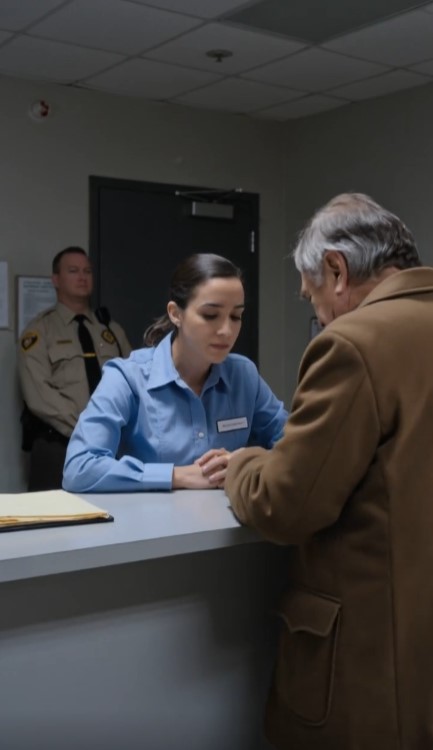
An old man refused to leave the post office after closing.
The lobby was already quiet. The last customers had gone, the lights above the counters had dimmed, and the clerk was gathering the remaining envelopes into a tray before locking up for the night.
Near the front counter stood an elderly man in a worn brown coat.
His name was Arthur.
He held one returned letter in both hands, gripping it so tightly the corners had bent.
The clerk, Maria, tried to speak kindly.
“Sir, we’re closing now. You can come back tomorrow morning.”
The security guard opened the front door and waited.
But Arthur did not move.
“This address is wrong,” he whispered.
Maria looked tired.
Returned mail came in every day. Wrong apartments. Old addresses. Missing names. People moved, letters came back, and most of the time there was nothing anyone could do.
“I’m sorry,” she said. “If it was returned, the address couldn’t be delivered.”
Arthur shook his head.
“No,” he said softly. “It came back after thirty years.”
The security guard sighed.
“Sir, please. We need to close.”
But Arthur kept staring at the envelope.
Everyone thought he was confused.
Then Maria noticed something strange.
The envelope was thicker than a normal letter.
And when Arthur placed it on the counter, she touched it and froze.
It was warm.
Not hot.
Not dangerous.
Just slightly warm, as if something inside had been protected close to someone’s hand before being mailed.
Maria frowned.
“May I see it?”
Arthur hesitated, then pushed it toward her.
The envelope was old, yellowed at the edges, and marked with several stamps and red return labels. The original handwriting was faded, but still readable.
To my father, Arthur Bennett.
Maria looked up.
“This was addressed to you?”
Arthur nodded.
“My daughter wrote it.”
His voice broke.
“She vanished thirty years ago.”
The room went still.
Arthur explained that his daughter, Emily, disappeared when she was twenty-two. They had argued before she left. He thought she would come home after a few days.
She never did.
For years, Arthur searched for her.
Police reports.
Hospitals.
Shelters.
Old friends.
Every place he could think of.
But no one found Emily.
Then, that morning, the returned letter arrived at his old family home, forwarded from a storage facility where lost mail had been discovered during a renovation. It had been sent decades earlier, but the address had been incomplete, misread, and lost in the system.
Now it had finally come back.
Maria turned the envelope carefully.
Something small was tucked inside the padding.
She opened it slowly, afraid of damaging whatever had waited inside for so long.
First came a folded note.
Then a tiny photograph.
Then a hospital bracelet.
Arthur’s hands began to shake.
Maria unfolded the bracelet beneath the counter light.
A baby’s name was printed on it.
Baby Girl Bennett.
A date.
A hospital name.
Arthur stared at it as if the air had left his body.
“My daughter had a child,” he whispered.
Maria opened the photograph.
It showed a young woman in a hospital bed, pale but smiling, holding a newborn baby wrapped in a white blanket.
Arthur touched the picture with trembling fingers.
“That’s Emily,” he said.
Then he began to cry.
The returned letter had carried the first clue that his daughter had left behind a child.
Maria stopped closing the post office.
She called the police.
The security guard locked the door, not to force Arthur out, but to keep the moment private.
Officers arrived and took the letter, bracelet, and photograph carefully. The hospital listed on the bracelet had closed years earlier, but its records had been transferred to a county archive.
By the next morning, investigators began searching.
The truth came slowly.
Emily had given birth shortly after she disappeared. She had tried to send the letter to her father, but the address had been written wrong in her weakened condition. The letter never reached him.
Soon after, Emily became seriously ill.
Her baby was placed into temporary care.
Records were changed.
Names were misspelled.
And somewhere in the confusion, the connection between Arthur, Emily, and the baby disappeared.
But the bracelet survived.
The photograph survived.
The letter survived.
And thirty years later, it found its way back.
Weeks passed before police found the woman who had once been that baby.
Her name was Clara.
She had grown up knowing very little about her birth mother. She had searched for family before, but without the right names or dates, every path had ended in silence.
Then one day, she received a call.
A grandfather was looking for her.
A grandfather who had never known she existed.
When Arthur met Clara for the first time, he brought the old letter with him.
They met in the same post office lobby where the story had begun.
Maria stood behind the counter, wiping tears from her eyes as Clara walked through the door.
Arthur rose slowly from the bench.
For a moment, neither of them spoke.
Then Clara saw the photograph in his hands.
“My mother,” she whispered.
Arthur nodded, crying.
“My daughter.”
Clara stepped forward.
Arthur reached for her hands.
“I didn’t know,” he said. “I would have come for you. I swear I would have come.”
Clara began to cry too.
“I looked for someone,” she whispered. “I just didn’t know who.”
Arthur pulled her into his arms, and the years between them seemed to collapse inside that small post office lobby.
The place that had nearly closed for the night became the place where a family opened again.
Later, Maria framed a copy of the returned envelope and kept it near the back counter.
Not because it was valuable.
But because it reminded her that some letters carry more than paper.
Some carry apologies.
Some carry secrets.
Some carry names that were almost lost forever.
And sometimes, the person everyone thinks is confused is only holding the one clue that can bring a family back together.
The post office was closing that night.
But one family’s story was just beginning.