
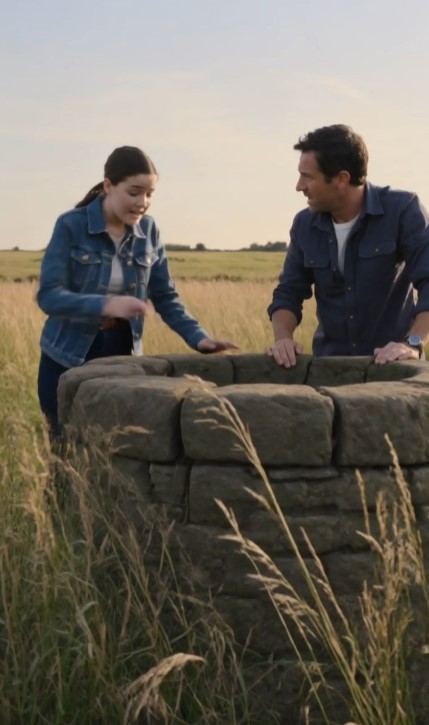
A farmer’s daughter heard braying from the abandoned field.
At first, her father told her not to worry.
“It’s probably coming from a nearby farm,” he said, wiping his hands on his jacket. “Sound carries out here.”
But twelve-year-old Lily stopped near the edge of the field and listened again.
The sound was weak.
Low.
Desperate.
It did not sound like an animal calling from far away.
It sounded like something trapped.
“Dad,” she whispered, “it’s coming from the old well.”
Her father’s face changed.
The old stone well had not been used in years. It sat near the back of the property, half-hidden by tall grass, weeds, and broken fence posts. Most people had forgotten it was even there.
Lily started walking toward it.
Her father followed quickly.
The braying came again.
Louder now.
When they reached the well and looked down, they froze.
At the bottom was a donkey.
She was covered in mud, pressed against the stone wall, and too weak to stand properly. Her ears drooped, her legs trembled, and her body was streaked with dirt from trying again and again to climb out.
No one knew how long she had been there.
Lily covered her mouth.
“Dad, we have to get her out.”
Her father immediately called the neighbors.
Within minutes, trucks pulled into the field. Men and women came running with ropes, blankets, gloves, and flashlights. Someone brought a tractor. Another neighbor called a veterinarian.
The donkey cried again from below.
“She’s exhausted,” one man said. “We have to go slow.”
They lowered ropes carefully into the well. One neighbor climbed down partway with a harness while others held the line from above. The donkey was frightened at first, flinching every time the rope touched her.
Lily knelt by the stones, speaking softly into the darkness.
“It’s okay,” she called. “We’re helping you.”
For nearly two hours, the neighbors worked together.
They placed blankets beneath the ropes so they would not hurt her. They lifted a little, stopped, adjusted, then lifted again. The donkey slipped once, and everyone gasped. Her hooves scraped against the stone, and for a terrible moment, Lily thought she would fall back down.
But her father held the rope tight.
“Steady,” he shouted. “Don’t let go.”
Finally, the donkey’s head appeared above the edge.
Then her shoulders.
Then her muddy body was lifted onto the grass.
Everyone cheered.
Lily ran to her side, tears in her eyes.
The donkey lay there breathing hard, too tired to move. The veterinarian checked her quickly and said she was weak, bruised, and dehydrated, but alive.
Someone brought a bucket of water.
Everyone expected the donkey to drink immediately.
But she didn’t.
Instead, she lifted her head.
Her ears turned toward the bushes near the broken fence.
Then she brayed again.
Softly.
Painfully.
Lily looked in the same direction.
“What is she looking at?” she whispered.
The donkey struggled to her feet. Her legs shook beneath her, but she took one step.
Then another.
She ignored the water.
She ignored the hay.
She limped straight toward the tall grass near the bushes.
Lily followed.
That was when she heard it.
A tiny cry.
Hidden in the grass was a baby donkey.
Small.
Shaking.
Curled beside the fence, calling weakly for its mother.
The field went silent.
Now everyone understood.
The donkey had not been crying only because she was trapped.
She had been crying because her baby was still outside the well, alone, hungry, and frightened.
The mother had used the last strength in her body to call for help.
Not just for herself.
For her baby.
Lily knelt beside the tiny foal as the veterinarian checked it. It was weak and cold, but alive. When they gently guided it toward its mother, the baby stumbled forward on trembling legs.
The donkey lowered her head.
The baby pressed against her side.
And the mother, who had spent hours trapped in mud and darkness, finally stood still.
Lily’s father wrapped one arm around his daughter’s shoulders.
“You heard her,” he said quietly.
Lily wiped her tears.
“She was trying to get back to her baby.”
Later, the farmer and his neighbors covered the old well properly and repaired the fence around the abandoned field. Nobody wanted another animal to fall in again.
But Lily never forgot the sound.
That weak bray carried across the field, ignored by adults as just another farm noise.
To her, it had sounded like a plea.
And she had been right.
Sometimes the cry people dismiss as ordinary is the sound of a life in danger.
Sometimes a rescue is not finished when the animal is free.
And sometimes, even from the bottom of a dark old well, a mother keeps calling because her baby is still waiting above.