
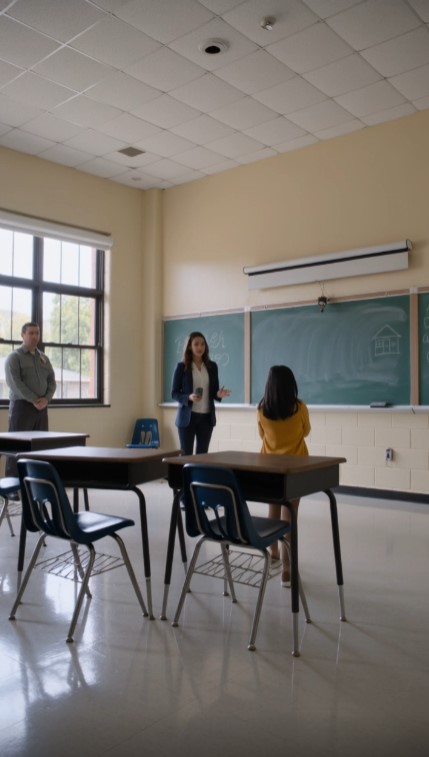
A little girl refused to erase the chalkboard after class.
The teacher told her to hurry.
The room was already empty.
Backpacks were gone, chairs were pushed in, and the hallway outside had grown quiet except for the sound of students leaving for the buses.
The janitor stood by the door with his cleaning cart, waiting patiently.
“Emma,” the teacher said gently, “we need to clean the board now.”
But Emma did not move.
She stood in front of the chalkboard, staring at one small corner near the bottom.
There was a tiny drawing there.
A house.
A window.
And a hand.
The teacher, Mrs. Carter, sighed softly and picked up the eraser.
“It’s just a drawing, sweetheart. We can make another one tomorrow.”
Emma stepped in front of the board.
“No,” she whispered.
Mrs. Carter froze.
Emma was usually quiet. Polite. The kind of child who followed every rule. She never argued, never interrupted, never refused instructions.
But now her eyes were filled with fear.
The janitor lowered his mop.
“What is it?” Mrs. Carter asked.
Emma pointed to the drawing.
“My friend drew that before she stopped coming.”
Mrs. Carter’s hand tightened around the eraser.
The friend’s name was Lily.
Lily had been absent for three days.
At first, the school thought she was sick. Her guardian had called once and said she would return soon. But something about the call had felt rushed, and Lily had not answered any messages from classmates.
Mrs. Carter turned back to the board.
Now she looked closer.
The little house was not drawn like a child’s normal doodle.
The roof lines were too sharp.
Too careful.
Inside the triangle of the roof, tiny numbers were hidden between the chalk marks.
Mrs. Carter leaned in.
Her breath caught.
It looked like an address.
A street number.
A crooked line that looked like a road.
And beside the drawn window, a tiny hand reaching out.
The janitor whispered, “That’s not just a picture.”
Mrs. Carter’s face went pale.
She took a photo of the chalkboard before anyone touched it. Then she called the principal. Within minutes, the office contacted police.
Emma stood beside her teacher, holding her sweater sleeves in her hands.
“She told me she was scared,” Emma whispered. “But I didn’t know what she meant.”
Mrs. Carter knelt beside her.
“You did the right thing by stopping me.”
Police followed the clue to a small house a few blocks from the school.
The curtains were closed.
The front porch was empty.
No one answered when officers knocked.
But from inside, behind a locked bedroom door, they heard crying.
When they forced the door open, they found Lily curled on the floor, clutching her school sweater.
She was frightened, hungry, and too scared to speak at first.
Later, officers learned that Lily had been kept home and isolated by an adult who did not want anyone asking questions. She had drawn the message during her last day at school, hoping someone would notice before it disappeared.
But no adult had understood it.
Not at first.
To them, it looked like chalk.
To Emma, it looked like her friend trying to speak.
When Lily was brought safely out of the house, Mrs. Carter cried in the hallway of the school. She kept thinking about how close she had come to erasing the only clue.
One swipe of an eraser.
One rushed cleanup.
One ordinary end to a school day.
And the message would have vanished forever.
The next morning, Lily’s seat was not empty anymore.
Emma ran to her and hugged her so tightly that neither girl spoke for several seconds.
Mrs. Carter looked at the chalkboard, now clean, and felt a deep ache in her chest.
Because she understood something she would never forget.
Children do not always ask for help in words.
Sometimes they draw it.
Sometimes they hide it in corners.
Sometimes they leave tiny clues because fear has made their voice too small.
Everyone thought Emma was being stubborn.
Everyone thought it was just chalk.
But one little girl saw a message no adult knew how to read.
And because she refused to let it be erased, her friend was finally found.