
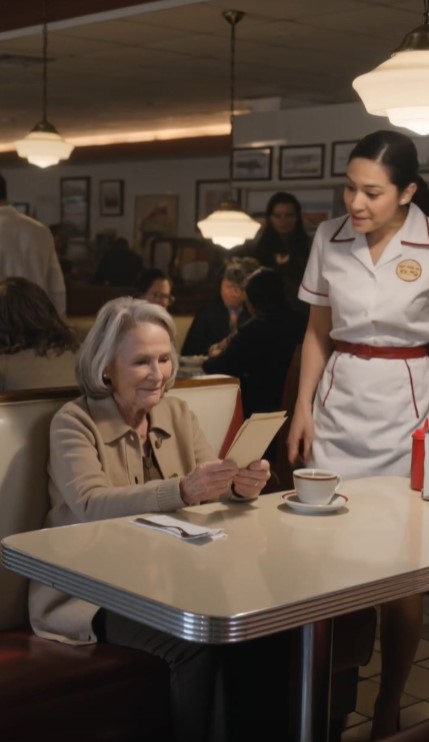
An elderly woman walked into a crowded diner and sat at a table already reserved.
The lunch rush had filled every booth. Plates clattered, coffee cups were refilled, and waitresses moved quickly between tables while customers waited near the door.
The small corner table by the window had a folded sign on it.
Reserved.
But the elderly woman walked straight to it.
She wore a soft gray coat, carried a small purse, and held an old photograph carefully in one hand. She lowered herself into the chair facing the window and placed the photo on the table like it belonged there.
The waitress, Grace, hurried over.
“I’m sorry, ma’am,” she said gently. “This table is reserved.”
The woman looked up and smiled.
“I know,” she said. “He always sat here.”
Grace’s expression softened.
Behind the counter, the manager noticed and sighed quietly.
“She’s here again,” he whispered.
The woman’s name was Margaret.
She had been coming to the diner every Friday for months.
Same table.
Same time.
Same order.
Two coffees.
One black.
One with cream.
But only one cup was ever touched.
People whispered about her.
Some thought she was confused.
Some thought she was grieving.
Some thought the diner should stop letting her take a reserved table when real customers were waiting.
But Grace never rushed her.
Because each Friday, Margaret would sit at that table, touch the old photo, and stare at the empty chair across from her as if someone might still walk through the door.
That day, a young man named Daniel was sitting nearby with his lunch half-finished.
He had not meant to listen.
But when Grace placed two coffees on Margaret’s table, something about the old woman’s trembling hands caught his attention.
Then he saw the photograph.
Daniel froze.
The man in the photo had the same jawline as his father.
The same eyes Daniel saw in the mirror.
And the same watch Daniel had once found in a box of his grandmother’s old things.
His heart began pounding.
“Excuse me,” Daniel said softly.
Margaret looked up.
Daniel pointed to the photo.
“Where did you get that?”
Margaret pulled it closer, suddenly protective.
“This was my husband,” she whispered.
Daniel’s face went pale.
“What was his name?”
The diner seemed to quiet around them.
Margaret answered carefully.
“Thomas Hale.”
Daniel stood so quickly his chair scraped against the floor.
“That was my grandfather’s name.”
Grace stopped beside the counter.
The manager turned around.
Margaret stared at Daniel’s face.
Her hands began to shake.
Then her eyes filled with tears.
“You have his eyes,” she whispered.
Daniel could barely breathe.
He had grown up hearing almost nothing about his grandfather. His father never spoke of him, only saying that old family pain was better left buried. Daniel had believed Thomas had walked away from the family long before he was born.
But Margaret’s photo told a different story.
In it, Thomas was young, smiling, and standing in front of the very same diner window where Margaret now sat.
Margaret touched the empty chair across from her.
“He came here every Friday,” she said. “Before the war. After the war. After every hard week. He said this table made the world feel smaller.”
Daniel slowly sat down across from her.
In the chair she had kept waiting.
Margaret explained that Thomas had loved his family more than anything. But years earlier, a terrible argument had split the family apart. Letters were returned. Phone calls went unanswered. Pride became silence, and silence became decades.
Thomas died still hoping someone would come back.
Margaret kept coming to the diner because it was the last place he had asked her to wait if the family ever returned.
Daniel lowered his head.
“My father thought he was abandoned,” he whispered.
Margaret began to cry.
“He was never abandoned in his heart. He waited.”
The untouched coffee sat between them.
For months, customers had seen an old woman sitting alone.
But she had not been alone.
She had been holding a place for the truth.
Daniel pulled out his phone and showed Margaret a photo of his father. Her hand flew to her mouth.
“Oh,” she whispered. “He looks like Thomas.”
Then Daniel called him.
His father did not want to come at first.
Too much time had passed.
Too much hurt had hardened into habit.
But when Daniel said, “Dad, she has Grandpa’s photo, and she’s been waiting every Friday,” there was silence on the line.
An hour later, an older man walked into the diner.
Margaret stood the moment she saw him.
For a few seconds, neither spoke.
Then Daniel’s father looked at the photograph on the table.
His voice broke.
“He kept that picture?”
Margaret nodded through tears.
“Always.”
The man covered his face.
“I thought he forgot us.”
Margaret stepped forward.
“No,” she whispered. “He saved this table for you.”
The diner was silent as years of pain finally cracked open. Grace wiped her eyes behind the counter. Customers who had once complained about the reserved table sat quietly, understanding at last.
That table had never been empty.
It had held grief.
Hope.
Memory.
And a truth waiting for the right person to sit down.
From that Friday on, Margaret no longer ordered two coffees for a chair that stayed empty.
She ordered three.
One for herself.
One for Daniel.
And one for the father who finally came back to hear the truth.
Sometimes people are not confused when they keep returning to the same place.
Sometimes they are keeping a promise.
Sometimes an empty chair is not empty at all.
It is waiting for the family story that was never finished.