
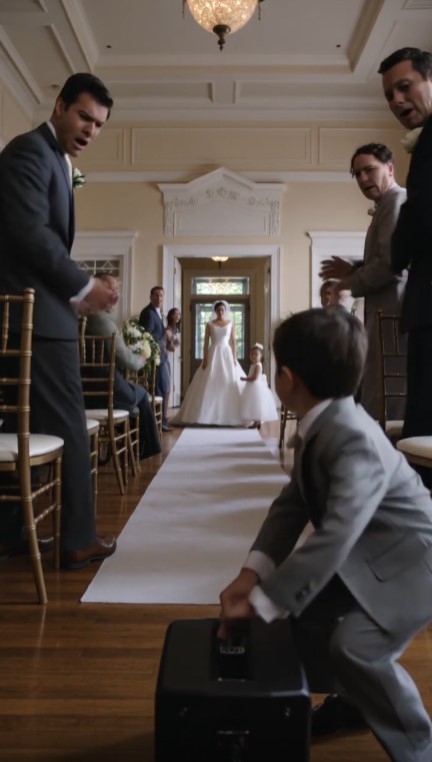
A little boy unplugged the speakers during a wedding.
The music stopped.
Guests gasped.
The bride froze in the aisle.
Everyone turned toward the boy standing beside the sound table with the cable in his hand. He could not have been more than eight years old, small in his suit, his face pale but determined.
The groom’s smile vanished.
“What are you doing?” he shouted.
The wedding hall went silent.
The bride stood halfway down the aisle, holding her bouquet tightly. Her bridesmaids looked confused. The pianist stopped playing. Guests lowered their phones.
The boy did not run.
He only pointed toward the back row.
“She said not to let the music start.”
Everyone turned.
Near the last row stood the little flower girl.
Her name was Emma.
She was pale, trembling, and gripping a tiny silver locket in both hands.
The bride’s expression changed.
Emma had barely spoken all morning. Everyone thought she was nervous because of the ceremony. She was the youngest cousin in the family, quiet and shy, the kind of child adults often overlooked.
The bride stepped out of the aisle and knelt in front of her.
“Emma,” she whispered, “what’s wrong?”
Emma looked at the groom.
Then at the bride.
Then she opened the locket.
Inside was a folded photograph.
Old.
Creased.
Hidden carefully behind the glass.
The bride took it with shaking fingers.
It showed her mother.
Younger.
Smiling.
Standing beside a man no one recognized.
On the back was a date.
The same date the bride had been told her mother died.
A cold silence moved through the hall.
The bride’s mother had supposedly passed away when the bride was a baby. That story had shaped her whole life. She had grown up with one framed photo, one explanation, and a grief she was too young to remember but old enough to carry.
But now she was holding a photograph that should not exist.
Her mother was alive in that picture on the very day everyone said she was gone.
The groom stepped forward quickly.
“This is ridiculous,” he said. “It’s an old photo. Don’t ruin the wedding over this.”
But Emma began to cry.
“My grandma said to give it to her before she married him.”
The bride looked up slowly.
“Who told you that?”
Emma’s voice shook.
“Grandma. She said your mom didn’t die that day. She said they made her leave.”
The bride’s hands began trembling so badly the photograph nearly fell.
Her aunt stood suddenly from the second row.
“That’s enough,” she snapped.
But her face was too pale.
Too afraid.
The bride noticed.
For the first time, she understood that the silence in the room was not confusion.
It was fear.
Secrets had been sitting in those chairs all along.
The little boy who unplugged the speakers stepped closer.
“She was crying,” he said softly. “She told me nobody would listen if the music started.”
The bride looked at the flower girl again.
Emma opened the back of the locket and pulled out a second tiny folded paper.
A name.
A town.
And one sentence written in shaky handwriting:
She deserves the truth before she gives away her life.
The wedding did not continue.
Not then.
Not with a lie standing at the altar.
Later, the truth came out piece by piece. The bride’s mother had not died on that date. She had been forced out of the family after refusing to accept a marriage arrangement and later kept away by relatives who rewrote the story. The man in the photograph had helped her escape, but letters she sent back were hidden. Calls were blocked. The bride was raised believing grief instead of abandonment.
And the groom’s family had known more than they admitted.
The marriage was part of a business arrangement dressed up as romance, tied to family pressure, money, and old secrets no one wanted exposed.
The silver locket had belonged to the bride’s mother.
It had passed quietly through the hands of one elderly grandmother who could not carry the guilt anymore. She gave it to Emma because she knew adults might argue, deny, or destroy it.
But no one would suspect the flower girl.
And no one would stop the wedding unless a child was brave enough to stop the music.
The bride sat in the empty bridal room afterward, still holding the photograph.
Her bouquet lay on the chair beside her.
Her veil had slipped from her hair.
Emma stood at the door, crying.
“I’m sorry,” she whispered. “I didn’t want to ruin it.”
The bride crossed the room and hugged her tightly.
“You didn’t ruin anything,” she said. “You saved me from walking into a life built on a lie.”
The little boy stood nearby, staring at the floor.
The bride reached for his hand too.
“And you were brave enough to listen.”
The wedding hall never forgot that day.
Guests came expecting vows.
Instead, they witnessed the moment two children stopped a secret from being buried forever.
Everyone thought the boy had ruined the ceremony.
Everyone thought the flower girl was scared.
But together, they did what the adults in the room were too afraid to do.
They told the truth.
And sometimes, the most important sound at a wedding is not the music starting.
It is the silence that comes when someone finally stops a lie from walking down the aisle.