
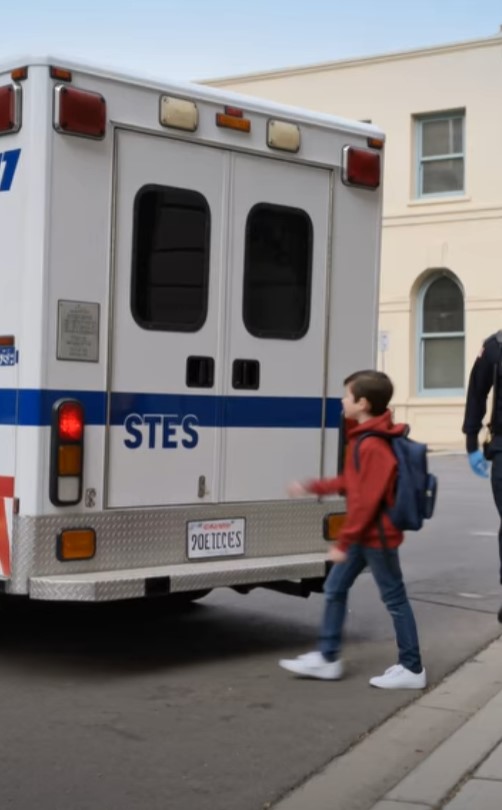
The ambulance doors were already closing.
The patient was inside, the paramedics were preparing to leave, and the siren was ready.
Then a little boy suddenly grabbed the rear handle and shouted:
“WAIT!”
The paramedics turned around.
His mother rushed toward him, startled by what he had done.
One of the responders stepped closer.
“Son, you have to move.”
But the boy refused.
Instead, he pointed toward a park bench across the street.
“There’s another one.”
Everyone looked.
At first, nobody saw anything.
The bench appeared empty.
The paramedic turned back toward the ambulance and began closing the door again.
Then the boy shouted even louder.
“UNDER THE BENCH!”
This time, one of the responders ran across the sidewalk.
As he reached the bench, he noticed something hidden behind it.
A heavy coat was draped partly across the ground.
Underneath it was an elderly man who had collapsed.
He was still conscious, but he was too weak to call out loudly enough for anyone nearby to hear him.
The boy had noticed something everyone else had missed.
While the crowd was focused on the first emergency, he had seen one of the elderly man’s hands moving beneath the coat.
That tiny movement was enough.
A second ambulance was immediately called.
Paramedics began helping the man while the little boy stood nearby with his mother.
The elderly man was stabilized and prepared for transport.
Before he was taken away, he slowly reached toward the child.
“You saw me,” he whispered.
The boy looked at him and gave a simple answer.
“Everybody was looking the other way.”
For a moment, nobody said anything.
The first ambulance had almost left.
Not because anyone did not care.
Not because the responders had ignored someone in need.
Everyone had simply been focused on the emergency directly in front of them.
Except one child.
He had looked somewhere else.
And because he did, another person received help.
Sometimes the most important thing is not seeing what everyone else sees.
It is noticing what everyone else misses.
The boy did not have medical training.
He did not have emergency equipment.
He did not know exactly what had happened.
He simply noticed a hand moving beneath a coat and refused to let the ambulance leave until someone checked.
That small act changed everything.
Sometimes the person delaying the rescue is not getting in the way.
Sometimes they are the reason there are two people to save.