
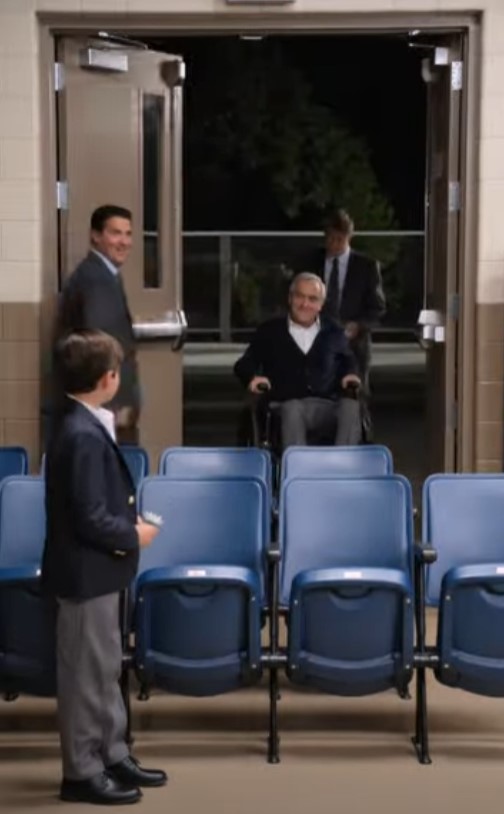
The school concert was completely full.
Parents stood along the walls. Teachers hurried around looking for extra chairs, and nearly every available space in the auditorium had been taken.
Except for one.
Near the front row was an empty wheelchair space.
Several people noticed it.
One parent stepped toward the opening, hoping to stand there for a better view.
But a little boy immediately moved in front of it.
“You can’t stand there,” he said.
The parent looked confused.
“No one is sitting there.”
The boy shook his head.
“I’m saving it.”
“For who?”
He would not answer.
The concert was only minutes away from beginning. Musicians were taking their places onstage, parents were raising their phones, and teachers were asking everyone to settle down.
Still, the boy guarded the empty space.
Then the auditorium doors opened.
An elderly man entered in a wheelchair.
The little boy’s entire face changed.
He smiled and pointed toward the man.
“That’s him.”
The elderly visitor was not a relative.
He was someone the boy had never known during the years when he was younger and stronger.
But to the boy’s mother, he was one of the most important people in the room.
Decades earlier, he had been her music teacher.
Her family had very little money at the time, and private lessons were something they simply could not afford.
The teacher knew that.
So he taught her anyway.
He stayed after school to help her practice.
When she struggled, he encouraged her.
And when he discovered that she did not have an instrument of her own, he helped provide her first violin.
There was one sentence he repeated to her over the years.
“One day, you’ll teach somebody else what music gave you.”
She never forgot it.
Years passed.
The young student grew up and became a music teacher herself.
She spent her days doing for other children what someone had once done for her—giving them confidence, patience, and a place to discover what they could become.
Now her own son was about to perform his first solo.
And he would be playing on the same school stage where his mother had once learned to believe in herself.
The little boy walked toward the elderly teacher.
In his hand was a small paper flower he had made himself.
He carefully handed it to him.
“My mom said you gave her music,” he said.
The old man looked toward the stage.
Then back at the child.
The boy pointed toward the empty space in the front row.
“I saved the best seat for you.”
For a moment, the elderly teacher said nothing.
He simply smiled.
Then he rolled into the place the boy had protected for him.
The auditorium lights dimmed.
The room became quiet.
The little boy walked onto the stage carrying his instrument.
His mother watched from the audience.
The elderly teacher sat only a few feet away.
Then the first notes began.
The boy had chosen a special melody for his solo.
It was the same piece his mother had learned from that teacher many years earlier.
The elderly man recognized it almost immediately.
His eyes filled with tears.
Across the room, the boy’s mother saw his reaction and began crying too.
To everyone else, it was simply a student performing at a school concert.
But for three people in that auditorium, the music connected decades of kindness.
A teacher had once helped a young girl when her family could not give her every opportunity she needed.
That girl grew up and carried his lesson forward.
And now her son was playing the same melody for the man who had started it all.
The little boy had not really been protecting an empty wheelchair space.
He had been saving a place for gratitude.
A place for a teacher who had changed his mother’s life long before he was born.
And a place for a thank-you that had taken an entire generation to finally arrive.