
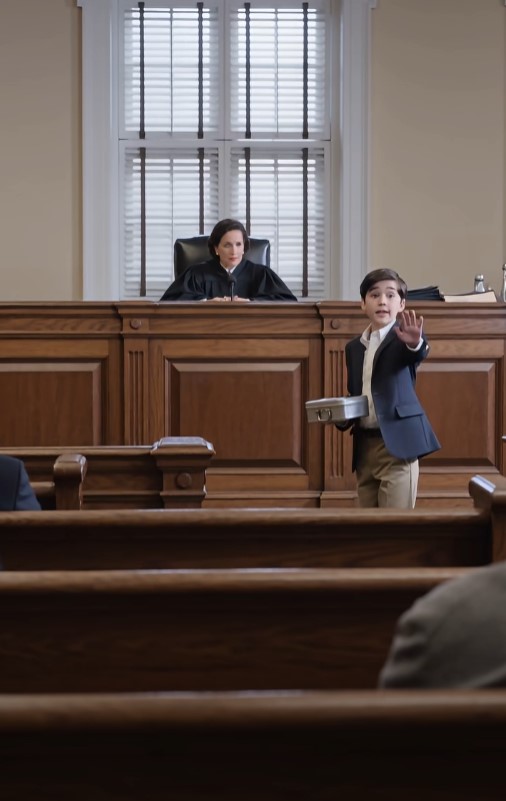
The judge was about to close the courtroom.
People were gathering their belongings.
Attorneys were organizing papers.
Then a twelve-year-old boy suddenly stood up.
“Please wait.”
His mother immediately reached for his arm.
“Sit down.”
But the boy didn’t move.
The judge looked over his glasses.
“What is it?”
The courtroom became quiet.
The boy stepped into the aisle carrying one dented metal lunchbox.
Security watched him carefully as he walked toward the front.
He placed the lunchbox on the table.
“This belongs to him.”
Then he pointed toward an elderly man sitting alone in the back row.
The man’s face changed instantly.
He went pale.
For several seconds, he simply stared at the lunchbox.
Forty years earlier, that elderly man had worked as a janitor at a small school.
He cleaned classrooms.
Swept hallways.
Emptied trash cans.
And every morning, he noticed the same little boy arriving without lunch.
That child was the twelve-year-old’s grandfather.
His family had very little money.
Most days, he came to school hungry.
But he never asked anyone for help.
The janitor noticed anyway.
So every morning, without saying a word, he left the same dented metal lunchbox beside the boy’s desk.
Inside was always something simple.
A sandwich.
An apple.
A carton of milk.
There was never a note.
Never a lecture.
Never a reminder that the boy owed him anything.
The janitor simply made sure he ate.
Then he disappeared before anyone could thank him.
Years passed.
The hungry schoolboy grew up.
He worked hard.
He built a business.
He raised a family.
Eventually, he became a grandfather himself.
But there was one thing he never forgot.
The man who had quietly fed him when nobody else knew he was hungry.
There was only one problem.
He had never learned the janitor’s full name.
As his health began failing years later, he told his grandson the story.
Then he made one final request.
“Find him.”
The twelve-year-old took that promise seriously.
With help from his mother, he searched through old school records.
Yearbooks.
Employment files.
Archived documents.
Month after month passed without an answer.
Then, completely by chance, they found a familiar name connected to an unrelated court hearing.
The former janitor would be there that morning.
So the boy brought the lunchbox.
The elderly man stared at him from the back row.
He still didn’t understand.
Then the boy opened the lid.
Inside was one fresh sandwich.
One apple.
And one carton of milk.
The old man’s eyes immediately filled with tears.
The boy gently pushed the lunchbox toward him.
“My grandpa said he owed you lunch.”
Nobody in the courtroom spoke.
The judge slowly removed his glasses.
The elderly man covered his mouth.
For forty years, he had believed that the small kindness he showed one hungry child had disappeared into the past.
He never expected repayment.
He never expected recognition.
He probably never imagined that child would remember him for the rest of his life.
But kindness has a strange way of surviving.
It had traveled through decades.
Through a family.
Through a dying grandfather’s final request.
And finally, through a twelve-year-old boy carrying an old lunchbox into a courtroom.
The elderly janitor slowly reached for it.
His hands trembled.
He looked at the sandwich.
Then at the boy.
“I never wanted him to pay me back.”
The child smiled.
“He knew.”
That was why his grandfather had never called it repayment.
It was simply lunch.
Forty years late.
Sometimes the smallest acts of kindness are the ones people remember the longest.
And sometimes a good deed doesn’t disappear at all.
Sometimes it simply takes the longest route home.